
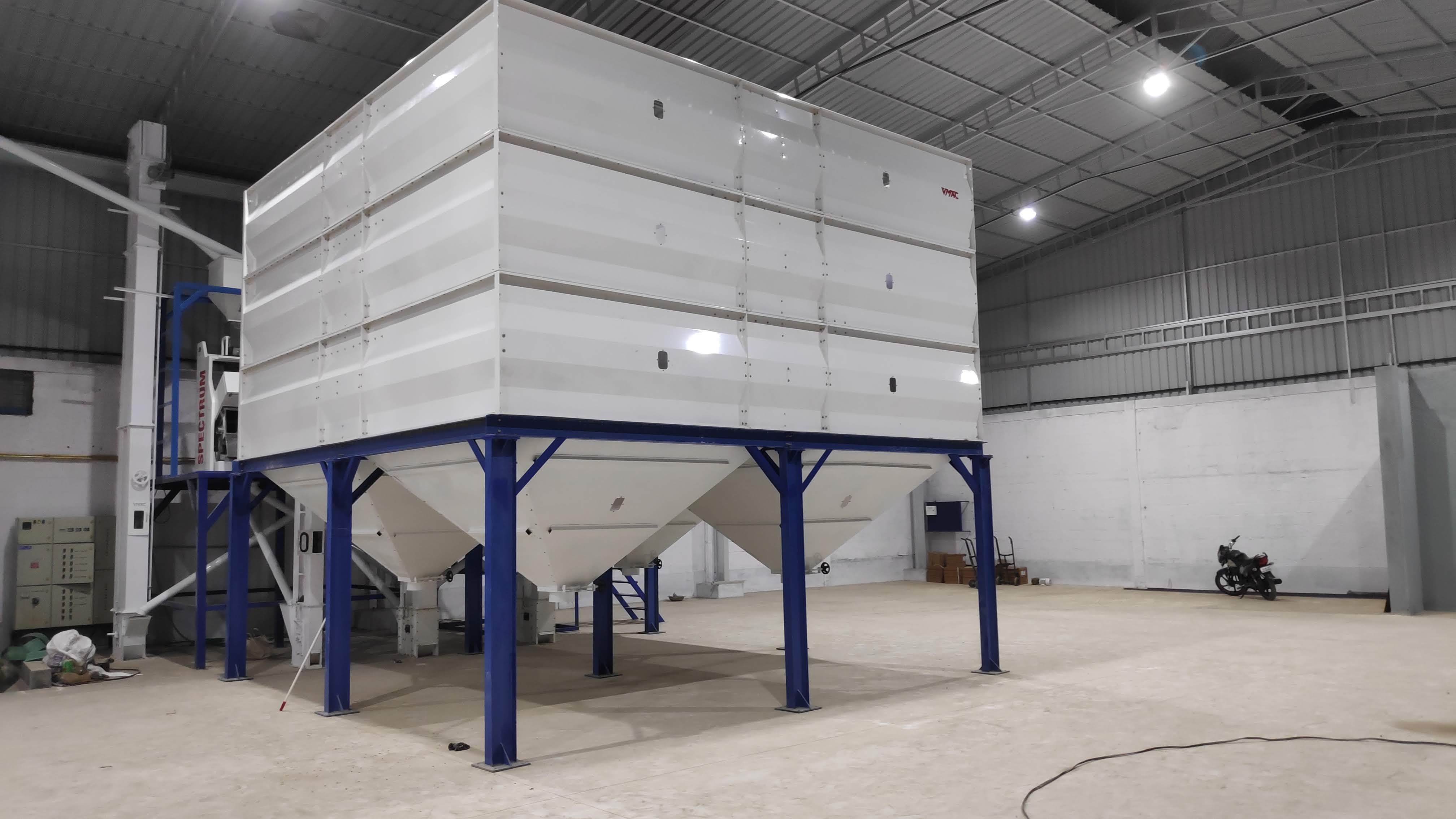
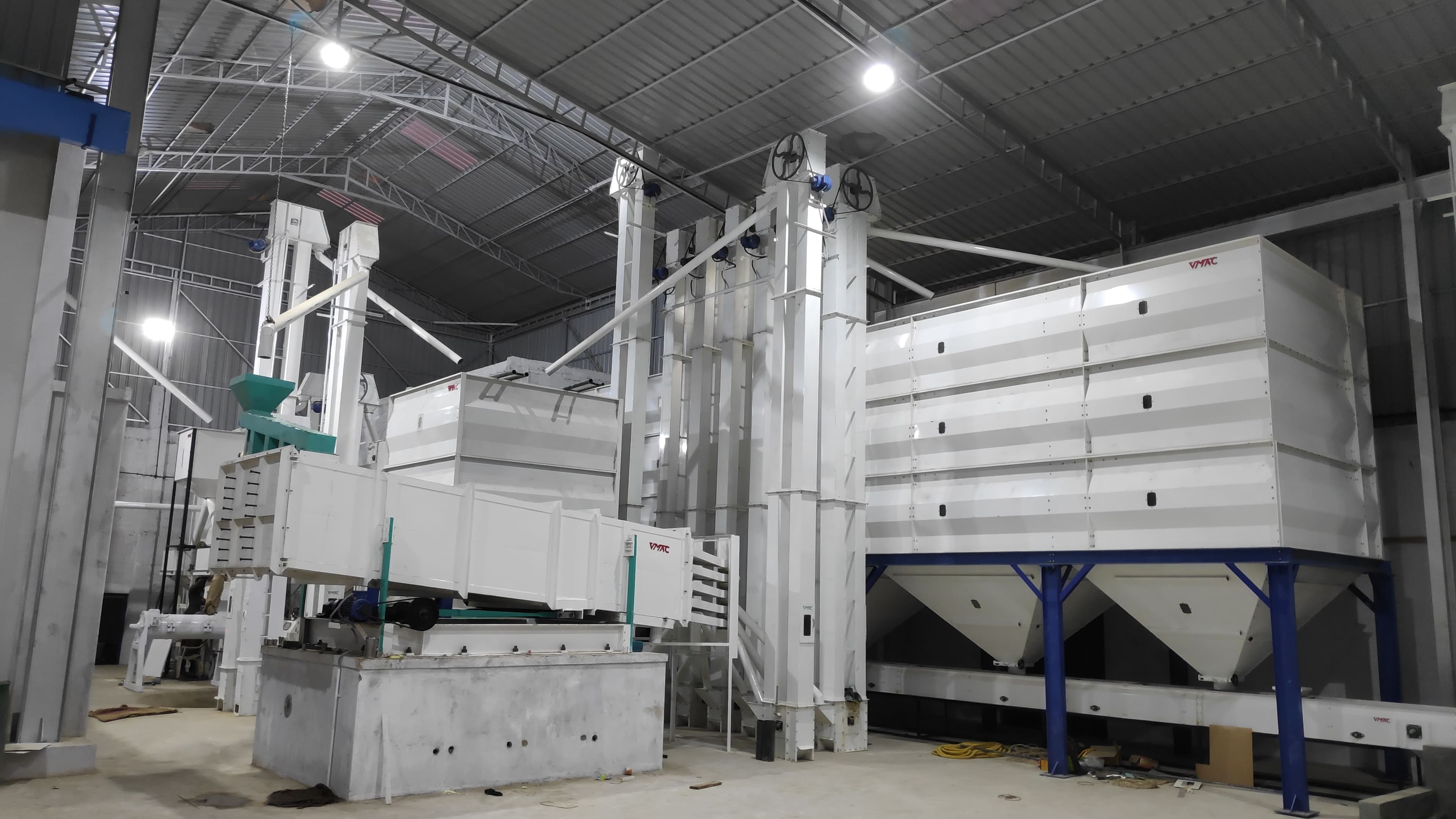
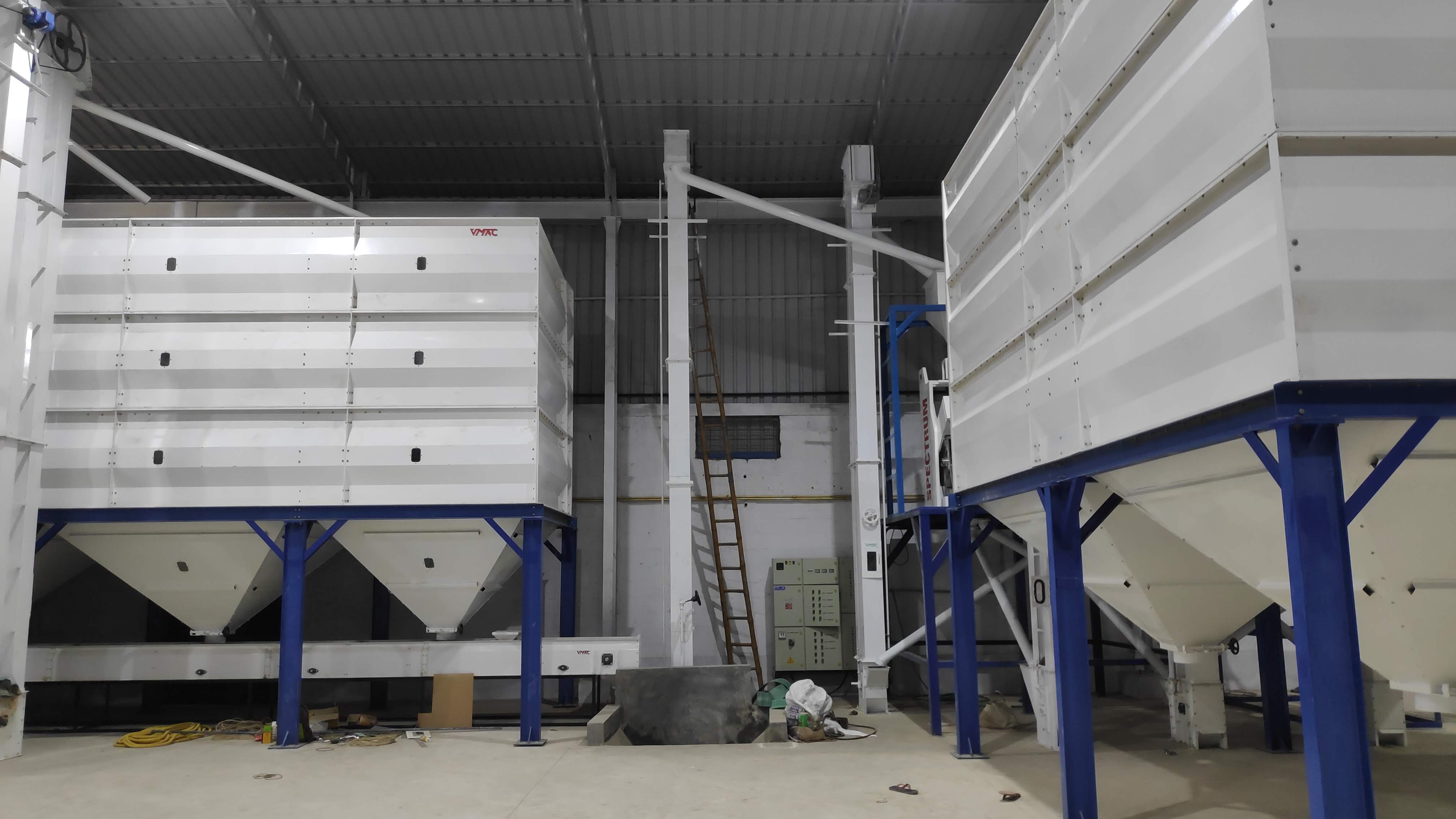
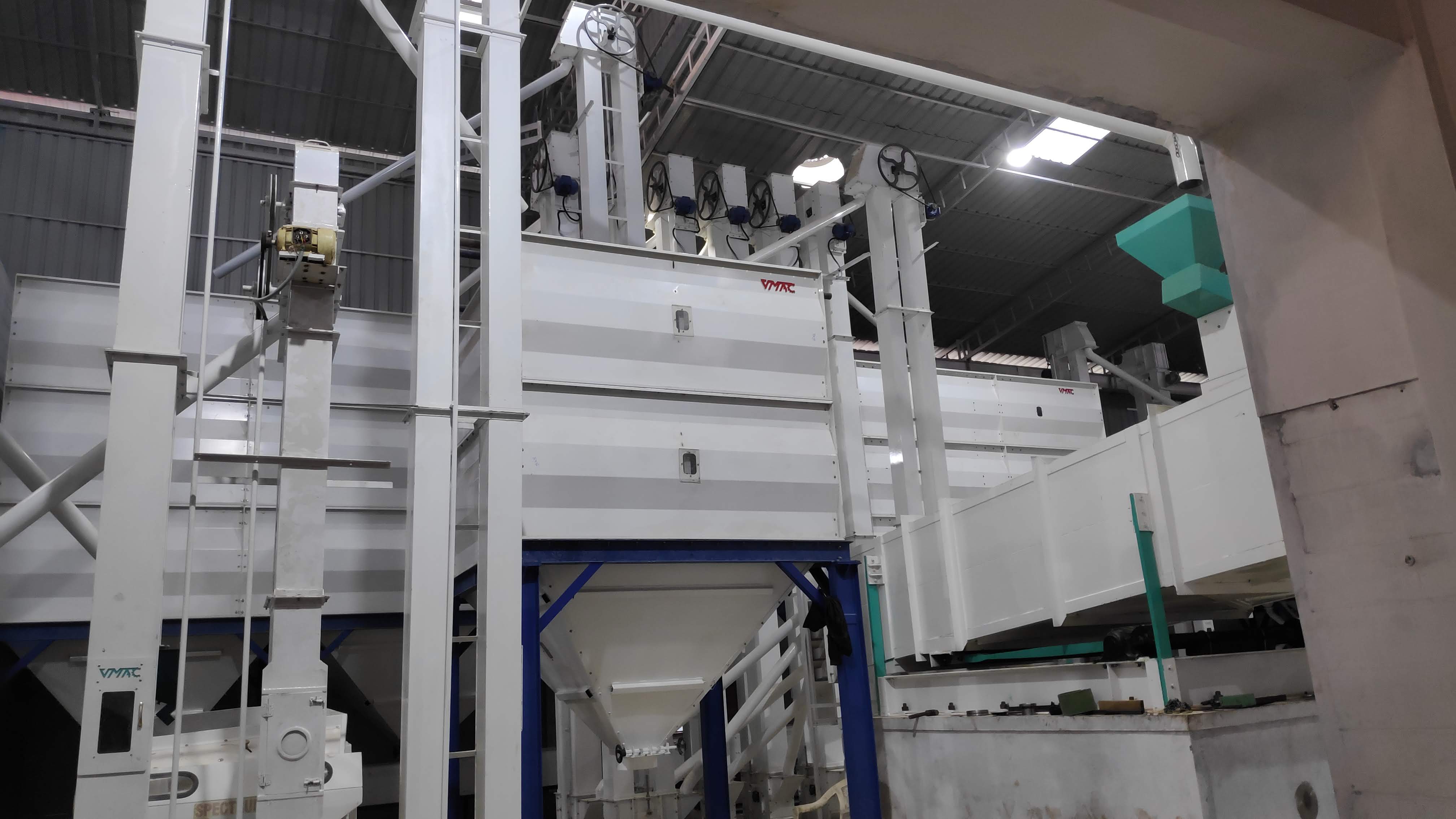
Coffee Silos / Green Coffee Storage Silos
Bolted corrugated galvanized steel silos for bulk green coffee storage — modular, aeration-ready, and sized from 10 to 200+ tonnes. Purpose-built for Indian curing works and East African export mills holding crop between processing and dispatch.
| Capacity range | 10 t (small curing works) to 200+ t per silo; custom configurations available |
| Diameter options | 3 m, 4.5 m, 6 m, 7.5 m, 9 m — selected based on target capacity and footprint constraints |
| Shell material | Hot-dip galvanized corrugated steel — G90 (standard) or G120 zinc coating (high-humidity environments) |
| Interior lining | Bare galvanized (standard); food-grade epoxy coating (optional); hermetic liner insert (optional) |
| Floor type | Hopper-bottom cone (standard for coffee, full gravity discharge) or flat-bottom with sweep auger (large capacity) |
| Aeration system | Perforated false floor plenum + centrifugal fan; 0.05–0.1 m³/min per tonne airflow recommended for tropical storage |
| Discharge mechanism | Hopper-bottom: gravity butterfly gate valve → receiving screw conveyor; Flat-bottom: electric sweep auger |
| Fill method | Top-fill via bucket elevator or pneumatic conveyor; adjustable fill cone with dust seal |
| Temperature monitoring | Thermometer probe ports at 3–4 vertical levels; compatible with digital temperature cable logging systems |
| Support structure | Galvanized steel legs on concrete ring beam (hopper-bottom); full concrete slab foundation (flat-bottom) |
Key Features
Bolted corrugated galvanized steel (GI) construction — G90 standard, G120 for high-humidity coastal and monsoon-affected locations; no on-site welding, fully field-assembled
Hopper-bottom (cone bottom) configuration preferred for coffee — full gravity discharge through butterfly gate valve to screw conveyor; eliminates sweep auger contact and the bean cracking it causes
Active aeration system: perforated false floor plenum plus centrifugal fan draws ambient air through the full bean column; prevents moisture stratification, hot spots, and premature aging during long holds
Multiple thermometer probe ports on shell allow temperature cable monitoring across the vertical grain mass; critical for detecting fermentation or moisture ingress before damage becomes visible
Modular bolted panel design is relocatable and expandable — add ring sections to increase height, or dismantle and reassemble at a new site; no permanent civil commitment beyond the concrete ring beam
Hermetic liner insert option converts any silo to modified-atmosphere storage — combined with CO₂ or N₂ flushing port, eliminates phosphine fumigation requirement for export-compliant pest management
Capacity range 10 t to 200+ t per silo; multiple silos with individual discharge gates enable lot separation and traceable single-origin holding within a common storage block
Compatible with bucket elevator top-fill and pneumatic conveyor top-fill; bottom discharge gates connect directly to receiving screw conveyor feeding bagging station or bulk truck fill spout
Food-grade epoxy interior coating available on request for specialty and certified-organic operations requiring zero zinc contact with the bean surface
Models & Sizing
Right-Sized for Every Operation
Four standard tiers cover the full range from small estate curing works to large central processing stations. All tiers use the same bolted corrugated GI panel system with hopper-bottom discharge; aeration is standard from the 30 t tier upward and optional on the 10 t tier.
VS-10
10 tonnes
capacity
Small estate curing works or co-operative collection point; holds roughly half a 20-foot container load; suitable for resting parchment before dispatching to a central curing station
VS-30
30 tonnes
capacity
Medium curing works shipping 1–2 containers per week; standard configuration for Coffee Board licensed facilities in Chikkamagaluru and Hassan districts; one silo per major grade (AA, AB, PB)
VS-60
60 tonnes
capacity
Active export curing works or washing station accumulating multiple lots before bagging; holds approximately 3.5 full 20-foot container loads; allows meaningful lot separation between single origins
VS-200
200 tonnes
capacity
Large central processing station or export warehouse; flat-bottom configuration with electric sweep auger; typically installed in banks of 3–6 silos for multi-variety, multi-grade holding; common in large East African CPS operations
Custom
Your specification
capacity
For operations requiring throughput beyond the standard range. VMAC engineers the machine to your exact capacity and processing conditions.
Request a Custom QuoteConfigurations
Coffee Silo Configurations
Standard bolted GI steel silos — hopper-bottom (preferred) and flat-bottom options
| Model | Capacity | Diameter | Approx. Height (to eave) | Floor Type | Aeration |
|---|---|---|---|---|---|
| VS-10 | 10 t | 3.0 m | 4.5 m | Hopper-bottom (cone) | Optional (0.37 kW fan) |
| VS-30 | 30 t | 4.5 m | 5.5 m | Hopper-bottom (cone) | Standard (0.55 kW fan) |
| VS-60 | 60 t | 6.0 m | 7.0 m | Hopper-bottom (cone) | Standard (0.75 kW fan) |
| VS-200 | 200 t | 9.0 m | 8.5 m | Flat-bottom + sweep auger | Standard (1.5 kW fan) |
| Custom | Built to your capacity and specification — contact us for a quote | ||||
Overview
About the Coffee Silos / Green Coffee Storage Silos
Green coffee must rest and wait: wait for the export order, wait to accumulate a full container load, wait while moisture equilibrates through the bean mass. How that waiting happens determines whether the coffee arrives at the roaster at the same quality it left the dry mill — or degraded by moisture gain, pest damage, or temperature cycling. VMAC coffee storage silos are bolted corrugated galvanized steel (GI) bins designed specifically for parchment coffee resting and green bean holding at curing works and export warehouses. The standard construction uses G90 or G120 zinc-coated corrugated panels that bolt together on a concrete ring beam — no welding required, fully field-assembled, and relocatable if your operation moves or expands. The single most important feature for Indian conditions — particularly Karnataka and Kerala during the southwest monsoon (June–September) — is the aeration system. A perforated false floor with a centrifugal fan draws ambient air through the bean mass during cool, dry night hours. This prevents the moisture stratification and hot-spot formation that silently damage beans during 2–6 month holding periods. Without aeration, beans in the top third of a large silo can gain 0.5–1% moisture from rising warm air while the bottom third dries out. For Coffee Board licensed curing works, silos represent the standard approach to approved bulk storage. A typical 20-foot export container holds 275 × 60 kg bags (16.5 tonnes net), meaning a curing works shipping 4 containers per week needs 60–70 tonnes of live green storage at minimum — usually met with four to six silos in the 15–20 tonne range. Hopper-bottom (cone bottom) silos are the preferred configuration for coffee: the conical discharge cone empties fully under gravity through a butterfly valve to a receiving screw conveyor, with no contact between the bean mass and any sweep auger mechanism. This matters because green coffee beans have less mechanical tolerance than grain — they crack under point loading from auger flights, generating fines that score poorly in grading. VMAC supplies silos as complete systems: the bolted steel structure, galvanized support legs, aeration fan package, thermometer probe ports, access ladder, and integration engineering to match your bucket elevator or pneumatic fill line. Hermetic liner inserts and CO₂/N₂ fumigation ports are available as options for operations requiring phosphine-free pest management.
How It Works
How It Works
Green coffee enters the silo from the dry mill output and rests under managed conditions until dispatch. Active aeration and temperature monitoring keep the bean mass stable throughout the holding period.
Filling via bucket elevator or pneumatic conveyor
Processed green coffee exits the final grading or color sorting stage and is conveyed to the silo top by bucket elevator or pneumatic line. An adjustable fill cone distributes grain evenly across the silo diameter to prevent conical peaks that cause uneven airflow. A fill-level sensor or sight glass indicates capacity.
Active aeration — temperature and moisture management
The centrifugal aeration fan draws ambient air through the perforated false floor and upward through the full bean column. In Karnataka and Kerala, fans are run during cool night hours (22:00–06:00) when outside dew point is below the target grain temperature of 18–22°C. This prevents moisture migration from warm lower zones to cool upper zones — the mechanism responsible for surface mold and clumping in unaerated silos. Thermometer cables read at three to four vertical levels; any rise above 25°C triggers an immediate aeration response.
Pest and atmosphere management during storage
Sealed silo with gasketed roof hatch and CO₂ or N₂ flushing port provides phosphine-free pest control for operations supplying buyers with chemical residue restrictions. Where hermetic liner inserts are fitted, the liner maintains the modified atmosphere within the bean mass. Standard aeration-only silos use scheduled phosphine tablet fumigation through roof ports; the perforated floor then allows spent gas venting after the exposure period.
Gravity discharge to bagging station or bulk truck
When an export order is confirmed, the hopper-bottom butterfly gate valve opens and green coffee flows by gravity to a receiving screw conveyor below the silo. The screw conveyor feeds directly to the weighing hopper above the bagging station for 60 kg jute or GrainPro bag filling, or diverts to a bulk fill spout for direct container loading. The hopper cone empties completely with no residual beans, eliminating cross-lot contamination between fills.
Know the Difference
Coffee Silos / Green Coffee Storage Silos vs. Bag / Pallet Warehouse Storage
Most curing works begin with open warehouse storage — bags stacked 7–8 rows high on pallets or dunnage. Silos represent the upgrade path once volume or quality requirements outgrow what warehouse storage can reliably deliver.
| Feature | Coffee Silos / Green Coffee Storage Silos | Bag / Pallet Warehouse Storage |
|---|---|---|
| Moisture control | Active aeration maintains target moisture 10.5–12.5%; aeration fan responds to ambient conditions; no moisture pickup from floor or wall | Passive — beans in bags absorb ambient RH; bottom rows on pallet gain moisture from concrete floor respiration; top rows may dry out unevenly |
| Pest management | Sealed structure enables hermetic or modified-atmosphere treatment; CO₂/N₂ flushing eliminates need for phosphine; no re-infestation gaps | Open stack requires repeated phosphine fumigation under tarpaulin; bags have seams and pinholes; re-infestation common in warehouse gaps |
| Space efficiency | Vertical storage — 20 t hopper silo occupies ~20 m² footprint; no aisle access required within the silo volume | 7–8 bag rows at ~60 kg/bag: 20 t requires ~24 m² floor area plus forklift aisle access; significantly larger building footprint per tonne |
| Lot traceability | Each silo is a discrete lot — variety, grade, and process type stored separately; discharge gate identifies the lot; no mixing on discharge | Lot integrity depends on labelling and physical separation of stacks; risk of mixing during forklift movement; harder to audit for certification |
| Labour cost | Mechanized fill and discharge; one operator manages multiple silos; aeration is automated; no bag handling within storage cycle | High labour — bags must be stacked, monitored, turned, and moved by hand or forklift; bag damage, splitting, and rebagging costs add up |
| Capital cost | Higher upfront — silo structure, aeration fan, conveyor integration; returns recovered over 15–25 year silo lifespan | Lower upfront — warehouse shed and pallets only; ongoing labour, bag, and fumigation costs are the primary operating expenses |
| Scalability | Add silos as throughput grows; modular ring sections increase height of existing silo; no building expansion needed | Requires larger shed building for additional capacity; building expansion is a significant civil cost and planning commitment |
For operations below 100 tonnes annual throughput, open warehouse storage with good pallet hygiene and regular fumigation is often adequate. Above that threshold — or where specialty/certified lots require documented lot integrity — silo storage rapidly justifies its capital cost through reduced labour, lower fumigation frequency, and better cup quality preservation.
Processing Line
Where It Fits in Your Processing Line
Green coffee storage silos sit at the boundary between dry mill processing and export dispatch — holding finished green beans in bulk until the export order arrives.
Dry Mill Pre-Cleaner
Huller (Rubber Roll / Disc)
Destoner
Grader (Flat Screen / Rotary Drum)
Gravity Separator
Color Sorter
Coffee Silos (Bulk Green Storage)
This machineHolds finished green coffee in lot-separated silos; aeration maintains 10.5–12.5% MC; discharge to bagging on export order
Bagging Station (Jute / GrainPro)
Bag to 60 kg for FCL export or bulk-fill spout for container direct load
FAQ
Frequently Asked Questions
What moisture content should green coffee be at when loaded into silos, and how do I maintain it during storage?
Green coffee for export should enter the silo at 10.5–12.5% moisture content (MC), with a water activity (aw) of 0.55–0.65. Above 13% MC, mold risk increases sharply; below 10% the beans become brittle and generate excessive fines during bagging. Maintain MC during storage by running the aeration fan only when outside air is drier and cooler than the bean mass — typically 22:00 to 06:00 in Karnataka and Kerala. Avoid aerating during high-humidity monsoon afternoons (July–August) when outside RH can reach 85–95%. A simple controller with a temperature–humidity sensor on the fan inlet prevents over-aeration.
How should I manage silo storage during the southwest monsoon in Karnataka and Kerala?
The June–September monsoon is the highest-risk period for green coffee in storage. Daytime RH regularly exceeds 85% in Hassan, Chikkamagaluru, and Coorg. The correct strategy is to run aeration fans exclusively during the pre-dawn window (02:00–06:00) when RH typically dips to 65–75% even during monsoon months. Seal the silo roof hatch and access points with gaskets during daylight hours to prevent humid air from entering by convection. Monitor thermometer cables daily — any unexplained temperature rise of more than 2°C in 48 hours is a warning sign of moisture uptake. For operations holding crop across the full monsoon, hermetic liner inserts inside the silo combined with a CO₂ or N₂ blanket are the most reliable solution.
How many silos do I need for a given monthly container export volume?
A standard 20-foot FCL coffee container holds 275 × 60 kg bags = 16.5 tonnes net. To ship N containers per month you need live green storage of approximately 2.5× monthly dispatch volume to cover the rolling processing-to-export cycle (typically 45–60 days between hulling and loading). Examples: 2 containers/month → ~80 t storage (e.g., three VS-30 silos); 4 containers/month → ~160 t storage (e.g., three VS-60 silos, or a mix with VS-30s per grade). Budget additional capacity for variety and grade separation — combining Arabica AA, AB, and Peaberry in the same silo eliminates your ability to certify them separately.
Why is hopper-bottom (cone bottom) preferred over flat-bottom for coffee specifically?
Coffee beans are more sensitive to mechanical damage than grain crops. A flat-bottom silo requires a sweep auger to move beans from the floor to the discharge outlet — the auger's rotating flights apply point loads that crack green beans, increasing the proportion of broken beans and fines in the output. A hopper-bottom silo discharges entirely by gravity: the conical floor funnels all beans to the central outlet butterfly gate without any mechanical contact. The outlet connects directly to a screw conveyor below the silo. This fully gravity, zero-auger path is why Coffee Board licensed curing works and specialty exporters standardize on hopper-bottom configurations for finished green storage.
Can silos be used for pest control without phosphine fumigation?
Yes. A sealed silo fitted with a hermetic liner insert and CO₂ flushing port can achieve coffee beetle (Hypothenemus hampei) and weevil kill without phosphine. The procedure: load the silo, install the liner, seal the roof hatch, inject CO₂ or N₂ until O₂ concentration drops below 1%, then seal the gas inlet. Maintain modified atmosphere for 10–14 days. This approach is required by several European specialty buyers and by organic certification bodies (NPOP, NOP) that prohibit phosphine residues. A gas analyzer port in the silo shell allows O₂ monitoring without breaking the seal during treatment.
What is the ideal storage temperature for green coffee and how do silos help maintain it?
The ideal range is 15–20°C; at 25°C+ aging accelerates and the risk of off-flavors (papery, baggy, aged notes) increases significantly. Indian highland curing works at 900–1,100 m elevation (Hassan, Chikkamagaluru) typically see ambient temperatures of 18–28°C — within acceptable range if silos are not exposed to direct afternoon sun. Specify light-colored roof panels or a simple roof shade structure on south-facing silos. Night aeration brings the bean mass temperature down to the ambient minimum each night. At lowland locations (coastal Karnataka, Tamil Nadu plains) where day temperatures exceed 30°C, active cooling through a chilled water coil in the aeration duct is an option for premium lots.
How do I load silos from my existing dry mill layout — can I use my current bucket elevator?
In most cases, yes. Silos require top-fill, meaning the inlet is at the highest point of the silo (typically 6–10 m above floor level). If your existing bucket elevator head discharge is at the right height and can be positioned over the silo top with a short transfer spout, no additional equipment is needed. Where the elevator head is lower than the silo top, a second short bucket elevator or a pneumatic dense-phase conveyor provides the elevation. VMAC provides integration engineering as part of the silo supply — we survey your existing mill layout and specify the transfer conveyor configuration before fabrication.
Are VMAC coffee storage silos compliant with Coffee Board of India storage regulations for licensed curing works?
Yes. Coffee Board of India regulations for Grade A and Grade B curing work licenses specify proper storage facilities for green coffee, including requirements for cleanliness, pest management, and lot separation. Bolted GI steel silos with sealed lids and aeration systems fully satisfy these requirements. VMAC supplies commissioning documentation, capacity certificates, and material specifications that can be submitted with license applications. For new curing work applications in Karnataka, we can also provide site layout plans showing silo placement in relation to hulling, grading, and bagging areas as required by the Board's inspection checklist.
What maintenance does a bolted steel silo require over its service life?
Annual maintenance involves: (1) inspecting all panel bolt connections and re-torquing any that have loosened due to thermal cycling; (2) checking the galvanized coating for any scratches or rust spots at panel edges and treating with zinc-rich cold galvanizing spray; (3) servicing the aeration fan bearings and checking belt tension or direct-drive coupling; (4) inspecting the hopper cone discharge gate seal and replacing the gasket if cracking is visible; and (5) cleaning the perforated false floor of any chaff, fines, or bean fragments that reduce airflow. With this maintenance schedule, bolted GI silos typically provide 20–35 years of service before major panel replacement is required. Keep a set of spare panels and bolts on site for field repair of any impact damage.
Send a Enquiry Request
Retail store
Mon-Sat 9am to 5pm.
B.M road, Hassan, Karnataka 573201
