
Quality Machines for Your Coffee Production Needs
Our high-performance machines simplify every step of coffee processing, from roasting to packaging. Designed for efficiency and consistency, our products help coffee businesses thrive.




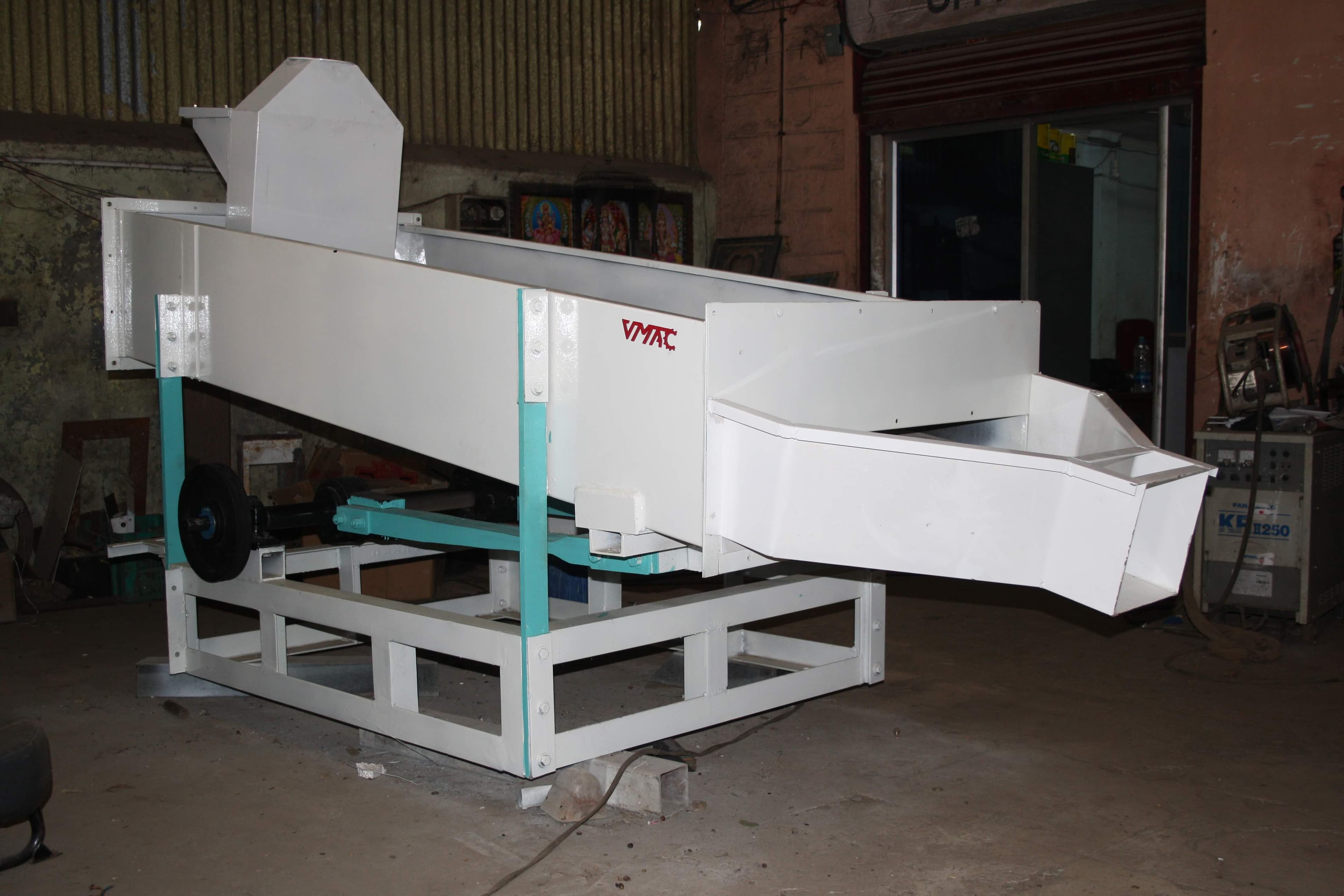
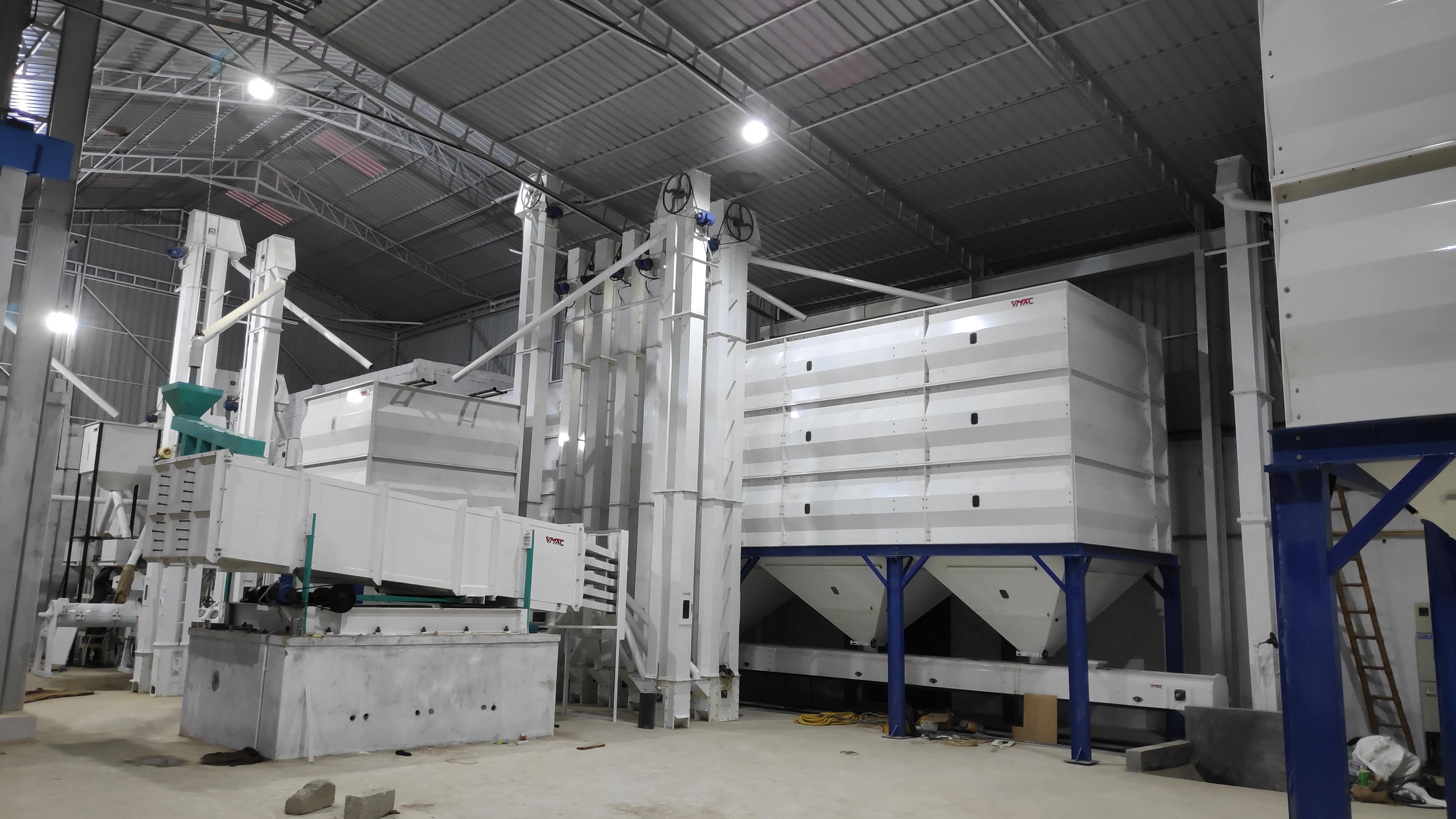
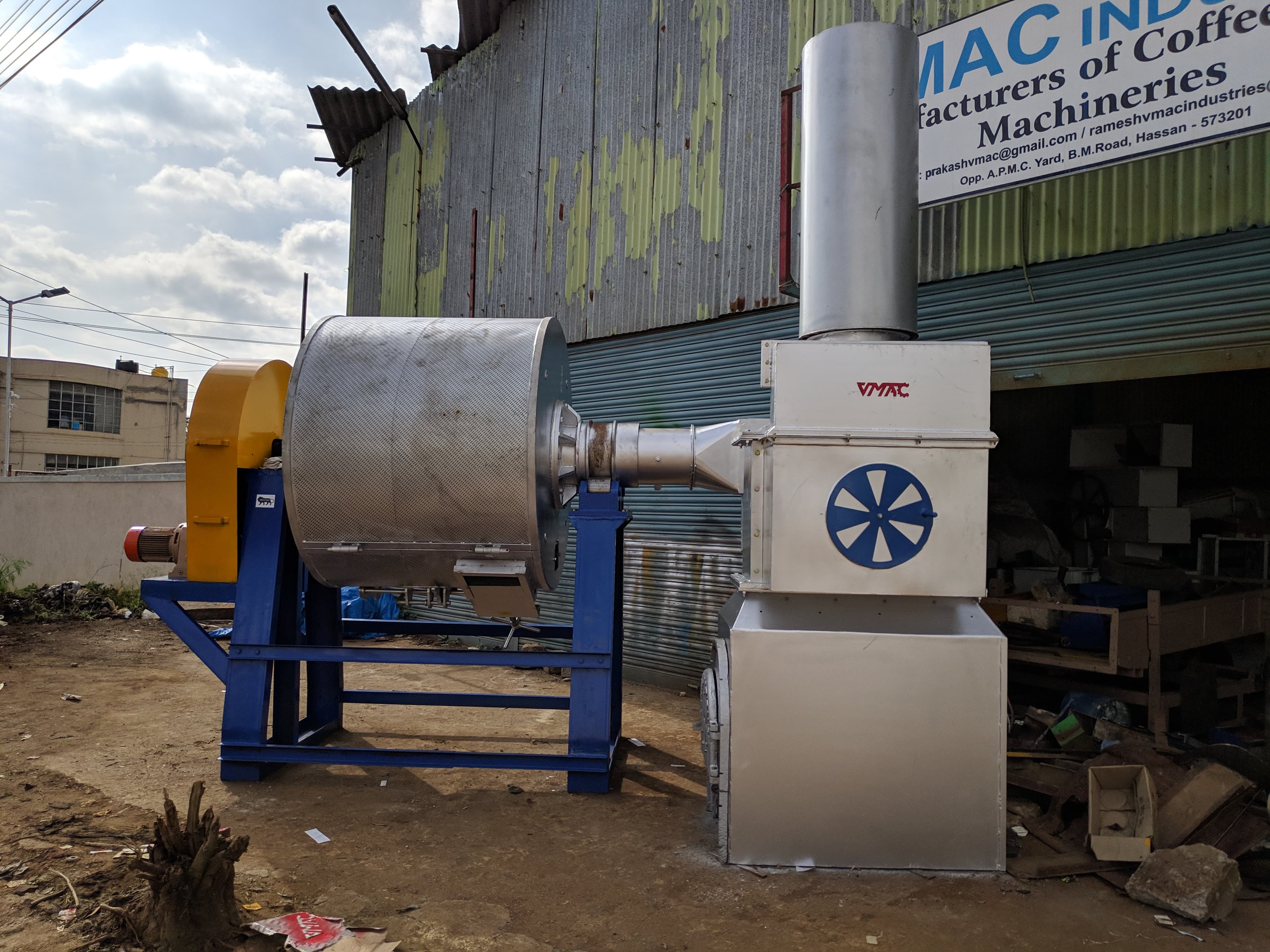
Coffee pre-processing equipment covers the essential machines that take freshly harvested coffee cherry from the field and prepare it for the downstream stages of hulling, grading, and export. This is where quality begins. Every decision made at the pre-processing stage — how thoroughly the cherry is cleaned, how precisely it is pulped, and how carefully it is dried — determines the cup quality, grade classification, and commercial value of the finished green bean. For estates and curing works across Karnataka, Kerala, and Tamil Nadu, investing in reliable pre-processing machinery is not optional; it is the foundation on which every subsequent quality outcome rests.
VMAC manufactures three core machines in this category, each addressing a distinct stage of the pre-processing workflow. The Coffee Pre-Cleaner is the first machine in the line, positioned at intake to remove gross foreign matter — sticks, stones, leaves, soil clods, rope fibres, and light chaff — from incoming cherry or parchment lots using a dual-screen vibratory design with integrated air aspiration. By stripping out debris before it reaches any other equipment, the pre-cleaner protects every downstream machine from jamming, bridging, and accelerated wear, while ensuring that only clean coffee proceeds to pulping or drying. Models range from 1 TPH for small cooperative installations to 15 TPH for large commercial curing works.
The Coffee Pulper is the defining machine in wet processing. Available in disc pulper and drum pulper configurations, it removes the outer fruit skin and mucilage from ripe cherry to expose the parchment-covered bean — the critical first step for washed Arabica and honey-processed coffees. Disc pulpers are the dominant choice for small and medium Arabica estates in Coorg, Chikmagalur, and Wayanad, offering precise gap adjustment and easy calibration. Drum pulpers serve high-volume commercial estates and central processing stations handling 2,000 kg cherry per hour and above. Proper pulping with minimal bean breakage is essential for clean fermentation and bright cup profiles, and VMAC pulpers are built with stainless-contact food-grade wetted parts and low water consumption designs suited to water-scarce harvest regions.
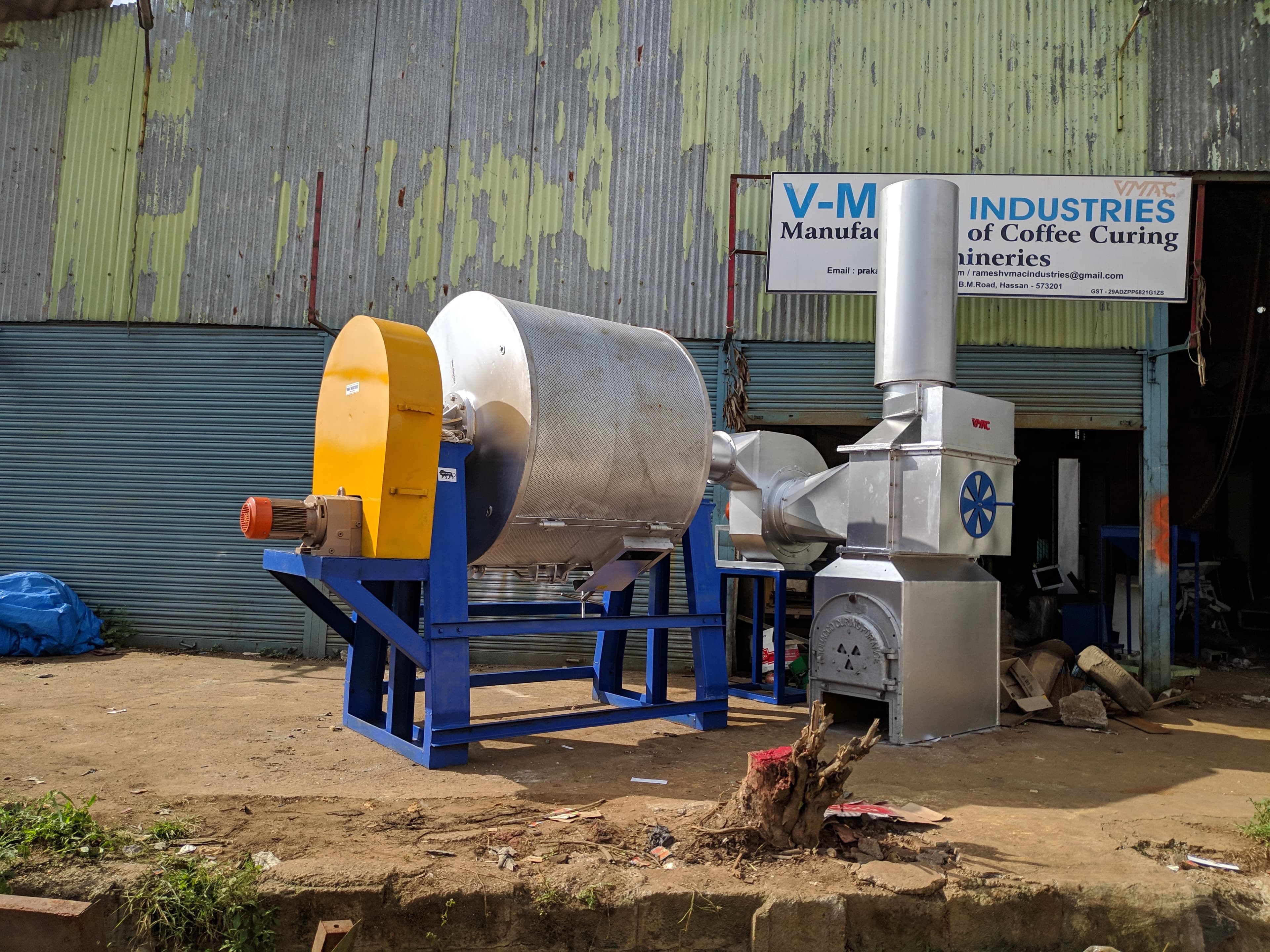
The Coffee Dryer is a rotary drum mechanical dryer that brings parchment coffee from 50-55% post-wash moisture down to the target 10-12% for safe storage, independent of weather conditions. Where sun drying on raised beds or patios takes three to six weeks and remains vulnerable to monsoon interruptions, the rotary dryer completes the same task in 18-36 hours with precise temperature control. Firewood and biomass furnaces are the standard heat source for Indian estates; LPG and diesel burner options are also available. The same machine handles parchment coffee, natural cherry coffee, and pepper — a significant advantage for mixed-crop plantations in Karnataka and Kerala looking to maximise return on capital equipment.
Together, these three machines form a complete pre-processing line suitable for wet mills, dry mills, and integrated estate processing facilities. Whether you operate a smallholder cooperative washing station in Wayanad, a medium Arabica estate in Chikmagalur, or a large-scale curing works in Hassan, the pre-processing stage sets the ceiling for everything that follows. Clean intake, precise pulping, and controlled drying are prerequisites for achieving Coffee Board of India grade certifications — Plantation AA, A, AB, and specialty designations — and for meeting the quality expectations of export buyers in Europe, Japan, and North America.
When selecting pre-processing equipment, consider your peak harvest throughput, the ratio of washed to natural coffee in your production plan, available fuel sources for drying, and water availability for pulping. VMAC offers equipment across the full capacity range and can configure integrated pre-processing lines with matching elevators and conveyors for seamless material flow between stages. All machines are built for the operating conditions of Indian coffee regions — three-phase 415V power supply, tropical humidity, and the demanding seasonal duty cycles of the October-to-February harvest window.
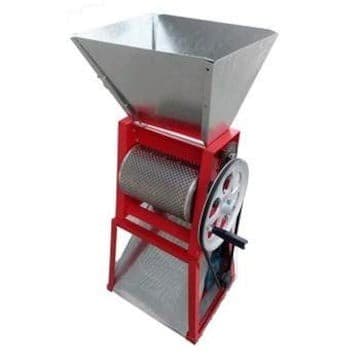
Hulling and chaff removal equipment represents the heart of the coffee dry mill — the stage where dried parchment or cherry coffee is transformed into clean, polished green beans ready for grading and export. Hulling strips the dried parchment shell or cherry husk from the bean, while chaff removal and polishing eliminate the residual silver skin, husk fragments, and dust that remain after hulling. Getting this stage right is critical: aggressive hulling causes bean breakage that reduces lot value and triggers defect penalties under Coffee Board of India and SCA grading standards, while inadequate chaff removal creates fire hazards and contaminates downstream sorting equipment. VMAC manufactures the full range of hulling and chaff removal machines needed to equip a complete dry mill line.
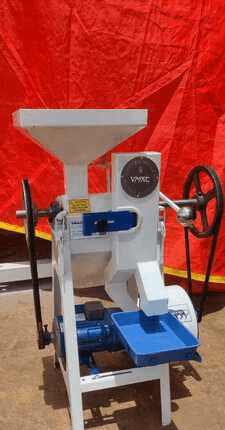
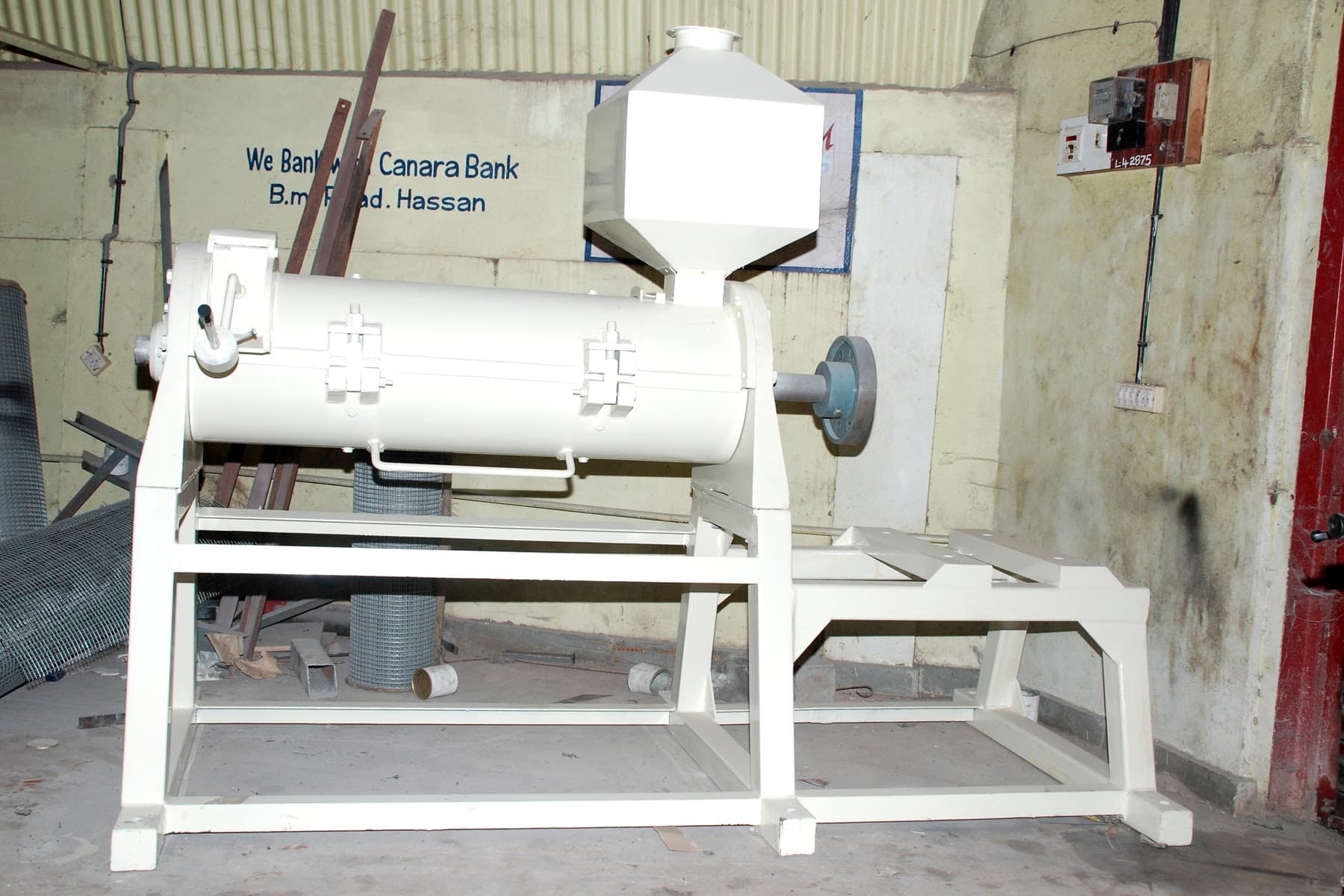
The Coffee Huller is the primary hulling workhorse, using an abrasive rotating disc against a stationary concave to strip dried parchment through controlled friction. It handles a wide range of parchment conditions — including over-dried lots, mixed-moisture batches, and beans with thick or irregular parchment — making it versatile for curing works processing both Arabica and Robusta. Capacities range from 250 kg/hr for small estate dry mills to 5 TPH for large commercial operations. For washed Arabica parchment destined for premium export markets, the Rubber Roll Huller is the preferred choice. Its counter-rotating rubber rolls use a gentle squeeze-and-shear action that achieves bean breakage rates below 1-2%, preserving lot outturn for Karnataka Plantation AA and Kerala Monsooned Arabica grades. The Disc Huller serves a different purpose entirely: its aggressive abrasive action is designed for natural and dry-processed coffee where the thick, lignified cherry husk must be ground away — the standard machine for Robusta cherry processing across Chikmagalur, Kodagu, and the Hassan district. For quality control laboratories and Coffee Board inspection facilities, the Coffee Sample Huller is a compact bench-top unit that hulls 50-500g parchment samples with minimal breakage, enabling rapid green bean assessment for defect counts and cupping sessions.
After hulling, chaff removal is essential. The Winnower (also called an aspirator) uses a vertical air column to separate lightweight chaff, silver skin, and parchment fragments from the heavier green beans based on terminal velocity differences. It is standard equipment in every curing works in Karnataka, Kerala, and Tamil Nadu — and it is not optional, because accumulated dry chaff is a documented fire hazard in mill buildings. VMAC winnowers feature variable-speed fan drives for precise airflow calibration across different crop densities, from heavy monsoon-processed beans to lighter naturals. Working in tandem with the winnower, the Chaff Cyclone Separator captures the chaff-laden exhaust air using centrifugal separation — no filters, no moving parts, no consumables — and collects the separated chaff in a sealed bin for disposal or biomass use. Operating a winnower without a cyclone means chaff is either blown into the building interior or exhausted outdoors without collection, creating fire risk and potential regulatory violations.
The Coffee Peeler Polisher completes the hulling line by removing the thin silver skin (testa) that remains on the green bean after hulling. Coffee Board of India grade standards for Plantation AA, A, AB, B, and C explicitly require polished beans, making this machine standard in virtually every curing works processing washed Arabica for export. Available in friction disc and abrasive drum variants, the peeler polisher removes 1-3% of bean weight as silver skin under correct settings, with integrated aspiration capturing liberated chaff at source. Models range from 500 kg/hr for estate dry mills to 10 TPH for large export curing works.
The correct sequence through this equipment is critical for both quality and efficiency: huller first, then winnower and chaff cyclone for chaff removal, then peeler polisher for silver skin removal, followed by a second winnowing pass to clean the polished beans before they proceed to screen grading. Each machine in the line depends on the one before it performing correctly. VMAC designs integrated hulling lines where capacities are matched across all machines, material flow between stages is handled by elevators and conveyors, and the entire circuit operates as a coordinated system rather than a collection of standalone machines.
Whether you are setting up a new curing works in Coorg, upgrading an existing dry mill in Wayanad, or expanding capacity at a multi-line facility in Chikmagalur, selecting the right combination of hulling technology — rubber roll for premium washed Arabica, disc huller for natural Robusta, abrasive huller for mixed processing — is the single most important equipment decision in the dry mill. VMAC offers the full range and can advise on the correct configuration for your coffee types, throughput requirements, and export market standards.
Purity and quality sorting equipment is the final line of defence in the coffee dry mill — the machines that take hulled, polished green coffee and sort it into precise, export-ready grade fractions while removing every foreign body, defective bean, and off-colour kernel that would trigger rejection at Coffee Board of India inspection or at the buyer's receiving warehouse. No amount of careful hulling and polishing can substitute for proper sorting. A single stone in an export bag can damage a roaster's grinder and end a commercial relationship. A batch of undersized beans mixed into a Plantation AA lot triggers immediate downgrading. Sorting equipment eliminates these risks systematically, and VMAC manufactures the complete range of machines needed for a fully equipped sorting line.
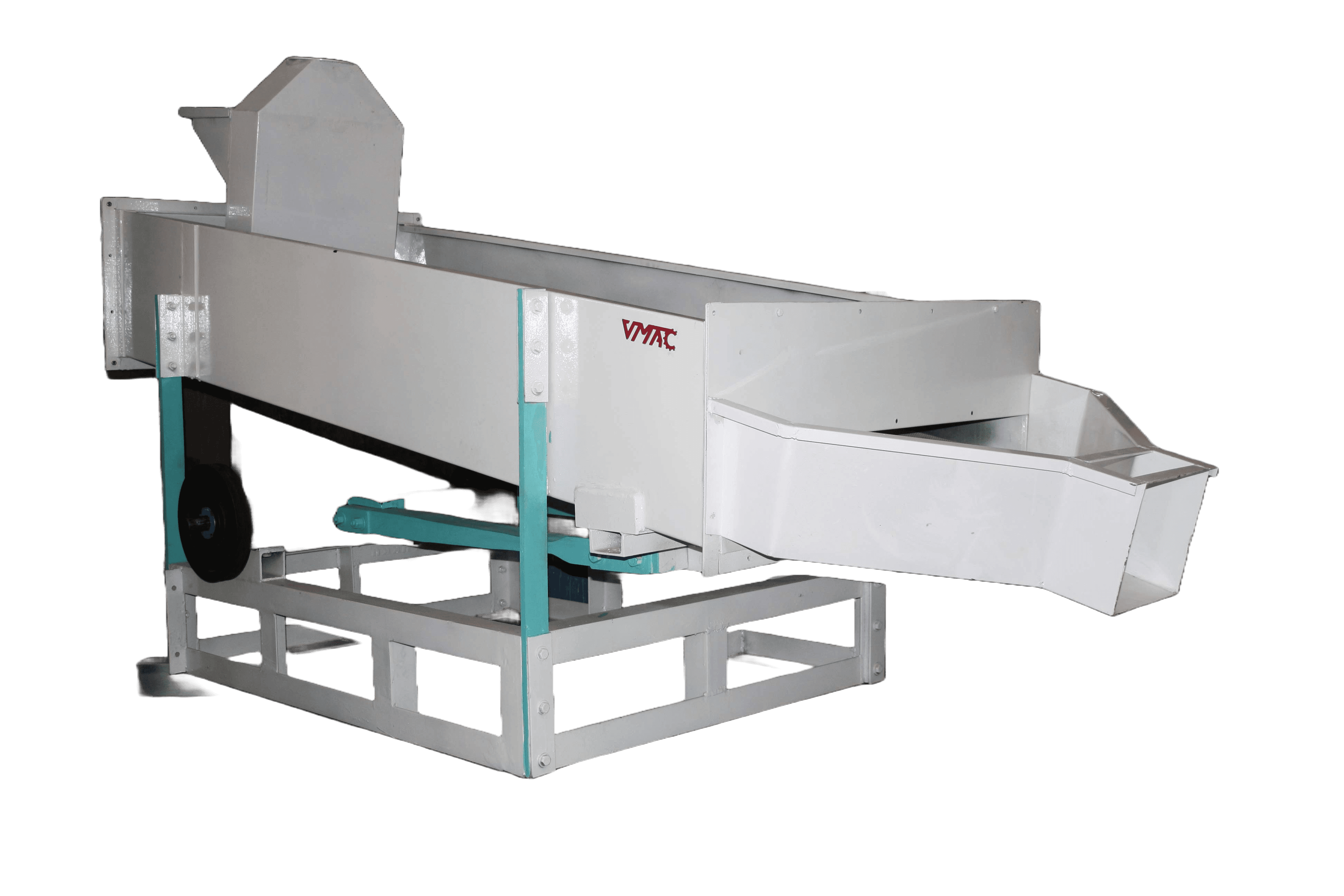
The Coffee Destoner runs early in the sorting sequence — after the pre-cleaner and before the huller in most mill configurations. It uses a vibrating inclined deck with calibrated upward airflow to exploit the density difference between coffee beans (approximately 1.35 g/cm3) and stones (approximately 2.5 g/cm3). Coffee is fluidized and carried downhill to the clean product discharge, while dense stones, gravel, glass fragments, and metal pieces remain in contact with the deck and are conveyed uphill into a sealed stone collection pocket. Running stones through a rubber roll huller causes catastrophic damage — shredded rolls, broken components, and repair costs many times the price of the destoner itself. The Coffee Board of India requires zero heavy foreign matter in export lots, making destoning standard in every licensed curing works across Karnataka, Kerala, and Tamil Nadu. VMAC destoners are available from 500 kg/hr for estate dry mills to 5 TPH for large curing works.
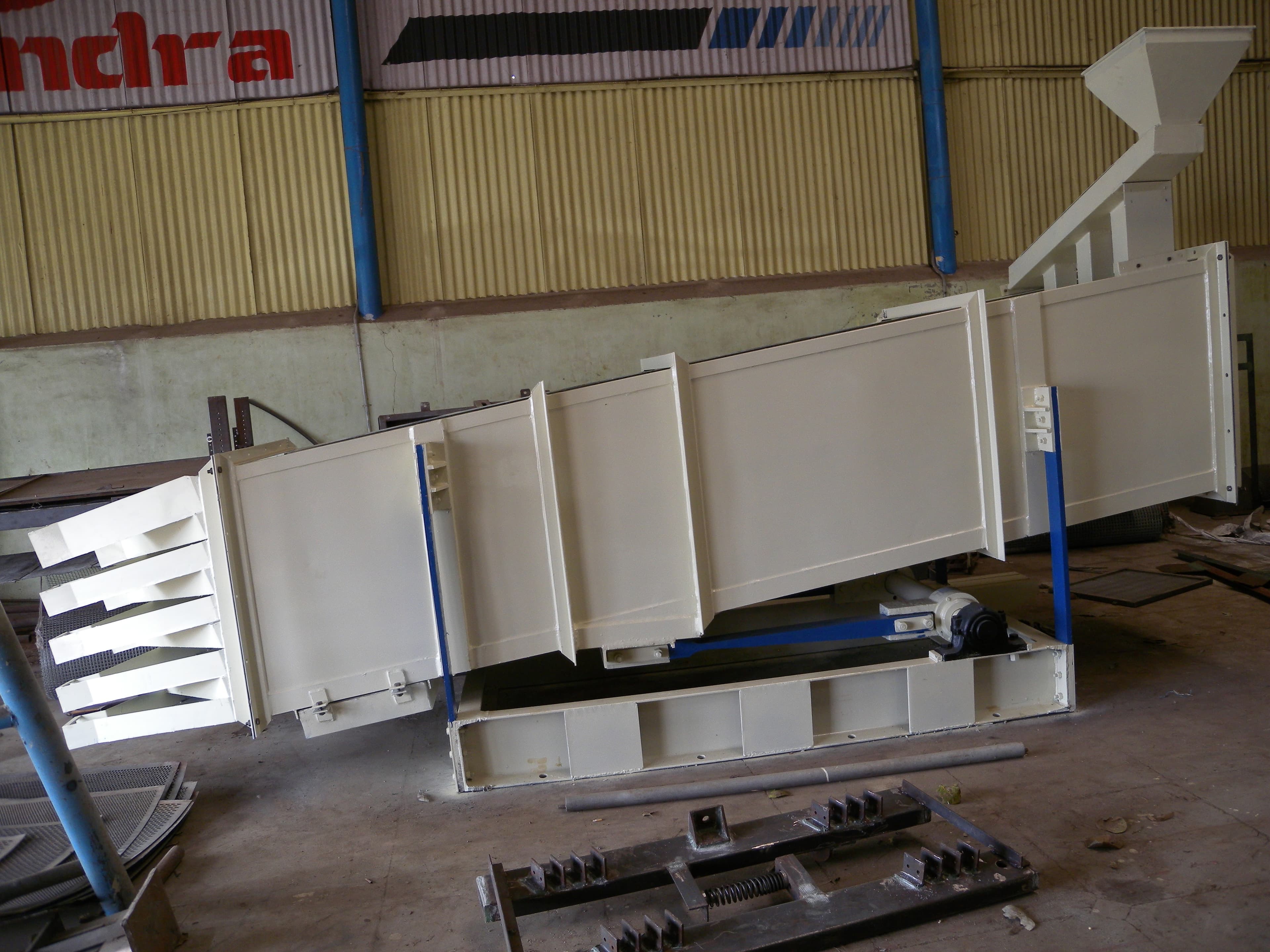
The Coffee Grader (also called a screen grader or sizing machine) is the machine that makes Coffee Board grade compliance possible. Using an eccentric-drive reciprocating mechanism to oscillate a stack of two to five perforated screen decks, it sorts green coffee by physical bean size into the specific screen fractions required for export certification: Plantation AA (Screen 17 and above), Plantation A (Screen 16 and above), Plantation B (Screen 15 and above), Plantation C (Screen 14 and above), and Peaberry grades. Round-hole decks sort flat beans by diameter, while oblong slot perforations separate round peaberries from flat beans in the same pass. Proper screen grading must occur before gravity separation — the gravity table requires uniform-size input to function correctly. VMAC graders range from 500 kg/hr two-deck estate models to 10 TPH four-deck industrial configurations with integrated peaberry screens.
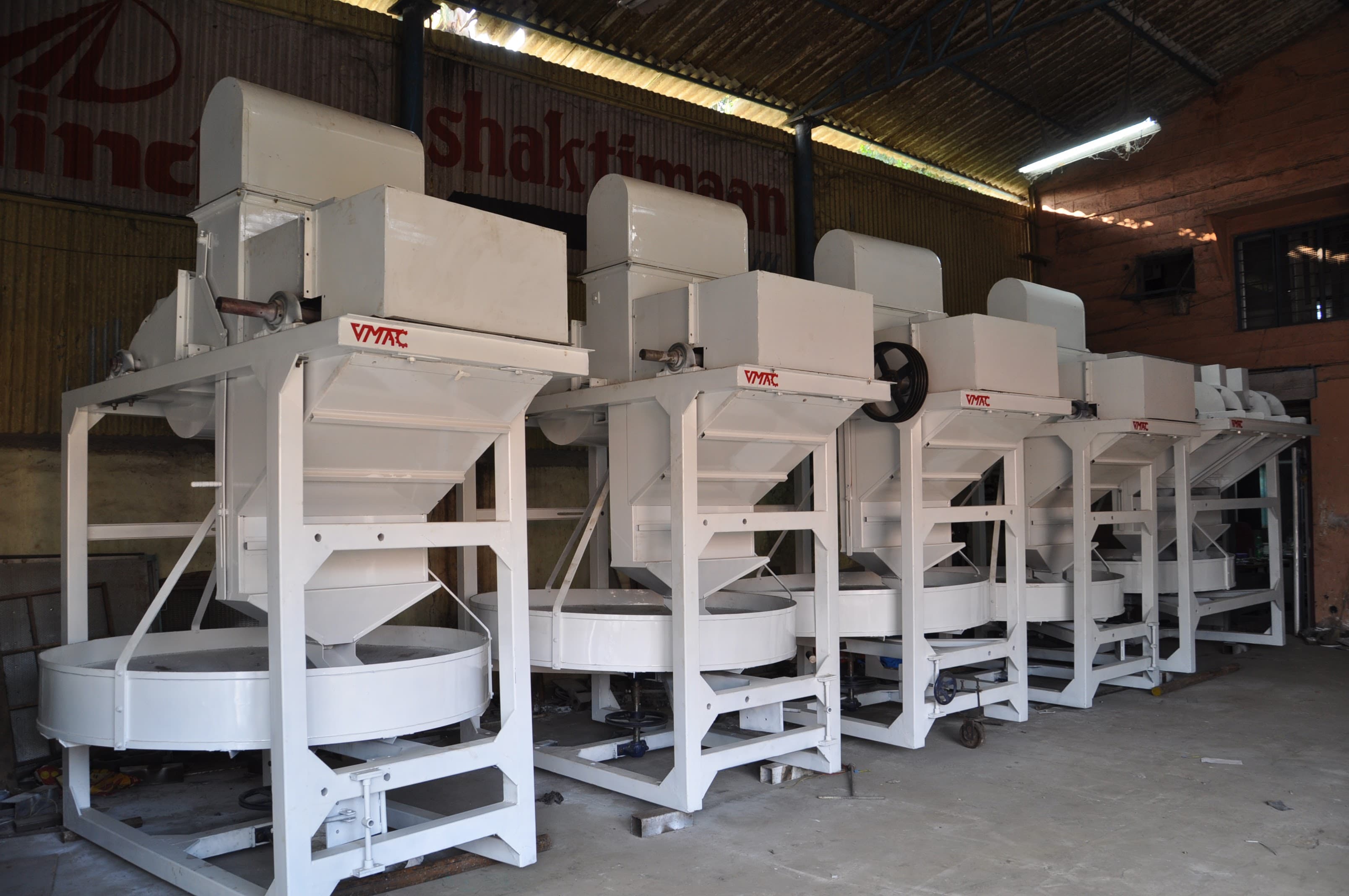
The Gravity Separator is the most powerful quality-sorting tool in the dry mill. It uses an air-fluidized vibrating deck to sort green coffee beans by specific density — the single most reliable method for separating premium, fully developed beans from low-density defects that screening cannot detect. Immature beans, hollow shells, withered beans, insect-damaged kernels, and floaters are all lighter than sound beans of the same screen size. The gravity separator stratifies them into three distinct output fractions: a heavy cut of concentrated premium-grade beans, a middlings blend, and a lights tailings fraction containing the defects. It is standard equipment in all Coffee Board-licensed curing works and a prerequisite for achieving Plantation AA, MNEB, and specialty export grades. Models range from 500 kg/hr for small estates to 10 TPH for large export curing works in Coorg, Chikmagalur, and the Shevaroy Hills.
The Color Sorter is the final automated quality gate before export bagging. Using high-resolution CCD camera arrays, it inspects every bean in free fall and ejects defective beans — black beans, sour beans, white beans, and discoloured kernels — with millisecond-fast air jets. These are colour-visible defects that no mechanical separator can detect: a black bean weighs the same and measures the same screen size as a sound bean, but it will ruin a cupping score. Available in 8 to 64 chute configurations with throughputs from 500 kg/hr to 8 TPH, VMAC color sorters include dual-side camera imaging for greater than 99% ejection accuracy and a second-sort outlet that allows the reject stream to be re-run to recover falsely ejected good beans.
The correct sorting sequence in a well-designed dry mill is: destoner, then screen grader (by size), then gravity separator (by density, run separately per screen fraction), then color sorter (by optical defect). Each machine removes a category of defect that the others cannot detect, and skipping any stage compromises the final lot quality. For estates and curing works in Wayanad, Kodagu, and across the Western Ghats coffee belt, this equipment is what separates commodity-grade output from premium export lots that command top prices at auction and in direct trade. VMAC supplies all four machines individually or as integrated sorting lines with matched capacities, connecting conveyors, and coordinated control systems for turnkey installation.
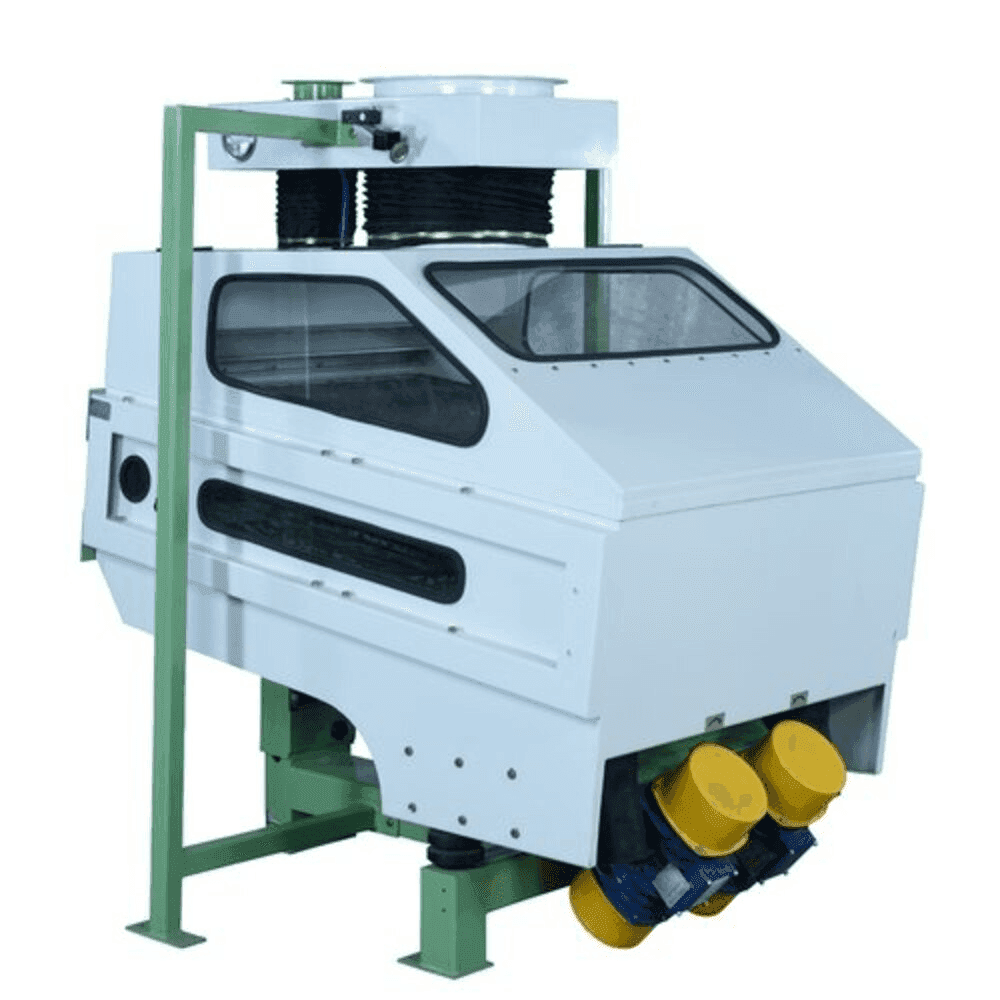
CCD optical sorter — removes black, sour, white, and discoloured beans. The final automated quality gate before export bagging.
Request a QuoteThe roasting and blending equipment category covers the two machines responsible for transforming green coffee into a finished, sale-ready product and for ensuring that product is consistent across an entire export lot or branded blend. In a typical Indian coffee value chain, green beans leave the dry mill as a graded, sorted commodity. Roasting and blending convert that commodity into a differentiated product with a specific flavour profile, cup character, and market identity. Whether the operation is a small estate roastery in Coorg selling branded filter coffee or a large curing works in Hassan adding roast capability for institutional supply, these machines sit at the value-addition stage of the processing line.
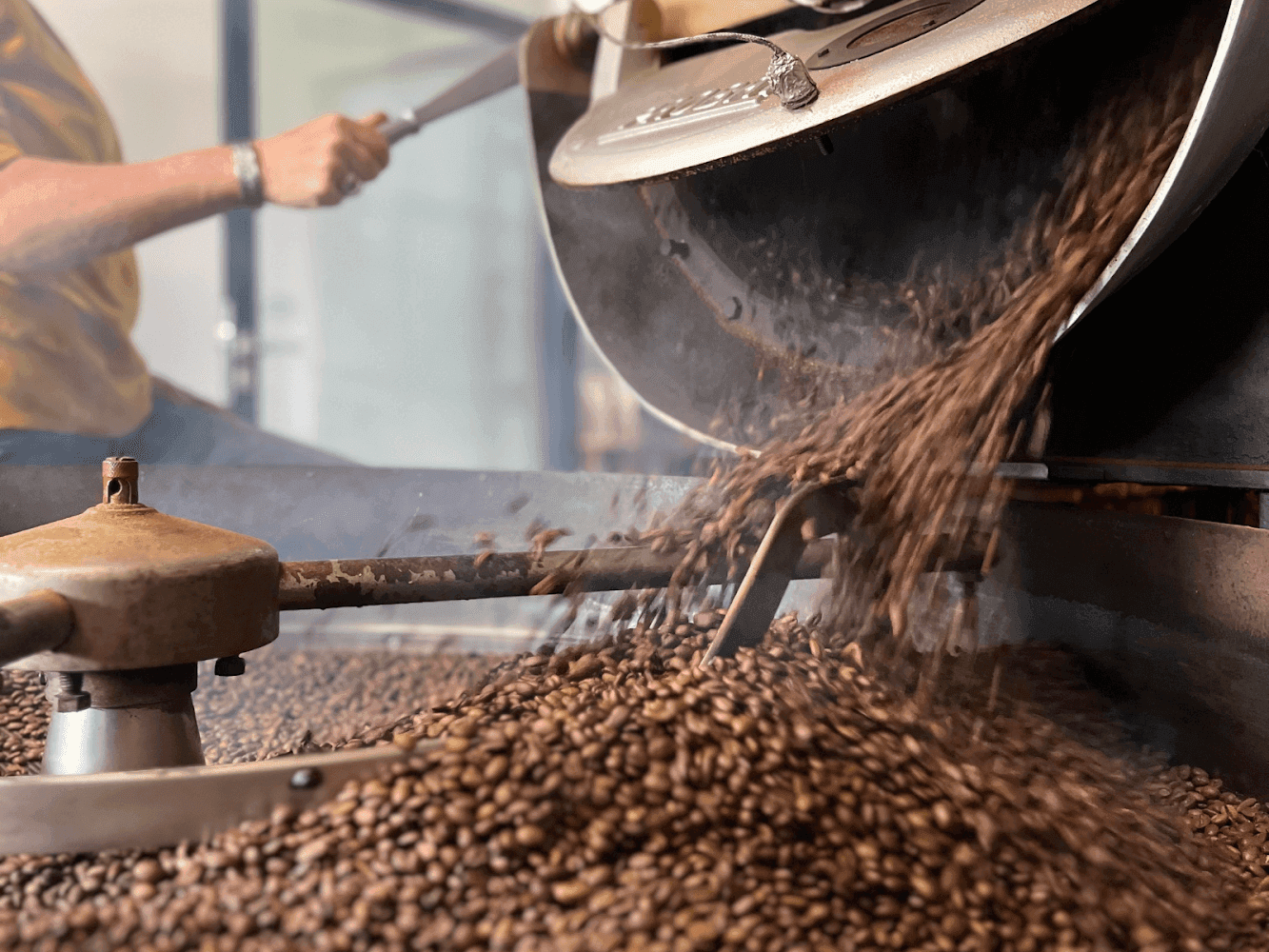
Coffee Roaster — VMAC's drum roasters are rotating-drum, LPG gas-fired machines that apply combined conduction and convection heat to green beans. The operator controls bean temperature, inlet air temperature, drum speed, and exhaust airflow to guide each batch through drying, Maillard browning, first crack, and development. An integrated cooling tray drops the roasted batch below 40°C in under four minutes, and a chaff cyclone on the exhaust duct captures silver skin released during roasting. Five models are available: the CR-5 (5 kg per batch, single-phase 230V) for estate roasteries and sample roasting, through the CR-10 (10 kg), CR-30 (30 kg), and CR-60 (60 kg) for small-to-commercial roasteries, up to the CR-120 (120 kg per batch, 3-phase 415V) for industrial operations producing 800–1,000 kg of roasted coffee per day. All models include digital PID temperature control, adjustable drum speed, and bean temperature probes for repeatable roast profiles.
Bulking Machine / Lot Blender — Export lots are rarely uniform. A 275-bag container may be assembled from dozens of small estate lots, screen-graded fractions, or seasonal harvest parcels. VMAC's rotary drum blender homogenises these sub-lots into a statistically uniform export lot in 5–15 minutes per batch. Internal baffles and flights tumble the beans in a controlled pattern, and composite sampling ports on the discharge chute allow blend verification before bags are filled. Four models cover batch sizes from 200 kg (BM-200, 1.5 kW) for small estate mills up to 2,000 kg (BM-2000, 7.5 kW) for high-volume exporters assembling multi-container lots. In Coffee Board-registered curing works, the bulking machine is a compliance requirement — the Board's export-lot registration system mandates that a declared grade be consistent throughout the registered quantity.
Together, these machines serve distinct segments of the Indian coffee industry. Estate roasteries across Karnataka, Kerala, and Tamil Nadu use the smaller roaster models for farm-to-cup branded products and direct-to-consumer retail. Medium and large curing works in Chikkamagaluru and Hassan use the bulking machine as a standard end-of-line machine before bagging for export. Some operations use both — roasting a portion of their output for domestic branded sales while bulking the rest for commodity export.
When selecting roasting equipment, the primary sizing factor is daily throughput: a CR-30 running 8-hour shifts produces 200–300 kg per day, while a CR-120 produces 800–1,000 kg. For bulking machines, size the drum to your container-filling rhythm — operations shipping fewer than 5 containers per month may find the BM-500 sufficient, while large exporters handling 25+ containers monthly need the BM-2000. Both machines integrate with the rest of the dry mill line through bucket elevators or screw conveyors for automated loading, and the bulking machine's elevated discharge height gravity-feeds directly into a bag loader or weigher. All equipment is manufactured at VMAC's facility in Hassan, Karnataka, with standard lead times of 4–8 weeks from order confirmation.
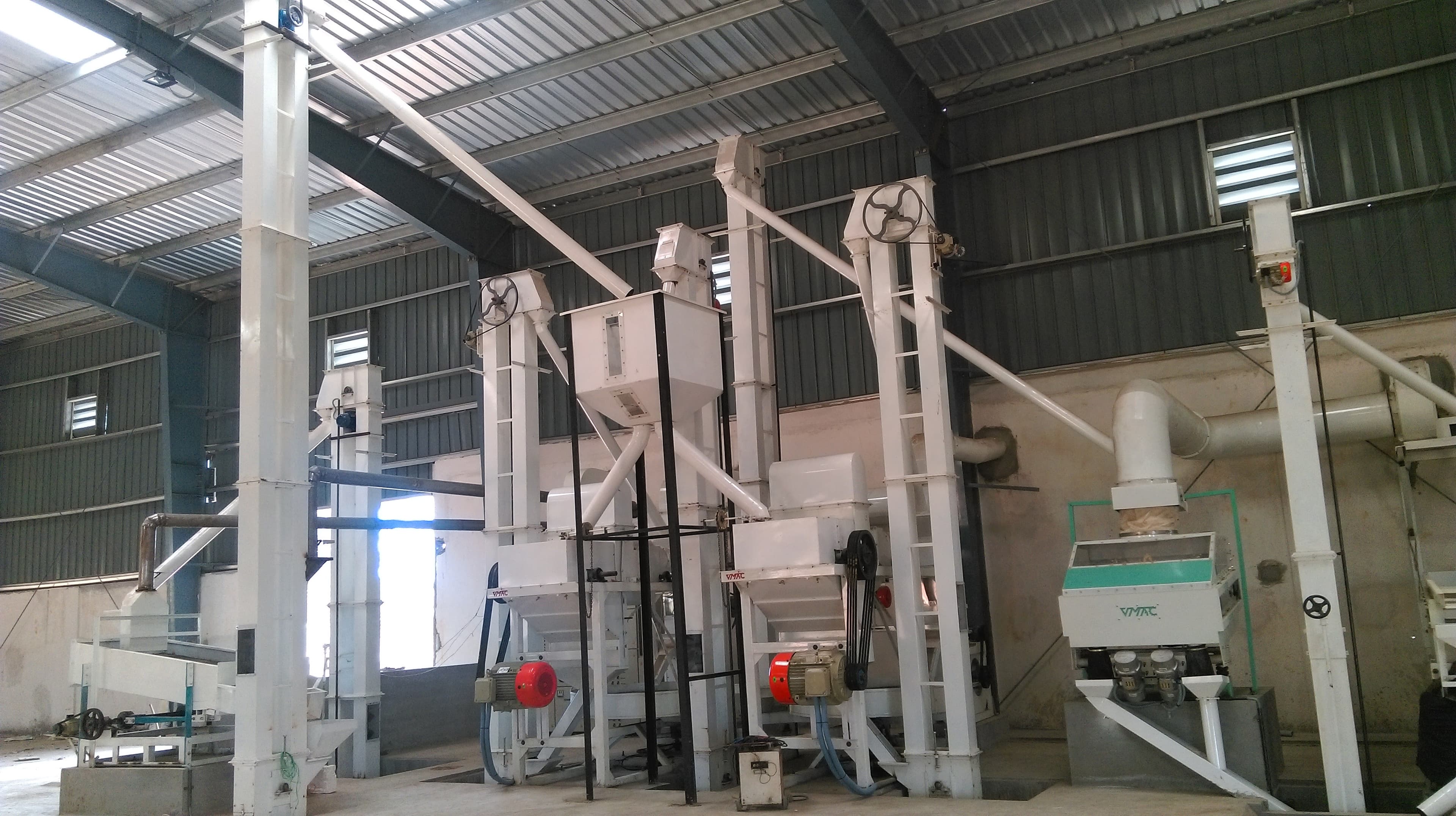
Material handling systems are the connective tissue of any coffee processing facility. Every processing machine — pre-cleaner, huller, grader, gravity separator, colour sorter — needs product delivered to its infeed and removed from its discharge. Without reliable, correctly sized conveyors and elevators between those machines, the entire line stops. In Indian curing works and East African export mills, material handling equipment typically accounts for 30–40% of the total machine count on the production floor, and its capacity must match or slightly exceed the throughput of every processing machine it serves.
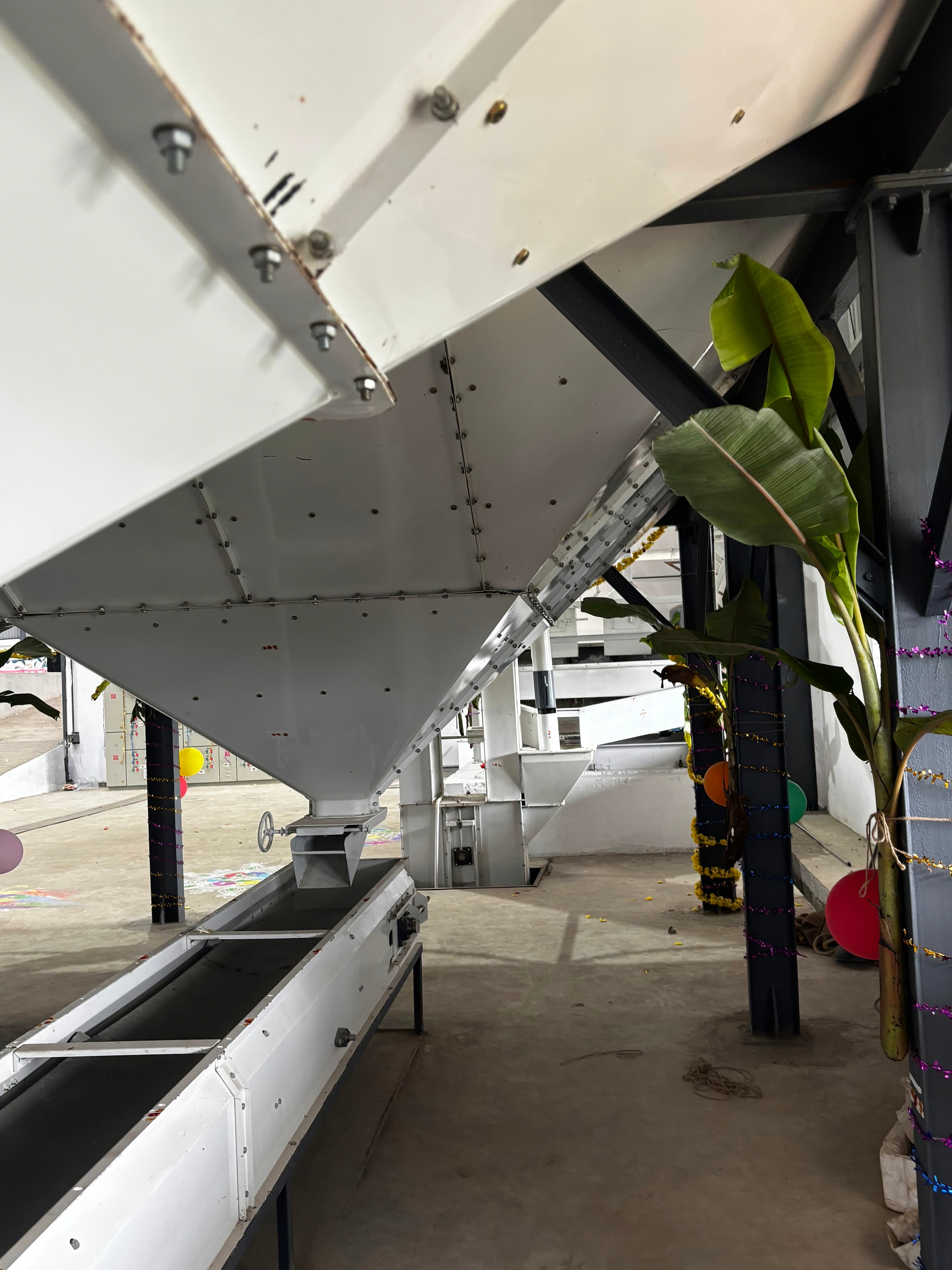
Belt Conveyor — The flat rubber or PVC belt conveyor is the backbone of horizontal material flow. Beans ride on the open belt surface with zero shearing, grinding, or compressive stress — making it the gentlest method of horizontal coffee conveyance in any mill. Standard belt widths of 300 mm to 600 mm cover throughputs from 500 kg/hr to 20 t/hr. A variable-frequency drive adjusts belt speed from 0.1 m/s (slow enough for a hand-sorting inspection table) to 2.0 m/s for high-throughput transfer. Flat belts handle inclines up to 18°; cleated or chevron belt variants convey at angles up to 45°. Belt materials include general-purpose rubber, food-grade PVC for hygiene-sensitive applications, and open-weave fabric for draining wet cherry. Belt conveyors appear at nearly every transfer point in a dry mill: feeding cherry from intake to pre-cleaner, linking the pre-cleaner to the huller, and moving sorted green coffee to the bagging station.
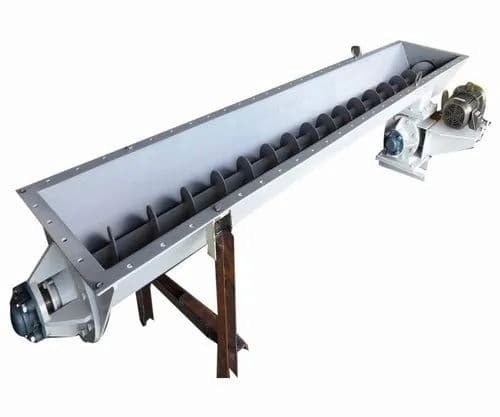
Screw Conveyor — The enclosed helical screw conveyor is the workhorse for short horizontal transfers where dust containment matters. A slowly rotating helical flight inside a U-trough or tubular housing pushes green coffee from one machine to the next — from huller discharge to pre-cleaner, from destoner to grader, or directly under a bag-loader hopper. The full enclosure means chaff and dust cannot escape into the working environment. Screw diameters from 100 mm to 400 mm cover throughputs from 500 kg/hr to 10 TPH, operating at 30–60 RPM to minimise bean breakage. Flanged trough sections bolt together for custom lengths to match any plant layout.
Bucket Elevator — Where screw conveyors and belt conveyors handle horizontal movement, bucket elevators handle vertical lifts. HDPE or nylon polymer buckets scoop coffee at the bottom boot, carry it upward inside an enclosed casing, and discharge it at the head into the next machine's infeed. A modern curing works with eight to twelve processing machines typically uses four to six bucket elevators running simultaneously. Standard head heights range from 3 m to 15 m, with custom fabrication to 20 m for multi-storey mill buildings. Capacity ranges from 1 TPH for small cooperative elevators to 20 TPH for large export plant installations. Belt-type construction is recommended for hulled green coffee where breakage is a concern; chain-type is available for heavier-duty work with cherry, pulp, or dried parchment.
Pneumatic Conveyor — For long-distance transfers, cross-building routing, or silo loading where mechanical conveyors would require expensive covered gantry structure, pneumatic conveyors move coffee through enclosed pipework using airflow. Pressure systems use a positive-displacement blower to push material through the pipeline; vacuum systems use a centrifugal fan to pull material into a pickup nozzle. Pipe diameters from 80 mm to 250 mm handle capacities from 1 TPH to 15 TPH over distances up to 100 m horizontal and 30 m vertical. Diverter valves allow a single blower to route material to multiple silos. Pneumatic systems are also the standard method for evacuating chaff and parchment dust from winnower and polisher cyclones to a central collection point.
Across Karnataka, Kerala, and Tamil Nadu, most curing works and estate mills use a combination of all four conveyor types in the same building — belt conveyors for long open-hall transfers, screw conveyors for short enclosed runs under hullers and graders, bucket elevators for every vertical lift between machines, and pneumatic lines for silo loading and chaff collection. When planning a new line or upgrading an existing facility, size each conveyor to at least 110% of the peak throughput of the processing machine it feeds. VMAC manufactures all four conveyor types at its Hassan, Karnataka facility and supplies complete multi-conveyor plant packages with matched capacities, discharge heights, and integration engineering.
Packing and storage systems cover the final stage of the coffee processing line — the machines and structures that hold finished green coffee in bulk until an export order arrives, then weigh, fill, seal, and prepare bags for dispatch. This is where the dry mill's output transitions from a production flow to a warehoused, trade-ready commodity. The quality of storage directly determines whether beans arrive at the buyer's roastery at the same grade they left the gravity separator, or degraded by moisture gain, pest damage, or temperature cycling. And the accuracy and speed of packing directly affects export compliance, labour cost, and container-loading throughput.
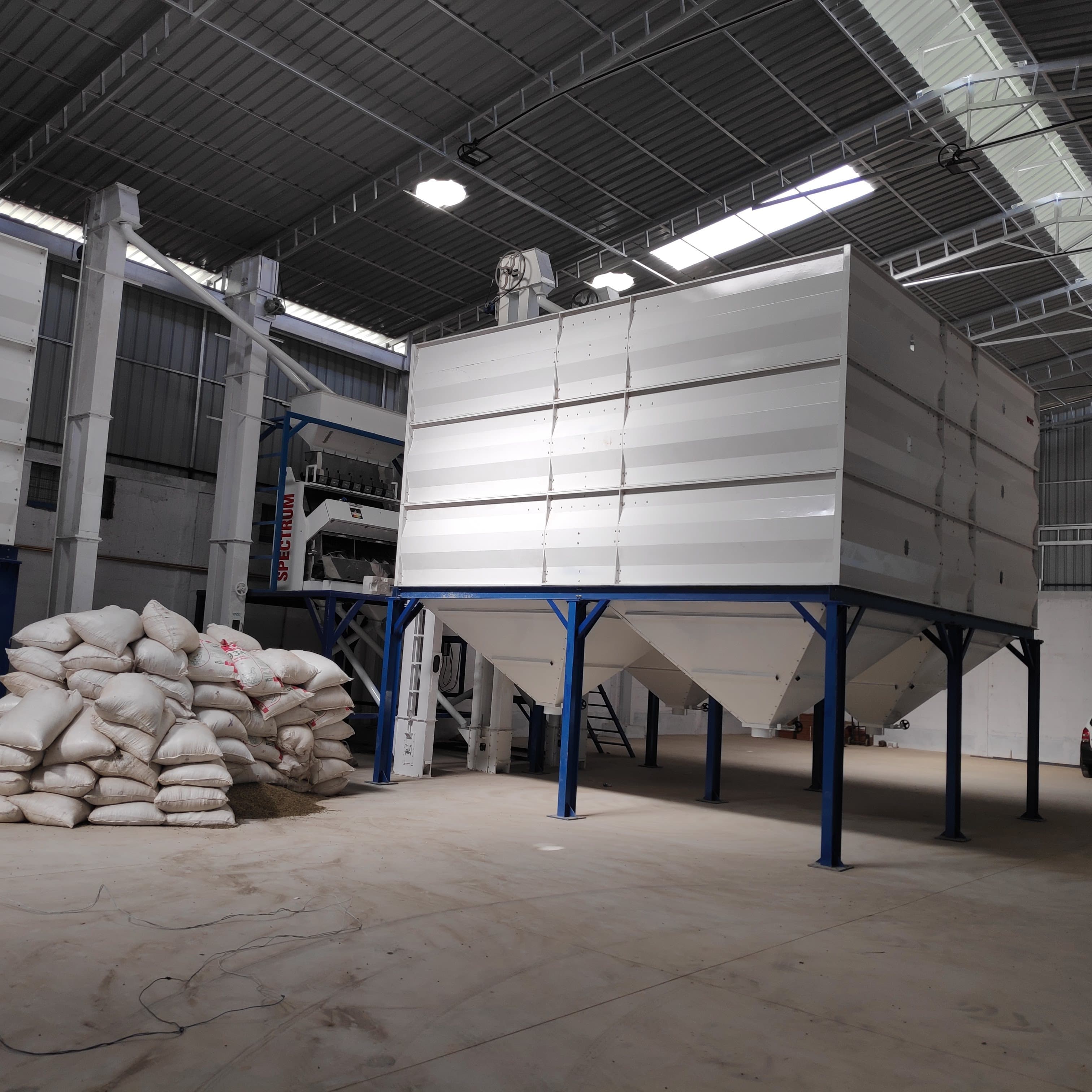
Coffee Silos / Green Coffee Storage Silos — VMAC's bolted corrugated galvanized steel silos are purpose-built for holding parchment coffee and green beans at curing works and export warehouses. The standard construction uses G90 or G120 zinc-coated corrugated panels that bolt together on a concrete ring beam — no welding required, fully field-assembled, and relocatable if operations expand. Hopper-bottom (cone bottom) silos are the preferred configuration for coffee: the conical discharge empties fully under gravity through a butterfly valve to a receiving screw conveyor, with no contact between the bean mass and any sweep auger mechanism. This matters because green coffee beans crack under point loading from auger flights, generating fines that score poorly in grading. The single most important feature for Indian conditions — particularly Karnataka and Kerala during the southwest monsoon from June to September — is the aeration system. A perforated false floor with a centrifugal fan draws ambient air through the bean mass during cool, dry night hours, preventing the moisture stratification and hot-spot formation that silently damage beans during 2–6 month holding periods. Capacity ranges from 10 tonnes for small estate curing works up to 200+ tonnes for large central processing stations, with multiple silos enabling lot separation by variety, grade, and processing method.
Coffee Bag Loader / Automatic Bagger — The bag loader is the weighing and filling machine at the very end of the dry mill line — filling 60 kg export jute bags, 50 kg domestic bags, or 500–1,000 kg FIBC supersacks with weighed, certified-weight green coffee. Two filling principles are available: the net-weight bagger pre-weighs a complete charge in a suspended hopper above the bag and releases the full batch when the target weight is confirmed, achieving ±100 g accuracy — the standard for export compliance. The gross-weight bagger fills directly into the bag on a platform scale, offering faster cycle time at ±200–300 g accuracy. For Coffee Board-licensed curing works, the load cell must carry a valid Legal Metrology stamp from the State Weights and Measures department — inspectors verify this during licensing renewals. Semi-automatic models handle 1–3 bags per minute with one operator positioning empty bags; fully automatic models with a bag elevator arm handle 3–6 bags per minute. The machine integrates directly with an inline bag stitcher via roller conveyor for a continuous fill-stitch-label workflow.
These two equipment types serve complementary functions in the export workflow. Silos provide the buffer between continuous dry mill processing and the intermittent, order-driven rhythm of export dispatch. A typical 20-foot container holds 275 bags at 60 kg each — 16.5 tonnes net — meaning a curing works shipping 4 containers per week needs 60–70 tonnes of live green storage at minimum. The bag loader then converts that bulk silo inventory into individually weighed, sealed, labelled export bags at the rate the container-stuffing schedule demands.
For operations in the major Indian coffee regions — Chikkamagaluru, Hassan, and Coorg in Karnataka; Wayanad in Kerala; the Nilgiris and Yercaud in Tamil Nadu — the storage challenge is managing moisture through the monsoon months. Silo aeration fans running during the pre-dawn window when relative humidity dips to 65–75% keep beans within the 10.5–12.5% moisture content target for export. Hermetic liner inserts with CO2 or N2 flushing provide phosphine-free pest management for operations supplying buyers with chemical residue restrictions, including organic-certified lots under NPOP and NOP standards.
When sizing storage, plan for approximately 2.5 times your monthly dispatch volume to cover the rolling processing-to-export cycle. For packing, the key decision is whether net-weight accuracy at ±100 g justifies the slightly slower cycle time compared to gross-weight filling — for Coffee Board-registered export lots, net-weight is strongly preferred because the weight on the bag must match the shipping document within a tight tolerance. VMAC supplies silos as complete systems including the bolted steel structure, galvanized support legs, aeration fan package, thermometer probe ports, and integration engineering to match your existing bucket elevator or pneumatic fill line. Bag loaders are supplied with calibration certificates and can be ordered as matched sets with roller conveyor and inline bag stitcher for a turnkey packing line.
Send a Enquiry Request
Retail store
Mon-Sat 9am to 5pm.
B.M road, Hassan, Karnataka 573201