
Category
Packing & Storage Systems
Packing and storage systems cover the final stage of the coffee processing line — the machines and structures that hold finished green coffee in bulk until an export order arrives, then weigh, fill, seal, and prepare bags for dispatch. This is where the dry mill's output transitions from a production flow to a warehoused, trade-ready commodity. The quality of storage directly determines whether beans arrive at the buyer's roastery at the same grade they left the gravity separator, or degraded by moisture gain, pest damage, or temperature cycling. And the accuracy and speed of packing directly affects export compliance, labour cost, and container-loading throughput.
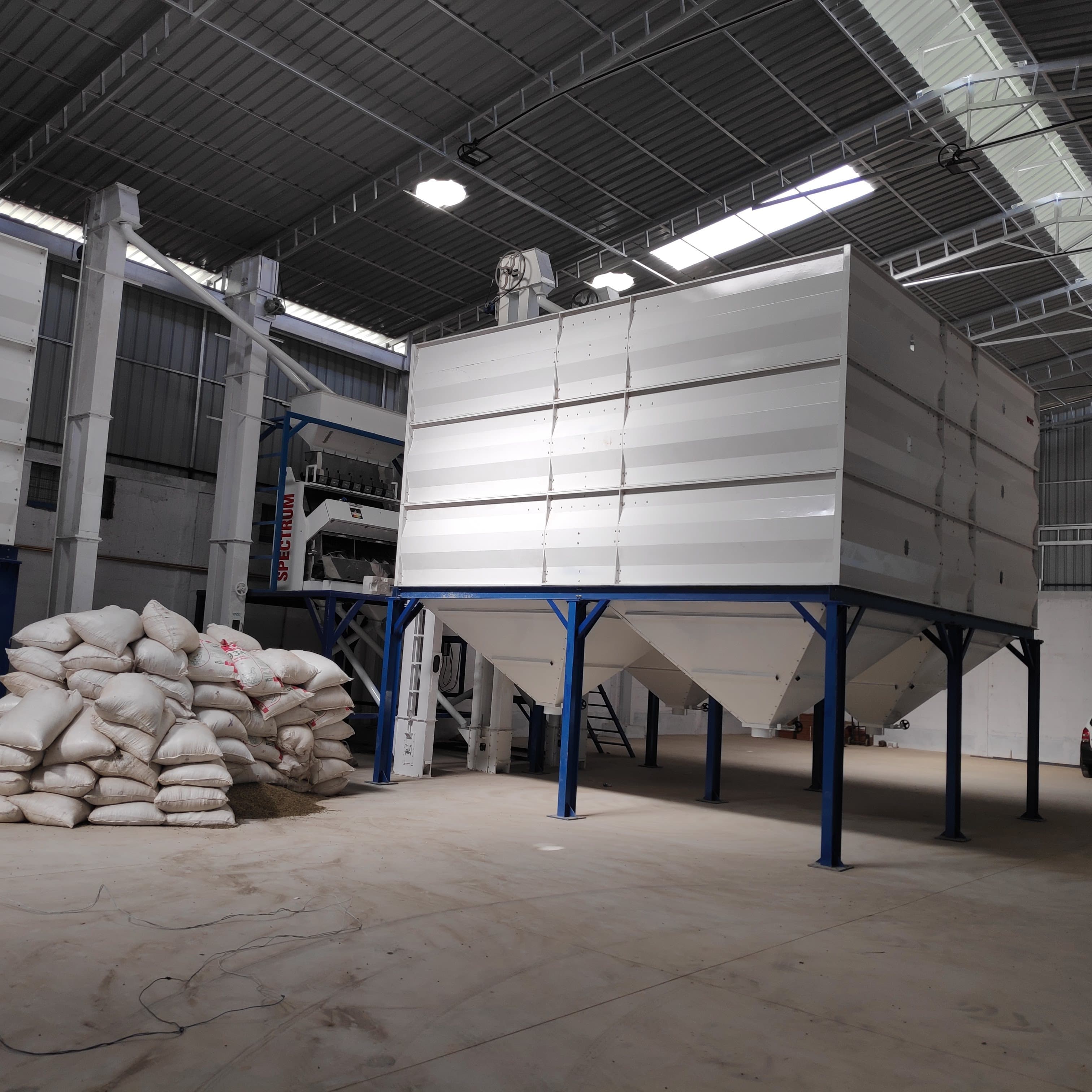
Coffee Silos / Green Coffee Storage Silos — VMAC's bolted corrugated galvanized steel silos are purpose-built for holding parchment coffee and green beans at curing works and export warehouses. The standard construction uses G90 or G120 zinc-coated corrugated panels that bolt together on a concrete ring beam — no welding required, fully field-assembled, and relocatable if operations expand. Hopper-bottom (cone bottom) silos are the preferred configuration for coffee: the conical discharge empties fully under gravity through a butterfly valve to a receiving screw conveyor, with no contact between the bean mass and any sweep auger mechanism. This matters because green coffee beans crack under point loading from auger flights, generating fines that score poorly in grading. The single most important feature for Indian conditions — particularly Karnataka and Kerala during the southwest monsoon from June to September — is the aeration system. A perforated false floor with a centrifugal fan draws ambient air through the bean mass during cool, dry night hours, preventing the moisture stratification and hot-spot formation that silently damage beans during 2–6 month holding periods. Capacity ranges from 10 tonnes for small estate curing works up to 200+ tonnes for large central processing stations, with multiple silos enabling lot separation by variety, grade, and processing method.
Coffee Bag Loader / Automatic Bagger — The bag loader is the weighing and filling machine at the very end of the dry mill line — filling 60 kg export jute bags, 50 kg domestic bags, or 500–1,000 kg FIBC supersacks with weighed, certified-weight green coffee. Two filling principles are available: the net-weight bagger pre-weighs a complete charge in a suspended hopper above the bag and releases the full batch when the target weight is confirmed, achieving ±100 g accuracy — the standard for export compliance. The gross-weight bagger fills directly into the bag on a platform scale, offering faster cycle time at ±200–300 g accuracy. For Coffee Board-licensed curing works, the load cell must carry a valid Legal Metrology stamp from the State Weights and Measures department — inspectors verify this during licensing renewals. Semi-automatic models handle 1–3 bags per minute with one operator positioning empty bags; fully automatic models with a bag elevator arm handle 3–6 bags per minute. The machine integrates directly with an inline bag stitcher via roller conveyor for a continuous fill-stitch-label workflow.
These two equipment types serve complementary functions in the export workflow. Silos provide the buffer between continuous dry mill processing and the intermittent, order-driven rhythm of export dispatch. A typical 20-foot container holds 275 bags at 60 kg each — 16.5 tonnes net — meaning a curing works shipping 4 containers per week needs 60–70 tonnes of live green storage at minimum. The bag loader then converts that bulk silo inventory into individually weighed, sealed, labelled export bags at the rate the container-stuffing schedule demands.
For operations in the major Indian coffee regions — Chikkamagaluru, Hassan, and Coorg in Karnataka; Wayanad in Kerala; the Nilgiris and Yercaud in Tamil Nadu — the storage challenge is managing moisture through the monsoon months. Silo aeration fans running during the pre-dawn window when relative humidity dips to 65–75% keep beans within the 10.5–12.5% moisture content target for export. Hermetic liner inserts with CO2 or N2 flushing provide phosphine-free pest management for operations supplying buyers with chemical residue restrictions, including organic-certified lots under NPOP and NOP standards.
When sizing storage, plan for approximately 2.5 times your monthly dispatch volume to cover the rolling processing-to-export cycle. For packing, the key decision is whether net-weight accuracy at ±100 g justifies the slightly slower cycle time compared to gross-weight filling — for Coffee Board-registered export lots, net-weight is strongly preferred because the weight on the bag must match the shipping document within a tight tolerance. VMAC supplies silos as complete systems including the bolted steel structure, galvanized support legs, aeration fan package, thermometer probe ports, and integration engineering to match your existing bucket elevator or pneumatic fill line. Bag loaders are supplied with calibration certificates and can be ordered as matched sets with roller conveyor and inline bag stitcher for a turnkey packing line.
Products in this Category
FAQ
Frequently Asked Questions
How do silos benefit coffee storage?
Silos provide large-scale, hygienic storage solutions for green or roasted coffee beans, protecting them from environmental factors and preserving their quality until further processing or packaging.
What is the role of a bag loader in coffee packaging?
A bag loader automates the filling of bags with coffee beans, increasing packaging efficiency, ensuring accurate weights, and reducing manual labor.
Why is proper packaging essential for coffee quality?
Proper packaging protects coffee beans from exposure to air, moisture, and light, preserving their freshness, flavor, and aroma during storage and transportation.
How does storage affect coffee freshness?
Proper storage conditions, such as controlled temperature and humidity, prevent degradation of coffee beans, maintaining their freshness and quality over time.
What packaging materials are best for preserving coffee quality?
Materials that provide barrier protection against oxygen, moisture, and light, such as multi-layered bags with valves, are ideal for preserving coffee quality.
Send a Enquiry Request
Retail store
Mon-Sat 9am to 5pm.
B.M road, Hassan, Karnataka 573201