
Category
Material Handling Systems
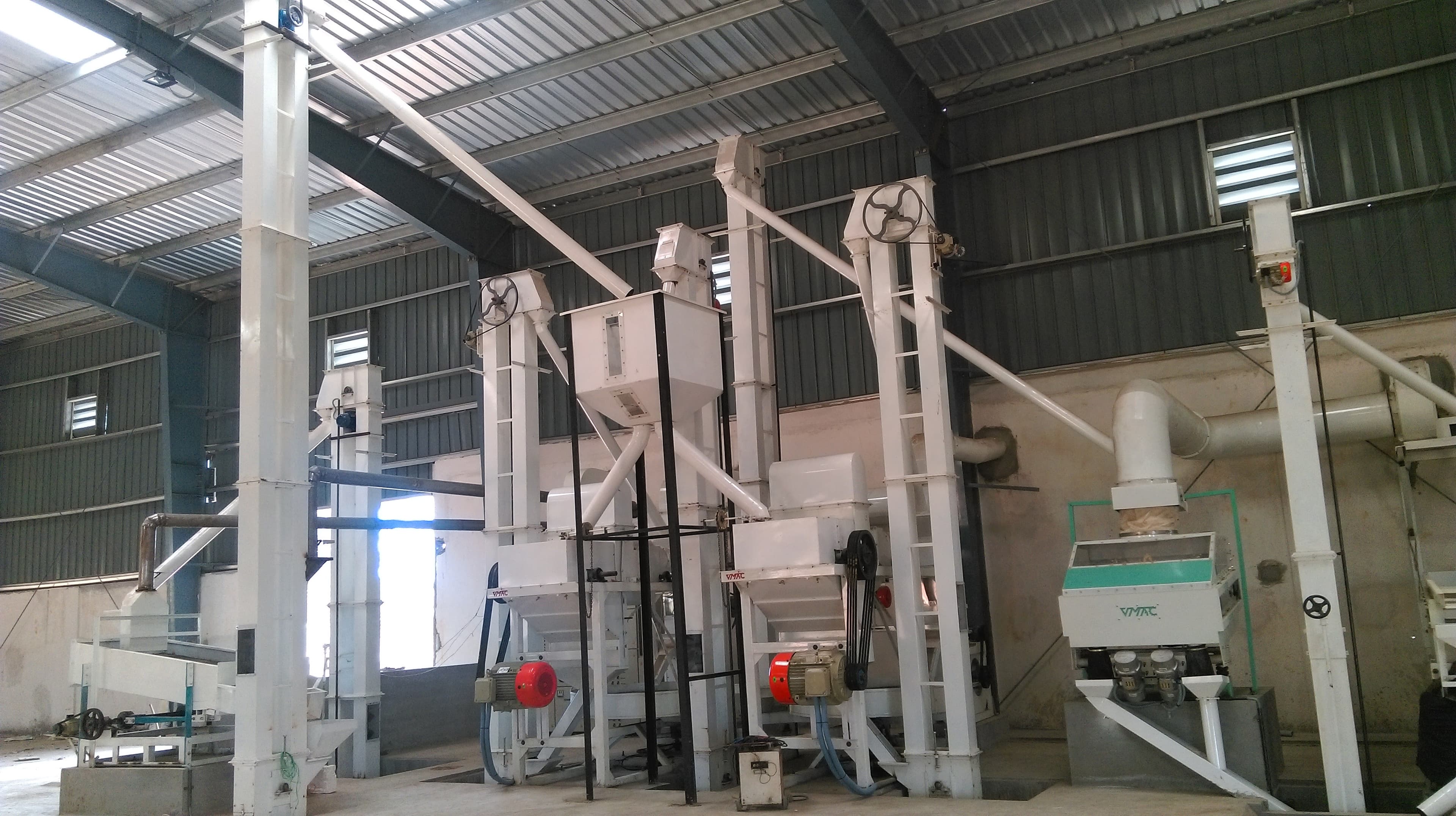
Material handling systems are the connective tissue of any coffee processing facility. Every processing machine — pre-cleaner, huller, grader, gravity separator, colour sorter — needs product delivered to its infeed and removed from its discharge. Without reliable, correctly sized conveyors and elevators between those machines, the entire line stops. In Indian curing works and East African export mills, material handling equipment typically accounts for 30–40% of the total machine count on the production floor, and its capacity must match or slightly exceed the throughput of every processing machine it serves.
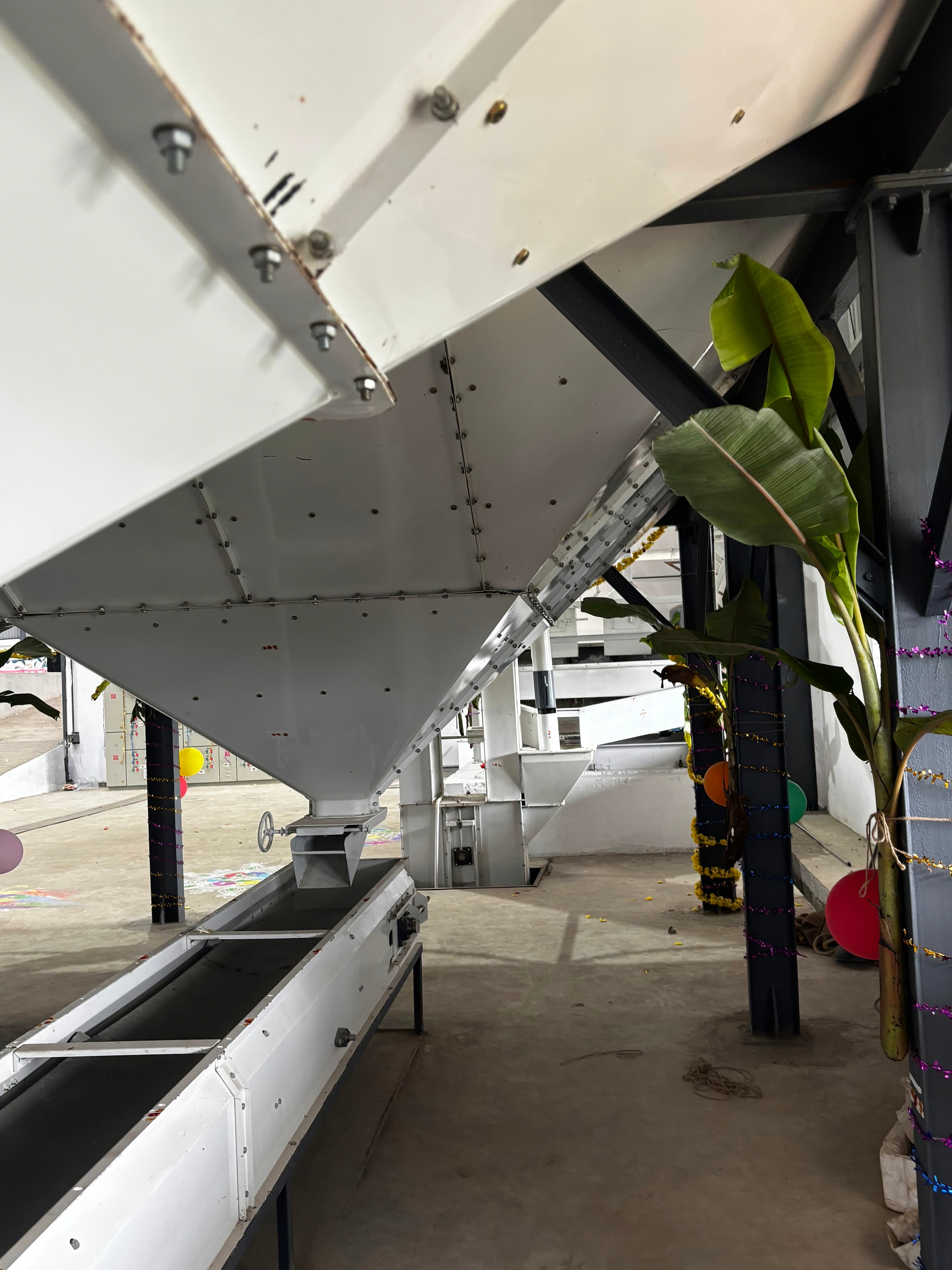
Belt Conveyor — The flat rubber or PVC belt conveyor is the backbone of horizontal material flow. Beans ride on the open belt surface with zero shearing, grinding, or compressive stress — making it the gentlest method of horizontal coffee conveyance in any mill. Standard belt widths of 300 mm to 600 mm cover throughputs from 500 kg/hr to 20 t/hr. A variable-frequency drive adjusts belt speed from 0.1 m/s (slow enough for a hand-sorting inspection table) to 2.0 m/s for high-throughput transfer. Flat belts handle inclines up to 18°; cleated or chevron belt variants convey at angles up to 45°. Belt materials include general-purpose rubber, food-grade PVC for hygiene-sensitive applications, and open-weave fabric for draining wet cherry. Belt conveyors appear at nearly every transfer point in a dry mill: feeding cherry from intake to pre-cleaner, linking the pre-cleaner to the huller, and moving sorted green coffee to the bagging station.
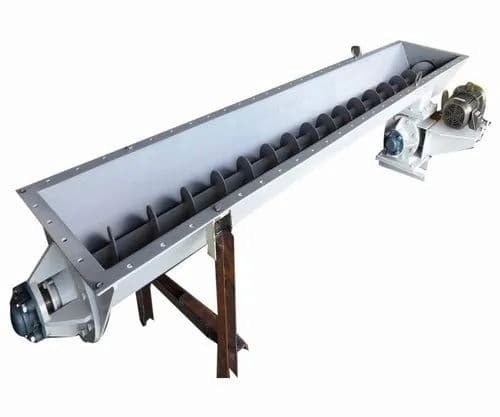
Screw Conveyor — The enclosed helical screw conveyor is the workhorse for short horizontal transfers where dust containment matters. A slowly rotating helical flight inside a U-trough or tubular housing pushes green coffee from one machine to the next — from huller discharge to pre-cleaner, from destoner to grader, or directly under a bag-loader hopper. The full enclosure means chaff and dust cannot escape into the working environment. Screw diameters from 100 mm to 400 mm cover throughputs from 500 kg/hr to 10 TPH, operating at 30–60 RPM to minimise bean breakage. Flanged trough sections bolt together for custom lengths to match any plant layout.
Bucket Elevator — Where screw conveyors and belt conveyors handle horizontal movement, bucket elevators handle vertical lifts. HDPE or nylon polymer buckets scoop coffee at the bottom boot, carry it upward inside an enclosed casing, and discharge it at the head into the next machine's infeed. A modern curing works with eight to twelve processing machines typically uses four to six bucket elevators running simultaneously. Standard head heights range from 3 m to 15 m, with custom fabrication to 20 m for multi-storey mill buildings. Capacity ranges from 1 TPH for small cooperative elevators to 20 TPH for large export plant installations. Belt-type construction is recommended for hulled green coffee where breakage is a concern; chain-type is available for heavier-duty work with cherry, pulp, or dried parchment.
Pneumatic Conveyor — For long-distance transfers, cross-building routing, or silo loading where mechanical conveyors would require expensive covered gantry structure, pneumatic conveyors move coffee through enclosed pipework using airflow. Pressure systems use a positive-displacement blower to push material through the pipeline; vacuum systems use a centrifugal fan to pull material into a pickup nozzle. Pipe diameters from 80 mm to 250 mm handle capacities from 1 TPH to 15 TPH over distances up to 100 m horizontal and 30 m vertical. Diverter valves allow a single blower to route material to multiple silos. Pneumatic systems are also the standard method for evacuating chaff and parchment dust from winnower and polisher cyclones to a central collection point.
Across Karnataka, Kerala, and Tamil Nadu, most curing works and estate mills use a combination of all four conveyor types in the same building — belt conveyors for long open-hall transfers, screw conveyors for short enclosed runs under hullers and graders, bucket elevators for every vertical lift between machines, and pneumatic lines for silo loading and chaff collection. When planning a new line or upgrading an existing facility, size each conveyor to at least 110% of the peak throughput of the processing machine it feeds. VMAC manufactures all four conveyor types at its Hassan, Karnataka facility and supplies complete multi-conveyor plant packages with matched capacities, discharge heights, and integration engineering.
Products in this Category
FAQ
Frequently Asked Questions
What is the significance of conveyors in coffee processing facilities?
Conveyors efficiently transport coffee beans between different processing stages, reducing manual labor, minimizing handling time, and maintaining a smooth production flow.
How do elevators function in coffee production plants?
Elevators move coffee beans vertically within multi-level processing facilities, facilitating the transfer between different stages and optimizing space utilization.
What are the benefits of using material handling equipment in coffee processing?
Material handling equipment streamlines the movement of coffee beans, enhances operational efficiency, reduces the risk of contamination, and minimizes labor costs.
How does material handling equipment contribute to product quality?
By ensuring gentle and efficient movement of beans, material handling equipment minimizes damage and contamination, preserving the quality of the coffee throughout processing.
What types of material handling equipment are commonly used in coffee processing?
Common types include conveyors, elevators, and pneumatic systems, each designed to move coffee beans efficiently through various stages of production.
Send a Enquiry Request
Retail store
Mon-Sat 9am to 5pm.
B.M road, Hassan, Karnataka 573201