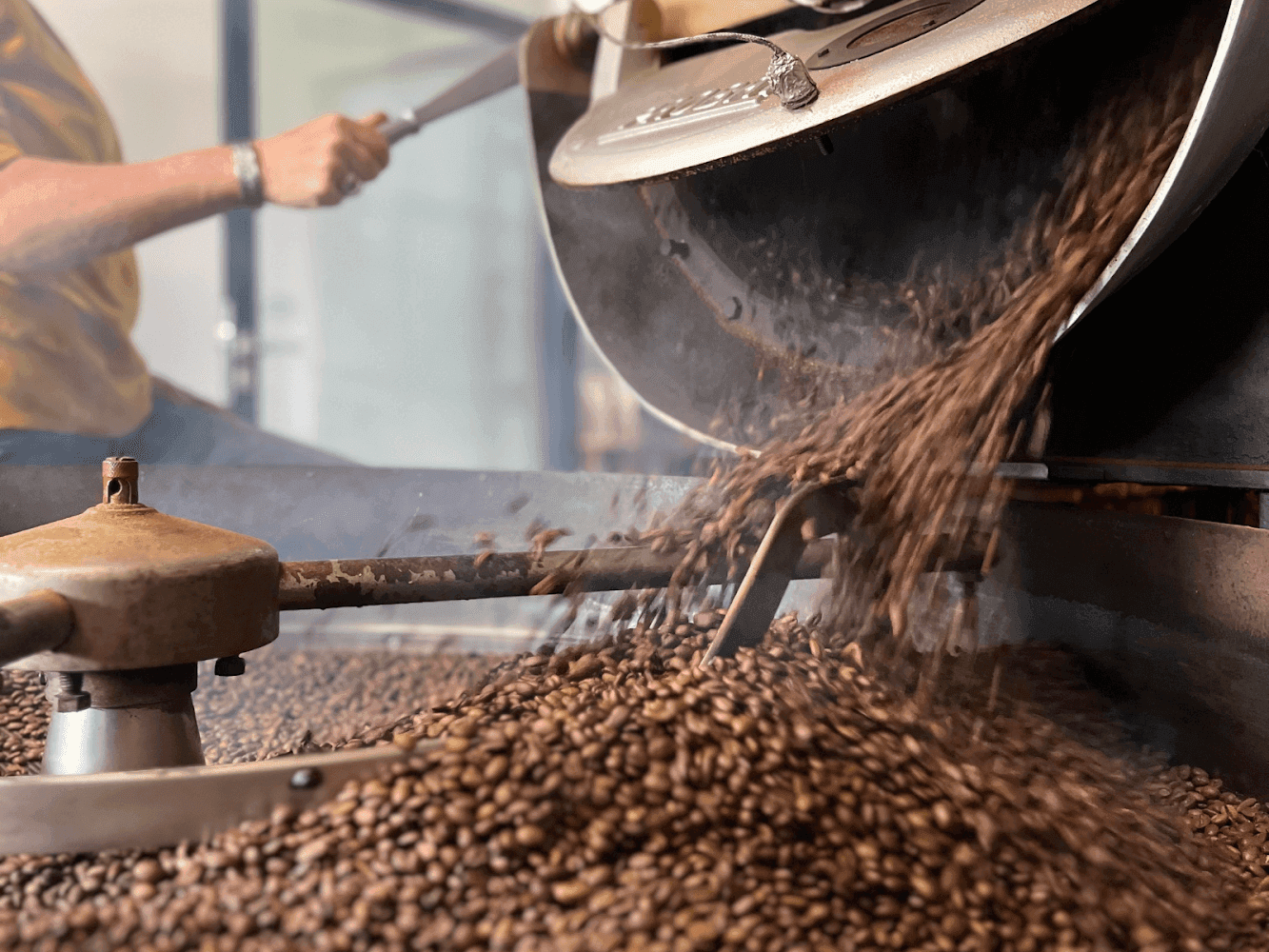
Coffee Bulking Machine / Lot Blender
Rotary drum blender for homogenizing large export lots from multiple sub-lots. Ensures consistent grade, moisture, and cup profile throughout a container load — the standard bulking machine used in Indian curing works and East African export mills.
| Batch Capacity Range | 200 kg – 2,000 kg per batch |
| Drum Volume | 0.35 m³ – 3.5 m³ (matched to batch capacity at ~0.6 kg/L fill density) |
| Blend Cycle Time | 5–15 minutes depending on drum size and target homogeneity |
| Motor Power | 1.5 kW – 7.5 kW (model-dependent) |
| Loading Height (inlet) | 1,800 mm – 2,600 mm from floor level |
| Discharge Type | Bottom gravity gate; adjustable chute angle for bag loader or weigher feed |
| Drum Speed | 8–18 RPM (fixed or variable speed drive) |
| Construction | Mild steel (standard) or 304 stainless steel contact surfaces (optional) |
| Drive | Gear-motor with V-belt transmission; optional variable frequency drive |
Key Features
Rotating drum with internal baffles and flights ensures thorough tumble-blending in 5–15 minutes per batch without damaging bean integrity
Batch capacities from 200 kg to 2,000 kg cover small curing works to large export warehouses — select the drum blender size matched to your container-filling throughput
Bottom-discharge gravity gate empties the full batch cleanly with no residual heel, preventing cross-contamination between consecutive lots
Compatible loading interfaces for bucket elevator or screw conveyor inlet — eliminates manual bag tipping and the labor cost of floor blending
Multiple composite-sampling ports along the discharge chute allow representative blend uniformity verification before bags are filled and stitched
Heavy-duty welded steel drum with anti-wear liner options; stainless steel contact surfaces available for specialty-grade and certified-organic operations
Variable-speed drive option allows cycle time and tumble intensity to be adjusted for different bean sizes, moisture levels, and blend uniformity targets
Compact footprint with elevated discharge height designed to gravity-feed directly into a bag loader or weigher — integrates naturally at the end of the dry mill line
Models & Sizing
Right-Sized for Every Operation
Four standard drum blender models cover the range from small curing works and estate mills to large export warehouses. All models share the same drive architecture and discharge gate design.
BM-200
200 kg/batch
capacity
Small estate mills and curing works blending single-estate sub-lots or screen-grade fractions; typically 1–2 containers per month
BM-500
500 kg/batch
capacity
Mid-size curing works and cooperative processing stations blending multiple-estate arrivals; 3–8 containers per month
BM-1000
1,000 kg/batch
capacity
Large curing works and export warehouses assembling full container lots from multiple origins; 10–25 containers per month
BM-2000
2,000 kg/batch
capacity
High-volume exporters and blending facilities assembling multi-container lots or large-format industrial blends; 25+ containers per month
Custom
Your specification
capacity
For operations requiring throughput beyond the standard range. VMAC engineers the machine to your exact capacity and processing conditions.
Request a Custom QuoteConfigurations
Bulking Machine Model Range
All models include bottom discharge gate, loading hatch, and baffled drum. Stainless steel contact surfaces and variable frequency drive are available as options on all models.
| Model | Batch Capacity | Drum Volume | Blend Cycle | Motor Power | Loading Height | Best For |
|---|---|---|---|---|---|---|
| BM-200 | 200 kg | 0.35 m³ | 5–8 min | 1.5 kW | 1,800 mm | Estate mills, small curing works |
| BM-500 | 500 kg | 0.85 m³ | 7–10 min | 3.0 kW | 2,000 mm | Cooperative stations, mid-size exporters |
| BM-1000 | 1,000 kg | 1.7 m³ | 8–12 min | 5.5 kW | 2,300 mm | Large curing works, export warehouses |
| BM-2000 | 2,000 kg | 3.5 m³ | 10–15 min | 7.5 kW | 2,600 mm | High-volume blending and multi-origin lots |
| Custom | Built to your capacity and specification — contact us for a quote | |||||
Overview
About the Coffee Bulking Machine / Lot Blender
Export lots rarely come from a single uniform source. A 275-bag container may be assembled from dozens of small estate lots, screen-graded fractions, or seasonal harvest parcels — each with slightly different moisture, density, and cup character. Without mechanical blending, the top of the stack and the bottom of the stack can diverge enough to fail a buyer's QC sample at destination. VMAC's coffee bulking machine solves this with a rotating drum equipped with internal baffles and flights that tumble the beans in a controlled, repeating pattern. In 5–15 minutes per batch, the drum blender achieves a statistically uniform blend that a composite discharge sample can verify before bagging. In India, the Coffee Board's export-lot registration system requires that a declared grade be consistent throughout the registered quantity. Curing works operators rely on the bulking machine — the term used by the Coffee Board — to meet this requirement when combining lots from multiple estates or multiple arrivals of the same estate. In East Africa, the lot blender or blending machine performs the same function at liquoring stations and export warehouses where outturn lots must match a pre-shipment sample approved by the auction system. Beyond export compliance, the batch blender is used for deliberate origin blending: combining Robusta from different estates to hit a target body and price point, or folding screen-separated fractions back together in controlled proportions to achieve a specified grade profile. Roasters sourcing from India or East Africa increasingly request blend-specific lots, making the lot mixer a commercial tool as much as a compliance tool. VMAC drum blenders are built in mild steel or stainless steel with a removable loading hatch and a bottom-discharge gate. They integrate directly with a bucket elevator or screw conveyor for automated loading, eliminating the labor and cross-contamination risks of manual bag blending on the floor.
How It Works
How It Works
The coffee bulking machine operates as a batch blender: each sub-lot is loaded, blended, sampled, and discharged before the next batch begins. The cycle is short enough that a single machine can keep pace with continuous bagging.
Loading
Sub-lots to be combined are fed into the drum via a bucket elevator or screw conveyor connected to the loading hatch. The operator loads each constituent lot in sequence — or simultaneously from multiple feed points — until the target batch weight is reached. The loading hatch is sealed before rotation begins.
Blending Cycle
The drum rotates at 8–18 RPM. Internal baffles and flights lift beans and cascade them across the full cross-section of the drum in a repeating pattern, progressively interleaving the constituents. A 5-minute cycle is sufficient for lots of similar density; 10–15 minutes is used when blending fractions with significant density or moisture differences, or when a tight uniformity tolerance is required.
Blend Uniformity Sampling
Before the discharge gate opens, a composite sample is drawn from multiple points along the planned discharge stream. The samples are cupped or graded to confirm that the blend matches the target profile. This step is required practice in Coffee Board-registered curing works and at East African liquoring stations operating under auction-system pre-shipment approval.
Discharge and Bagging
The bottom discharge gate opens and the blended lot flows by gravity into the bag loader or weigh-and-fill station below. The drum is inspected for residual beans and cleaned between lots where cross-contamination would be commercially significant (e.g., between Robusta and Arabica or between certified-organic and conventional lots).
Know the Difference
Coffee Bulking Machine / Lot Blender vs. Hand / Bag Blending
Manual bag blending — emptying bags onto a floor pile and re-mixing with shovels, or sequentially layering bags — is still widely practised in smaller operations. The table below compares it with mechanical drum blending.
| Feature | Coffee Bulking Machine / Lot Blender | Hand / Bag Blending |
|---|---|---|
| Blend uniformity | Statistical homogeneity achieved in a fixed, repeatable cycle; verifiable by composite sampling | Highly operator-dependent; floor layering gives partial uniformity but no controlled tumbling action |
| Labor requirement | 1 operator to supervise loading and discharge; loading automated via elevator or conveyor | 4–8 workers for floor turning, bag emptying, and re-bagging; intensive physical labor |
| Cycle time (1,000 kg lot) | 8–12 minutes including loading and discharge | 45–90 minutes for floor blending and re-bagging at comparable scale |
| Foreign matter and contamination risk | Closed drum eliminates floor dust, debris, and cross-lot contamination during blending | Floor blending exposes beans to dust, insects, and accidental mixing with adjacent lots |
| Traceability and documentation | Batch log records input lots, weights, cycle time, and sample result — audit trail for Coffee Board or buyer | Paper records reliant on supervisor; no mechanical record of blend proportions or cycle |
| Scalability | Same machine handles 200 kg and 2,000 kg batches by adjusting fill; throughput scales with shift hours | Labor requirement scales linearly with lot size; productivity ceiling reached quickly at large volumes |
| Bean damage | Low-speed tumbling (8–18 RPM) with smooth flights minimizes chip and breakage | Shovel and floor-turning can chip beans, increasing broken and below-grade fraction |
| Capital cost | Equipment investment recovered rapidly against labor savings at volumes above 5 containers/month | No capital cost but high recurring labor cost; economical only at very small or irregular volumes |
For operations producing fewer than 2 containers per month, manual bag blending may remain cost-effective. Above that threshold, the drum blender typically pays back within one export season on labor savings alone.
Processing Line
Where It Fits in Your Processing Line
The bulking machine sits at the very end of the dry mill, after all sorting and grading is complete and just before bagging. It is the final quality-assurance step before the export lot is sealed.
Gravity Separator
Removes light, heavy, and density-defective beans
Color Sorter
Removes black, brown, and discolored defects
Bulking Machine
This machineCombines multiple sub-lots into a homogeneous export lot
Bag Loader
Fills 60 kg jute or GrainPro-lined bags to target weight
Bag Stitcher
Seals filled bags for export
FAQ
Frequently Asked Questions
How do I know the blend is uniform after a cycle?
The standard protocol is composite sampling: draw small samples from the discharge stream at the beginning, middle, and end of the batch discharge and combine them into a single representative sample. This composite sample is then graded or cupped against the target specification. For Coffee Board-registered lots, this sample is retained as part of the export lot documentation. On the BM-1000 and BM-2000 models, multiple discharge sampling ports are fitted as standard to facilitate this.
What is the typical blend cycle time and what affects it?
Most batches reach acceptable homogeneity in 5–15 minutes. Shorter cycles (5–8 min) are sufficient when blending lots of similar density, moisture, and screen size — for example, combining two consignments of the same estate at the same grade. Longer cycles (10–15 min) are appropriate when blending constituents with measurable density or moisture differences, such as combining lots from different altitudes or processing methods. Running beyond 15 minutes provides diminishing returns and is generally not necessary.
Can the bulking machine blend green coffee and roasted coffee together?
The drum blender is designed for green (parchment-off) coffee in the dry mill context. While it can physically tumble roasted beans, roasted coffee is best handled in a dedicated roasted-coffee blending drum to avoid residual chaff and off-flavour transfer. Contact us if your application involves roasted coffee blending — the drum geometry and lining specification differ.
What lots can be combined in a single batch?
Any green coffee intended to be sold as a single declared lot. Common use cases include: multiple estate arrivals of the same Coffee Board-registered variety and grade; screen-separated fractions being recombined to a target grade profile; Robusta from different estates being blended to a commercial specification; and consignment parcels from different harvest weeks being assembled into a uniform export quantity. Do not blend lots of different declared varieties or processing methods if they are to be sold as single-origin or single-method certified.
What is the difference between a bulking machine and manual bag blending?
Manual bag blending — emptying bags onto the warehouse floor, mixing with shovels or by sequential layering, and re-bagging — achieves partial blending but with significant variability, high labor input, and contamination exposure. A drum blender achieves statistically uniform blending in a closed, controlled environment in a fraction of the time. At volumes above 5 containers per month, the labor savings alone typically recover the machine investment within a single export season.
Why does the Coffee Board require bulking for export lot registration?
The Coffee Board of India's export-lot registration process requires that a declared grade be consistent throughout the registered quantity so that the pre-shipment sample submitted to the buyer is representative of the entire container. When an exporter assembles a lot from multiple estate arrivals or curing-works batches, the only way to reliably meet this requirement is to mechanically blend the constituent parcels into a homogeneous lot before drawing the official pre-shipment sample.
How is the machine loaded — do we still need to tip bags manually?
All VMAC drum blenders are designed to receive feed from a bucket elevator or screw conveyor, which eliminates manual bag tipping at height. The elevator or conveyor is loaded at floor level from a hopper or directly from bags tipped at ground level — a significantly safer and faster workflow. If your facility does not yet have a bucket elevator, we can supply one sized to match the blender's loading height and throughput.
Can the drum blender be used for coffee that still has parchment on?
Yes. The drum blender operates on parchment coffee as well as parchment-off green coffee. In wet-processing operations where lots from different fermentation tanks are being assembled before hulling, a drum blender upstream of the huller can homogenize the parchment lot. The baffles and flights are designed to handle the slightly higher bulk volume of parchment coffee relative to green beans.
What maintenance does the machine require?
Routine maintenance is straightforward: inspect and grease the drum trunnion bearings monthly, check the V-belt tension and gear-motor oil quarterly, and inspect the discharge gate seal for bean dust build-up after each shift. The interior of the drum should be inspected weekly for bean fragments caught in baffle joints, especially when switching between lots. Full preventive maintenance kits and spare bearing and belt sets are available from VMAC.
Send a Enquiry Request
Retail store
Mon-Sat 9am to 5pm.
B.M road, Hassan, Karnataka 573201