
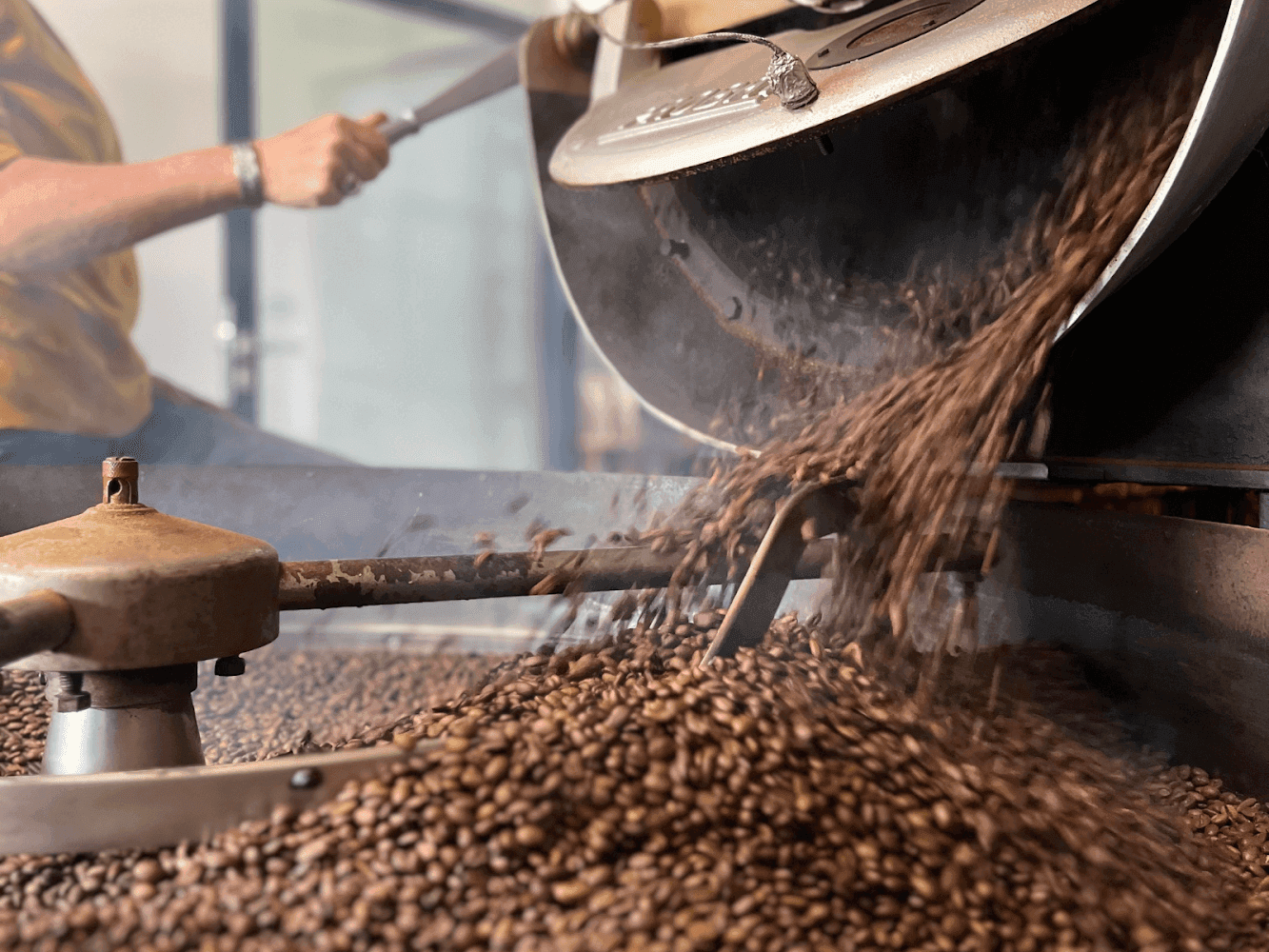
Coffee Roaster
Drum roasting machine that transforms green coffee into roasted product through controlled conduction and convection heat — enabling farm-to-cup value addition and local branded coffee production.
| Batch capacity range | 5 kg – 120 kg green coffee per batch (model-dependent) |
| Drum speed | 40–60 RPM (variable, model-dependent) |
| Roast chamber temperature | 195–230°C (bean temperature at target roast) |
| Charge temperature | 180–220°C inlet air temperature at load |
| Total batch cycle time | 12–18 minutes (full roast profile; excludes cool-down) |
| Cooling time | <4 minutes to below 40°C (integrated cooling tray) |
| Heat source | LPG / propane gas (natural gas available on request) |
| Gas consumption | 0.8–1.2 kg LPG per kg green coffee roasted (model-dependent) |
| Power supply | Single-phase 230V (5–10 kg); 3-phase 415V, 50 Hz (30 kg and above) |
| Motor power | 0.75–5.5 kW (drum + cooling fan + chaff blower, combined) |
| First crack temperature | ~196°C bean temperature |
| Development time ratio (DTR) | Specialty target: 20–25% DTR (development time ÷ total roast time) |
Key Features
Rotating drum at 40–60 RPM — continuous tumbling ensures even heat exposure across every bean in the charge
Combined conduction + convection heat transfer — drum surface conducts heat to beans in contact while hot airflow heats beans in suspension, the hallmark of the Probat-type and Jabez Burns-type drum roaster
Integrated cooling tray with stirring arms and exhaust fan — drops bean temperature below 40°C in under 4 minutes to stop the roast reaction and lock in roast degree
Dedicated chaff cyclone on exhaust duct — captures silver skin released at first crack, prevents burner fouling and fire risk from accumulated chaff
Bean temperature probe + digital PID controller — monitors rate of rise (RoR) and holds inlet air temperature to programmed setpoints throughout the roast profile
Adjustable drum speed control — slows drum for gentle light-roast profiles, increases for faster heat transfer on dark-roast commercial batches
LPG/propane gas burner — most reliable fuel source across India, Ethiopia, and East Africa; adjustable flame with manual gas valve and pilot safety
Cast-iron or stainless-steel drum construction — food-grade surfaces, cleanable, long service life in continuous production environments
Sample door and sight glass — operator can draw small samples mid-roast and visually monitor colour development and listen for first crack without interrupting the roast
Models & Sizing
Right-Sized for Every Operation
Five model tiers from 5 kg sample/craft roaster through 120 kg industrial batch roaster — all LPG gas-fired drum roasters with integrated cooling tray and chaff cyclone.
CR-5
5 kg per batch
capacity
Estate roastery, café roastery, sample roasting for quality grading — up to 40 kg/day throughput
CR-10
10 kg per batch
capacity
Small branded coffee producer, farm-to-cup estate, specialty roastery — 80–100 kg/day throughput
CR-30
30 kg per batch
capacity
Medium-scale roastery or cooperative value-addition unit — 200–300 kg/day throughput
CR-60
60 kg per batch
capacity
Commercial roastery supplying regional retail or institutional buyers — 400–500 kg/day throughput
CR-120
120 kg per batch
capacity
Industrial roastery, curing works with roast facility, or bulk institutional supply — 800–1,000 kg/day throughput
Custom
Your specification
capacity
For operations requiring throughput beyond the standard range. VMAC engineers the machine to your exact capacity and processing conditions.
Request a Custom QuoteConfigurations
Model Selection Guide
All models — LPG gas-fired drum roaster, integrated cooling tray, chaff cyclone, digital PID temperature control
| Model | Batch Capacity | Drum Volume | Gas Consumption | Batch Time | Power Supply | Best For |
|---|---|---|---|---|---|---|
| CR-5 | 5 kg | ~15 litres | 0.9–1.1 kg LPG/batch | 12–16 min | Single-phase 230V | Estate roastery, café, sample roasting |
| CR-10 | 10 kg | ~30 litres | 1.8–2.2 kg LPG/batch | 12–16 min | Single-phase 230V | Small branded producer, farm-to-cup |
| CR-30 | 30 kg | ~90 litres | 5–6 kg LPG/batch | 13–17 min | 3-phase 415V, 50 Hz | Cooperative value-addition, medium roastery |
| CR-60 | 60 kg | ~180 litres | 10–12 kg LPG/batch | 14–18 min | 3-phase 415V, 50 Hz | Commercial roastery, regional supply |
| CR-120 | 120 kg | ~360 litres | 20–24 kg LPG/batch | 15–18 min | 3-phase 415V, 50 Hz | Industrial roastery, institutional bulk supply |
| Custom | Built to your capacity and specification — contact us for a quote | |||||
Overview
About the Coffee Roaster
VMAC's Coffee Roaster is a rotating drum roaster (tostador / torrador de café) that applies conduction and convection heat to transform green coffee into roasted product with a precisely controlled roast profile. The rotating drum — typically running at 40–60 RPM — tumbles the charge continuously, exposing every bean to even heat transfer while the operator manages bean temperature, inlet air temperature, drum speed, and exhaust airflow to guide the roast through drying, Maillard browning, first crack, and development. An integrated cooling tray pulls the roasted batch out of the drum and drops the bean temperature below 40°C in under 4 minutes, stopping the roast reaction and locking in the intended roast degree. A chaff cyclone — positioned on the exhaust duct — captures the silver skin released during the drying and first-crack phases, preventing it from fouling the burner or recirculating into the roast chamber. Available from 5 kg sample/small-batch models through 10 kg, 30 kg, 60 kg, and 120 kg commercial-industrial models — sized for estate roastery operations, local branded coffee producers, and medium curing works adding roast capability. Fuelled by LPG/propane gas, which is the most reliable heat source across India and East Africa. Supplied with temperature probes, digital PID temperature controller, drum speed control, and chaff collection. Compatible with 3-phase 415V, 50 Hz supply for models above 10 kg. Built for operators who need repeatable roast profiles — from a Karnataka estate selling branded roasted coffee to a Nairobi roastery handling washed Ethiopian Arabica lots.
How It Works
How It Works
A drum roaster applies heat in two modes simultaneously: conduction from the hot drum surface to beans in direct contact, and convection from the heated airflow passing through the drum. The operator controls the rate at which temperature rises — the rate of rise (RoR, measured in °C/min) — throughout four distinct roast phases.
Loading — charge temperature and thermal mass
Green coffee is loaded into the preheated drum through the charge door. The drum is preheated to 180–220°C before loading — the 'charge temperature'. When cold green beans enter the hot drum, the bean temperature probe reads a sharp initial drop (the 'turning point'). The thermal mass of the drum and the burner flame together determine how quickly the drum recovers this temperature drop. Batch size must not exceed the rated capacity — overloading slows recovery and compresses the roast profile.
Drying phase — 100°C to 150°C
The first stage of the roast drives off the free moisture in the green beans (green coffee carries 10–13% moisture content). The beans absorb heat endothermically — the drum temperature can rise while the bean temperature climbs slowly. The beans turn from green to yellow and give off a grassy, hay-like aroma. This phase must be long enough to dry the beans uniformly; too short a drying phase produces baked, underdeveloped coffee. The chaff cyclone begins collecting silver skin loosened by the thermal expansion of the beans.
Browning and Maillard reactions — 150°C to 196°C
Above 150°C the beans enter the browning phase: Maillard reactions between amino acids and reducing sugars create hundreds of aroma and flavour precursor compounds. The beans turn from yellow through tan to light brown. Caramelisation of sugars begins above 170°C. The rate of rise (RoR) should be positive and controlled throughout this phase — a crashing RoR (rate slowing sharply before first crack) is a common cause of baked, flat-tasting coffee. The operator manages airflow and gas valve to hold a steady RoR of 8–12°C/min for most profiles.
First crack and development — 196°C onwards
At approximately 196°C bean temperature, the internal steam pressure causes the bean cell walls to rupture — an audible cracking sound, similar to popcorn. This is first crack. The exothermic reaction briefly self-accelerates the bean temperature. Development time begins at first crack: this is where the roaster determines the final roast degree. Light roast: discharge 30–60 seconds after first crack onset. Medium roast: 60–90 seconds. Medium-dark to dark: 90–120 seconds. Development time ratio (DTR) — development time divided by total roast time — should be 20–25% for specialty profiles. The operator monitors the sample door, aroma, and colour to judge the endpoint.
Discharge and cooling — locking in the roast
At the roast endpoint, the drum gate opens and the batch discharges onto the integrated cooling tray. Cooling arms stir the beans continuously while an exhaust fan draws cool ambient air through the tray, dropping bean temperature below 40°C in under 4 minutes. Rapid cooling is essential: beans continue to roast from their own stored heat after discharge — slow cooling darkens the roast unpredictably. After cooling, beans are rested for at least 8–24 hours in a vented container to allow degassing of CO₂ before packaging. The chaff cyclone is emptied between batches.
Know the Difference
Coffee Roaster vs. Fluid Bed Roaster
The drum roaster (batch roaster, tostador) and the fluid bed roaster are the two most common types used in specialty and commercial production. They differ fundamentally in heat transfer method, which affects roast character, profile flexibility, and equipment cost.
| Feature | Coffee Roaster | Fluid Bed Roaster |
|---|---|---|
| Heat transfer method | Conduction (drum surface) + convection (airflow) — dual mode | Convection only — beans are suspended in heated air stream, no surface contact |
| Roast character / cup profile | Fuller body, more complex Maillard notes; favoured for espresso and commercial blends | Brighter, cleaner acidity; perceived as lighter and more acidic — favoured for filter and single-origin pour-over |
| Profile control | Excellent — independent control of drum speed, inlet air, gas, and exhaust airflow | Good — primarily controls airflow temperature and volume; fewer independent variables |
| Batch capacity range | 5 kg to 300+ kg per batch; scales to industrial volumes | 1 kg to 150 kg; less common above 60 kg in commercial configurations |
| Gas / energy consumption | 0.8–1.2 kg LPG per kg roasted; thermal mass of drum retains heat between batches | 0.5–0.8 kg LPG per kg roasted; no drum thermal mass, energy efficiency advantage |
| Chaff handling | Chaff cyclone on exhaust duct — standard; silver skin separated from roast airstream | Chaff carried in suspension with beans; requires cyclone on outlet airstream; more chaff in product |
| Maintenance and repair | Simple mechanical components — drum, bearings, burner, cooling tray; widely serviced in India and East Africa | Blower motors and ductwork more sensitive to coffee fines buildup; specialist maintenance |
| Market presence in India / East Africa | The dominant roaster type — spare parts, technicians, and operator knowledge widely available | Less common; specialist use in specialty roasteries; parts and service less accessible |
For Indian and East African operators: the drum roaster is the practical choice for most commercial and estate roastery applications. The fluid bed roaster suits specialty roasteries specifically targeting bright filter profiles where cup character justifies the different equipment infrastructure.
Processing Line
Where It Fits in Your Processing Line
The roaster sits at the value-addition stage of the dry mill line — it receives cleaned, graded, hulled green coffee and transforms it into roasted product ready for resting, grinding, and packaging.
Green coffee storage
GrainPro-lined bags or metal silos, 10–13% moisture content
Pre-cleaning / scalper
Removes dust, chaff, and foreign matter before roasting
Coffee Roaster
This machineDrum roaster: drying → Maillard → first crack → development → discharge
Cooling tray (integrated)
Drops bean temperature below 40°C in under 4 minutes
Degassing / resting
8–24 hours in vented container; CO₂ off-gassing before packaging
Industrial grinder (optional)
For ground coffee production: burr grinder or roller mill
Packaging
Valve bags (whole bean), foil pouches (ground), or bulk sacks for institution supply
FAQ
Frequently Asked Questions
What roast profiles can a drum roaster produce?
A drum roaster can produce light, medium, medium-dark, and dark roast profiles — the full Agtron scale from approximately #95 (very light / cinnamon roast) down to #25 (Italian / French dark roast). Profile is controlled by adjusting total roast time, development time after first crack, inlet air temperature, and gas valve position. For specialty buyers, the typical target is a medium-light to medium profile with a development time ratio (DTR) of 20–25% — development time (time from first crack to discharge) divided by total roast time. Batch-to-batch repeatability depends on recording and replaying the same gas, airflow, and time parameters.
How much LPG does a coffee roasting machine consume per batch?
LPG consumption is approximately 0.8–1.2 kg of LPG per kg of green coffee roasted, depending on roast degree, drum preheat management, and operator technique. A 10 kg batch on the CR-10 will use roughly 10–12 kg of LPG per hour of roasting (including preheat). Preheat consumes a fixed amount of gas regardless of batch size — roasting more batches per shift spreads the preheat cost. LPG consumption is higher for dark roast profiles and for small batches in large drums. As a rough operating cost guide: at Indian LPG commercial rates (~₹90/kg in Karnataka), roasting costs ₹80–110 per kg of green coffee in gas alone on the CR-30 model.
What is first crack and why does it matter for roast control?
First crack is the audible popping sound that occurs when bean internal steam pressure ruptures the cell walls, at approximately 196°C bean temperature. It marks the beginning of the 'development phase' — the window in which the roaster determines the final roast character. Discharge 30–60 seconds after first crack produces a light roast; 60–90 seconds produces medium; beyond 90 seconds moves toward medium-dark and dark. Listening for first crack is the primary skill of the roaster operator. The bean temperature probe and RoR display confirm timing, but the sound of first crack is the trigger. A second crack at approximately 218–224°C marks the start of dark / French roast and signals rapid carbonisation — most specialty and commercial operators discharge well before second crack.
How many batches can I roast per day?
A 12–18 minute roast cycle plus 4 minutes cooling equals approximately 16–22 minutes per batch turnaround. On a CR-30 (30 kg batch) operating for 8 hours, you can run approximately 20–25 batches, giving 600–750 kg of roasted coffee per day (green-in weight). Roasted coffee weighs approximately 15–20% less than green — a 30 kg green charge produces around 24–25.5 kg roasted. Add time for preheat (20–30 minutes at start of day) and cleaning between blends. A production roastery running the CR-60 on a single shift can produce 400–500 kg roasted per day.
What is the weight loss during roasting?
Coffee loses 15–20% of its green weight during roasting as moisture and CO₂ are driven off. Light roasts lose approximately 12–15% (predominantly moisture). Medium roasts lose 15–18%. Dark roasts lose 18–23%. This weight loss — called 'roast loss' or 'shrinkage' — must be factored into your green coffee buying and pricing. If you purchase green coffee at ₹300/kg and roast to medium (17% roast loss), the green cost per kg of roasted coffee is ₹300 ÷ 0.83 = ₹361/kg, before adding gas, labour, and packaging.
Does the coffee roasting machine need a chaff collector?
Yes — a chaff cyclone is essential on any drum roaster operating above about 5 kg per batch. Silver skin (the thin seed coat on green beans) is released during the drying and first-crack phases. Without a cyclone, chaff accumulates in the exhaust duct and burner area, creating a fire risk. The chaff cyclone separates silver skin from the exhaust airstream and collects it in a removable container. It should be emptied every 3–5 batches. VMAC supplies a chaff cyclone as standard on all CR-series models.
Can the same roasting machine handle both Arabica and Robusta?
Yes. The same drum roaster handles both Arabica and Robusta without modification. Roast profiles differ slightly: Robusta beans are denser and typically require a slightly higher charge temperature or longer roast time to achieve the same internal bean temperature at discharge. Robusta is commonly roasted darker for espresso blends and South Indian filter coffee. Washed Arabica for specialty is typically roasted lighter with more precise DTR control. Operators store different roast profile parameters (gas position, airflow, total time, DTR target) for each coffee type as named recipes.
What maintenance does a drum roaster require?
Daily: empty the chaff cyclone every 3–5 batches; clean the cooling tray and drum interior after the last batch of the day; check and clean the sample door and sight glass. Weekly: inspect burner nozzle for carbon deposits; check drum bearing temperature by touch; lubricate drum shaft bearings with food-safe grease per manufacturer schedule. Monthly: inspect and clean the exhaust duct for chaff and coffee oil deposits; check burner pilot safety valve function; inspect drum drive belt tension. Annually: inspect drum for wear at the sealing rings; service the gas valve and pressure regulator. A drum roaster with proper maintenance has a service life of 15–25 years in commercial operation.
How do I connect a coffee roasting machine to LPG supply?
VMAC's CR-series roasters connect to a standard commercial LPG cylinder manifold or bulk LPG tank. The burner requires a regulated supply at 0.28–0.35 bar (28–35 kPa) working pressure — use a two-stage regulator for bulk tanks or a commercial high-pressure regulator for cylinder banks. For the CR-30 and above, we recommend a multi-cylinder manifold with auto-changeover to prevent production interruptions when one cylinder empties. All gas connections must be made by a licensed gas fitting technician and comply with IS 8737 / local petroleum rules. VMAC supplies the roaster with a burner assembly and internal gas valve; field gas connection is the installer's responsibility.
What is the difference between a sample roaster and a production roaster?
A sample roaster (100g–500g batch) is used by cuppers and green coffee buyers to evaluate a lot before purchase or before committing to a production roast profile — it roasts a representative sample of the lot in approximately 8–10 minutes. The CR-5 (5 kg) is the smallest production roaster VMAC supplies — it is suitable for estate roasteries, café roasteries, and specialty producers who sell small volumes. The key difference from a sample roaster is repeatability across consecutive batches: production roasters have the drum thermal mass and temperature stability to deliver consistent profiles across 20+ consecutive batches in a day. A sample roaster is optimised for speed and accessibility, not multi-batch production consistency.
Send a Enquiry Request
Retail store
Mon-Sat 9am to 5pm.
B.M road, Hassan, Karnataka 573201
