
Category
Roasting & Blending Equipment
The roasting and blending equipment category covers the two machines responsible for transforming green coffee into a finished, sale-ready product and for ensuring that product is consistent across an entire export lot or branded blend. In a typical Indian coffee value chain, green beans leave the dry mill as a graded, sorted commodity. Roasting and blending convert that commodity into a differentiated product with a specific flavour profile, cup character, and market identity. Whether the operation is a small estate roastery in Coorg selling branded filter coffee or a large curing works in Hassan adding roast capability for institutional supply, these machines sit at the value-addition stage of the processing line.
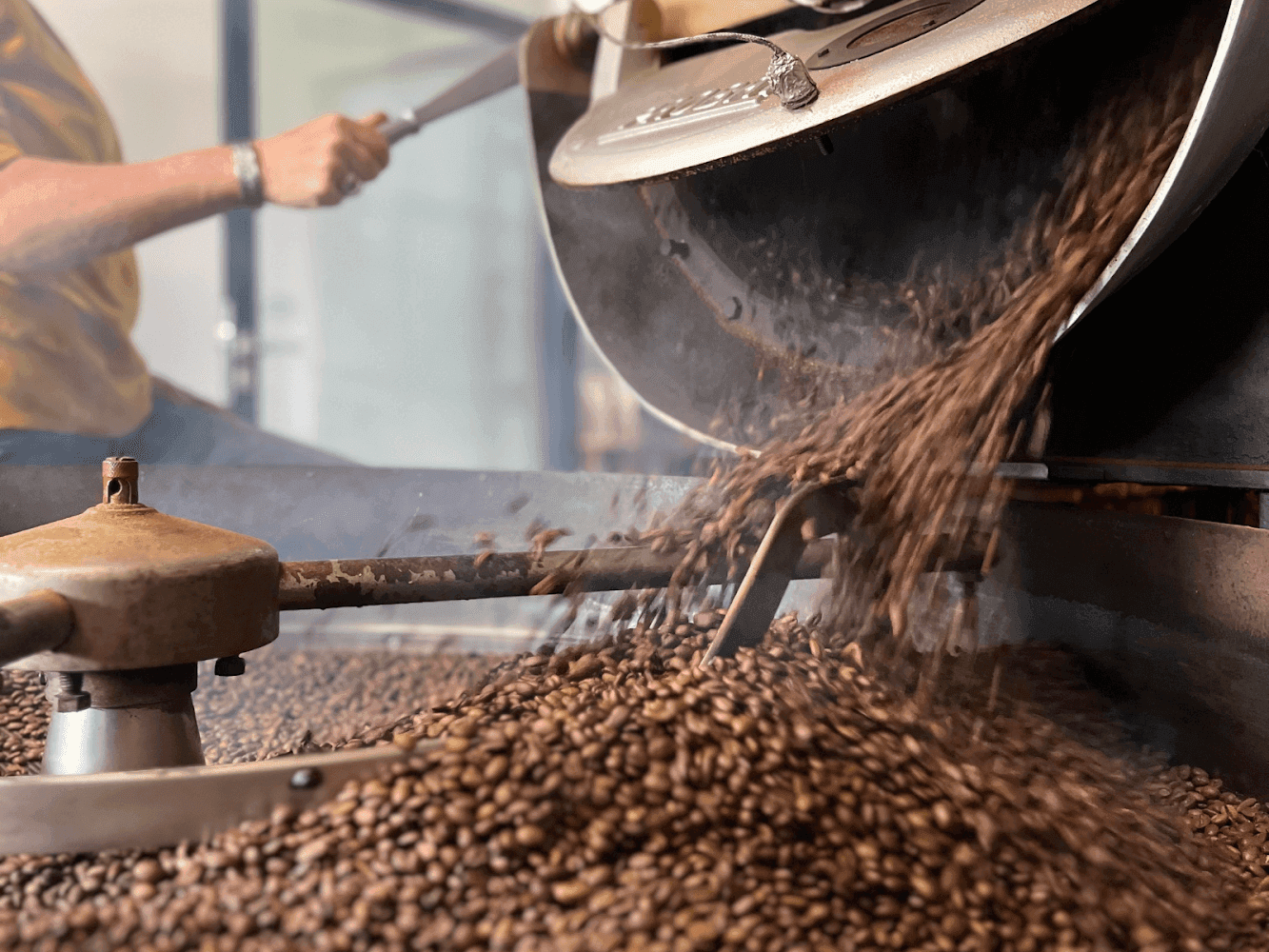
Coffee Roaster — VMAC's drum roasters are rotating-drum, LPG gas-fired machines that apply combined conduction and convection heat to green beans. The operator controls bean temperature, inlet air temperature, drum speed, and exhaust airflow to guide each batch through drying, Maillard browning, first crack, and development. An integrated cooling tray drops the roasted batch below 40°C in under four minutes, and a chaff cyclone on the exhaust duct captures silver skin released during roasting. Five models are available: the CR-5 (5 kg per batch, single-phase 230V) for estate roasteries and sample roasting, through the CR-10 (10 kg), CR-30 (30 kg), and CR-60 (60 kg) for small-to-commercial roasteries, up to the CR-120 (120 kg per batch, 3-phase 415V) for industrial operations producing 800–1,000 kg of roasted coffee per day. All models include digital PID temperature control, adjustable drum speed, and bean temperature probes for repeatable roast profiles.
Bulking Machine / Lot Blender — Export lots are rarely uniform. A 275-bag container may be assembled from dozens of small estate lots, screen-graded fractions, or seasonal harvest parcels. VMAC's rotary drum blender homogenises these sub-lots into a statistically uniform export lot in 5–15 minutes per batch. Internal baffles and flights tumble the beans in a controlled pattern, and composite sampling ports on the discharge chute allow blend verification before bags are filled. Four models cover batch sizes from 200 kg (BM-200, 1.5 kW) for small estate mills up to 2,000 kg (BM-2000, 7.5 kW) for high-volume exporters assembling multi-container lots. In Coffee Board-registered curing works, the bulking machine is a compliance requirement — the Board's export-lot registration system mandates that a declared grade be consistent throughout the registered quantity.
Together, these machines serve distinct segments of the Indian coffee industry. Estate roasteries across Karnataka, Kerala, and Tamil Nadu use the smaller roaster models for farm-to-cup branded products and direct-to-consumer retail. Medium and large curing works in Chikkamagaluru and Hassan use the bulking machine as a standard end-of-line machine before bagging for export. Some operations use both — roasting a portion of their output for domestic branded sales while bulking the rest for commodity export.
When selecting roasting equipment, the primary sizing factor is daily throughput: a CR-30 running 8-hour shifts produces 200–300 kg per day, while a CR-120 produces 800–1,000 kg. For bulking machines, size the drum to your container-filling rhythm — operations shipping fewer than 5 containers per month may find the BM-500 sufficient, while large exporters handling 25+ containers monthly need the BM-2000. Both machines integrate with the rest of the dry mill line through bucket elevators or screw conveyors for automated loading, and the bulking machine's elevated discharge height gravity-feeds directly into a bag loader or weigher. All equipment is manufactured at VMAC's facility in Hassan, Karnataka, with standard lead times of 4–8 weeks from order confirmation.
Products in this Category
FAQ
Frequently Asked Questions
What are the advantages of using a coffee roaster machine?
A coffee roaster machine allows precise control over roasting parameters, enabling the development of specific flavor profiles and ensuring consistency across batches.
How does a bulking machine aid in coffee blending?
A bulking machine homogenizes coffee beans from different batches or origins, ensuring a consistent blend that meets desired flavor profiles and quality standards.
Why is blending important in coffee production?
Blending combines beans from various origins or roast levels to create unique flavor profiles, balance acidity and body, and maintain consistency in the final product.
How does roasting affect coffee flavor?
Roasting transforms the chemical and physical properties of green coffee beans, developing the characteristic flavors and aromas associated with coffee.
What factors influence the roasting process?
Factors such as temperature, time, and airflow influence the roasting process, affecting the development of flavors, aromas, and the overall quality of the coffee.
Send a Enquiry Request
Retail store
Mon-Sat 9am to 5pm.
B.M road, Hassan, Karnataka 573201