
Chaff Cyclone Separator
Cyclone separator for collecting chaff, husk, and dust discharged by the winnower in a coffee dry mill. Centrifugal separation removes entrained solids from exhaust airflow — protecting the work environment, meeting dust-control requirements, and collecting chaff for disposal or biomass use.
| Rated airflow capacity | 1,000 m³/hr (small winnower, 0.5–1 TPH coffee) to 12,000 m³/hr (large industrial winnower, 6–10 TPH). Cyclone must be sized to match the airflow volume of the connected winnower — undersizing causes high pressure drop and reduced winnower performance. |
| Inlet air velocity | 12–20 m/s at the cyclone inlet nozzle. This velocity range generates sufficient centrifugal force for effective chaff separation. Below 12 m/s, separation efficiency drops significantly; above 20 m/s, pressure drop rises sharply and structural loads increase. |
| Separation efficiency | 95–98% for chaff and coarse husk particles (>50 micron). 85–92% for fine dust (10–50 micron). Sub-10-micron dust fractions require a secondary wet scrubber or bag filter if regulatory requirements demand near-zero exhaust particulate. |
| Pressure drop across cyclone | 150–350 Pa at rated airflow. This must be accounted for in the sizing of the winnower exhaust fan — the fan must overcome the cyclone pressure drop in addition to the duct friction losses to maintain the required airflow through the winnower. |
| Collection bin volume | 50 litres (small model) to 400 litres (industrial model). Bin sized for one full production shift between empties based on typical chaff yield of 15–20 kg chaff per tonne of coffee processed. Rotary airlock valve available to prevent air ingress during bin emptying. |
| Cyclone body dimensions | Cone diameter: 250 mm (1,000 m³/hr model) to 900 mm (12,000 m³/hr model). Overall height including cone and dust bin: 1,200 mm to 4,200 mm. Inlet nozzle: sized to maintain 14–18 m/s at rated flow. Outlet vortex tube diameter: approximately 0.5× cone diameter. |
| Construction | Mild steel body (standard) or SS 304 (corrosion-resistant option for high-humidity environments). Cone interior with optional replaceable wear liner (3 mm MS plate) for abrasive fine-dust applications. Flanged inlet and outlet nozzles for duct connection. Inspection hatch at cone base. |
| Rotary airlock valve (optional) | Star-wheel rotary valve at cone discharge prevents air bypass through the collection bin. Driven by a 0.18–0.37 kW geared motor. Required when cyclone is operating under suction (fan downstream of cyclone) to maintain airtight cone base and prevent loss of centrifugal efficiency. |
| Ducting requirement | Round sheet-metal duct from winnower exhaust to cyclone inlet; duct velocity maintained at 12–18 m/s to prevent chaff settling in duct runs. Maximum recommended duct length between winnower and cyclone: 15 m (additional duct length increases pressure drop and requires fan re-rating). |
| Installation | Typically installed outside the building or in a utility bay adjacent to the milling floor. Cyclone mounted on a mild-steel support frame bolted to a concrete pad. Inlet and outlet ducting penetrates the building wall. Clean-air outlet discharged to atmosphere via an upward-facing exhaust stack (minimum 3 m above ground level). |
Key Features
Tangential entry cyclone body — chaff-laden air enters at the inlet nozzle and spins centrifugally; no filter media, no moving parts, no consumables
Centrifugal separation at 5–8× gravitational force inside the cyclone cone — effective separation of chaff, husk fragments, and fine dust from carrier airflow
Sealed collection bin at cone apex collects separated chaff; rotary valve (airlock) option prevents air bypass through the discharge and maintains cyclone efficiency
Collection bin sized for one full operating shift between empties — minimises manual intervention and prevents backfill into the cyclone cone
Fire safety: removes airborne chaff from the mill interior atmosphere, eliminating the single largest dust-fire hazard in a dry-mill building
Environmental compliance: provides a contained chaff collection point suitable for biomass fuel, composting, or controlled waste disposal
Protects downstream exhaust fans from chaff abrasion — cyclone positioned before the exhaust fan, not after, extends fan impeller service life
Mild steel or SS 304 construction; cone interior lined with replaceable wear liner for abrasive dust applications
Installed outside the building or in a separate utility bay; ducting from winnower exhaust to cyclone inlet and from cyclone clean-air outlet to exhaust stack
Multiple units can be manifolded to a common collection bin to handle exhaust from multiple winnowers on a single production floor
Models & Sizing
Chaff Cyclone Model Range
VMAC chaff cyclones are sized by the airflow volume of the connected winnower. Capacity is rated in m³/hr of inlet airflow. Match the cyclone model to the winnower's rated airflow — not to the coffee throughput.
CC-1000 (Small Winnower Circuit)
1,000–2,000 m³/hr airflow
capacity
Small estate dry mills with a single winnower handling 500–1,500 kg/hr of coffee. Compact unit; collection bin capacity 50–80 litres. Suitable for estate-scale hulling lines.
CC-3000 (Mid-Scale Winnower)
2,000–4,000 m³/hr airflow
capacity
Mid-scale dry mills and curing works running a single large winnower at 1,500–3,000 kg/hr. Collection bin 120–200 litres. Standard configuration for Karnataka cooperative dry mills.
CC-6000 (Large Winnower / Multiple Aspirators)
4,000–7,000 m³/hr airflow
capacity
Large curing works running high-capacity winnowers or manifolded exhaust from two mid-scale aspirators. Collection bin 250–400 litres. Rotary airlock valve strongly recommended at this capacity to avoid bin backfill during high-throughput runs.
CC-12000 (Industrial Multi-Line)
7,000–12,000 m³/hr airflow
capacity
Industrial-scale export curing works with multiple hulling lines running simultaneously. Rotary airlock valve standard; flanged inlet and outlet for large-bore ducting. Collection bin 400 litres with manual or conveyor discharge.
Custom
Your specification
capacity
For operations requiring throughput beyond the standard range. VMAC engineers the machine to your exact capacity and processing conditions.
Request a Custom QuoteConfigurations
Chaff Cyclone Separator Model Range
Cyclones sized by winnower exhaust airflow volume — passive separation with no filter media or moving parts inside the cyclone body
| Model | Airflow Capacity | Cone Diameter | Collection Bin | Rotary Airlock | Best For |
|---|---|---|---|---|---|
| CC-1000 | 1,000–2,000 m³/hr | 250–320 mm | 50–80 litres | Optional (0.18 kW) | Small estate hulling line |
| CC-3000 | 2,000–4,000 m³/hr | 400–500 mm | 120–200 litres | Optional (0.25 kW) | Mid-scale curing works |
| CC-6000 | 4,000–7,000 m³/hr | 600–700 mm | 250–400 litres | Recommended (0.37 kW) | Large winnower / dual aspirators |
| CC-12000 | 7,000–12,000 m³/hr | 800–900 mm | 400 litres | Standard (0.55 kW) | Industrial multi-line curing works |
| Custom | Built to your capacity and specification — contact us for a quote | ||||
Overview
About the Chaff Cyclone Separator
In a coffee dry mill, every winnower and aspirator produces a high-velocity stream of chaff-laden exhaust air. The chaff and husk stripped from the bean must go somewhere — and without a cyclone separator, that somewhere is the interior of the milling building, or a raw exhaust stack discharging directly to the outside atmosphere. Neither outcome is acceptable in a modern processing facility. VMAC's chaff cyclone separator captures this exhaust stream and uses the centrifugal separation principle to cleanly segregate solid chaff, husk, and dust from the carrier airflow before the air is exhausted. The cyclone works without filters, moving parts, or consumables. Chaff-laden air from the winnower enters the cyclone body tangentially at high velocity. The resulting vortex spins the incoming air in a tight downward helix along the outer wall of the cone. Centrifugal force — far greater than gravitational force alone — drives the solid particles (chaff, husk fragments, fine dust, and light parchment pieces) outward against the cone wall. These solids lose velocity against the wall, spiral downward, and collect in a dust bin or sealed collection hopper at the bottom of the cone. The cleaned air reverses direction at the apex of the cone and exits upward through the central vortex tube (vortex finder), discharging to atmosphere or returning to the building air circuit through an exhaust stack. The chaff cyclone is not an optional accessory — it is a functional requirement of the winnower circuit. Operating a winnower without a cyclone means chaff is exhausted directly into the building atmosphere (creating a serious fire hazard and respiratory health risk for workers), or blown outside without collection (creating waste and potential regulatory violations). Chaff is highly flammable — the combination of elevated temperatures from the hulling circuit, airborne chaff, and a source of ignition creates the conditions for a mill fire. The cyclone addresses this by collecting chaff in a controlled manner at a single point. It also protects the fan impeller in any downstream exhaust blower from chaff abrasion, extending fan service life significantly. VMAC cyclones are rated by airflow volume in m³/hr (CFM), not by coffee throughput — the sizing parameter is the airflow capacity of the winnower to which the cyclone is connected. Standard models cover winnower airflows from 1,000 m³/hr to 12,000 m³/hr. Multiple cyclones can be manifolded together to handle multiple winnower exhaust streams.
How It Works
How It Works
The chaff cyclone uses the centrifugal separation principle to remove chaff, husk, and dust from the high-velocity exhaust airstream discharged by the winnower. There are no filter media and no moving parts inside the cyclone body — separation is achieved entirely by aerodynamic forces.
Tangential inlet — establishing the vortex
Chaff-laden air from the winnower exhaust enters the cyclone body through a tangential inlet nozzle at 14–18 m/s. The tangential entry angle forces the incoming airstream into a circular path immediately upon entering the cylindrical upper section of the cyclone body. This initiates the outer vortex — a tight downward helical rotation of the air along the inner wall of the cone. The centrifugal acceleration generated at this rotational speed is 5–8 times gravitational acceleration — far greater than the settling velocity of the chaff and dust particles in the airstream.
Centrifugal separation in the cone
As the outer vortex descends through the conical lower section, the cone wall progressively converges. The diameter reduction increases the rotation velocity (conservation of angular momentum) — increasing centrifugal force on the solid particles. Chaff, husk fragments, and dust are driven centrifugally outward against the cone wall. Their forward velocity is arrested by wall contact, and they spiral downward under gravity along the cone wall to the bottom discharge point. Meanwhile, the clean air — now carrying only sub-micron dust that could not be centrifuged out — reaches the bottom of the cone.
Inner vortex reversal and clean-air exit
At the narrow apex of the cone, the descending outer vortex is unable to continue downward and reverses direction. It transitions into an upward-spinning inner vortex — rotating in the same direction as the outer vortex but now ascending through the central axis of the cyclone body. This inner vortex of cleaned air exits upward through the vortex finder tube (a central tube projecting into the cyclone from the top) and is discharged to atmosphere via the exhaust stack. The vortex finder diameter and depth are critical design parameters — they determine the cut size (the smallest particle that the cyclone can separate) and the pressure drop across the unit.
Chaff collection and discharge
Separated chaff and dust accumulate at the cone apex and fall into the collection bin below. The rotary airlock valve (where fitted) continuously discharges collected chaff into a bin or onto a conveyor without breaking the suction seal of the cone. Without a rotary airlock, the collection bin must be emptied periodically with the system shut down. Collected chaff is dry, light, and consistent — suitable for biomass fuel use in the mill's coffee husk boiler, composting, or removal as agricultural waste.
Defect Separation
What the Chaff Cyclone Captures — and What It Cannot Handle
The chaff cyclone is designed to receive the exhaust airstream from the winnower only — it should never receive whole coffee beans, unprocessed cherry, or dense debris. The following describes what the cyclone correctly captures and what it is not designed for.
Captured by the cyclone
Coffee chaff and silver skin
The primary material captured: lightweight chaff (silver skin fragments) stripped from green coffee beans by the huller, peeler, or polisher and carried in the winnower exhaust airstream. This is the bulk of the cyclone's load in a dry mill. Captured at 96–98% efficiency at full airflow.
Dried husk and parchment fragments
Light fragments of dried coffee husk or parchment that pass through the winnower alongside chaff. These are denser than chaff but still light enough to be carried in the exhaust airstream. The cyclone captures these effectively due to their relatively large surface area and low density.
Fine coffee dust
Sub-millimetre dust generated by the impact forces in the huller and polisher. This fraction is lighter than whole chaff and requires the higher centrifugal force of a correctly sized, high-inlet-velocity cyclone. Particles above 50 microns are captured at 90–95% efficiency; finer dust (10–50 microns) at 85–90%.
Light parchment pieces
Incompletely hulled parchment fragments that are light enough to be entrained in the winnower airflow. These are captured in the cyclone collection bin and can be screened and returned to the hulling circuit if the volume is significant.
Not suitable for cyclone processing
Whole coffee beans or parchment
Coffee beans or intact parchment should never reach the cyclone — the winnower upstream must capture and re-route any beans that are aspirated. If whole beans are appearing in the cyclone collection bin, the winnower feed rate is too high or the air velocity is set incorrectly, causing good beans to be over-aspirated.
Sub-10-micron respirable dust
Very fine dust generated by high-speed hulling or polishing may not be captured efficiently by a single cyclone stage. If regulatory requirements specify near-zero exhaust particulate, a secondary wet scrubber or bag filter installed downstream of the cyclone clean-air outlet is required.
Dense foreign material (stones, metal)
Heavy, dense material — stones, metal fragments, sand — should be removed upstream by the pre-cleaner and destoner before ever reaching the huller and winnower. These materials will pass through the winnower without being aspirated and should not appear in the chaff circuit.
A chaff cyclone is a single-stage separator for the winnower exhaust circuit only. It is not a dust collector for general mill use. For overall mill dust management — including dust from bag-filling stations, conveyor transfer points, and hulling enclosures — additional point-source extraction and collection is required.
Know the Difference
Chaff Cyclone Separator vs. Open exhaust / no cyclone
Some mills exhaust winnower chaff-laden air directly into the building or through an open stack to atmosphere without any collection device. The comparison below illustrates the operational and safety implications of both approaches.
| Feature | Chaff Cyclone Separator | Open exhaust / no cyclone |
|---|---|---|
| Chaff destination | Chaff collected at a single controlled point in the collection bin; handled manually or via conveyor for disposal or biomass use | Chaff disperses inside the building or into the surrounding environment; accumulates on floors, equipment, rafters, and electrical panels |
| Fire hazard | Low: airborne chaff concentration in the building atmosphere is minimal; chaff is concentrated in a contained collection bin | High: airborne chaff is highly flammable; concentrated chaff deposits on hot machinery surfaces create ignition risk; a leading cause of dry-mill fires |
| Worker health and respiratory safety | Dust and chaff removed from building atmosphere; compliance with occupational dust exposure limits is achievable | Workers continuously exposed to chaff dust, parchment fragments, and fine silica dust; respiratory health risk over a processing season |
| Environmental compliance | Clean-air outlet stack meets standard industrial exhaust particulate limits for coffee processing facilities | Open exhaust discharges visible chaff and particulate to atmosphere; potential violation of local industrial emissions or nuisance regulations |
| Equipment protection | Cyclone positioned before the exhaust fan protects fan impeller from chaff abrasion; significantly extends fan service life | Chaff passes through the exhaust fan impeller continuously; abrasive wear increases fan maintenance frequency and impeller replacement cost |
| Winnower performance | Cyclone pressure drop is predictable and constant; fan sizing accounts for it; winnower operates at stable, designed airflow | Without defined back-pressure, exhaust duct resistance can fluctuate; winnower airflow may be inconsistent — affecting chaff separation quality at the winnower itself |
| Chaff as biomass resource | Collected chaff available as a clean, dry fuel for husk-fired boilers, coffee-husk briquette production, or controlled composting | Chaff dispersed; no recovery possible; represents a waste of a potential fuel or compost resource |
A chaff cyclone is mandatory in any mill operating under a curing-works licence or aiming for environmental and safety compliance. The capital cost is low relative to the fire risk, health liability, and equipment wear it prevents.
Processing Line
Position in Dry Mill Air Circuit
The chaff cyclone is positioned in the exhaust air circuit downstream of the winnower — it is not a bean-handling machine but an air-handling machine. It receives and processes the exhaust airstream from the winnower, not the bean stream.
Huller (Rubber-roll, Disc, or Dry Huller)
Removes parchment or husk from coffee; generates chaff, husk fragments, and dust
Peeler / Polisher (optional)
Removes residual silver skin; additional chaff and fine dust generation
Winnower / Aspirator
Air column at controlled velocity strips chaff and light material from the bean stream; heavy chaff-laden air exits through the winnower exhaust duct
Chaff Cyclone Separator
This machineReceives chaff-laden exhaust air from winnower; centrifugal separation removes chaff, husk, and dust; clean air exits to exhaust stack; chaff collected in bin below
Exhaust fan (if suction-draw system)
Where the system draws air by suction (fan downstream of cyclone), fan is protected from chaff abrasion by the cyclone upstream
Exhaust stack to atmosphere
Cleaned air discharged upward to atmosphere; particulate levels after cyclone meet standard industrial emission limits
Chaff collection bin / biomass store
Collected chaff transferred to bin or conveyor for biomass fuel, composting, or waste removal
FAQ
Frequently Asked Questions
How is the chaff cyclone sized — why is it rated in m³/hr and not kg/hr?
A chaff cyclone is an air-handling device, not a bean-handling machine. It receives the exhaust airstream from the winnower and separates solids from that airstream. The key sizing parameter is therefore the volume of air moving through the system — measured in m³/hr or CFM (cubic feet per minute) — rather than the weight of coffee being processed. A correctly sized cyclone must be able to accept the full exhaust airflow from the connected winnower without creating excessive back-pressure that would reduce the winnower's aspiration velocity. To size the cyclone, you need the winnower's rated airflow (from the winnower's technical datasheet). VMAC can assist with sizing if you provide your winnower model and rated airflow.
Is a chaff cyclone the same as a dust collector?
Not exactly, though the terms are sometimes used interchangeably in mill settings. A chaff cyclone is a primary cyclonic separator designed for the high-volume, coarse chaff and husk fraction from the winnower exhaust — it handles a large airflow with a relatively high solid loading efficiently. A dust collector (bag filter or wet scrubber) is a secondary device designed to capture very fine dust particles (sub-10-micron range) that a cyclone cannot efficiently separate. In a well-designed mill, the cyclone is the primary separator on the winnower exhaust; if environmental regulations require very low exhaust particulate, a secondary bag filter is installed on the cyclone's clean-air outlet. The cyclone alone is sufficient for most Indian dry-mill operating environments.
Where should the cyclone be installed — inside or outside the building?
Outside the building, or in a separate utility bay with its own ventilation, is strongly preferred. Installing the cyclone outside keeps the chaff-collection point away from the production floor, reduces the chaff load on the building atmosphere, and makes the clean-air exhaust stack straightforward — the clean-air outlet is simply the top of the cyclone pointing skyward. The duct run from the winnower exhaust through the building wall to the cyclone inlet should be as short as possible — typically under 10–12 metres — to minimise duct pressure drop and prevent chaff settling in horizontal duct runs. If an outdoor installation is not possible, a dedicated utility room with its own ventilation louvers is acceptable.
What happens if the cyclone collection bin is not emptied regularly?
If the collection bin fills up completely and chaff continues to accumulate, the cone apex becomes blocked. Blocked cone apex has two consequences: first, the chaff can back up into the cone itself and begin to fill the lower vortex region, significantly reducing separation efficiency. Second, in a suction system, the blocked apex creates an air bypass — outside air is drawn into the cone from the collection bin opening, short-circuiting the inner vortex and pulling separated chaff back up into the outlet. For continuous-operation mills, a rotary airlock valve at the cone discharge allows continuous chaff removal without interrupting the cyclone's operation. Without a rotary airlock, establish a bin-emptying routine based on the expected chaff generation rate — typically 15–20 kg of chaff per tonne of coffee processed.
Can the chaff from the cyclone be used as fuel or fertiliser?
Yes — collected coffee chaff (silver skin and husk) has a calorific value of approximately 15–16 MJ/kg, making it a viable supplementary fuel for husk-fired boilers used in coffee drying. Many Indian curing works that operate husk-fired hot-air generators for mechanical dryers use the chaff cyclone output directly as supplementary boiler feed. Chaff can also be composted as a low-nitrogen organic matter for soil amendment on the estate, or briquetted with coffee husk to produce fuel pellets. The key advantage of the cyclone collection point is that the chaff is collected dry and clean — not mixed with water or mucilage — making it suitable for direct fuel or compost use.
Does the chaff cyclone require any power to operate?
The cyclone body itself requires no power — separation is entirely aerodynamic and passive. The energy driving the airflow through the cyclone comes from the winnower's exhaust fan (in a pressure-discharge system) or the suction fan (in a negative-pressure system). The only powered component associated with the cyclone is the optional rotary airlock valve, which requires a small geared motor of 0.18–0.55 kW depending on the model. Even with the airlock valve, the chaff cyclone's power consumption is negligible compared to the huller and winnower motors it serves.
What maintenance does the chaff cyclone require?
The cyclone body itself has no internal moving parts and therefore has almost no maintenance requirement. The key inspection points are: (1) the cone interior walls for abrasive wear — on high-silica-dust applications, the cone apex area can thin over time; inspect annually with a flashlight through the clean-air outlet or the inspection hatch. (2) The inlet nozzle for chaff buildup — tangential entry means chaff sometimes compacts at the junction of the inlet and cone wall; inspect and clear at the start of each season. (3) The rotary airlock valve (where fitted) — grease the end-plate bearings every 200 operating hours; inspect the star-wheel vanes for chaff compaction. (4) The duct connections — check all flanged joints for air leaks that reduce cyclone efficiency.
Send a Enquiry Request
Retail store
Mon-Sat 9am to 5pm.
B.M road, Hassan, Karnataka 573201
Related Products
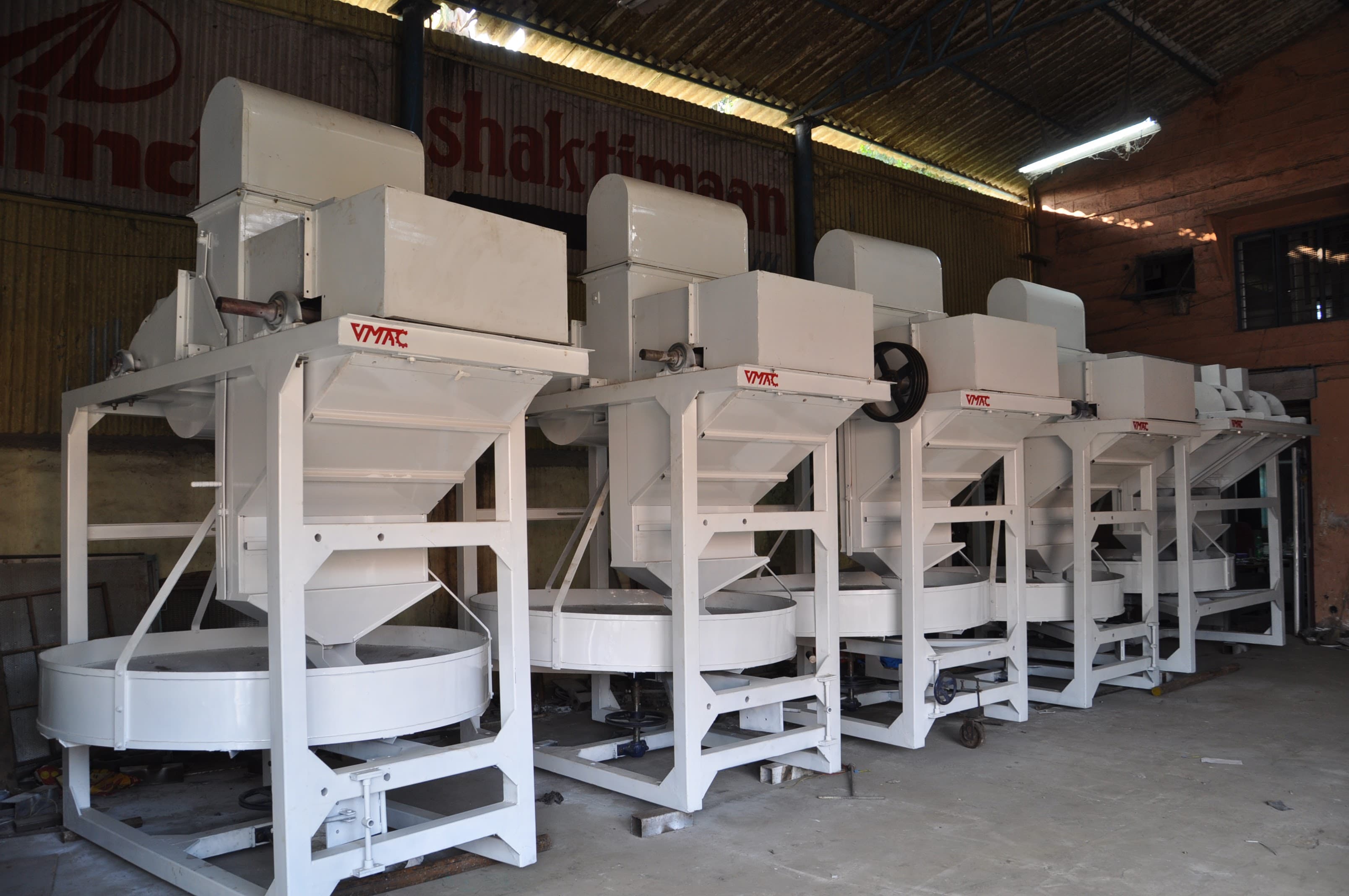
Coffee Huller
Abrasive disc huller for removing dried parchment and husk from washed parchment coffee — high throughput, adjustable hulling intensity, and low bean breakage for dry mill operations.
Rubber Roll Coffee Huller
Counter-rotating rubber roll huller that gently removes parchment from dried washed Arabica with less than 1–2% bean breakage. The industry-standard hulling machine for parchment coffee in Karnataka, Kerala, and Tamil Nadu estates.
Disc Coffee Huller
Abrasive rotating-disc huller for natural and dry-processed coffee — removes dried husk from cherry-processed Robusta and Arabica naturals that rubber roll machines cannot handle. Capacity 300 kg/hr to 5 TPH.