
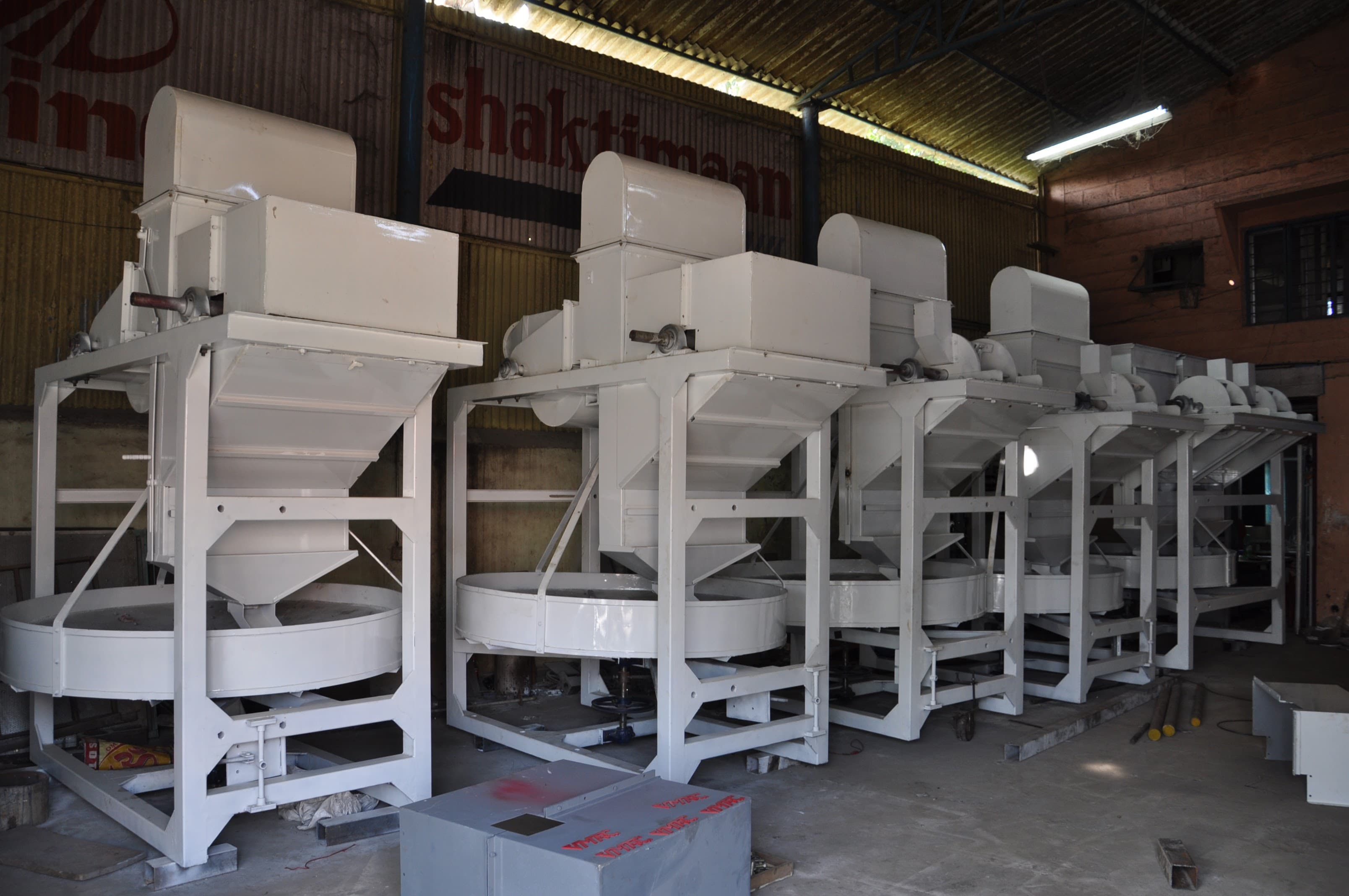
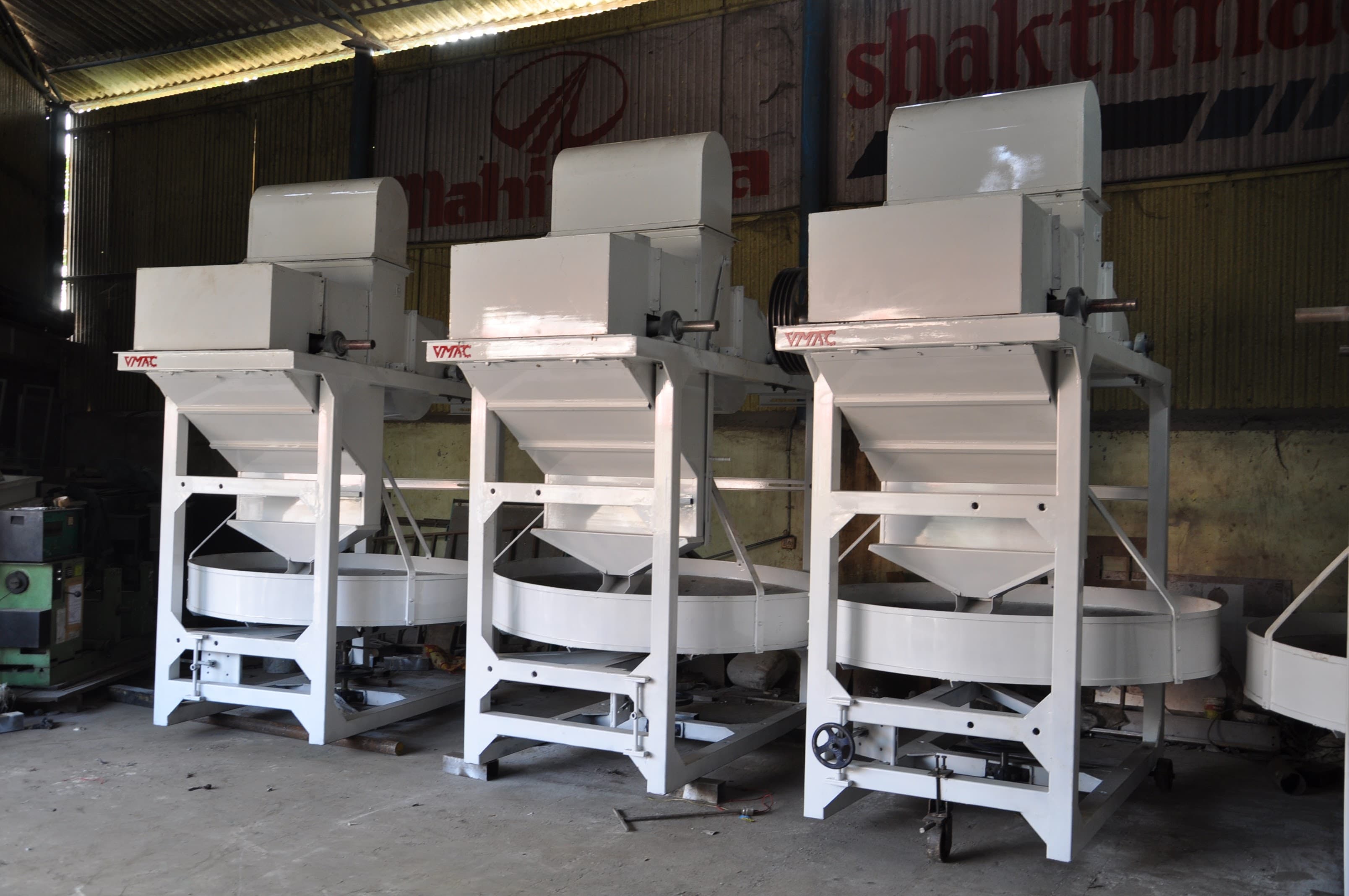
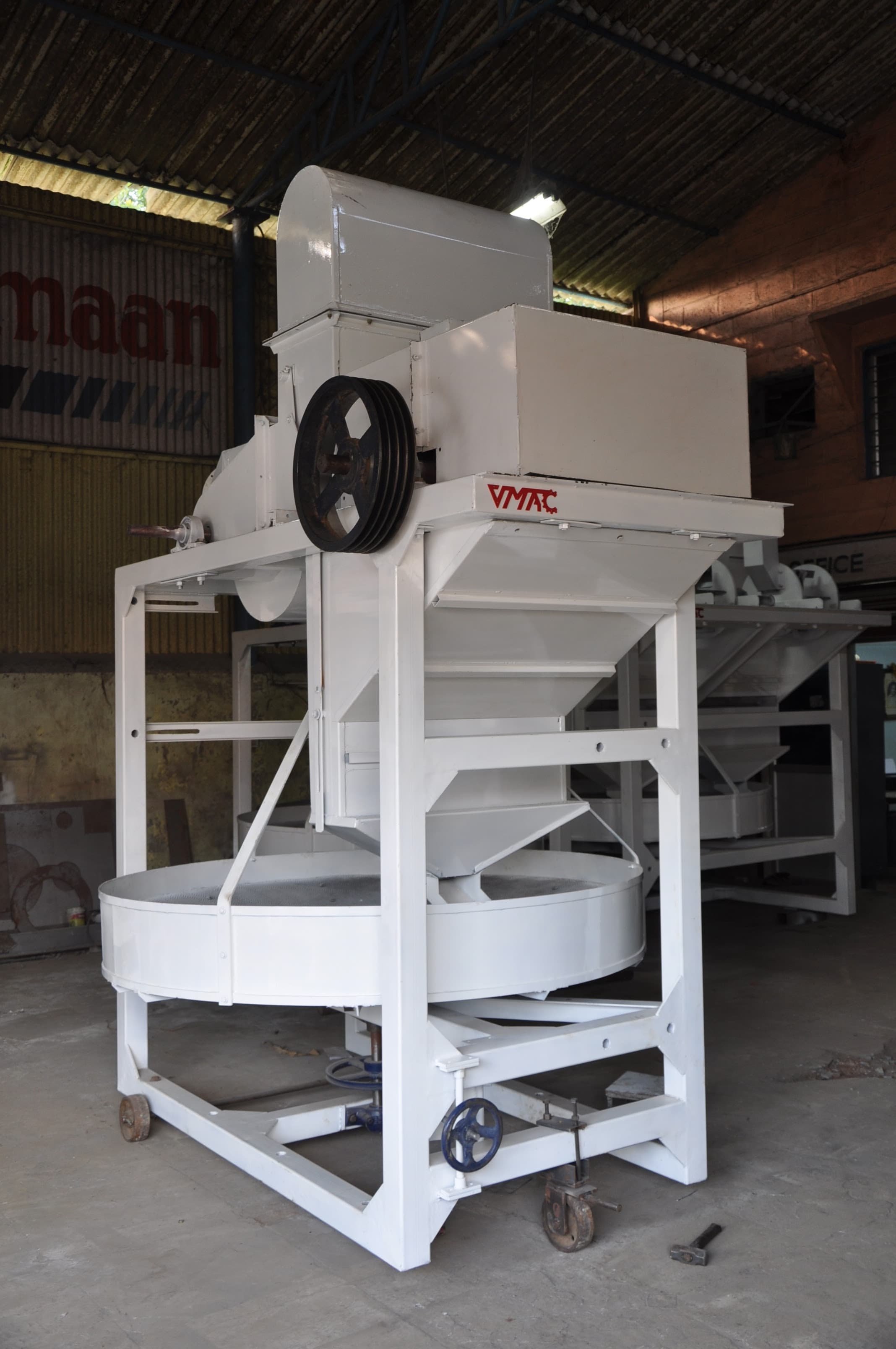
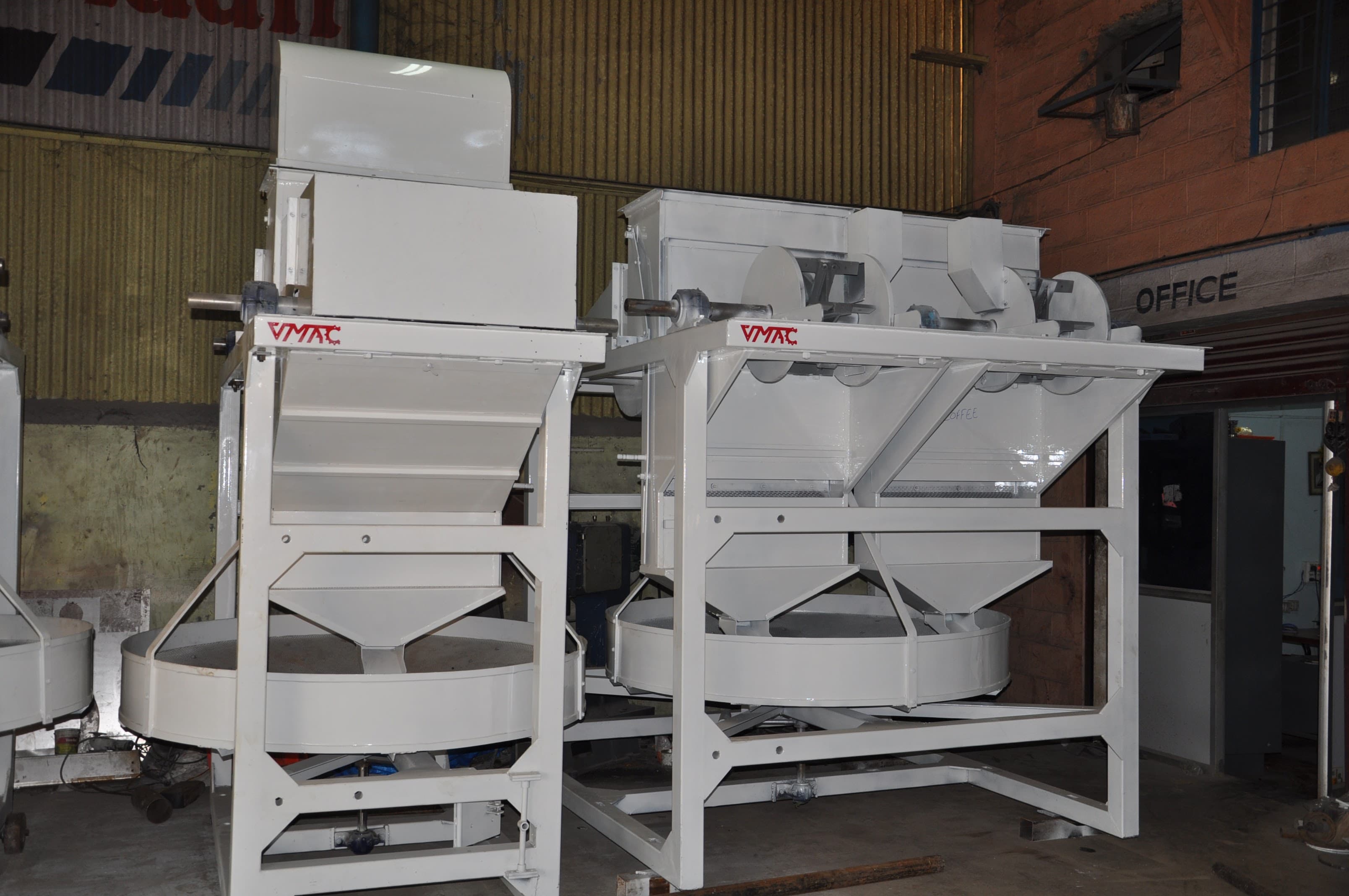
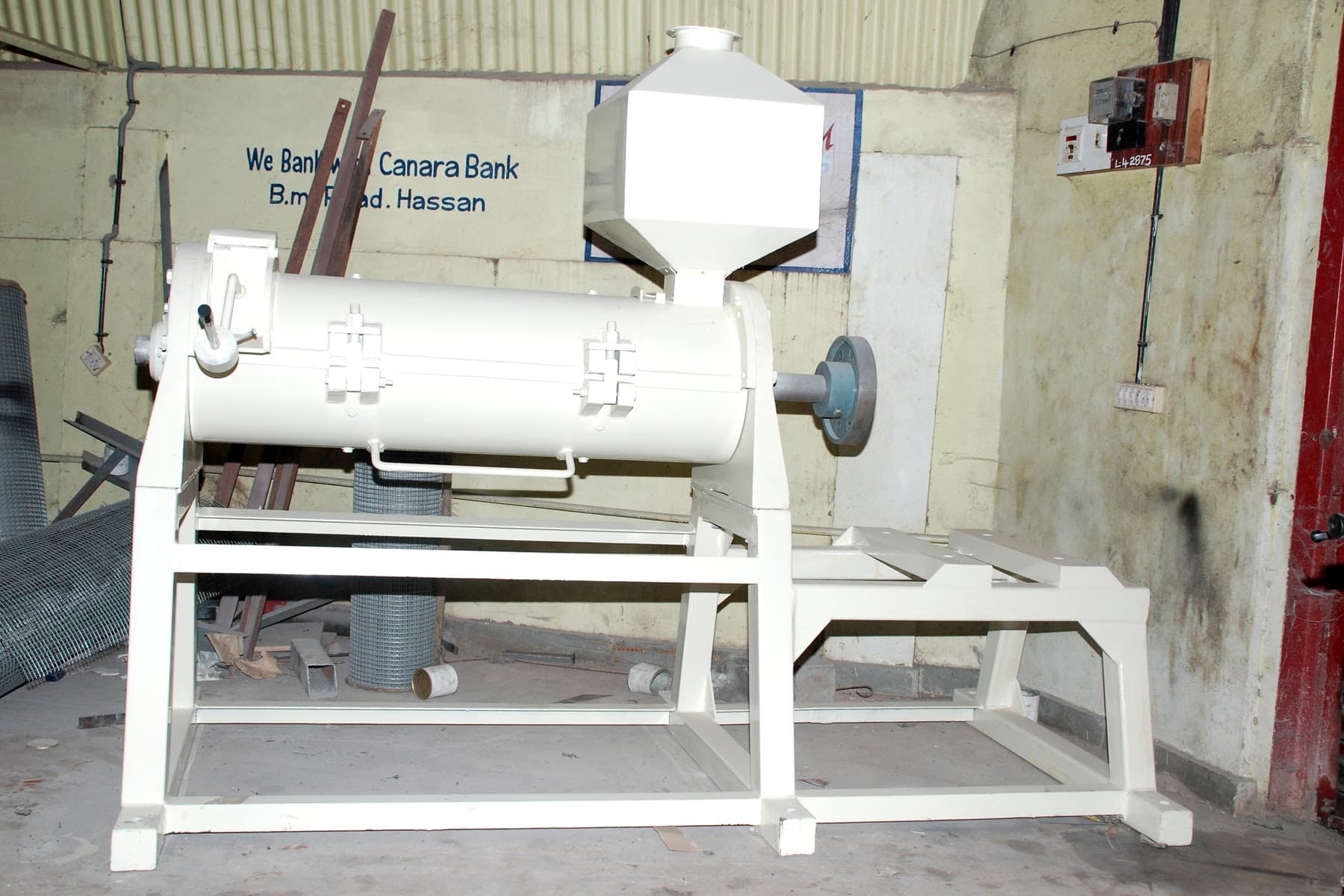
Coffee Huller
Abrasive disc huller for removing dried parchment and husk from washed parchment coffee — high throughput, adjustable hulling intensity, and low bean breakage for dry mill operations.
| Capacity range | 250 kg/hr – 5,000 kg/hr |
| Main motor power | 3 HP – 20 HP |
| Hulling mechanism | Abrasive rotating disc vs. stationary concave |
| Recommended input moisture | 10–12% (dried parchment coffee) |
| Hulling gap | Adjustable — screw mechanism, operator-controlled |
| Power supply | 3-phase, 440V, 50 Hz |
Key Features
Abrasive disc and stationary concave design removes parchment cleanly in a single pass for standard washed Arabica and Robusta lots
Adjustable hulling gap via screw mechanism — operator sets hulling intensity per crop, moisture level, and parchment thickness
Handles variable parchment conditions including over-dried lots, thick parchment, and mixed-moisture batches that stall rubber roll hullers
Cast iron hulling chamber with hardened abrasive disc — disc is field-replaceable without specialist tools; spare discs available ex-stock
Heavy-gauge fabricated steel frame with vibration-isolated motor mounting — robust enough for continuous multi-shift operation in large curing works
Chaff and green bean discharge separated at output — huller output feeds directly to aspirator or winnower for inline chaff removal
Models from 250 kg/hr (small estate dry mill) to 5 TPH (large curing works) — single machine line-up with common spare parts across tiers
Bean breakage rate under 2% at correct settings and input moisture — low breakage preserves lot outturn and reduces losses
Models & Sizing
Coffee Huller Model Range
VMAC manufactures Coffee Hullers across six capacity tiers, from small estate dry mills running 250 kg/hr to large curing works processing 5 TPH. All models share the same replaceable abrasive disc architecture and adjustable hulling gap mechanism. Contact VMAC for exact specifications and custom configurations.
Small Estate
250–500 kg/hr
capacity
Small estate dry mills and smallholder cooperative processing units. Handles seasonal lots of 20–50 bags per day. Single-shift operation.
Medium Estate
500–1,000 kg/hr
capacity
Medium estates and cooperative dry mills processing 50–100 bags per day. Suitable for estates in Coorg, Wayanad, and Nilgiris processing Arabica and Robusta.
Large Estate / Small Curing Works
1,000–2,000 kg/hr
capacity
Large estates and small registered curing works. Multi-variety processing. Handles 100–200 bags per day across two shifts.
Medium Curing Works
2,000–3,000 kg/hr
capacity
Licensed curing works processing Plantation grades, Robusta, and natural coffee. Multi-lot, multi-shift operation servicing several farms.
Large Curing Works
3,000–4,000 kg/hr
capacity
High-volume curing works and export processing plants. Continuous operation, often paired with a rubber roll huller for specialty lots. Handles 500+ bags per day.
Export Processing Plant
4,000–5,000 kg/hr
capacity
Large-scale commercial export mills in Karnataka, Kerala, and Tamil Nadu. Bulk Arabica and Robusta processing. Often installed as two-machine lines with bypass routing.
Custom
Your specification
capacity
For operations requiring throughput beyond the standard range. VMAC engineers the machine to your exact capacity and processing conditions.
Request a Custom QuoteConfigurations
Full Model Range — Coffee Huller
All models feature an adjustable hulling gap, replaceable hardened abrasive disc, cast iron hulling chamber, and 3-phase 440V power supply. Capacities are for dried parchment coffee at 10–12% moisture. Contact VMAC for exact dimensions and custom configurations.
| Model Tier | Capacity (kg/hr) | Motor Power | Hulling Mechanism | Best For |
|---|---|---|---|---|
| Small Estate | 250–500 | 3 HP | Abrasive disc | Small estate / cooperative dry mill |
| Medium Estate | 500–1,000 | 5 HP | Abrasive disc | Medium estate / cooperative dry mill |
| Large Estate / Small Curing Works | 1,000–2,000 | 7.5 HP | Abrasive disc | Large estate / small curing works |
| Medium Curing Works | 2,000–3,000 | 10 HP | Abrasive disc | Licensed curing works — multi-variety |
| Large Curing Works | 3,000–4,000 | 15 HP | Abrasive disc | High-volume curing works / export plant |
| Export Processing Plant | 4,000–5,000 | 20 HP | Abrasive disc | Large-scale commercial export mill |
| Custom | Built to your capacity and specification — contact us for a quote | |||
Overview
About the Coffee Huller
VMAC's Coffee Huller is an abrasive disc-type hulling machine designed for the dry mill stage of coffee processing. It receives dried parchment coffee (moisture content 10–12%) and removes the endocarp — the dried parchment shell — through controlled abrasive friction between a rotating abrasive disc and a stationary concave, releasing clean green beans with chaff as a byproduct. The hulling gap, disc speed, and feed rate are all independently adjustable, giving operators precise control over hulling intensity to match the specific parchment thickness and batch characteristics of each crop. The machine is the primary hulling workhorse in Indian coffee dry mills processing washed Arabica and washed Robusta. Unlike rubber roll hullers — which use a compression-and-shear mechanism suited to uniform, soft parchment — the disc huller handles a wider range of parchment conditions including over-dried lots, mixed lots, and beans with thicker or irregular parchment. It produces clean hull removal in a single pass for most parchment coffees and is available in capacities from 250 kg/hr for small estate dry mills to 5 TPH for large curing works. All VMAC Coffee Huller models are built on a heavy-gauge mild steel fabricated frame with cast iron hulling chamber, hardened abrasive disc, and adjustable hulling pressure mechanism. Output from the huller feeds directly to an aspirator or winnower to remove the separated chaff before the green bean stream continues to the polisher, screen grader, and downstream quality equipment. Models from small estate to commercial curing works capacity are available; all share the same replaceable-disc architecture and standard maintenance schedule.
How It Works
How It Works
The Coffee Huller uses controlled abrasive friction to strip the dried parchment (endocarp) from each bean. A rotating hardened abrasive disc and a fixed concave surface create a confined hulling zone where beans are continuously fed, abraded, and discharged. The gap between the disc and concave determines hulling intensity and is the primary operator adjustment.
Feed and metering
Dried parchment coffee enters the hulling chamber through a gravity-fed inlet hopper. A feed gate or rotary valve controls the rate of entry into the hulling zone. Feed rate is adjusted to match the disc speed and gap setting — overfeeding causes incomplete hulling and re-circulation; underfeeding wastes capacity and increases bean exposure time in the abrasive zone.
Abrasive disc hulling
Inside the hulling chamber, beans are caught between the spinning abrasive disc and the stationary concave shell. The abrasive surface scours and breaks the brittle dried parchment layer through repeated contact. Unlike rubber roll hullers, which squeeze and shear, the disc huller removes parchment by abrasion — making it effective on parchment coffee across a range of moisture contents and parchment thicknesses.
Hulling gap adjustment
The gap between the disc face and the concave is set by an external screw mechanism before or during operation. A tighter gap increases abrasion and is used for thick parchment, over-dried lots, or beans requiring more aggressive hulling. A wider gap reduces intensity and is used for correctly-dried, thin-parchment lots to minimise bean breakage. The correct gap setting is the most important variable for achieving clean hull removal with low breakage.
Bean and chaff discharge
Hulled green beans and the stripped chaff (dried parchment flakes, silver skin) exit together from the lower discharge of the hulling chamber. The green bean and chaff stream is conveyed immediately to an aspirator or winnower, where an upward air column separates and collects the light chaff while the green beans pass through as product. The green bean stream then continues to the polisher and screen grader.
Know the Difference
Coffee Huller vs. Rubber Roll Huller
Both the Coffee Huller (disc-type) and the Rubber Roll Huller remove the outer layer from dried coffee beans, but they work on different mechanical principles, target different processing conditions, and suit different operations. Understanding the difference prevents mismatched equipment selection.
| Feature | Coffee Huller | Rubber Roll Huller |
|---|---|---|
| Hulling mechanism | Abrasive friction — rotating abrasive disc scours and breaks parchment through repeated surface contact | Compression and shear — two counter-rotating rubber rolls squeeze the bean and slip-shear the parchment off |
| Primary application | Washed parchment coffee; also handles over-dried lots, thick parchment, and mixed-moisture batches | Washed parchment coffee at correct moisture (10–12%); best performance on uniform, well-dried, consistently-sized lots |
| Parchment condition tolerance | Higher — abrasion works across a wider range of moisture and parchment thickness; handles difficult lots | Narrower — rubber rolls lose efficiency on over-dried lots; parchment breaks rather than shears cleanly |
| Bean breakage | Under 2% at correct gap setting and moisture — slightly higher than rubber roll at ideal conditions | Lowest of all huller types at correct moisture and roll pressure — the industry benchmark for breakage-sensitive specialty lots |
| Wear parts and replacement | Abrasive disc wears with use — typically replaced every 1–3 seasons depending on throughput; disc replacement is fast and field-done | Rubber rolls wear and harden with use — roll replacement more frequent in high-throughput operations; rolls are the primary ongoing cost |
| Suitable coffee type | Washed Arabica, Washed Robusta, natural/dry-processed cherry (where abrasive stripping of the dried fruit layer is required) | Primarily washed/parchment coffee. Not recommended for natural/dry-processed cherry — insufficient force to remove dried fruit layer |
| Capacity range | 250 kg/hr to 5 TPH — single machine covers small estate to large curing works | Typically 200 kg/hr to 3 TPH — medium-capacity ceiling; very large operations use multiple units |
| Best use case | Mixed-lot curing works, operations with variable input quality, large-volume hulling where robustness matters | Specialty and high-value lots where minimising breakage is the priority; operations with consistently well-dried, uniform input |
Many curing works operate both machine types — rubber roll hullers for premium specialty lots where breakage tolerance is tight, and disc hullers for bulk lots, natural coffee, and variable-condition batches. The two machines are complementary, not interchangeable.
Processing Line
Where the Coffee Huller Sits in the Dry Mill
The Coffee Huller is the first major processing machine in the dry mill sequence after dried parchment coffee arrives from the drying yard or mechanical dryer. It is positioned after a pre-cleaner and destoner (which protect the hulling disc) and before the winnower, polisher, and grading equipment.
Drying yard / mechanical dryer
Parchment coffee dried to 10–12% moisture content. Moisture uniformity is critical — uneven drying causes mixed hulling performance and elevated breakage.
Pre-cleaner / scalper
Removes gross foreign material: sticks, string, large stones, mud clods, and debris that damage the hulling disc
Destoner
Removes stones and dense foreign material. Dense stones in the hulling chamber chip and crack the abrasive disc — destoning before hulling is essential for disc life
Coffee Huller (disc-type)
Removes dried parchment / endocarp from washed parchment coffee. Output is green beans mixed with chaff and parchment fragments
Winnower / aspirator
Air column separates and collects light chaff and parchment fragments from the green bean stream. Often integrated immediately after the huller outlet
Peeler / polisher
Removes remaining silver skin from the bean surface; smooths and brightens the bean. Improves visual grade and reduces dust
Screen grader (flat or rotary)
Separates hulled beans by screen size into Grade A, B, C, and Peaberry fractions. Each fraction is processed separately downstream
Gravity separator
Sorts each screen-graded size fraction by density — removes immature beans, hollow shells, withered beans, and insect-damaged beans
Colour sorter (CCD / laser)
Removes colour-based defects not separable by density: full blacks, partial blacks, sour beans, discoloured beans
Hand sorting / garbling table
Final manual inspection pass. Catches remaining visual defects before weighing and bagging
Weighing, bagging, export
Bags labelled with lot number, grade, crop year, and ICO mark
VMAC supplies this machine on its own or as part of a complete coffee processing line, with every machine matched to your capacity.
FAQ
Frequently Asked Questions
What is a coffee huller and what does it do?
A coffee huller removes the dried parchment layer (endocarp) from washed coffee beans after the drying stage. Washed coffee goes through the wet mill where the cherry skin and pulp are removed, leaving the green bean enclosed in a tough parchment shell. After drying to 10–12% moisture, the parchment must be removed before the green bean can be graded and exported. The huller performs this step — it is the first and most critical machine in the dry mill sequence. Without hulling, no downstream grading, polishing, or quality sorting is possible.
What is the difference between a disc huller and a rubber roll huller?
The two machine types use different mechanical principles. A disc huller (also called an abrasive huller) removes parchment through abrasive friction between a spinning abrasive disc and a fixed concave. A rubber roll huller uses two counter-rotating rubber rolls that squeeze and shear the parchment off each bean. Rubber roll hullers produce lower bean breakage at correct moisture on well-dried, uniform lots and are preferred for specialty and premium grades. Disc hullers handle a wider range of parchment conditions including over-dried, thick-parchment, and variable-moisture batches, making them the standard workhorse in mixed-lot curing works. Many large curing works use both — rubber roll for premium lots, disc huller for bulk and difficult lots.
What moisture content should parchment coffee be at before hulling?
The recommended input moisture for hulling is 10–12% (wet basis). At this moisture, the parchment is dry and brittle enough to be removed cleanly by abrasion without excessive force on the bean. Coffee above 13% moisture can result in incomplete hulling — the parchment is still pliable and wraps rather than breaks. Coffee below 9% is over-dried — the bean itself becomes brittle and breakage increases significantly. Moisture checking with a calibrated grain moisture meter before hulling is standard practice in every well-run dry mill.
What bean breakage rate should I expect from a disc huller?
A well-set VMAC Coffee Huller running correctly-dried parchment coffee (10–12% moisture) at 70–80% of rated capacity achieves bean breakage under 2%. Breakage increases when: input moisture is too low (below 9%), the hulling gap is set too tight, feed rate is too high (beans circulate in the chamber), or the abrasive disc is worn past replacement threshold. Breakage should be checked on every new lot — weigh the broken/chip fraction from the winnower discharge and express it as a percentage of input weight. If breakage exceeds 3%, stop and investigate before processing the full lot.
Can a disc huller process natural (dry-processed) coffee?
Yes — a disc huller can process natural (dry-processed) coffee where the entire dried cherry (skin, mucilage, parchment) is removed in one pass. This is a more aggressive application than parchment hulling and requires wider gap settings and potentially lower feed rates. Rubber roll hullers are not suitable for natural coffee because the dried fruit layer is too thick and fibrous for the compression-shear mechanism. The disc huller is the correct choice for natural processing operations.
How do I select the right capacity huller for my operation?
Size the huller to run at 70–80% of its rated capacity during peak season — this gives a safety margin for capacity variation and produces more consistent hulling quality than running at maximum throughput. For a small estate processing 50 bags (50 kg bags, parchment weight) per day in a single shift, a 250–500 kg/hr model is appropriate. A curing works processing 300–400 bags per day across two shifts needs a 1,500–2,000 kg/hr model. Factor in: peak season volume (not average), number of operating hours per day, and any plans to add upstream dryer capacity that will increase hulling demand in future seasons.
How often does the abrasive disc need to be replaced?
Disc life depends on throughput volume, coffee variety (robusta is harder on discs than arabica), and material cleanliness (stones and grit dramatically accelerate disc wear). In typical Indian curing works conditions, an abrasive disc lasts 1–3 processing seasons. Indicators that the disc needs replacement: hulling completeness is falling despite tightening the gap, the gap screw has reached its minimum useful travel, or visible wear channels appear on the disc surface. VMAC supplies replacement discs ex-stock for all models. Disc replacement does not require specialist tools and is done in the field by the operator.
Does the huller also remove the silver skin?
The disc huller removes the primary parchment layer but does not reliably remove the silver skin (seed coat / silverskin) that adheres to the surface of the green bean beneath the parchment. A separate polisher or peeler-polisher machine is used after hulling to remove the silver skin. Some operations skip polishing, but Coffee Board export grades and most international buyers expect polished beans. The standard sequence is: huller → winnower → polisher → screen grader.
What is the difference between hulling washed coffee versus natural coffee?
Washed (parchment) coffee arrives at the huller with only the endocarp (parchment) to remove — the cherry skin and pulp were removed during wet processing. This is a single thin layer and the disc huller removes it cleanly at standard settings. Natural (dry-processed) coffee arrives with the full dried cherry intact — dried skin, dried mucilage/pulp, and parchment all adhering to the bean. This requires more aggressive hulling: a wider hulling chamber, higher abrasion intensity, and slower feed rate. Natural processing generates significantly more chaff and requires more frequent winnower cleaning. Input moisture for natural coffee hulling is typically 11–13% of cherry weight.
What maintenance does the Coffee Huller require?
Routine maintenance includes: daily cleaning of the hulling chamber discharge and chaff outlets (compacted chaff reduces throughput), weekly inspection of the abrasive disc surface and gap setting calibration, belt tension check and lubrication of bearings per the maintenance schedule, and clearance of any blockages in the feed inlet. Before each new season: replace the abrasive disc if wear marks indicate reduced effectiveness, check and re-tighten all fasteners on the hulling chamber cover (vibration loosens these over a season), and lubricate all grease points. Keep a log of disc gap settings per coffee variety and moisture level — this saves setup time at the start of each lot.
Related guides
Learn more about this equipment
VMAC Industries
How to Size a Coffee Huller for Your Throughput
A practical sizing guide for coffee estate owners and curing works operators — how to match huller type, capacity, and gap settings to your bean variety, daily volume, and processing conditions.
Read the guide →
VMAC Industries
Choosing the Right Huller for Your Coffee Variety and Scale
Discover how selecting the ideal coffee huller can boost efficiency, maintain bean integrity, and ensure the highest product quality across different coffee varieties and production volumes.
Read the guide →
Send a Enquiry Request
Retail store
Mon-Sat 9am to 5pm.
B.M road, Hassan, Karnataka 573201
Related Products
Rubber Roll Coffee Huller
Counter-rotating rubber roll huller that gently removes parchment from dried washed Arabica with less than 1–2% bean breakage. The industry-standard hulling machine for parchment coffee in Karnataka, Kerala, and Tamil Nadu estates.
Disc Coffee Huller
Abrasive rotating-disc huller for natural and dry-processed coffee — removes dried husk from cherry-processed Robusta and Arabica naturals that rubber roll machines cannot handle. Capacity 300 kg/hr to 5 TPH.
Coffee Peeler Polisher
Removes the silver skin (testa) from hulled green beans by abrasive or friction action — producing a brighter, cleaner export bean that meets Coffee Board of India polishing requirements for Plantation grade certification.