
Disc Coffee Huller
Abrasive rotating-disc huller for natural and dry-processed coffee — removes dried husk from cherry-processed Robusta and Arabica naturals that rubber roll machines cannot handle. Capacity 300 kg/hr to 5 TPH.
| Capacity range | 300 kg/hr (small estate) to 5,000 kg/hr (large curing works). Effective throughput depends on coffee type: natural Robusta cherry hulls faster than parchment Arabica on the same machine due to the abrasive mechanism's efficiency on harder material. |
| Bean breakage rate | 3–8% on parchment Arabica (not recommended primary use); 2–5% on natural Robusta cherry at correct gap and moisture. Lower breakage on natural coffee reflects the abrasive mechanism's suitability for hard, dry husk material. |
| Disc diameter | 200 mm to 500 mm depending on model capacity. Larger diameter discs provide greater abrasive surface area and are used on high-capacity models. |
| Disc material | Carborundum (silicon carbide) abrasive stone discs — standard for most coffee hulling applications. Metal disc option with replaceable abrasive segments available for heavy-duty Robusta bulk processing. |
| Disc gap range | 1.0 mm to 6.0 mm adjustable. Typical working gap for natural Robusta cherry: 2.0–3.5 mm. For Arabica naturals: 1.5–2.5 mm. Gap is adjusted based on bean size and desired hull removal completeness. |
| Motor power | 2.2 kW (300–600 kg/hr) · 3.7 kW (600–1,000 kg/hr) · 5.5 kW (1,000–2,000 kg/hr) · 7.5 kW (2,000–3,000 kg/hr) · 11–15 kW (3,000–5,000 kg/hr). |
| Drive mechanism | V-belt primary drive from motor to disc shaft. Disc speed typically 600–1,200 RPM depending on disc diameter and coffee type. VFD option on 5.5 kW and above models for continuous speed adjustment. |
| Feed moisture requirement | Natural/cherry coffee: 10–12% moisture (dry basis). At moisture above 13%, the husk becomes leathery and resists abrasion, reducing hulling efficiency and increasing power consumption. Below 9%, husk becomes very brittle; hulling is fast but dust generation increases significantly. |
| Construction | Heavy cast-iron or fabricated steel disc housing · Abrasive carborundum or metal disc elements (field-replaceable) · Adjustable disc-gap mechanism with graduated scale · Inlet feed gate with adjustable flow control · Mild steel fabricated main frame with anti-vibration mounts |
| Power supply | 3-phase, 415V, 50 Hz (standard Indian grid supply) |
Key Features
Abrasive rotating disc mechanism removes dried cherry husk from natural and dry-processed coffee — the correct technology for Robusta cherry and Arabica naturals
Adjustable disc gap with graduated scale — controls hulling intensity for different coffee types, moisture levels, and bean sizes
Handles natural, dry-processed, and parchment coffee types — versatile across the full range of Indian and Indian-export processing methods
Higher throughput capacity than rubber roll hullers of equivalent motor size — abrasive disc action is more efficient on hard dried husk
Cast-iron or heavy fabricated steel disc housing — resists the high-friction heat and impact loads generated by hard dried husk
Field-replaceable abrasive disc elements — worn discs dressed or replaced without shaft disassembly; dressing tool supplied
Adjustable feed-rate gate at inlet — prevents overloading the disc gap, which causes hull choking and uneven hulling across the bean mass
Integrated discharge skirt with chaff-exit slots — allows fine husk fragments to exit without blocking the discharge chute
Three-phase 415V / 50 Hz standard; VFD option on large models for continuous disc-speed adjustment between coffee types
Models & Sizing
Right-Sized for Every Operation
VMAC disc hullers are available in five capacity configurations from small estate machines to large industrial hullers for high-volume Robusta processors. All models use the same abrasive disc technology and adjustable disc-gap mechanism; they scale by disc diameter, motor power, and throughput capacity.
DH-300 (Small Estate)
300–500 kg/hr
capacity
Small Robusta estates and cooperative processing units hulling 3–6 bags per hour of natural cherry coffee. Single-phase 230V available on request. Entry-level machine for Karnataka Robusta self-processing.
DH-800 (Estate Commercial)
600–1,000 kg/hr
capacity
Estate-scale commercial mills and small curing works hulling 8–12 bags per hour. Standard configuration for Hassan and Shivamogga district Robusta processors.
DH-1500 (Medium Curing Works)
1,200–1,800 kg/hr
capacity
Licensed curing works processing 15–20 bags per hour. Handles full-season processing for one large estate or multiple smaller accounts. VFD option available.
DH-3000 (Large Curing Works)
2,500–3,000 kg/hr
capacity
Large Coffee Board-licensed curing works processing 28–35 bags per hour. Suited for Karnataka processors handling bulk Robusta cherry accounts. VFD standard on this model.
DH-5000 (Industrial)
4,000–5,000 kg/hr
capacity
High-volume industrial processing stations handling 45–55 bags per hour. For export-volume Karnataka and Kerala processors with pre-dried, pre-cleaned natural cherry input. Tandem installation available for 8–10 TPH lines.
Custom
Your specification
capacity
For operations requiring throughput beyond the standard range. VMAC engineers the machine to your exact capacity and processing conditions.
Request a Custom QuoteConfigurations
Disc Huller Model Range
Five capacity configurations from small estate to industrial scale — all with adjustable disc gap and field-replaceable abrasive disc elements
| Model | Capacity | Motor | Disc Diameter | VFD | Best For |
|---|---|---|---|---|---|
| DH-300 | 300–500 kg/hr | 2.2 kW | 200 mm | Optional | Small estate / cooperative |
| DH-800 | 600–1,000 kg/hr | 3.7 kW | 280 mm | Optional | Estate commercial mill |
| DH-1500 | 1,200–1,800 kg/hr | 5.5 kW | 350 mm | Optional | Medium curing works |
| DH-3000 | 2,500–3,000 kg/hr | 7.5 kW | 420 mm | Standard | Large curing works |
| DH-5000 | 4,000–5,000 kg/hr | 11–15 kW | 500 mm | Standard | Industrial / export plant |
| Custom | Built to your capacity and specification — contact us for a quote | ||||
Overview
About the Disc Coffee Huller
The disc huller — also called a plate huller or abrasive disc huller — is the correct hulling technology for natural and dry-processed coffee where the dried outer husk (the whole dried cherry skin and pulp layer) must be removed by friction and abrasion rather than the gentle squeeze-and-shear action of rubber rolls. The machine's working element is a set of rotating abrasive discs or plates that are pressed against a stationary or counter-rotating disc surface. Coffee beans fed between the rotating and stationary disc surfaces are subjected to a controlled abrasive action that grinds and strips the dried husk away from the green bean. The disc gap (clearance between the rotating and stationary surfaces) is adjustable, and the feed rate is regulated through an inlet gate, allowing the operator to control the intensity of the hulling action for different coffee types and moisture levels. In Indian coffee processing, the disc huller is the standard machine for natural-processed Robusta cherry and for dry-processed Arabica naturals from estates in Chikmagalur, Kodagu, and Wayanad that produce a portion of their crop as sundried naturals for domestic roasting and blending markets. Natural Robusta cherry — the dominant coffee type in Karnataka's Robusta belt — is dried as whole cherry to 10–12% moisture; the thick, lignified outer husk requires the aggressive abrasive action of a disc huller for effective removal. Attempting to hull this material on a rubber roll machine results in failure to hull and rapid rubber roll destruction. The disc huller is also used for Robusta parchment hulling in mills that do not operate a separate rubber roll line, though breakage on parchment will be higher than with rubber rolls. VMAC disc hullers are constructed with a heavy cast-iron or fabricated steel frame, abrasive stone or carborundum-faced disc elements, and an adjustable disc-gap mechanism with graduated scale. The rotating disc is belt-driven from a three-phase motor; disc speed is fixed by pulley ratio selection but can be offered with a VFD on larger models for continuous speed adjustment to match different crop densities and moisture levels. Disc elements wear in service and must be dressed or replaced when the abrasive surface becomes glazed or worn below the effective cutting profile — VMAC supplies replacement disc elements and dressing tools for all models. For large-volume Robusta processors in Hassan, Chikmagalur, and Shivamogga districts, VMAC offers tandem disc huller configurations where two machines in series hull at matched throughput, with the second machine performing a light re-hulling pass to clean up any hull-on beans that escaped the first stage.
How It Works
How It Works
The disc huller removes dried husk from natural and dry-processed coffee through controlled abrasion between rotating and stationary disc surfaces. The process works best when the feed is uniformly dried and the disc gap is calibrated to the bean type and size.
Feed metering and inlet control
Dried natural or cherry coffee at 10–12% moisture is fed into the inlet hopper. An adjustable gate at the inlet controls the feed rate — the volume of coffee entering the disc gap per unit time. Overfeeding chokes the gap, causing beans to jam between the discs and increasing breakage and power draw; underfeeding reduces throughput without improving quality. Pre-cleaned coffee with large debris, sticks, and coarse foreign matter removed by an upstream scalper is fed here. Unlike rubber roll hullers, disc hullers are somewhat more tolerant of mixed-size feed, but pre-sizing still improves uniformity of hulling across the bean size distribution.
Abrasive disc action and husk removal
Coffee beans enter the disc gap — the space between the rotating disc face and the stationary (or counter-rotating) disc or plate. The rotating disc surface, faced with carborundum or an equivalent abrasive material, drags across the bean surface at high speed. This abrasion strips and grinds the dried husk layer away from the bean. The disc gap is set wide enough to avoid crushing the bean itself but close enough to apply sufficient abrasive force to the husk. Because the husk of naturally processed coffee is harder, thicker, and more resistant than the parchment layer of washed coffee, the abrasive mechanism is both necessary and appropriate — it can efficiently remove material that rubber rolls cannot grip and shear.
Discharge and coarse husk separation
As hulled beans and husk fragments exit the disc gap at the machine's discharge, the mixture falls through a discharge skirt fitted with coarse slots or a perforated screen. The largest husk fragments are retained or directed to a separate outlet, while hulled beans and fine husk dust pass through together. This coarse separation at discharge reduces the burden on the downstream winnower. The hulled bean mixture — green beans, fine husk, dust, and some residual parchment or silver skin fragments — then falls by gravity or is conveyed by belt or bucket elevator to the winnower.
Winnowing and chaff removal
The disc huller's output contains a higher proportion of coarse husk fragments and dust than the output of a rubber roll huller, because the abrasive mechanism generates more particulate material. A correctly sized winnower (aspirator) positioned immediately downstream must be capable of handling this heavier chaff load. The winnower's upward air column, set to 5–8 m/s for natural coffee with its heavier husk fragments, lifts and carries away all husk, chaff, and dust while hulled beans fall through to the clean discharge. The chaff-laden air stream exits to a chaff cyclone. For large disc hullers at 3–5 TPH, two winnowers in parallel or a high-capacity aspirator model may be required to keep pace with the hulled discharge.
Know the Difference
Disc Coffee Huller vs. Rubber Roll Huller
The disc huller and the rubber roll huller are both hulling machines, but they address completely different coffee types and hulling requirements. The distinction between them is not a quality difference — it is a fundamental suitability question determined by the type of coffee being processed.
| Feature | Disc Coffee Huller | Rubber Roll Huller |
|---|---|---|
| Working principle | Abrasive rotating discs grind and strip dried husk from the bean surface through friction — high-force, high-heat mechanism suited for hard, thick dried husk | Counter-rotating rubber rolls grip and shear parchment off the bean through a squeeze-and-differential-speed action — gentle mechanism suited for thin, brittle parchment shell |
| Primary coffee type | Natural/dry-processed Robusta cherry and Arabica naturals — where the entire dried cherry must be removed. Also suitable for Robusta parchment. | Washed/wet-processed Arabica parchment — where only the thin parchment shell must be removed. Not suitable for natural cherry with full dried husk. |
| Bean breakage rate | 2–5% on natural Robusta cherry; 3–8% on parchment coffee — higher than rubber rolls on parchment but appropriate for natural processing | <1–2% on parchment Arabica — the lowest breakage rate of any hulling technology, but cannot hull natural cherry effectively |
| Capacity range (typical) | 300 kg/hr to 5+ TPH — generally higher throughput per motor kW due to the efficiency of abrasive action on hard husk material | 200 kg/hr to 3 TPH — lower peak throughput, constrained by roll diameter and the slower shear-nip mechanism |
| Heat generated | Significant friction heat at disc contact — requires monitoring in sustained high-throughput runs; regular short breaks in processing prevent heat buildup | Minimal heat — rubber roll deformation absorbs energy rather than converting it to friction heat at the bean surface |
| Wear component cost and cycle | Carborundum discs require dressing or replacement when glazed or worn — typically every 500–1,000 hours. Dressing tool supplied. Cost per event is moderate. | Rubber rolls require re-covering or replacement every 300–600 hours. Re-covering is available from VMAC at lower cost than new rolls. |
| Tolerance of mixed-size feed | More tolerant than rubber rolls — abrasive action is less gap-sensitive, though pre-sizing still improves hulling uniformity | Highly sensitive to mixed-size feed — a single gap setting under-hulls large beans and breaks small beans simultaneously |
Mills processing both natural Robusta cherry and washed Arabica parchment need both machines. A disc huller cannot substitute for a rubber roll huller on parchment Arabica destined for specialty export without incurring unacceptable breakage losses. A rubber roll huller cannot hull natural cherry. Install both in parallel lines and route coffee to the correct machine by processing type.
Processing Line
Where It Fits in Your Processing Line
The disc huller sits at the hulling stage of the natural coffee dry mill sequence — after drying and pre-cleaning of cherry coffee, before winnowing. The position is fixed: dried cherry must be pre-cleaned before entering the disc gap.
Cherry intake and flotation
Separates floaters from sinkers; floaters are over-ripe or damaged and processed separately
Drying (patio, raised bed, or mechanical dryer)
Natural/cherry coffee dried as whole fruit to 10–12% moisture — the mandatory feed condition for disc hulling
Pre-cleaner / Scalper
Removes sticks, stones, oversized debris, and surface dust from dried cherry before hulling
Disc Huller
This machineAbrasive disc removal of dried cherry husk from natural Robusta and Arabica naturals
Winnower / Aspirator
Removes husk fragments, chaff, and dust — higher chaff load than after rubber roll hulling; size winnower accordingly
Destoner
Removes stones and dense foreign matter by specific gravity — critical after natural drying which can introduce soil and stones
Coffee Peeler / Polisher
Removes residual silver skin; optional for naturals but recommended for export grades
Screen Grader
Separates hulled green coffee into export-specification size fractions
Gravity Separator
Separates by density per size fraction — removes shells, lights, and density-defect beans
Color Sorter
Removes colour-visible defects: black, sour, white, and discoloured beans
Bagging / Bulking
Weighing, bagging, stitching, and storage per grade
FAQ
Frequently Asked Questions
What types of coffee can a disc huller process?
A disc huller is designed primarily for natural and dry-processed coffee — both Robusta cherry and Arabica naturals — where the entire dried fruit (skin and pulp layer combined) must be removed by abrasion. It can also hull Robusta parchment coffee, where the dried parchment layer needs removal. The disc huller is particularly well-suited for Indian natural Robusta cherry from Karnataka, which is dried as whole fruit and has a thick, hard, lignified outer husk that requires abrasive removal. For washed and wet-processed Arabica parchment coffee, a rubber roll huller is the better choice because it produces significantly lower bean breakage — the disc huller's abrasive action is too aggressive for the thin, brittle parchment of washed Arabica.
Why can't I use a rubber roll huller for natural Robusta cherry?
Natural Robusta cherry has a thick, hard, dried outer husk that is fundamentally different in structure and resistance from the thin parchment layer of washed Arabica. Rubber rolls remove parchment through a grip-and-shear mechanism that depends on the parchment being brittle and cleanly separable from the bean surface — which is true for washed Arabica parchment at 10–12% moisture. The dried husk of natural cherry is too hard and too firmly bonded for this mechanism: attempting to hull it on rubber rolls will either fail to remove the husk (under-hulling rate over 30–50%) or destroy the rubber rolls within a single processing shift as the hard husk edges cut into the rubber surfaces. A disc huller's abrasive mechanism is designed specifically for this material.
What moisture level does the coffee need to be before disc hulling?
Natural and cherry coffee should be dried to 10–12% moisture content (dry basis) before disc hulling. At this moisture level, the husk is sufficiently dry and brittle to be efficiently abraded and removed. Above 13% moisture, the husk becomes leathery and flexible, resisting the abrasive action — disc hulling at above 13% produces incomplete hull removal, increased power consumption, and heat buildup at the disc surfaces. Below 9% moisture, the husk is very brittle; hulling is fast but dust and fine particulate generation increases sharply, placing higher demands on the downstream winnower and chaff cyclone dust collection system. Measure moisture with a calibrated grain moisture meter across multiple samples from the lot before processing.
How does the disc gap setting affect hulling quality?
The disc gap is the clearance between the rotating abrasive disc surface and the stationary surface, and it is the primary control variable for hulling quality. A gap that is too wide does not apply sufficient abrasive force to the bean surface — the result is incomplete hulling with husk still attached to many beans (hull-on rate above acceptable). A gap that is too tight crushes or chips the bean before the husk is removed, increasing breakage. The correct gap is established by running a test batch and inspecting the output: target below 3% hull-on beans and below 5% broken beans (or your specific lot target). Adjust in 0.5 mm increments. Gap settings vary by coffee type: natural Robusta cherry typically hulls well at 2.0–3.5 mm; Arabica naturals typically need 1.5–2.5 mm depending on bean size. Record the gap per coffee type in your mill operations log.
How often do the abrasive discs need to be dressed or replaced?
Abrasive discs require inspection every 200–300 hours of operation and typically need dressing every 500–800 hours, depending on throughput, coffee abrasiveness, and operating conditions. The failure mode is glazing — the abrasive surface becomes smooth through wear, losing cutting efficiency. A glazed disc produces high hull-on rates (incomplete hulling) without a corresponding increase in breakage, because the disc is no longer abrading effectively. Dressing the disc with the supplied dressing tool re-exposes the abrasive grit and restores cutting efficiency. When the disc can no longer be dressed back to effective performance (typically after 3–5 dressing cycles), the disc element must be replaced. VMAC supplies replacement carborundum disc elements and metal disc segments for all models. Keep one set of spare disc elements in stock at the start of each processing season.
Can a disc huller handle both Arabica and Robusta in the same facility?
Yes, the same disc huller can be used for both Arabica natural/dry-processed lots and natural or parchment Robusta, but the disc gap and feed rate settings must be adjusted between crops. Arabica naturals are typically smaller in bean size than Robusta cherry and require a narrower gap. Robusta cherry has a larger diameter and thicker husk and requires a wider gap with a higher feed rate. For a curing works processing both crops in the same season, switching between crops requires a gap resetting (5–10 minutes) and a test batch run to verify. For mills processing both washed Arabica parchment and natural Robusta, only the natural/dry-processed material should go through the disc huller — the washed Arabica parchment should be routed to a rubber roll huller.
Is disc hulling suitable for specialty natural Arabica processing?
Disc hulling is used for natural Arabica in commercial and mid-grade production, but the higher breakage rate (3–8% versus less than 1–2% for rubber rolls) is a consideration for specialty lots targeting low-defect grades. For specialty natural Arabica where minimising breakage is important — for example, high-altitude Ethiopian Arabica naturals or Coorg estate naturals targeting SCA Grade 1 — some mills prefer to use a rubber roll huller even for natural processing, accepting slightly higher incomplete-hulling rates in exchange for lower breakage, then running a second pass to clean up under-hulled beans. For standard commercial natural Arabica grades (FAQ, Cherry, Robusta grades), the disc huller is the correct and cost-effective choice. VMAC can advise on machine selection for specific lot quality targets.
How does the disc huller compare to a motorised stone huller on a coffee estate?
A motorised stone huller (sometimes called a mortar-and-pestle or impact huller on small Indian estates) uses a high-speed rotating beater or impeller to impact and fragment the husk from the bean. It is simpler in construction than a disc huller and typically less expensive, but produces significantly higher breakage (10–20%) and has less controllable hulling intensity. A disc huller provides adjustable gap control, a more uniform abrasive action across the bean surface, and substantially lower breakage rates — making it the correct investment for commercial curing works and any estate targeting export-quality output. For on-estate pre-processing where bean quality requirements are lower and the operator is self-consuming or selling to a local trader, a simple motor huller may suffice; for commercial scale and export-grade requirements, the disc huller is the appropriate machine.
Related guides
Learn more about this equipment
VMAC Industries
How to Size a Coffee Huller for Your Throughput
A practical sizing guide for coffee estate owners and curing works operators — how to match huller type, capacity, and gap settings to your bean variety, daily volume, and processing conditions.
Read the guide →
VMAC Industries
Choosing the Right Huller for Your Coffee Variety and Scale
Discover how selecting the ideal coffee huller can boost efficiency, maintain bean integrity, and ensure the highest product quality across different coffee varieties and production volumes.
Read the guide →
Send a Enquiry Request
Retail store
Mon-Sat 9am to 5pm.
B.M road, Hassan, Karnataka 573201
Related Products
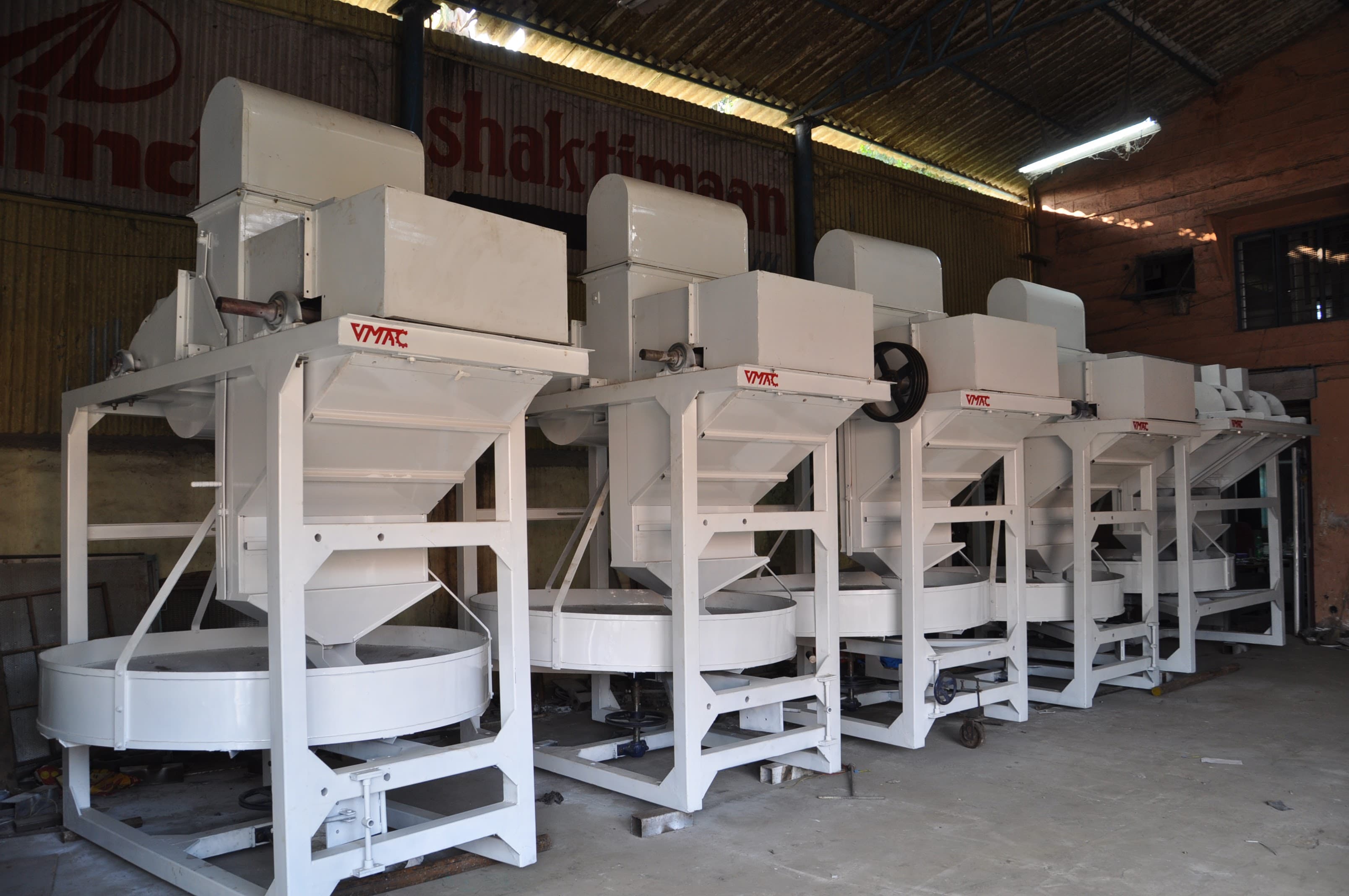
Coffee Huller
Abrasive disc huller for removing dried parchment and husk from washed parchment coffee — high throughput, adjustable hulling intensity, and low bean breakage for dry mill operations.
Rubber Roll Coffee Huller
Counter-rotating rubber roll huller that gently removes parchment from dried washed Arabica with less than 1–2% bean breakage. The industry-standard hulling machine for parchment coffee in Karnataka, Kerala, and Tamil Nadu estates.
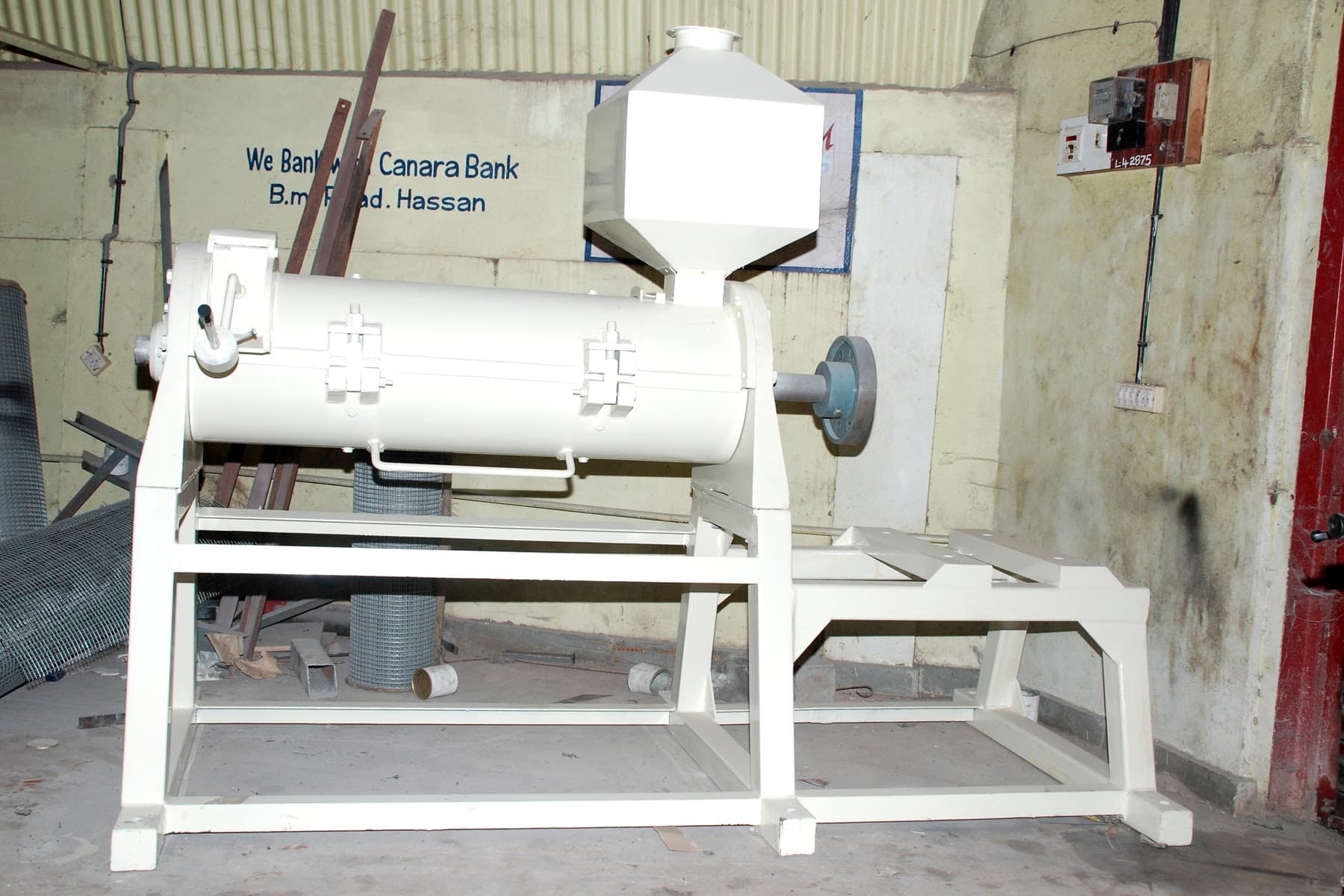
Coffee Peeler Polisher
Removes the silver skin (testa) from hulled green beans by abrasive or friction action — producing a brighter, cleaner export bean that meets Coffee Board of India polishing requirements for Plantation grade certification.