
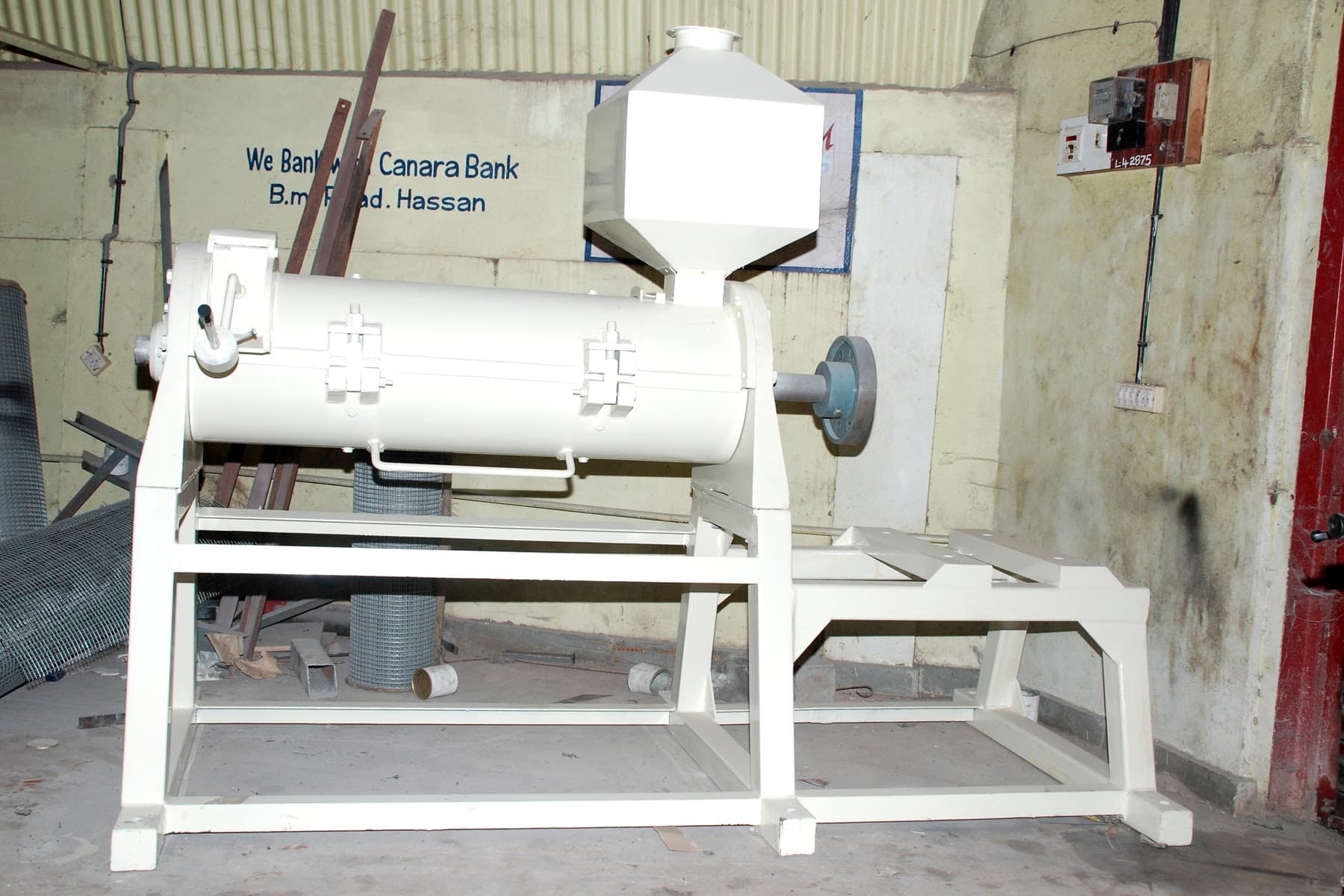
Coffee Peeler Polisher
Removes the silver skin (testa) from hulled green beans by abrasive or friction action — producing a brighter, cleaner export bean that meets Coffee Board of India polishing requirements for Plantation grade certification.
| Capacity range | 500 kg/hr – 10,000 kg/hr (model-dependent) |
| Motor power | 3 kW – 15 kW (model-dependent) |
| Polishing mechanism | Friction disc (standard) or abrasive drum (available on request) |
| Drum / disc diameter | 250 mm – 600 mm (model-dependent) |
| Adjustable gap / clearance | Yes — steplessly adjustable to control polishing intensity |
| Retention time | 8–25 seconds (adjustable via feed rate and drum speed) |
| Water addition | Optional — 1–3% bean weight; gravity-fed metering valve on equipped models |
| Bean temperature rise | ≤ 8 °C above ambient when correctly set; built-in cooling fan on models ≥ 2 TPH |
| Outturn loss | 1–3% of green bean weight (silver skin removed) |
| Power supply | 3-phase, 415V, 50 Hz |
Key Features
Removes silver skin (seed coat / testa) by abrasive drum or friction disc action — standard Indian export requirement for Plantation AA, A, AB, B, C grades
Friction disc type preferred for washed Arabica — bean-on-bean action is gentler than roller abrasion, preserving surface oils and reducing breakage rate
Optional controlled water addition (1–3% bean weight) reduces heat build-up and improves silver skin release without wetting the green coffee
Integrated aspiration at discharge — liberated silver skin chaff captured at source and exhausted to chaff cyclone, preventing fire hazard and dust contamination
Adjustable drum gap / disc clearance and feed rate — polishing intensity tuned per crop, moisture level, and grade requirement
Built-in cooling fan on medium and large models limits bean temperature rise to under 8 °C above ambient — protects cup quality on extended runs
Removes 1–3% of bean weight as silver skin under correct settings — minimal outturn loss with complete silver skin removal
Available in abrasive roller and friction disc variants — select based on species (Arabica vs Robusta), throughput, and market requirement
Modular design — installs directly after the huller in the dry mill line; discharge connects to existing winnower or aspirator without additional transition equipment
Models & Sizing
Right-Sized for Every Operation
VMAC manufactures peeler polishers across four capacity tiers from 500 kg/hr for small estate dry mills to 10 TPH for large export curing works. All models feature the friction disc polishing mechanism as standard (abrasive drum available on request), adjustable disc gap, and integrated aspiration. Water addition is fitted as standard on models above 2 TPH; available as an option on smaller models.
Small Estate
500–1,200 kg/hr
capacity
Small estates and cooperative dry mills processing up to 100 bags per day. Suits single-variety washed Arabica operations where Coffee Board Plantation B or C certification is targeted.
Medium Estate / Cooperative
1,200–3,000 kg/hr
capacity
Medium estates and cooperative curing facilities processing 100–300 bags per day. Handles Plantation AA, A, and AB grades. Water addition optional.
Large Estate / Small Curing Works
3,000–6,000 kg/hr
capacity
Large estates and licensed curing works serving multiple farms. Continuous multi-shift operation. Water addition fitted as standard. Cooling fan integrated.
Export Curing Works
6,000–10,000 kg/hr
capacity
High-volume export curing works and processing plants handling full daily throughput across all Arabica and Robusta export grades. Often installed in parallel with the huller for matched throughput.
Custom
Your specification
capacity
For operations requiring throughput beyond the standard range. VMAC engineers the machine to your exact capacity and processing conditions.
Request a Custom QuoteConfigurations
Full Model Range — Coffee Peeler Polisher
All models use the friction disc mechanism as standard and include integrated aspiration. Abrasive drum configuration available on request. Water addition fitted on models 3,000 kg/hr and above; optional on smaller models. Contact VMAC for exact dimensions and custom configurations.
| Model Tier | Capacity (kg/hr) | Motor Power | Disc Diameter | Water Addition | Cooling Fan | Best For |
|---|---|---|---|---|---|---|
| Small Estate | 500–1,200 | 3–4 kW | 250–300 mm | Optional | No | Small estate / cooperative |
| Medium Estate / Cooperative | 1,200–3,000 | 5.5–7.5 kW | 350–400 mm | Optional | No | Medium estate / cooperative curing |
| Large Estate / Small Curing Works | 3,000–6,000 | 7.5–11 kW | 450–500 mm | Standard | Yes | Large estate / licensed curing works |
| Export Curing Works | 6,000–10,000 | 11–15 kW | 550–600 mm | Standard | Yes | High-volume export curing works |
| Custom | Built to your capacity and specification — contact us for a quote | |||||
Overview
About the Coffee Peeler Polisher
VMAC's Coffee Peeler Polisher — known in India simply as the peeler polisher — removes the thin papery silver skin (seed coat / testa) that remains adhered to the green bean surface after hulling. Polishing is an optional but frequently mandatory step for Indian export Arabica: Coffee Board of India grade standards for Plantation AA, A, AB, B, and C explicitly require polished beans, making the peeler polisher standard equipment in virtually every Karnataka, Kerala, and Tamil Nadu curing works processing washed Arabica for export. Two polishing mechanisms are available. The abrasive drum polisher lines the inside of a rotating drum with abrasive material; beans tumbling inside are abraded against the drum surface, stripping the silver skin by friction between bean and drum. The friction polisher (also called a conical or centrifugal polisher) drives beans through a narrow conical passage where bean-against-bean friction strips the silver skin with less mechanical aggression — preferred for Arabica where over-polishing removes surface oils and causes cosmetic blemishes. VMAC's standard offering is the friction disc type with integrated aspiration: liberated silver skin and chaff are captured at source by an air column and exhausted to a chaff cyclone before emission. Key settings — feed rate, drum or disc gap, and for some models a controlled water addition of 1–3% bean weight — determine polishing intensity. Correctly set machines remove 1–3% of input bean weight as silver skin without raising bean temperature more than 5–8 °C above ambient. Over-aggressive settings increase breakage, raise temperature, and strip surface oils from the bean — reducing cup quality. An integrated cooling fan or water addition helps manage heat on high-throughput models. Models range from 500 kg/hr for estate dry mills to 10 TPH for large export curing works. The output polished green coffee exits directly to a winnower or aspirator to remove liberated chaff before screen grading.
How It Works
How It Works
A coffee peeler polisher — whether abrasive drum or friction disc type — strips the silver skin from green beans by controlled mechanical friction. The silver skin (seed coat) is already loosened by hulling; the polisher completes its removal with minimal bean damage when set correctly.
Bean feed and metering
Hulled green coffee is fed from the huller discharge into the polisher hopper. A feed gate or rotary valve meters the beans at a controlled rate into the polishing chamber. Feed rate determines residence time — slower feed increases polishing intensity; faster feed reduces it. For models with water addition, a metering valve introduces 1–3% water by weight at the feed inlet, which softens the silver skin and reduces friction heat.
Abrasive or friction contact
In a friction disc polisher, beans are centrifugally driven between a rotating disc and a stationary conical housing. The bean-on-bean and bean-on-disc contact strips the silver skin by shear and compression forces — a gentler action than direct abrasion. In an abrasive drum polisher, beans tumble inside a rotating drum lined with abrasive material and are stripped by direct bean-to-abrasive contact. The disc type is preferred for washed Arabica; the drum type is used for Robusta or where heavier silver skin removal is required.
Silver skin release and heat management
As friction breaks the adhesion between the silver skin and the bean surface, the silver skin flakes away as fine papery chaff. Friction generates heat in the bean mass. On models with integrated cooling fans, ambient air is drawn through the polishing chamber continuously, limiting temperature rise. Water addition (where fitted) provides evaporative cooling in addition to softening the silver skin. Bean temperature should not exceed 35 °C during polishing — above this, surface oils can be mobilised and cup quality may be affected.
Chaff aspiration and discharge
Polished beans and liberated silver skin chaff exit the polishing chamber together. An integrated air column or aspiration duct — positioned immediately at the discharge — draws the lightweight chaff away from the heavier bean stream. Chaff is conveyed pneumatically to a chaff cyclone where it is collected and separated from the exhaust air. Silver skin chaff is highly combustible and must always be exhausted to a properly designed chaff cyclone — never accumulate loose silver skin near heat sources or electrical equipment.
Polished bean output
Clean polished green beans exit the polisher discharge chute and flow to the next machine in the dry mill line — typically a winnower or aspirator for a final chaff-removal pass, followed by screen grading. Visual inspection of the discharge stream should show beans with a smooth, bright surface and no visible silver skin patches. If patches remain on more than 5% of beans, the gap is too wide or feed rate too fast — reduce feed rate first, then close the gap incrementally.
Know the Difference
Coffee Peeler Polisher vs. Skipping Polishing (Unpolished Export)
Polishing is an optional step — and in many specialty coffee markets outside India, unpolished washed coffee is acceptable or even preferred. The decision to include a peeler polisher in the dry mill depends entirely on the target market and grade certification required. This comparison sets out when polishing adds value and when it can be omitted.
| Feature | Coffee Peeler Polisher | Skipping Polishing (Unpolished Export) |
|---|---|---|
| Appearance of export bean | Bright, clean surface with no visible silver skin — meets the visual standard for Indian Plantation grades and preferred by Middle East and certain East Asian markets | Some silver skin remains on bean surface — acceptable in specialty markets (SCA, Nordic buyers) but visually inferior for commodity and traditional export markets |
| Coffee Board of India grade certification | Required — Plantation AA, A, AB, B, C, and Robusta grades for Indian export must be polished per Coffee Board norms; curing works without a polisher cannot certify these grades | Not possible for Plantation grades — Indian export grade certification requires polished beans; unpolished coffee cannot be licensed as Plantation grade |
| Specialty and direct trade market access | Neutral — most specialty buyers (SCA-standard) do not require polishing; polishing is not a quality marker for specialty | Preferred by many specialty and direct-trade buyers — particularly for natural or honey process coffees where polishing is not traditional and unpolished surface texture is expected |
| Chaff content in export bag | Lower — polishing removes silver skin before bagging, reducing chaff that can break down and contaminate beans during ocean freight | Higher residual chaff — more silver skin fragments shed inside the bag during transit; less relevant for jute sacks but noticeable in GrainPro-lined bags |
| Bean temperature and breakage risk | Adds a small heat and breakage risk — incorrectly set polishers raise bean temperature and increase fines; correctly set polishers add negligible risk | No additional heat or breakage — one fewer machine in the line reduces processing time and potential mechanical damage |
| Processing cost and time | Adds machine cost, power consumption (3–15 kW), 1–3% outturn loss, and additional handling time per lot | Lower cost per kg processed — no polisher investment, no outturn loss, no additional energy; justified where market does not require polishing |
| Correct recommendation | Use for: Indian Plantation grade export (all washed Arabica); Robusta domestic market lots where appearance is required; markets specifying polished green coffee | Use for: specialty export (SCA-standard); natural and honey process Arabica for European and North American specialty buyers; Robusta for industrial roasters who specify unpolished |
For Indian curing works: polishing is not optional — it is required for Coffee Board grade certification of all Plantation grades. For specialty-focused farms or cooperatives exporting directly to roasters in North America or Europe, confirm with the buyer before installing a polisher. Many specialty buyers explicitly do not want polished coffee.
Processing Line
Where It Fits in Your Processing Line
The peeler polisher sits immediately after the huller in the dry mill sequence — before winnowing, before screen grading, and before density separation. It is the first post-hulling refinement step.
Pre-cleaner / scalper
Removes gross foreign material — sticks, soil lumps, large debris — before hulling
Destoner
Removes dense foreign objects (stones, glass, metal) heavier than coffee — protects huller and polisher from impact damage
Huller
Rubber-roll huller (washed parchment Arabica) or disc huller (natural / pulped natural) removes dried parchment or husk; silver skin remains loosely adhered to bean surface after hulling
Peeler / Polisher
This machineRemoves silver skin (testa) by abrasive drum or friction disc action; integrated aspiration removes liberated chaff at source; mandatory for Indian Plantation grade export certification
Winnower / aspirator
Final air-column chaff removal — catches any remaining silver skin fragments and parchment dust that passed through the polisher
Screen grader
Separates polished green beans by screen size — Plantation AA (Screen 18+), AB, B, C, and peaberry fractions; must run after polishing, not before
Gravity separator
Density-sorts each screen-graded fraction separately; removes immature beans, hollow shells, and insect-damaged beans invisible to the polisher
Colour sorter (CCD / laser)
Removes colour-visible defects — black beans, sour beans, white and chalky beans — that mechanical and density sorting cannot detect
Weighing, bagging, export
Polished, graded, and sorted beans bagged in jute or GrainPro-lined bags; labelled with grade, ICO mark, lot, and crop year
FAQ
Frequently Asked Questions
Is polishing required for Indian coffee export grades?
Yes, for all Coffee Board of India Plantation grades — Plantation AA, A, AB, B, and C — polishing is required. Indian curing works licensed by the Coffee Board must produce polished beans when processing these grades for export. The requirement applies to washed Arabica. Without a peeler polisher in the dry mill line, a curing works cannot certify or export these grades through Coffee Board channels. Robusta grades for domestic and export markets are also commonly polished in India, though the market requirement is somewhat less rigid for Robusta than for Arabica.
What is silver skin, and why does it need to be removed?
Silver skin — technically the seed coat or testa — is a thin, papery layer that covers the green coffee bean. It is the innermost layer of the cherry, lying directly against the bean surface. After hulling, the parchment is removed but the silver skin typically remains partially or fully adhered to the bean. Silver skin removal is required for three reasons: (1) appearance — polished beans look brighter and more uniform, meeting the visual standard of commodity export markets; (2) Coffee Board grade certification — Indian Plantation grades explicitly require polished beans; (3) chaff reduction — silver skin shed inside an export bag during transit breaks into fine dust that can contaminate beans and creates a poor impression on opening.
What is the difference between an abrasive polisher and a friction polisher?
An abrasive polisher uses a drum or rollers lined with abrasive material (similar to coarse sandpaper) that directly abrades the silver skin off the bean surface. The action is aggressive and effective even on heavily adhered silver skin — commonly used for Robusta. A friction polisher (also called a conical or centrifugal polisher) drives beans through a narrowing conical passage where bean-on-bean and bean-on-disc contact strips the silver skin by shear forces rather than direct abrasion. The action is gentler, preserves surface oils, and causes less breakage. For washed Arabica intended for export, the friction polisher is strongly preferred. VMAC supplies the friction disc type as standard.
Will polishing damage the beans or affect cup quality?
Correctly set polishing causes negligible cup quality impact — the silver skin is a structural layer, not a flavour-contributing one, and its removal at the correct intensity does not affect the bean's cellular structure or endosperm. Problems occur when machines are incorrectly set: too aggressive a gap or too slow a feed rate causes excessive abrasion, raising bean temperature above 35–40 °C and stripping surface oils that contribute to freshness during storage. Signs of over-polishing include chalky bean surface texture, higher-than-normal fines and breakage, and elevated bean temperature at discharge. The single most important setting is the gap — set it to the minimum that achieves silver skin removal, not the maximum.
What does the water addition option do, and do I need it?
Water addition introduces 1–3% water by weight (of the green bean input) at the polisher feed inlet. The water softens the silver skin slightly, reducing the mechanical force needed to strip it, which in turn reduces friction heat and lowers breakage rates. It also provides a small amount of evaporative cooling. Water addition is most useful on high-throughput machines running continuously — at 3 TPH and above, without water or a cooling fan, bean temperature can creep above safe limits during sustained operation. For small estate machines running short batches with cooling time between lots, water addition is less critical. Water must be metered carefully — too much wets the beans and causes downstream moisture problems.
Can polishing increase the proportion of broken beans in the lot?
Yes, over-polishing does increase the breakage rate — beans that are already stressed from hulling can fracture in the polishing chamber if the gap is too tight or retention time too long. Correctly set polishers add 0.1–0.5% additional breakage on top of huller breakage — this is negligible. If breakage is visibly high at polisher discharge, widen the disc gap first, then reduce feed rate. Beans that enter the polisher already cracked or very brittle (from over-drying) will break regardless of polisher settings — check incoming bean moisture (target 10–12% moisture before hulling). Post-hulling screen grading will remove most broken beans regardless, so some polisher-induced fines are recovered by the screen grader.
How is the silver skin chaff collected and disposed of?
Silver skin chaff is captured by the integrated aspiration system at the polisher discharge. The aspirator draws the lightweight chaff away from the heavier bean stream and conveys it pneumatically to a chaff cyclone where the chaff settles out and clean air is exhausted. VMAC's peeler polisher ships with a compatible chaff cyclone specification — the cyclone is not included as standard but VMAC can supply it as part of a complete dry mill package. Silver skin chaff is highly combustible — it is used as boiler fuel in some curing works, or disposed of as organic waste. Never allow loose silver skin to accumulate near electrical panels, motors, or any ignition source.
Does the peeler polisher come before or after the screen grader?
Always before the screen grader. Polishing must be done on the entire unhulled lot before size separation, because the polishing machine is not size-sensitive — it processes the full bean stream uniformly. Screen grading after polishing also ensures that any fines or fragments produced during polishing are removed by the screen grader, keeping the final size-graded fractions clean. If polishing were done after screen grading, you would need to run each size fraction through the polisher separately, which increases handling, introduces contamination risk between fractions, and negates the efficiency of the sequence. The correct sequence is: Huller → Polisher → Winnower → Screen Grader.
Is a polisher used for natural process or honey process Arabica?
Rarely. Natural and honey process Arabica — where the cherry dries with fruit attached — is typically polished only if the target market explicitly requires it. Most specialty buyers purchasing natural or honey process Arabica from India or East Africa expect unpolished or lightly processed beans, and the cup character of these coffees is partly attributed to the surface compounds that heavy polishing would remove. For Indian Plantation grades produced from natural process (drip-dried) cherry, polishing is still required for Coffee Board grade certification. For direct export to specialty buyers under a private label or direct trade arrangement, confirm the buyer's specification before polishing.
What maintenance does a peeler polisher require?
Key maintenance items: (1) Disc or drum wear surfaces — the friction disc or abrasive drum lining wears over time and reduces polishing effectiveness; inspect monthly and replace when polishing quality drops or gap adjustment can no longer compensate. (2) Aspiration duct cleaning — silver skin chaff accumulates in bends and transitions of the aspiration ductwork; clear weekly during peak season to prevent blockage and fire risk. (3) Bearing lubrication — the main disc shaft and feed roller bearings require periodic greasing per the maintenance schedule. (4) Feed gate or rotary valve wear — check that the feed metering device maintains consistent flow; worn feed gates allow surge feeding that over-polishes briefly, then under-polishes. (5) Water addition valve calibration — if fitted, verify the water metering rate at the start of each day to prevent under- or over-application.
Send a Enquiry Request
Retail store
Mon-Sat 9am to 5pm.
B.M road, Hassan, Karnataka 573201
Related Products
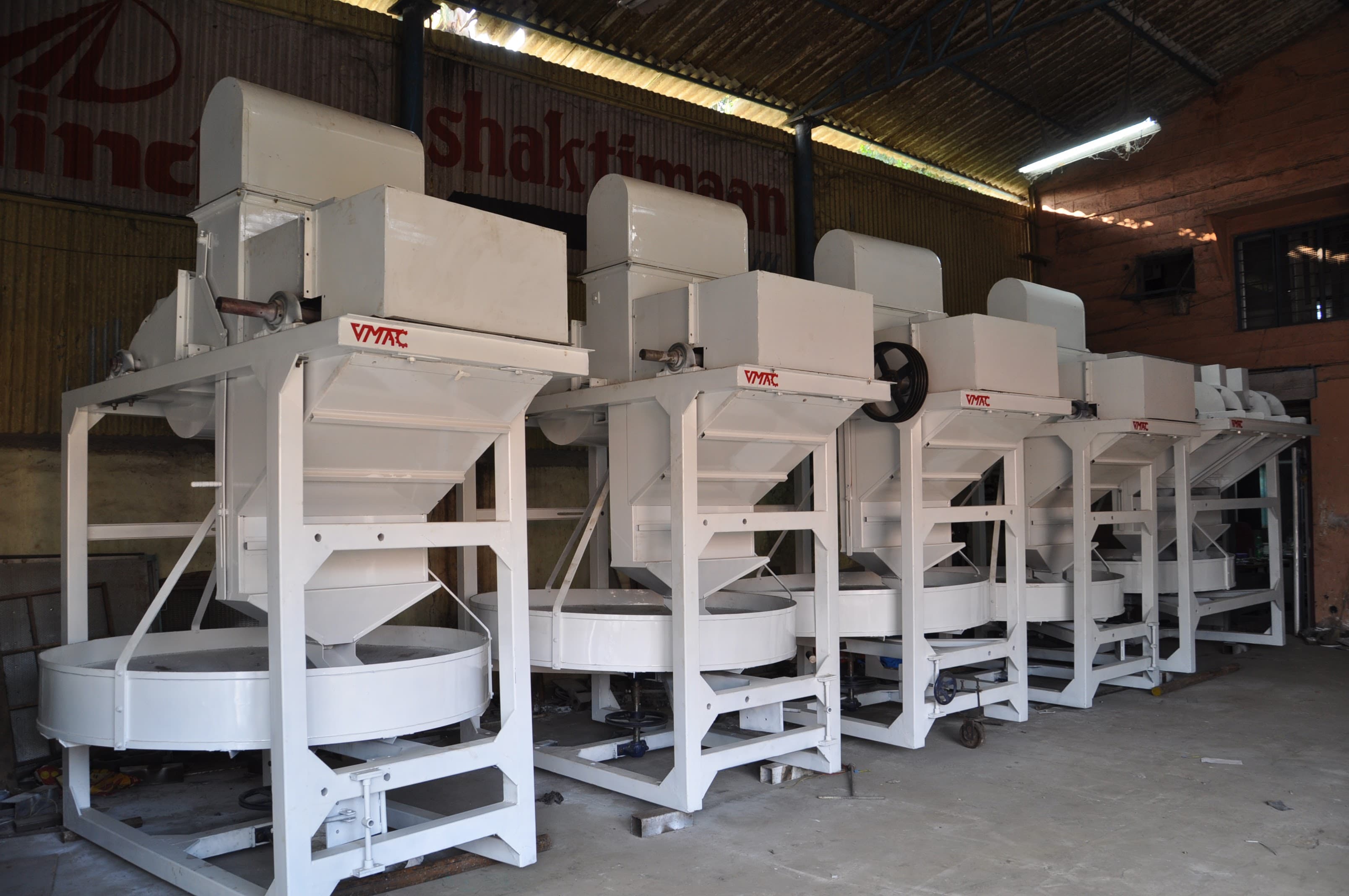
Coffee Huller
Abrasive disc huller for removing dried parchment and husk from washed parchment coffee — high throughput, adjustable hulling intensity, and low bean breakage for dry mill operations.
Rubber Roll Coffee Huller
Counter-rotating rubber roll huller that gently removes parchment from dried washed Arabica with less than 1–2% bean breakage. The industry-standard hulling machine for parchment coffee in Karnataka, Kerala, and Tamil Nadu estates.
Disc Coffee Huller
Abrasive rotating-disc huller for natural and dry-processed coffee — removes dried husk from cherry-processed Robusta and Arabica naturals that rubber roll machines cannot handle. Capacity 300 kg/hr to 5 TPH.