
VMAC Industries
·2026-04-16
How to Size a Coffee Huller for Your Throughput
Most huller sizing mistakes come down to one problem: the buyer picks a machine based on peak throughput printed on the spec sheet and ignores everything else. Then the huller either chokes on feed variations, breaks too many beans, or sits idle half the day because it was oversized for the operation. This guide walks through a proper sizing approach — the same one we use when recommending hullers to estates in Coorg and Chikmagalur, curing works in Hassan, and export mills across East Africa and Southeast Asia.
Start With Your Bean Type — It Decides the Huller Category
Before you look at any capacity number, answer one question: are you hulling washed parchment or natural (dry-processed) cherry?
This single factor eliminates half your options immediately.
Washed parchment (Arabica or Robusta): You have two choices — a rubber roll huller or a disc-type coffee huller. Rubber rolls give the lowest breakage in the industry (under 1-2%), which matters if you are selling specialty-grade or auction lots. The disc-type huller is more forgiving with mixed-moisture and mixed-size feed, and breakage stays under 2% at correct settings.
Natural/dry-processed cherry (Robusta or Arabica naturals): You need an abrasive disc huller. Period. Rubber rolls cannot handle dried cherry — the hard, irregular husk destroys the rubber surfaces within hours. Do not attempt it regardless of what anyone tells you.
Monsooned Malabar or other specialty washed lots: Rubber roll huller is the clear choice here. The gentle differential-speed action preserves the swollen, fragile bean structure that makes Monsooned Malabar valuable.
If you process both washed parchment and natural cherry in the same facility — which is common in Karnataka and Kerala where estates grow both Arabica and Robusta — you need two huller types on the line, or at minimum, a disc-type coffee huller that can handle both with gap adjustments.
The Sizing Formula
Here is the formula we use for every installation:
Capacity needed (kg/hr) = (Daily bags x bag weight) / Operating hours / 0.75
The 0.75 factor accounts for real-world downtime: feed interruptions, minor adjustments, cleaning between lots, shift changeovers. If you size to 100% utilization, you will never hit your daily target.
Worked Example 1: Small Estate
A 50-acre estate in Wayanad processing its own cherry:
- Daily volume: 50 bags x 50 kg = 2,500 kg/day
- Operating hours: 8 (single shift)
- Capacity needed: 2,500 / 8 / 0.75 = 417 kg/hr
This points to a small estate model in the 250-500 kg/hr range (3 HP disc-type coffee huller, or an RRH-200 rubber roll at 200-400 kg/hr if processing washed parchment exclusively).
Worked Example 2: Large Estate or Co-op
A curing works in Chikmagalur handling intake from multiple estates:
- Daily volume: 300 bags x 50 kg = 15,000 kg/day
- Operating hours: 16 (two shifts)
- Capacity needed: 15,000 / 16 / 0.75 = 1,250 kg/hr
This requires a large estate model in the 1,000-2,000 kg/hr range. For washed parchment, that is an RRH-1500 rubber roll huller. For natural cherry, a DH-1500 abrasive disc huller. For a mixed operation, you would run both in parallel lines or sequence them depending on the season.
Worked Example 3: Export-Scale Curing Works
A large curing works in Hassan running 800+ bags/day:
- Daily volume: 800 bags x 50 kg = 40,000 kg/day
- Operating hours: 16 (two shifts)
- Capacity needed: 40,000 / 16 / 0.75 = 3,333 kg/hr
This puts you in the 4,000-5,000 kg/hr tier — a 20 HP disc-type coffee huller or a DH-5000 abrasive disc huller (11-15 kW with VFD standard). At this scale, you are almost certainly running multiple hullers in parallel for redundancy anyway.
The Three Huller Types and Where Each Fits
Rubber Roll Huller
Two rubber-coated rolls rotate in opposite directions at a 5-15% speed differential. The faster roll pulls the parchment off while the slower roll holds the bean. It is the gentlest hulling mechanism available.
Specifications across the range:
- RRH-200: 200-400 kg/hr, 1.5 kW
- RRH-500: up to 500 kg/hr
- RRH-1500: up to 1,500 kg/hr
- RRH-3000: 2,500-3,000 kg/hr, 7.5 kW
Breakage rate: Under 1-2% — the lowest of any huller type. This is why every specialty exporter in southern India runs rubber rolls for their top lots.
Critical requirements:
- Feed must be pre-sized for best results. Different screen sizes need different roll gaps. For Screen 17-18 (AA-grade), start at 1.5-1.8 mm gap and fine-tune from there.
- Input moisture must be 10-12%. Above 13%, the parchment sticks and the rolls slip instead of stripping cleanly.
- Never feed natural cherry through rubber rolls. The dried husk is abrasive and will score the rubber surfaces beyond repair.
Roll life: 300-600 processing hours before re-covering is needed. Budget for this — it is a consumable, not a failure. Estates running 8-hour days through a 3-month season will typically get through one set of rolls per season.
Disc-Type Coffee Huller
An abrasive rotating disc works against a stationary concave. This is the workhorse design that handles the widest range of inputs.
Specifications across the range:
- 250-500 kg/hr at 3 HP
- 500-1,000 kg/hr at 5 HP
- 1,000-2,000 kg/hr at 7.5 HP
- 2,000-3,000 kg/hr at 10 HP
- 3,000-4,000 kg/hr at 15 HP
- 4,000-5,000 kg/hr at 20 HP
Breakage rate: Under 2% at correct settings on washed parchment.
Where it excels: Over-dried lots, mixed-moisture batches, and operations that switch between bean types through the season. If you are an estate in Tamil Nadu processing both washed Arabica and some natural Robusta, this is the machine that handles both without drama.
Disc life: 1-3 seasons depending on throughput and feed abrasiveness. Significantly longer than rubber roll consumables, which partly offsets the slightly higher breakage rate.
Abrasive Disc Huller
Carborundum or silicon carbide abrasive discs designed specifically for natural/dry-processed coffee.
Specifications across the range:
- DH-300: 300-500 kg/hr, 2.2 kW
- DH-500: 500-800 kg/hr
- DH-1500: 1,200-1,500 kg/hr
- DH-3000: 2,500-3,000 kg/hr
- DH-5000: 4,000-5,000 kg/hr, 11-15 kW
Breakage rate: 2-5% on natural Robusta cherry. This is inherent to the process — dried cherry husks are hard and irregular, and some bean fracture is unavoidable. Well-maintained machines with correct gap settings stay at the lower end of that range.
Gap settings:
- Natural Robusta cherry: 2.0-3.5 mm
- Arabica naturals: 1.5-2.5 mm (tighter because the bean is denser and the husk thinner)
Disc life: 500-1,000 hours between replacements. Dressing (resurfacing) is needed every 500-800 hours to maintain cutting efficiency. VFD (variable frequency drive) comes standard on 5.5 kW and above models, letting you fine-tune RPM to match the feed characteristics.
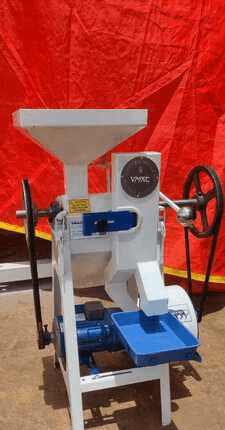
VMAC Huller Range
Moisture: The Factor Most Buyers Underestimate
Every huller has an optimal moisture window, and ignoring it causes more problems than picking the wrong capacity.
10-12% moisture content is the target range for hulling. At this level, the parchment or husk is brittle enough to fracture cleanly, and the bean is resilient enough to resist cracking.
Above 13%: Rubber roll hullers suffer the most. The parchment becomes pliable instead of brittle, so the rolls slip and smear rather than strip. You get incomplete hulling, reduced throughput, and excessive roll wear. Disc hullers can tolerate slightly higher moisture but efficiency drops sharply. If your lots consistently arrive above 13%, you need to add a drying stage or hold the parchment longer before hulling.
Below 9%: The beans become brittle and breakage rates climb across all huller types. You will also see more dust and fines, which load up your downstream winnower and reduce the proportion of whole beans reaching the grader. Over-dried lots from delayed processing or extended sun-drying are common in parts of East Africa — if this describes your operation, the disc-type coffee huller handles it better than rubber rolls because the abrasive action is less sensitive to brittleness.
Invest in a reliable moisture meter and check every lot before it enters the huller. This one habit prevents more quality loss than any machine upgrade.
Breakage Tolerance and Market Requirements
Your acceptable breakage rate depends entirely on where the coffee is going.
Specialty export (auction lots, direct trade, single-origin): You need breakage under 1%. This means rubber roll hullers on pre-sized, moisture-controlled washed parchment. There is no shortcut. Every broken bean is a defect that drops your score.
Commercial export: Breakage under 2% is standard and achievable with either rubber rolls or a well-adjusted disc-type coffee huller. Most curing works in Karnataka and Kerala target this range.
Domestic market or instant coffee supply: Breakage up to 5% is commercially acceptable. Abrasive disc hullers processing natural Robusta cherry at high throughput will land in this range, and that is fine for the end use.
Match the huller to the market, not the other way around. Running a rubber roll huller on cherry destined for instant coffee manufacturing is wasted precision. Running a high-throughput abrasive disc on specialty Arabica parchment is throwing money away in breakage.
Feed Uniformity and Pre-Sizing
Rubber roll hullers are sensitive to feed size variation. The roll gap is fixed (or manually adjusted), so beans significantly smaller or larger than the gap setting will either pass through unhulled or get crushed.
For Screen 17-18 AA-grade parchment, start with a roll gap of 1.5-1.8 mm and adjust based on output inspection. If you are feeding mixed screen sizes — which is reality for most estate-level operations before grading — the disc-type coffee huller is more tolerant because the abrasive action works across a wider size range without gap changes.
The practical approach for mixed operations: run a pre-cleaner and destoner upstream (you need these anyway for stone and debris removal), and if you are using rubber rolls, add a pre-grading screen to sort by size before the huller. The cost of one additional screen pays for itself in reduced breakage and more consistent hulling.
Where the Huller Sits in Your Processing Line
A huller is not a standalone machine. It performs best when correctly positioned in the processing sequence:
- Pre-cleaner — removes sticks, leaves, stones, and oversized debris
- Destoner — removes remaining stones and heavy foreign matter
- Huller — removes parchment or dried cherry husk
- Winnower/aspirator — separates husk fragments from clean bean
- Grader/sizer — sorts beans by screen size
- Gravity separator — sorts by density to remove defects
Feeding a huller without pre-cleaning and destoning accelerates wear on discs and rolls, introduces foreign matter into the hulled output, and increases breakage from stones jamming the mechanism. Every installation we commission includes these upstream machines as standard — not as optional extras.
Sizing Mistakes to Avoid
Oversizing by more than 30%: Running a 3,000 kg/hr huller at 800 kg/hr means the feed bed is too thin, residence time is too short, and hulling efficiency drops. The machine was designed to work under load.
Ignoring seasonal peaks: An estate in Coorg may process 50 bags/day in the early season but 200 bags/day at peak harvest. Size for 70-80% of peak, not average — you can extend hours during peak weeks, but you cannot make a small huller run faster.
Forgetting about downstream bottlenecks: A 5,000 kg/hr huller feeding into a 2,000 kg/hr grader means hulled coffee piles up between machines. Size the entire line together, not individual machines in isolation.
Skipping the 0.75 utilization factor: Every operator thinks they will run at 100% efficiency. None do. The changeovers, cleaning, and minor adjustments are real. Use 0.75, or 0.70 if your operation involves frequent lot changes for traceability.
Not sure which huller suits your operation?
Tell us your bean variety, daily bag count, and moisture profile — VMAC's engineers will recommend the right huller type, capacity, and gap setting for your line.