
Coffee Trommel Grader
Rotary drum screen grader for size-classifying coffee cherry, parchment, or green beans at high throughput. Continuous tumbling action self-cleans perforations and handles high-moisture wet cherry — separating undersize debris, grading material into two or more size fractions, and discharging overs at the drum exit.
| Capacity range | 500 kg/hr (small estate model) to 10,000 kg/hr (large intake / industrial trommel). Rated at 65–70% moisture cherry. Throughput for dry parchment or green bean will be higher at equivalent drum dimensions. |
| Drum dimensions | Drum diameter: 400 mm (small) to 1,200 mm (industrial). Drum length: 900 mm (small, 1 screen section) to 3,600 mm (industrial, 3 screen sections). Larger drums provide more screen area and allow more separation fractions. |
| Screen aperture sizes | First section (undersize screen): 6–8 mm round apertures (removes pin-cherry, soil, fine debris). Intermediate section(s): 10–14 mm round apertures (grades cherry by size). Aperture sizes supplied to specification — contact VMAC for custom aperture combinations. |
| Drum rotation speed | 15–30 RPM. Adjustable via VFD or belt-pulley ratio. Lower RPM suits sticky or overripe cherry; higher RPM suits dry or free-flowing material. Excessive RPM causes centrifugal pinning of material to drum wall — defeating the tumbling action. |
| Drum inclination | Fixed at 2°–6° from horizontal (factory-set per model; adjustable at installation). Inclination controls bean residence time in the drum: shallower angle increases residence time for better separation; steeper angle increases throughput rate. |
| Drive system | Geared motor driving chain-and-sprocket on drum periphery (standard) or friction-roller drive (heavy-duty industrial models). Chain drive preferred for wet-mill environments: more tolerant of coffee pulp and water exposure than belt drives. |
| Motor power | 0.37 kW (single-phase, 500 kg/hr estate model) · 0.75 kW (1–2 TPH) · 1.5 kW (2–4 TPH) · 2.2 kW (4–6 TPH) · 3.7 kW (6–10 TPH). Power consumption is low relative to throughput — the drum does not do mechanical work on the beans, only rotation. |
| Output fractions | 2 fractions (small / normal) + overs reject from a single-intermediate-screen drum. 3 fractions (small / normal-A / normal-B) + overs from a dual-intermediate-screen drum. Undersize and overs are reject streams; one or two intermediate fractions are product cherry. |
| Screen panel material | Mild steel (standard) or SS 304 (recommended for wet-mill applications and export curing works). Bolt-in panels; no welding required for replacement. Panel replacement time: 20–40 minutes per section. |
| Construction | Heavy mild-steel or SS 304 drum shell · Fabricated MS main frame · Bolt-in perforated screen panels · Geared motor with chain drive · Collection hoppers below each screen section · Inclined mounting frame with adjustable feet · Optional chute extensions for direct discharge to pulper or conveyor |
Key Features
Rotating perforated cylinder continuously self-clears — no screen blinding even with wet, high-moisture cherry at 65–70% moisture content at harvest
Multi-section drum: first screen section removes undersize pin-cherries and debris; one or two intermediate sections grade to target size; overs discharge at far end
Gentle tumbling action avoids fruit bruising — critical before pulping, where bruised cherry increases fermentation inconsistency and mucilage breakdown
Continuous operation design: no reciprocating inertia loads, lower vibration than flat screens, suitable for mounting above pulper intake hoppers
Chain-and-sprocket or friction-roller drive on drum periphery — robust under continuous wet-season operating conditions; minimal lubrication access points
Fabricated mild-steel or SS 304 drum frame with bolt-in replaceable screen panels; panels changed without removing the drum from the frame
Adjustable drum inclination (2°–6°) controls residence time and throughput rate — steeper angle increases throughput; shallower angle extends separation time for difficult lots
Accepts feed directly from receiving hopper or wet conveyor — no prior sizing required; suitable for first machine after cherry intake
Can be paired downstream with a flat screen grader in dry mills: trommel pre-grades to narrow size spread, flat screen produces final export-specification fractions
Models from 500 kg/hr to 10 TPH; single-phase models available for estate installations without three-phase power supply
Models & Sizing
Trommel Grader Model Range
VMAC trommel graders are available in five capacity tiers from small estate cherry intake to large centralised wet-mill stations. All models use the same chain-drive rotating drum principle with bolt-in replaceable screen panels.
TG-500 (Estate Single-Phase)
500–800 kg/hr cherry
capacity
Small estate wet mills receiving up to 3–5 tonnes of cherry per day. Single-intermediate-screen drum produces undersize reject and one product fraction. Compact footprint; single-phase power option for estates without three-phase connection.
TG-1500 (Small Wet Mill)
1,000–2,000 kg/hr cherry
capacity
Small to mid-scale wet mills receiving 10–20 tonnes per day. Two screen sections (undersize + one intermediate). Suitable for estate cooperatives and small centralised processing stations.
TG-3000 (Mid-Scale Wet Mill)
2,000–4,000 kg/hr cherry
capacity
Mid-scale centralised wet mills receiving 20–40 tonnes per day. Two or three screen sections producing undersize, normal-small, and normal-large fractions. Standard configuration for Karnataka and Kerala cooperative wet mills.
TG-6000 (Large Wet Mill / Dry-Mill Pre-Grader)
4,000–6,000 kg/hr
capacity
Large wet mills and dry-mill pre-grading applications. Three screen sections produce two product size fractions plus overs and undersize. Used upstream of flat screen graders in large curing works to narrow the size range of parchment or green bean feed.
TG-10000 (Industrial Intake)
6,000–10,000 kg/hr
capacity
Large centralised intake stations handling multiple farms or estate blocks simultaneously. Heavy-duty chain drive on drum periphery; SS 304 screen panels standard. Suitable for processing stations receiving cherry from 500+ acres under a single roof.
Custom
Your specification
capacity
For operations requiring throughput beyond the standard range. VMAC engineers the machine to your exact capacity and processing conditions.
Request a Custom QuoteConfigurations
Trommel Grader Model Range
Rotary drum graders for cherry intake, wet-mill pre-processing, and dry-mill pre-grading applications
| Model | Capacity (cherry) | Motor | Drum Size | Screen Sections | Output Fractions | Drive Type |
|---|---|---|---|---|---|---|
| TG-500 | 500–800 kg/hr | 0.37 kW | 400 mm × 900 mm | 2 (undersize + 1 intermediate) | Undersize + 1 product + overs | Chain & sprocket |
| TG-1500 | 1,000–2,000 kg/hr | 0.75 kW | 600 mm × 1,500 mm | 2 (undersize + 1 intermediate) | Undersize + 1 product + overs | Chain & sprocket |
| TG-3000 | 2,000–4,000 kg/hr | 1.5 kW | 800 mm × 2,400 mm | 3 (undersize + 2 intermediate) | Undersize + 2 products + overs | Chain & sprocket |
| TG-6000 | 4,000–6,000 kg/hr | 2.2 kW | 1,000 mm × 3,000 mm | 3 (undersize + 2 intermediate) | Undersize + 2 products + overs | Chain & sprocket |
| TG-10000 | 6,000–10,000 kg/hr | 3.7 kW | 1,200 mm × 3,600 mm | 3 (undersize + 2 intermediate) | Undersize + 2 products + overs | Friction roller (heavy-duty) |
| Custom | Built to your capacity and specification — contact us for a quote | |||||
Overview
About the Coffee Trommel Grader
The trommel grader — also called a rotary drum grader, rotary screen, drum screen, or drum sizer — is the high-throughput workhorse of coffee wet mills and large dry mills worldwide. Where a flat oscillating screen grader achieves fine export-specification precision in a relatively narrow size range, the trommel excels at handling large volumes of wet, sticky, or unevenly sized material that would blind or overload a flat screen within minutes. VMAC's trommel graders use a precision-perforated rotating cylinder inclined at a fixed angle. Coffee cherry, parchment, or green beans are fed at the upper (feed) end; as the drum rotates at 15–30 RPM, material tumbles continuously across the perforated panels. Small undersize material — soil particles, small stones, partially formed pin-cherries — falls through the first (smallest aperture) screen section and is collected in a hopper below. Normal-sized material progresses along the drum and exits through intermediate screen sections into their own collection hoppers. Oversized debris — twigs, clumped cherries, leaf litter, and overs — continues to the far end of the drum and discharges into a reject chute. In a wet mill, the trommel grader is typically the first machine after the cherry-receiving hopper. Cherry arrives from the field in a wide size range: a mix of fully formed cherries, underdeveloped pin-cherries, and foreign debris. Feeding this directly to the pulper subjects the pulping drum and burr plates to unnecessary wear from overs and clogs from undersize material. Pre-grading by the trommel produces a uniform-sized cherry feed that increases pulping efficiency and reduces cherry damage. In dry mills and curing works, the trommel is used upstream of the flat screen grader to narrow the size spread of the parchment or green bean lot — a narrower size range fed to the flat screen increases flat-screen throughput, reduces screen blinding, and improves separation precision at size-boundary fractions. The drum's continuous rotation is the key operational advantage over flat screens for wet material. As the drum turns, perforations continuously present a clean face to the material, preventing the blinding that flat-screen perforations experience when processing freshly harvested cherry at 65–70% moisture. Drive systems use a chain-and-sprocket or friction-roller arrangement on the drum periphery, driven by a geared motor. VMAC trommel graders are available from 500 kg/hr for estate-scale cherry receipt to 10 TPH for large wet-mill intake stations.
How It Works
How It Works
The trommel grader separates coffee cherry by diameter using a rotating perforated cylinder. Material tumbles inside the drum as it rotates, and falls through apertures that match its size — smaller material exits early, oversized material exits last. The process is continuous and requires no manual intervention.
Feed intake and entry into drum
Coffee cherry — or parchment / green bean in dry-mill applications — is fed into the upper end of the inclined rotating drum via an inlet chute or directly from the receiving hopper conveyor. The drum rotates at 15–30 RPM. The combination of drum rotation and the shallow downward inclination carries the cherry mass forward along the drum length. As the drum rotates, cherry continuously tumbles — preventing any single berry from sitting stationary against the screen surface. The inlet zone has no perforations: all material is conveyed forward before any separation begins, ensuring even distribution across the active screen length.
First screen section — undersize removal
The first perforated section of the drum carries the smallest apertures — typically 6–8 mm round holes for wet-cherry processing. Pin-cherries (underdeveloped cherries too small to pulp correctly), small stones, soil clods, and sand grains fall through these apertures as they tumble against the screen. This material is collected in the first hopper below the drum and diverted to a waste stream or a separate small-cherry processing path. The continuous rotation prevents blinding: as soon as a perforation is loaded, drum rotation brings it to the top of the rotation arc where material falls away under gravity.
Intermediate screen section(s) — size grading
After passing the undersize section, the remaining material enters one or two intermediate screen sections with larger apertures — typically 10–14 mm for normal cherry. Fully formed cherries of target size fall through these apertures into collection hoppers below. Each intermediate section can have a different aperture to produce a finer size split — for example, an 11 mm section followed by a 13 mm section produces a small-medium fraction and a large fraction as two separate product streams. These size-graded fractions represent the product cherry and proceed to the pulper or further processing.
Overs discharge
Any material that has not passed through any screen section — oversized overs including double-cherries (two fruits fused), large clumps of dried material, green unripe overs, twigs, and leaf debris — exits at the far end of the drum through the overs discharge chute. In a well-managed cherry intake, overs should be a small fraction of the total volume; high overs percentage indicates a harvest maturity problem or foreign material issue that should be addressed at the picking and delivery stage. Overs are typically composted, separated for natural processing as a distinct lot, or re-fed after manual inspection.
Know the Difference
Coffee Trommel Grader vs. Flat Screen / Vibrating Screen Grader
Both the trommel grader and the flat vibrating screen grader separate coffee by physical size, but they are optimised for entirely different positions in the processing line and different material conditions. Understanding this distinction determines whether to use one, the other, or both in sequence.
| Feature | Coffee Trommel Grader | Flat Screen / Vibrating Screen Grader |
|---|---|---|
| Separation principle | Rotating perforated cylinder — material tumbles as drum rotates; beans fall through apertures along the cylinder length by gravity | Horizontally mounted reciprocating flat screens — beans oscillate over perforated panels; smaller beans stratify downward and fall through |
| Screen blinding with wet material | Very low — continuous rotation brings each perforation to the top of the arc where material drops away; tolerates wet cherry at 65–70% moisture without blinding | Moderate to high — wet, sticky, or dusty beans coat round perforations in flat panels; requires pre-cleaning and dry material for consistent operation |
| Throughput | 500 kg/hr to 10 TPH per unit. Higher throughput per unit than equivalent flat-screen area due to continuous rotation without inertia reversal | 500 kg/hr to 10 TPH per unit; throughput is maximised when feed size range is pre-narrowed (e.g., by an upstream trommel) |
| Separation precision at size boundaries | Lower than flat screen — tumbling action means some borderline-size beans pass the aperture on their second or third rotation; not recommended as sole final grader for export specification | Higher precision — stratification by oscillation produces well-defined size fractions suitable for Coffee Board export-grade specification compliance |
| Suitable material condition | Wet cherry, freshly harvested parchment, partially dried naturals — all high-moisture, sticky, or variable-moisture material is handled well | Dry, hulled, winnowed green bean — best performance with clean, dry, uniform material; pre-cleaning required upstream |
| Recommended position in line | Wet mill: first machine after cherry receipt, before pulper. Dry mill: pre-grading stage upstream of flat screen grader to narrow size spread | Dry mill: final grading stage after hulling, polishing, and winnowing; before gravity separator and colour sorter |
| Peaberry separation capability | No — round apertures only separate by diameter; cannot distinguish round peaberries from flat beans of similar diameter | Yes — oblong slot decks can be incorporated to separate round peaberries from flat beans in the same machine pass |
| Fruit bruising risk | Very low — gentle tumbling with no impact forces; preferred for cherry pre-processing before pulping | Low — oscillating action is gentle, but not normally used with whole cherry as flat screens blind rapidly with wet fruit |
Best practice for large commercial mills: use the trommel grader at cherry intake (wet mill) or as a dry-mill pre-grader upstream of the flat screen. Use the flat screen grader for final export-specification sizing. The two machines are complementary: the trommel handles volume and wet material; the flat screen delivers precision and grade compliance.
Processing Line
Position in Wet Mill Processing Line
The trommel grader is positioned as the first active processing machine after cherry receipt — before the classifier, pulper, and all subsequent wet-mill equipment. Its purpose is to remove debris and normalise the size distribution of the cherry feed before it enters the pulper.
Cherry receipt / receiving hopper
Cherry delivered by pickers or transport trucks; accumulated in hopper before processing begins
Trommel Grader (Rotary Drum Grader)
This machineFirst active machine: removes pin-cherries, soil, stones, and debris; grades cherry by size; overs diverted to reject or natural processing stream
Cherry Classifier (Flotation / Density Separator)
Separates ripe (sinking) cherry from floaters — unripe, overripe, and damaged cherry
Coffee Pulper
Removes skin and pulp from ripe cherry; uniform-sized cherry from trommel reduces pulper wear and cherry breakage
Demucilager / Fermentation tank
Removes mucilage from parchment by mechanical demucilaging or controlled wet fermentation
Washing channel / Grading channel
Final mucilage rinse; channel flow also provides a second density-based quality separation
Drying beds / Mechanical dryer
Parchment dried to target moisture (10.5–11.5%)
Parchment storage / Milling
Dry parchment held until dry-mill processing; proceeds to hulling, grading, and export preparation
FAQ
Frequently Asked Questions
What is the difference between a trommel grader and a flat screen grader for coffee?
A trommel grader uses a rotating perforated cylinder; a flat screen grader uses horizontally mounted reciprocating perforated panels. The trommel's key advantage is its ability to handle wet, sticky, high-moisture material — freshly harvested cherry at 65–70% moisture — without screen blinding. The flat screen grader achieves higher precision at size-boundary fractions and is required for final export-specification grading (Coffee Board Plantation grades). In practice, large mills use both: the trommel at cherry intake for high-throughput pre-grading, and the flat screen in the dry mill for precise final grading of the hulled and winnowed bean.
Where in the wet mill does the trommel grader sit?
The trommel grader is positioned as the first active processing machine after the cherry-receiving hopper — before the cherry classifier, before the pulper, and before all other wet-mill equipment. This position is deliberate: the trommel removes the debris and size extremes (pin-cherries and overs) that would damage or clog downstream machines, particularly the pulper. Feeding unsized, ungraded cherry directly to a pulper increases pulper wear, causes cherry damage from size mismatches between cherry and pulper gap settings, and reduces overall pulping efficiency.
Can a trommel grader handle overripe or damaged cherry?
Yes — the trommel grades purely by physical diameter, not by density or maturity. Overripe, damaged, and sound ripe cherry of the same diameter will all pass through the same intermediate screen aperture together. Separation of ripe from unripe or overripe cherry by density (flotation) is performed by the cherry classifier or flotation channel positioned downstream of the trommel. The trommel removes the foreign debris and size extremes; the classifier then separates the properly sized cherry by maturity and density.
What size apertures should I specify for coffee cherry processing?
For Arabica cherry: undersize screen 6–7 mm (removes pin-cherry and debris); intermediate screen 10–12 mm (normal cherry passes through). For Robusta cherry: undersize screen 7–8 mm; intermediate screen 12–14 mm (Robusta cherry is typically larger than Arabica). If you are processing mixed Arabica and Robusta lots, or a wide range of cherry sizes from a mixed altitude or variety crop, specify a dual intermediate section: one screen at 10–11 mm and one at 13–14 mm — this gives you three classified streams. Contact VMAC with your specific cherry variety and average cherry diameter if you are unsure.
How do I set the drum rotation speed for best results?
The correct drum speed is the lowest RPM that provides adequate tumbling action without material accumulating at the feed end. At too-low RPM, cherry piles up and rides through the drum without making contact with the screen surface — throughput drops and separation is poor. At too-high RPM, centrifugal force pins cherry against the drum wall and prevents it from falling through apertures — material passes through without separation. For most coffee cherry, 18–22 RPM is a good starting point. If your machine is equipped with a VFD, begin at 15 RPM and increase until cherry is visibly tumbling freely across the full screen length. For models without VFD, the factory-set pulley configuration is calibrated for standard cherry.
Can a trommel grader be used in a dry mill for parchment or green bean grading?
Yes — trommel graders are widely used in dry mills as a pre-grading stage upstream of flat screen graders. Parchment arriving from storage or a natural-processing drying bed often has a wide size range. Feeding this directly to a flat screen grader results in low throughput and screen blinding. Running the parchment through a trommel first narrows the size spread — the flat screen then handles a more uniform feed, improving throughput by 20–40% and reducing wear on screen panels. In large Robusta curing works, a trommel pre-grader before the flat screen grader is standard practice.
How often do screen panels need to be replaced on a trommel grader?
Trommel screen panels in a wet-mill application (processing cherry) typically last 3–6 processing seasons before aperture wear becomes significant. In dry-mill pre-grading (parchment or green bean), the harder, abrasive material wears panels faster — typically 2–4 seasons depending on throughput volume. The failure mode to inspect for is aperture enlargement: measure aperture diameter annually with a calibrated pin gauge. When apertures have enlarged by more than 0.5–1.0 mm from their nominal dimension, separation accuracy at the boundary fraction is compromised. VMAC supplies replacement screen panels for all models; panels are bolted and can be replaced in 20–40 minutes per section without removing the drum.
What maintenance does a trommel grader require during the processing season?
Daily: inspect screen panels visually for torn or damaged perforations; clean the drum interior after each processing session to remove cherry pulp, mucilage, and debris accumulation that can cause imbalance and vibration. Weekly: check chain drive tension and lubricate chain with food-grade lubricant; inspect drum bearing housings for unusual heat or noise. Monthly: check the drum inclination angle has not shifted; inspect mounting bolts and frame fasteners for tightening; check collection hoppers for blockages or buildup at discharge chutes. At season end: wash and dry the entire drum; grease all bearings; inspect all screen panels; replace worn or damaged panels before the next season begins.
Send a Enquiry Request
Retail store
Mon-Sat 9am to 5pm.
B.M road, Hassan, Karnataka 573201
Related Products
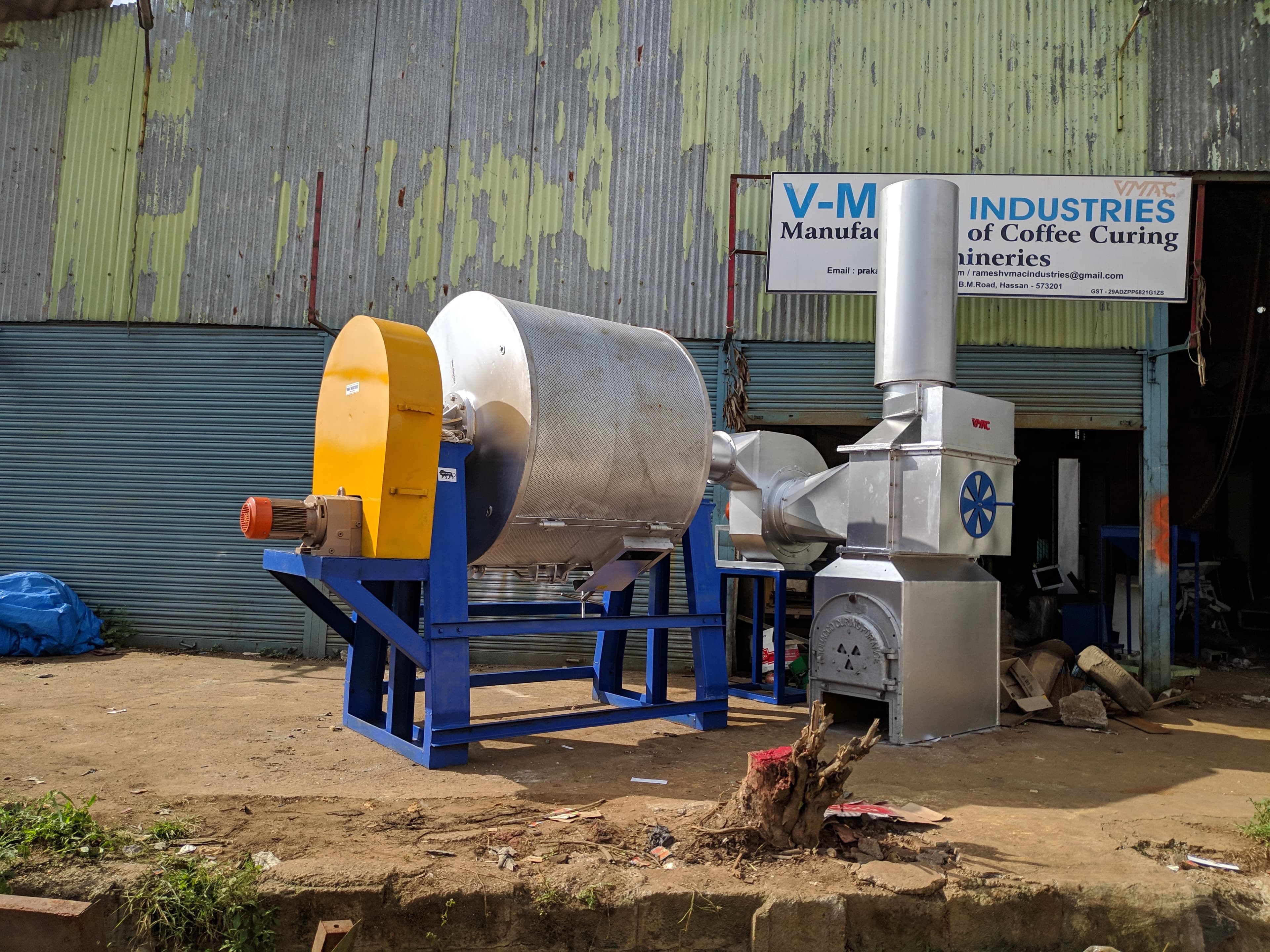
Coffee Dryer
Rotary drum dryer for parchment coffee, cherry coffee, and pepper. Reduces moisture from 50–55% post-pulping down to 10–12% for safe storage — weather-independent and significantly faster than sun drying.
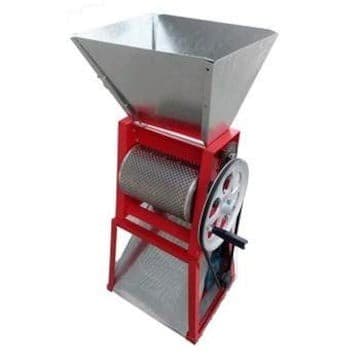
Coffee Pulper
Removes the fruit skin and outer mucilage from ripe coffee cherries to expose the parchment-covered bean — the critical first step in washed and honey processing that determines cup quality from the very beginning.
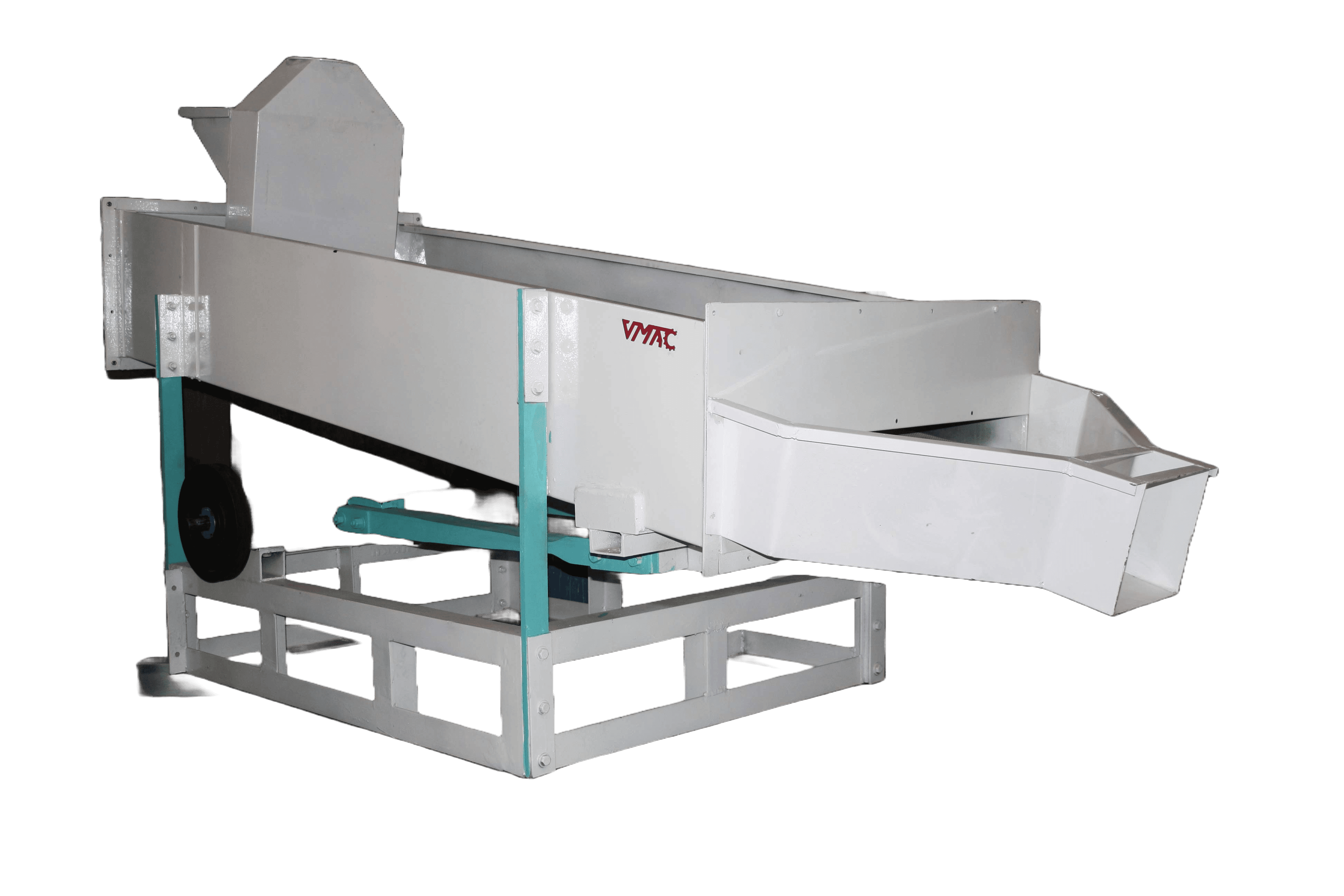
Coffee Pre-Cleaner
Vibratory scalping screen with air aspiration — removes sticks, leaves, large stones, soil clods, and light chaff from coffee cherry or parchment at intake, protecting every downstream machine in the processing line.