
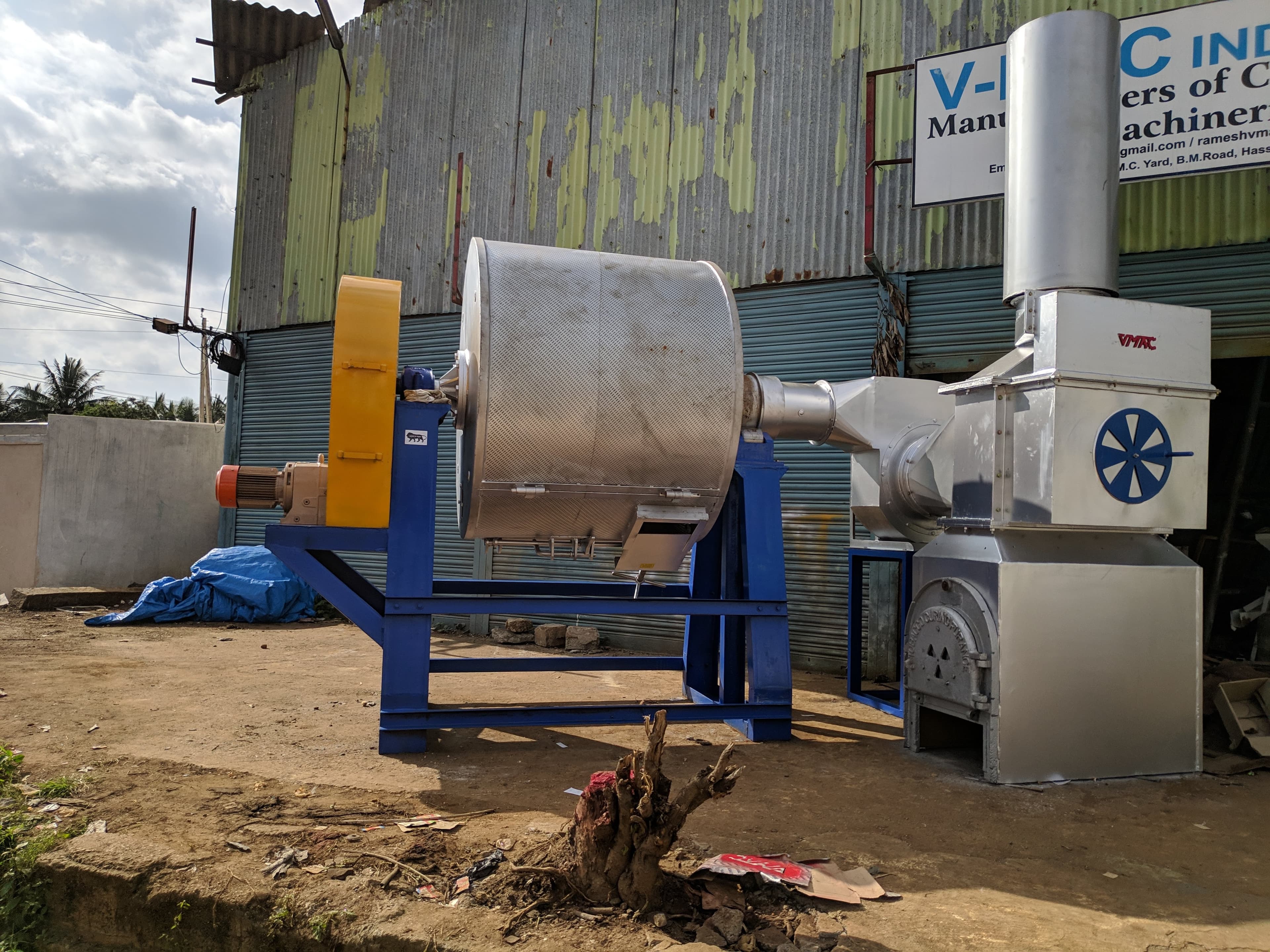
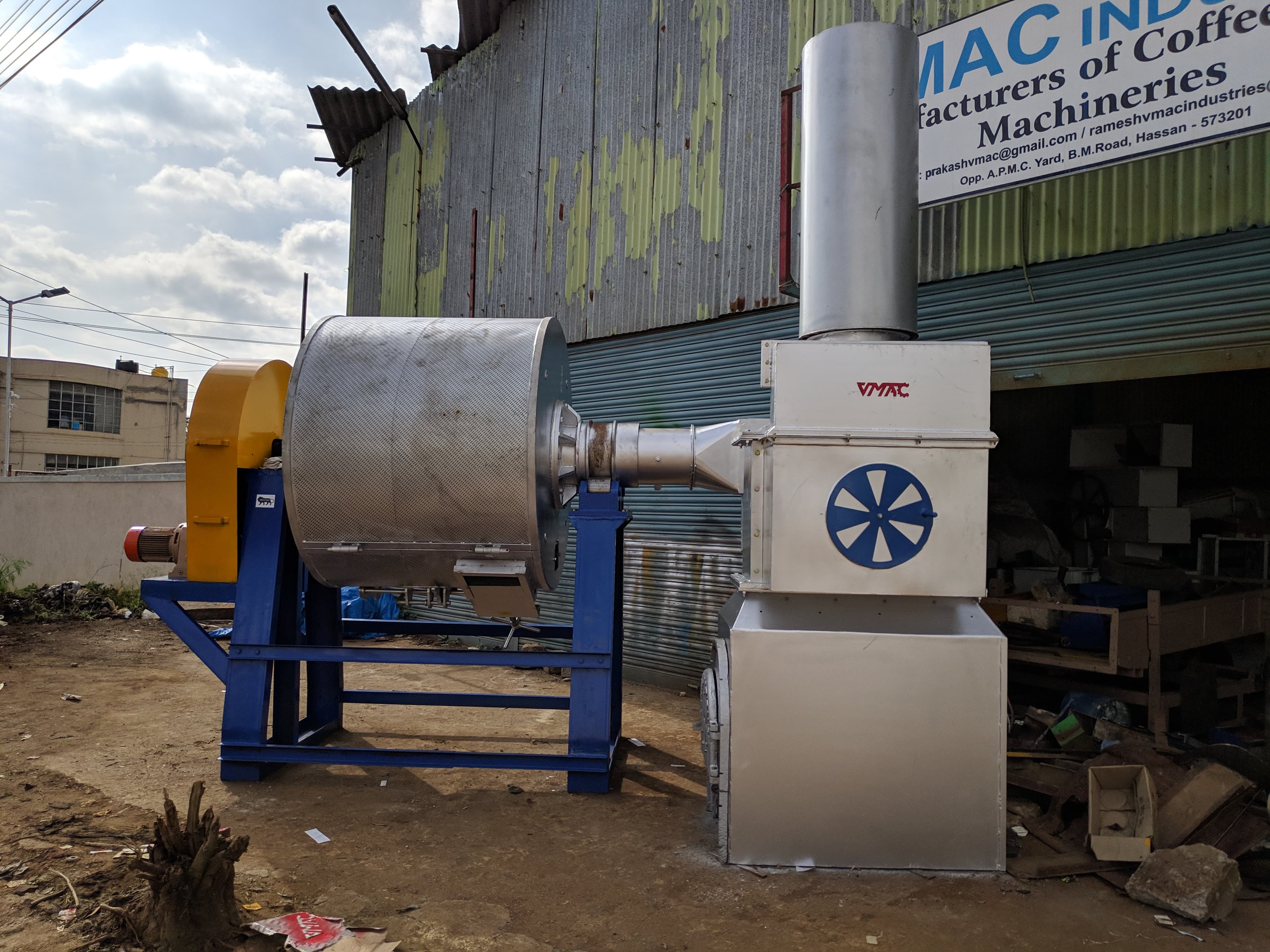
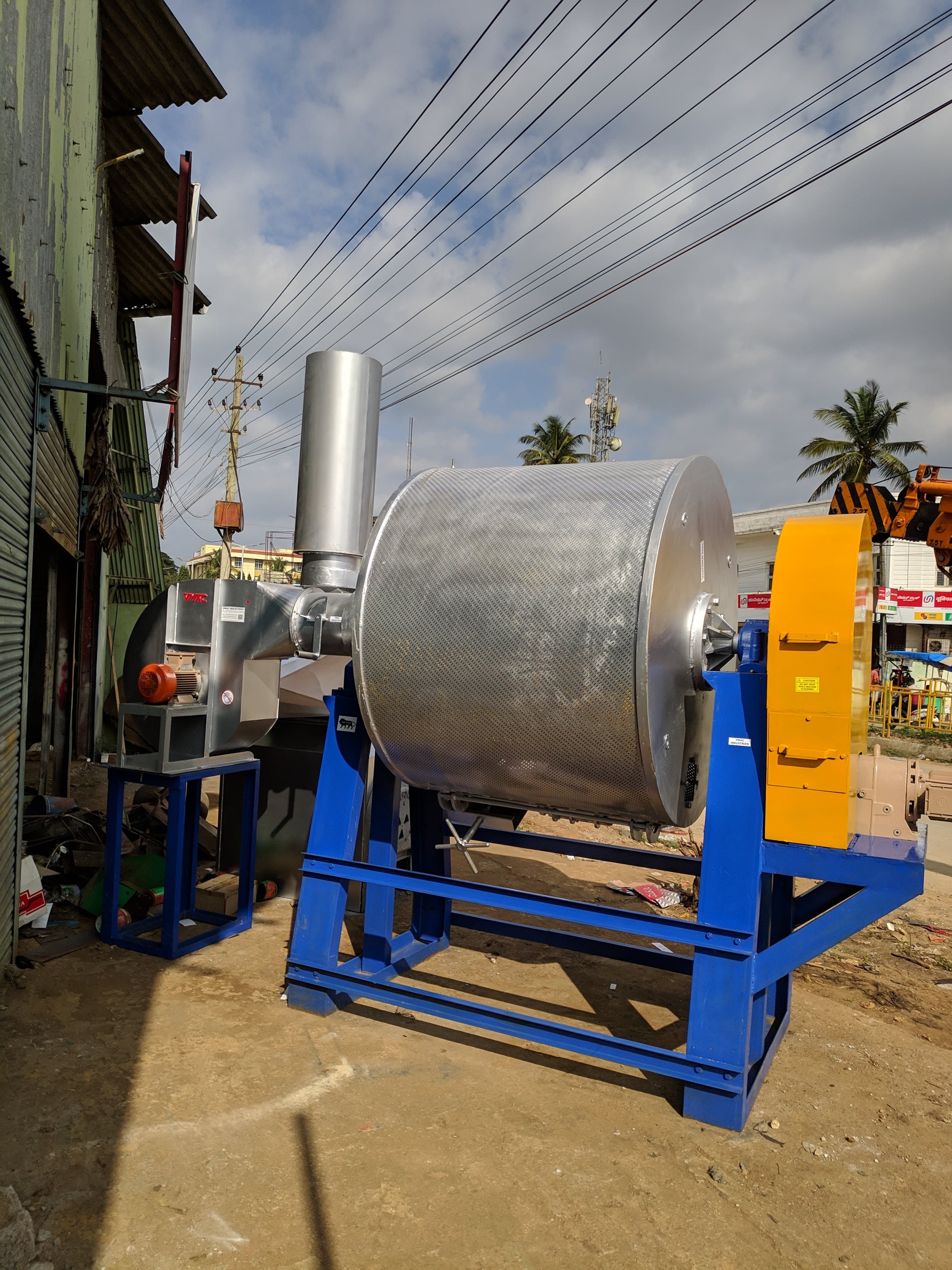
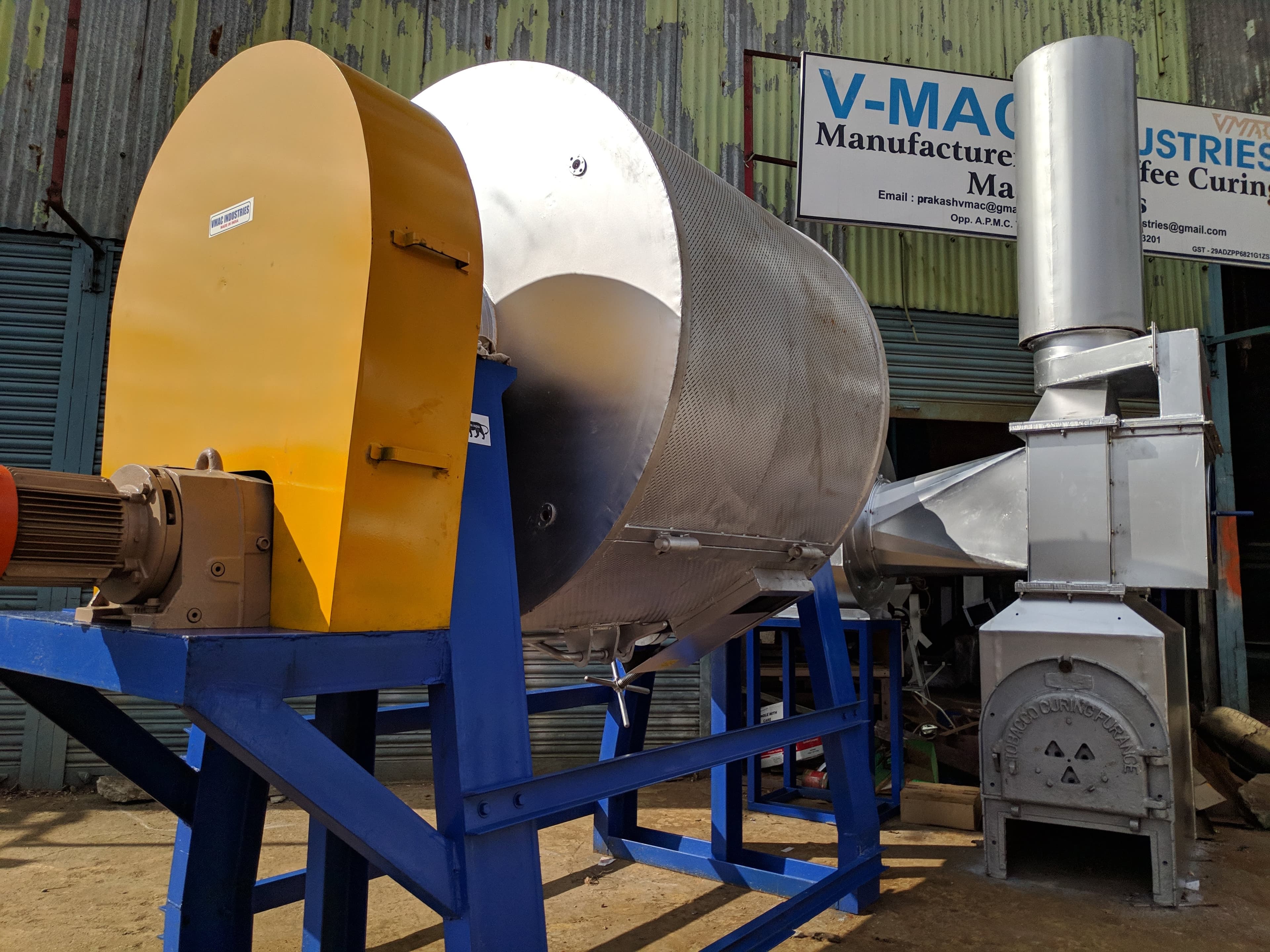
Coffee Dryer
Rotary drum dryer for parchment coffee, cherry coffee, and pepper. Reduces moisture from 50–55% post-pulping down to 10–12% for safe storage — weather-independent and significantly faster than sun drying.
| Capacity (batch) | 100 kg – 2,000 kg per batch (model dependent) |
| Drum dimensions | Diameter 600 mm – 1,800 mm · Length 1,200 mm – 4,500 mm (model dependent) |
| Motor power (drum drive) | 0.5 HP – 5 HP; blower motor 0.5 HP – 3 HP (model dependent) |
| Heat source | Firewood / biomass furnace (standard); LPG burner or diesel burner (optional) |
| Drying temperature range | 40–55°C (parchment: 40–50°C; cherry: up to 55°C; pepper: 50–60°C) |
| Moisture reduction | From 50–55% (post-wash parchment) or 45–50% (cherry) to 10–12% target moisture; cycle time 18–36 hours depending on load and heat output |
| Drum rotation speed | 3–8 RPM (adjustable via drive pulley; slow rotation prevents bean damage) |
| Construction | Mild-steel drum body with perforated panels · Mild-steel frame · Trunnion roller supports · Insulated hot-air duct · Integral firebox or burner mount |
| Power supply | Single-phase 230V or 3-phase 415V, 50 Hz |
Key Features
Rotary drum tumbling action ensures every bean cycles repeatedly through the hot-air zone — no cold spots, no moisture pockets, no manual turning required during the drying cycle
Perforated drum body allows moisture-laden exhaust air to escape radially, preventing condensation re-absorption and maintaining consistent airflow through the bean mass from loading to discharge
Compatible with firewood / biomass furnace (standard), LPG burner, or diesel burner heat sources — operator selects heat source at specification stage based on available fuel and operating economics
Integrated thermometer and adjustable firebox damper allow temperature to be held within safe drying bands: 40–50°C for parchment, up to 55°C for cherry — prevents case hardening and internal cracking
Weather-independent operation: drying proceeds regardless of monsoon, cloud cover, or overnight conditions — eliminates the yield and quality risk of interrupted open sun drying during the harvest peak
Multi-crop capability: the same drum processes parchment coffee, natural cherry coffee, and pepper — maximises machine utilisation for mixed-crop Karnataka, Kerala, and Tamil Nadu estates
Heavy mild-steel drum with replaceable perforated panels; drum-support trunnion rollers are field-maintainable wear parts with long service intervals under normal seasonal use
Batch discharge via end-gate opening — dried product empties cleanly without residual wet pockets; machine can be reloaded immediately for continuous batch-cycle operation through a harvest day
Models & Sizing
Coffee Dryer Model Range
VMAC rotary drum coffee dryers are available in five capacity tiers from small estate single-batch units to large curing works industrial dryers. All models use the same perforated rotary drum principle with firebox/biomass furnace as standard heat source. LPG and diesel burner options are available across the range. Contact VMAC for exact drum dimensions, custom configurations, and double-drum parallel installations for high-throughput applications.
CD-100 — Small Estate / Micro-Mill
100 kg / batch
capacity
Small estate owner-operated wet mills processing 5–20 acres of coffee. Single-batch operation; suited for specialty micro-lots, trial processing, and smallholder cooperative drying stations. Also used for pepper drying on mixed-crop farms in Coorg and Wayanad.
CD-300 — Estate Model
300 kg / batch
capacity
Mid-size estate wet mills in Karnataka and Kerala processing 20–80 acres per harvest. Two to three batches per day achieves 600–900 kg/day throughput — sufficient for a complete day's pulped yield on most medium Arabica estates. Standard estate model.
CD-500 — Commercial Estate
500 kg / batch
capacity
Large estates and cooperative drying stations in Chikmagalur, Hassan, and Wayanad. Handles full-day yield of 80–200 acres in two to three batches. Commonly paired with a raised-bed pre-dryer for hybrid wet-to-semi-dry inlet moisture reduction.
CD-1000 — Large Estate / Curing Works
1,000 kg / batch
capacity
Large estate integrated wet mills and small curing works handling 200–500 acres or receiving coffee from multiple growers. One to two batches per operational day. Suitable for both Arabica parchment drying and Robusta cherry drying. Standard configuration for mid-scale curing works in Karnataka.
CD-2000 — Industrial / Curing Works
2,000 kg / batch
capacity
High-volume commercial curing works, large estate groups, and central processing stations handling output from 500+ acres or multiple supplier estates. Continuous batch-cycle operation with multiple runs per day. Heavy-duty trunnion supports; large firebox with high-volume forced-draft blower. Suited to large Karnataka and Tamil Nadu export-volume processors.
Custom
Your specification
capacity
For operations requiring throughput beyond the standard range. VMAC engineers the machine to your exact capacity and processing conditions.
Request a Custom QuoteConfigurations
Full Model Range — Coffee Dryer
All models use perforated rotary drum principle with firewood / biomass furnace as standard heat source. LPG and diesel burner options available across the range. Drum RPM adjustable via drive pulley. Contact VMAC for exact drum dimensions, double-drum configurations, and bespoke firebox specifications.
| Model | Batch Capacity | Drum Motor | Blower Motor | Heat Source (Standard) | Best For |
|---|---|---|---|---|---|
| CD-100 | 100 kg / batch | 0.5 HP | 0.5 HP | Firewood / biomass | Small estate, micro-mill, specialty lots, pepper drying |
| CD-300 | 300 kg / batch | 1 HP | 1 HP | Firewood / biomass | Medium estate, 20–80 acres, standard Karnataka / Kerala model |
| CD-500 | 500 kg / batch | 2 HP | 1.5 HP | Firewood / biomass | Large estate, cooperative drying station, Chikmagalur / Wayanad |
| CD-1000 | 1,000 kg / batch | 3 HP | 2 HP | Firewood / biomass | Large estate wet mill, small curing works, 200–500 acres |
| CD-2000 | 2,000 kg / batch | 5 HP | 3 HP | Firewood / biomass | Industrial curing works, large estate groups, 500+ acres |
| Custom | Built to your capacity and specification — contact us for a quote | ||||
Overview
About the Coffee Dryer
VMAC's Industrial Coffee Dryer is a rotary drum mechanical dryer designed for drying parchment coffee (wet-processed Arabica and Robusta), natural or cherry coffee, and pepper in a single machine. The core working element is a perforated rotating cylinder that continuously tumbles the crop while forced hot air flows through the bean mass — the combination of rotation and airflow eliminates the cold spots and moisture pockets that make sun drying unpredictable. Where raised-bed or patio sun drying takes 3–6 weeks depending on weather, the rotary dryer brings parchment coffee from 50–55% moisture (freshly washed) down to the target 10–12% moisture in 18–36 hours of controlled drying, and cherry coffee from similar post-harvest moisture to 11–12% in a comparable cycle depending on initial moisture load and heat source output. The heat source is a separate firewood or biomass furnace (the dominant choice for Indian estates and curing works given fuel availability and cost), with LPG and diesel burner options available for installations where firewood is not practical. Heat from the furnace is drawn through an insulated duct into the drum chamber by a blower; the drum's perforated body allows moisture-laden air to escape radially while the tumbling action ensures every bean in the load cycles through the warm-air zone repeatedly. Drum rotation speed, air temperature, and drying cycle time are the three operating variables — temperature control is the most critical, as prolonged exposure above 50°C for parchment coffee or 55°C for cherry coffee causes case hardening, internal cracking, and quality degradation that is irreversible. An integrated thermometer and adjustable firebox damper allow the operator to hold drying temperature within a safe band. VMAC manufactures rotary coffee dryers from 100 kg/batch capacity (small estate or cooperative model) through to 2,000 kg/batch industrial units for large wet mills and curing works. The same machine is used across Karnataka, Kerala, and Tamil Nadu estates for both Arabica and Robusta parchment drying and, out of season, for pepper and spice drying — a significant advantage for mixed-crop plantations looking to maximise return on capital equipment investment.
How It Works
How the Coffee Dryer Works
A rotary drum coffee dryer combines two drying mechanisms simultaneously: forced hot air flowing through the bean mass to carry away moisture vapour, and drum rotation to continuously tumble the beans so every part of the load receives uniform heat and airflow exposure. The operator sets temperature and monitors moisture at regular intervals; the machine does the rest automatically.
Loading the drum
Freshly washed and drained parchment coffee — typically at 50–55% moisture after washing channels — or sun-pre-wilted cherry coffee is loaded into the drum through the end-gate or a top-mounted inlet hatch. Load volume is matched to the rated batch capacity; overloading reduces airflow through the bean mass and extends cycle time. For parchment coming directly from washing, a brief 2–4 hour pre-drain on raised beds before loading reduces the initial free water load and shortens the drum cycle. The firebox is lit and brought to operating temperature before loading begins.
Rotation and heat application
Once loaded and sealed, the drum drive motor is started. The drum rotates at 3–8 RPM — slow enough that beans are lifted and gently tumbled rather than thrown against the drum wall, preventing mechanical damage to parchment. The blower draws hot air from the furnace chamber through the insulated feed duct into the drum interior. Hot air permeates the bean mass, picks up surface moisture vapour, and exits through the perforated drum wall as humid exhaust air. The operator monitors the thermometer at the hot-air inlet and adjusts the firebox damper to maintain the correct temperature band: 40–50°C for parchment, up to 55°C for cherry. Exceeding these limits causes case hardening — a hard dry outer layer that traps moisture inside the bean, leading to mould development in storage despite a correct surface moisture reading.
Moisture monitoring and cycle management
At regular intervals — typically every 2–4 hours — the operator withdraws a sample through the inspection hatch and checks moisture using a portable grain moisture meter. Parchment coffee should be held above 30% during the first phase of drying (the 'free moisture' phase) when drying rate is fastest; reducing heat in this phase wastes fuel but is less damaging than over-drying. As moisture drops below 20%, the 'bound moisture' phase begins — drying slows, heat must be moderated further, and the remaining moisture must be removed gradually. Drying is complete when the sample reads 11–12% on the moisture meter, confirmed by the feel of the parchment — it should crack cleanly when folded rather than bending. Under-drying (above 13%) risks mould and mycotoxin development in storage; over-drying (below 10%) causes excessive brittleness and bean breakage in the huller.
Discharge and conditioning
When the target moisture is reached, the drum is stopped and the end-gate is opened. Hot dried coffee discharges by gravity and the remaining drum rotation. Freshly machine-dried coffee should not be bagged immediately — it is slightly above ambient temperature and the moisture gradient between the bean surface and interior needs to equilibrate. A 12–24 hour resting period in a well-ventilated clean store (a 'conditioning rest') allows moisture to redistribute evenly through each bean before the lot is moved to huller intake or parchment storage. Conditioning reduces the risk of 'checks' — internal cracks that cause bean breakage during hulling — which are caused by an excessive moisture gradient when hot, surface-dry beans are hulled immediately after drying.
Know the Difference
Coffee Dryer vs. Sun Drying (Raised Beds / Patio Drying)
For Indian coffee estates and curing works, the primary drying decision is between mechanical rotary drum drying and traditional sun drying on raised beds or concrete patios. Both methods can produce good results — but they differ substantially in speed, labour, risk profile, and capital requirement. The right choice depends on scale, location, and the estate's quality and logistics priorities.
| Feature | Coffee Dryer | Sun Drying (Raised Beds / Patio Drying) |
|---|---|---|
| Drying duration | 18–36 hours per batch (parchment); 24–48 hours for cherry — total cycle from 50% moisture to 11–12% in under 2 days | 3–6 weeks for parchment; 4–8 weeks for cherry (natural process) — highly dependent on weather, altitude, and cloud cover |
| Weather dependency | Fully weather-independent — drying proceeds through monsoon rain, overcast skies, and overnight hours without interruption | Completely weather-dependent — rain events require cover or sheeting; extended monsoon or cloud cover can double cycle time and increase mould risk substantially |
| Moisture uniformity | High uniformity — drum rotation ensures all beans experience equivalent heat and airflow; moisture variation within a batch is typically ±0.5–1.0% | Variable uniformity — beans at the bottom of a deep patio layer or under-turned beds dry slower than surface beans; adequate turning (every 2–4 hours) is required for uniformity but is labour-intensive |
| Labour requirement | Low ongoing labour — one operator monitors temperature and samples moisture every 2–4 hours; no turning, raking, or covering work required | High labour — manual raking and turning required every 2–4 hours during daylight; covering at night or during rain; monitoring for fermentation hotspots in thick layers |
| Contamination and quality risk | Low — enclosed drum prevents bird, insect, and dust contamination; no exposure to rain splash or floor contamination if loading is managed correctly | Moderate to high — open beds require bird nets; patio drying risks soil and stone contamination from splashing; rain events can cause mould initiation if not covered quickly |
| Flavour and cup quality | Equivalent to sun drying for washed parchment coffee when temperature is controlled correctly; some specialty buyers prefer slow sun drying for natural/honey process for specific flavour development | Slow sun drying on raised beds with careful turning is considered optimal for natural and honey process coffees — extended drying promotes complex flavour development in the mucilage layer that fast drum drying may not fully replicate |
| Land and infrastructure | Compact footprint: a 500 kg batch dryer requires approximately 4–6 sq m of covered floor space; no large patio or raised-bed infrastructure needed | Significant land and infrastructure: drying 1,000 kg of wet parchment requires 200–400 sq m of raised beds or patio area; concrete finishing, shade structures, and cover sheets add cost |
| Operating cost | Firewood and electricity cost per batch; cost per kg depends heavily on local firewood price — typically ₹0.50–₹2.00 per kg green coffee equivalent in Karnataka | Low direct operating cost (sunlight is free) but high indirect cost in labour, lost capacity during monsoon, and quality risk from uncontrolled drying interruptions |
Most medium and large Indian wet mills use a hybrid approach: initial sun pre-drying on raised beds for 3–5 days to reduce moisture from 55% to 30–35% (the fastest-drying free-moisture phase is done cheaply outdoors), followed by mechanical drum drying to finish to the 11–12% target. This hybrid method reduces firewood consumption by 40–60% compared to full drum drying from wet, while retaining weather independence for the critical final drying phase where mould and over-drying risk is highest.
Processing Line
Where the Coffee Dryer Fits in the Processing Line
The dryer sits in the wet mill sequence immediately after washing and mucilage removal. Its output — parchment or cherry at 11–12% moisture — is the input to the dry mill (curing works). Correct drying is the last irreversible quality step before hulling: poorly dried coffee cannot be corrected downstream.
Cherry intake / reception
Freshly harvested cherries received, weighed, and checked for ripeness — ripe-dominant lots processed first
Flotation tank (cherry sorter)
Water flotation removes floaters (unripe, overripe, damaged cherry); ripe cherry sinks and feeds the pulper
Coffee Pulper
Removes cherry skin; parchment exits with mucilage intact for washed or honey process
Fermentation tanks / Demucilager
Washed process: fermentation breaks down mucilage (12–48 hours); honey process: partial or full mucilage retained for drying
Washing channels
Washed process only — flowing water removes fermented mucilage; parchment exits at ~50–55% moisture ready for drying
Coffee Dryer (Rotary Drum)
This machineReduces moisture from 50–55% (parchment) or 45–50% (cherry) to 10–12% target; 18–36 hour cycle; temperature monitoring critical throughout
Conditioning / Parchment storage
12–24 hour resting period post-drying for moisture equilibration before hulling; parchment stored in jute bags in ventilated store
Dry mill (Curing Works) intake
Hulling, polishing, grading, gravity separation, color sorting, and bagging for export — begins at this stage
FAQ
Frequently Asked Questions
What is the capacity range of the VMAC Coffee Dryer?
VMAC rotary drum coffee dryers are available in batch capacities from 100 kg to 2,000 kg per batch. Throughput over a working day depends on batch size and cycle time: a CD-500 running 500 kg batches on an 18–24 hour cycle achieves 500–1,000 kg of dried parchment per day in continuous two-batch operation. For higher throughput, double-drum parallel configurations are available. Contact VMAC with your peak-season daily cherry intake to size the dryer correctly — undersizing creates a processing bottleneck during the harvest peak.
What materials are used in the construction of the Coffee Dryer?
The drum body and frame are fabricated from mild steel with a painted or primer-coated exterior. The perforated drum panels are mild steel; replacement panels are available as wear spares. The hot-air duct between the firebox and drum entry is mild steel with insulation wrapping to minimise heat loss. The trunnion support rollers are mild-steel or cast-iron machined components. Food-contact surfaces inside the drum are not stainless as standard — the interior drum temperature and tumbling action prevent moisture retention, reducing corrosion risk. If stainless interior panels are required for a specific application, they are available on request.
Is the Coffee Dryer suitable for drying products other than coffee?
Yes — the VMAC rotary drum dryer is routinely used for pepper drying on mixed-crop estates, and can be used for cardamom, dried chilli, and other spices or agricultural commodities with similar bulk density and temperature tolerance. Pepper typically dries at 50–60°C, slightly above the coffee parchment range. When switching between coffee and pepper, clean the drum interior thoroughly to prevent cross-contamination of aromas — residual pepper oils on drum surfaces can taint a subsequent coffee batch. The same drum dimensions and drive mechanism are used; only the firebox temperature setting changes.
What are the heat source options for the Coffee Dryer?
The standard heat source is a firewood or biomass furnace — the most practical and cost-effective option for most Indian estates given firewood availability on or near the farm. LPG burner and diesel burner options are available for installations where firewood is not available or where a cleaner, more controllable heat source is preferred. LPG and diesel burners provide more precise temperature control with less operator attention at the firebox, but operating cost per batch is significantly higher than firewood. Some curing works use LPG for the final drying phase where precise temperature control is most critical, and firewood for the bulk initial drying phase.
Does the Coffee Dryer feature automatic operation?
The drum rotation and blower run continuously and automatically once started. Temperature regulation, however, requires manual operator attention: the firebox damper is adjusted by the operator based on thermometer readings at the hot-air inlet. Fully automated temperature control (thermostat-linked damper or burner modulation) is available as an option on CD-1000 and CD-2000 models. Moisture monitoring — the key quality control step — requires manual sampling every 2–4 hours with a portable moisture meter; fully automated inline moisture sensing is not standard on the VMAC rotary drum dryer.
What are the power requirements for the Coffee Dryer?
Power consumption is low — the drum motor and blower motor together draw between 1 HP and 8 HP depending on model. The CD-100 and CD-300 models can run on single-phase 230V power, which is relevant for remote estate locations with limited electrical infrastructure. CD-500 and above use 3-phase 415V, 50 Hz. The primary energy input is heat from the firebox, not electricity — electrical power only drives the drum and blower. Detailed power specifications for each model are available from VMAC on request.
How does the rotary drum mechanism benefit the drying process?
The rotary drum provides two linked benefits. First, continuous tumbling ensures every bean in the batch cycles repeatedly through the hot-air zone — beans at the centre of a stationary pile would experience very different temperature and airflow to beans at the surface, creating moisture non-uniformity. Rotation eliminates this variation without any manual intervention. Second, tumbling prevents the beans from forming a compacted mass that blocks airflow; the loose, continuously moving bed allows hot air to permeate through the entire load. Together, these mechanisms make the rotary drum substantially more uniform and less labour-intensive than open sun drying or flat-bed mechanical dryers.
What drying temperature should I use for parchment coffee vs. cherry coffee?
Parchment coffee (wet-processed Arabica or Robusta with the parchment layer intact) should be dried at 40–50°C. The parchment layer provides some insulation to the bean inside, but temperatures above 50°C risk case hardening — a hard dry crust forming on the parchment surface that traps residual moisture inside and later causes mould in storage or cracking during hulling. Cherry (natural process, dried with the entire fruit intact) can tolerate up to 55°C because the full fruit layers provide better insulation to the bean; higher temperature accelerates drying of the thick fruit body. In practice, a conservative approach is recommended: start at the lower end of the range (40°C for parchment, 45°C for cherry), hold steady, and only increase if the cycle is running significantly longer than expected.
Is the Coffee Dryer energy-efficient?
Firewood consumption depends on batch size, initial moisture content, ambient humidity, and heat losses from the duct and drum. Typical firewood consumption is 0.3–0.6 kg of dry firewood per kg of water evaporated. A 500 kg batch of parchment entering at 55% moisture and exiting at 12% moisture has approximately 215 kg of water to evaporate — requiring roughly 65–130 kg of dry firewood. Energy efficiency is substantially improved by: (1) pre-drying on raised beds to 30–35% moisture before loading, which reduces the evaporation task by approximately 50%; (2) using dry seasoned firewood rather than fresh-cut wood with high inherent moisture; and (3) insulating the hot-air duct to reduce heat losses between firebox and drum inlet.
What maintenance is required for the Coffee Dryer?
Daily maintenance during the season: check trunnion roller bearings for overheating (touch test) and unusual noise; inspect the perforated drum panels for blocked holes (clean with compressed air or brush); check the drive belt tension on the drum motor; confirm the hot-air duct seals are intact and not leaking. Weekly: grease the drum trunnion bearings and the drive shaft bearings per the manual schedule (typically every 50–100 operating hours). At season end: clean the drum interior thoroughly to remove coffee oils, chaff, and residual material; inspect the perforated panels for corrosion or damage; check the firebox refractory lining for cracks; re-grease all bearings before storage. Full maintenance guidelines are provided in the VMAC operator manual.
Can the Coffee Dryer be customised to specific requirements?
Yes — VMAC offers a range of customisation options including alternative heat source configurations (LPG or diesel burner in place of the standard firebox), double-drum parallel installations for estates needing higher continuous throughput, extended drum length for improved drying uniformity on challenging lots, and stainless-steel interior drum panels for applications requiring food-grade metal contact surfaces. Custom drum diameters for specific crop types (large pepper batches, cardamom) are also available. Contact the VMAC sales team with your crop type, batch capacity requirement, available fuel, and any site constraints for a tailored specification.
What is the warranty period for the Coffee Dryer?
VMAC machines are covered by a standard one-year warranty on manufacturing defects covering the drum body, drive mechanism, blower, and structural frame from the date of installation and commissioning. Warranty does not cover wear parts (perforated drum panels, trunnion roller surfaces, drive belts, and firebox refractory lining) — these are consumable items with service lives that depend on throughput volume and operating practices. Extended warranty and annual maintenance contracts are available for larger CD-1000 and CD-2000 installations. Contact VMAC directly for warranty terms applicable to your specific model and installation.
Are there any safety features incorporated into the Coffee Dryer?
The dryer includes an integrated thermometer at the hot-air inlet duct for continuous temperature monitoring — the primary safety control against case hardening or fire risk from overheating. An inspection hatch on the drum body allows the operator to view and sample the bean mass during operation. The drum end-gate is mechanically latched and should not be opened while the drum is rotating. For CD-1000 and CD-2000 models, an emergency stop button on the control panel cuts drum motor and blower simultaneously. The firebox is a separate enclosed chamber; the fire-to-air path is indirect (heat transfers to moving air, not direct flame contact with the crop), reducing fire risk substantially compared to direct-heat dryers.
What moisture level should I target at the end of the drying cycle, and how do I measure it?
Target 11–12% moisture content for parchment coffee destined for storage or immediate dry milling. 10–11% is acceptable but approaching the over-dry threshold; below 10% causes excessive brittleness and bean breakage in the huller. Above 13% creates active mould and mycotoxin risk in storage, particularly under high ambient humidity in Karnataka and Kerala post-harvest conditions. Measure moisture using a portable grain moisture meter calibrated for coffee — hand-held instruments such as those from Farmcomp, Wile, or equivalent brands are widely used on Indian estates. Take 3–4 samples from different points in the drum batch and average the readings. Confirm the reading with a sensory check: correctly dried parchment snaps cleanly when bent; under-dried parchment bends without breaking.
How does the hybrid sun-drying and drum-drying method work, and is it worth using?
The hybrid method uses open sun drying on raised beds for the initial high-moisture phase (from ~55% down to 30–35%), then finishes drying in the drum to the 11–12% target. This approach is worth using wherever it is logistically practical because it reduces firewood consumption by 40–60% compared to full drum drying from wet, substantially lowering the operating cost per batch. The logic is that the first phase of drying — removing free surface moisture — proceeds fastest and cheapest in open air when weather is dry, because no fuel is required. The risk of mould initiation during this phase is low because the beans are drying actively. The final phase — removing bound moisture from 30% to 12% — is slower, requires more controlled temperature, and is the phase most vulnerable to weather interruption. Completing this phase in the drum provides weather independence precisely where it matters most.
Related guides
Learn more about this equipment
VMAC Industries
Wet vs Dry Processing: Equipment Requirements Compared
A practical equipment comparison for coffee producers deciding between wet (washed) and dry (natural) processing — what machines each method needs, what's shared, and how to choose based on your operation.
Read the guide →
VMAC Industries
How to Set Up a Wet Processing Line
A practical guide to building a washed coffee processing line — from cherry reception through drying. Machine sequence, water requirements, capacity matching, and site planning for Indian estates and cooperatives.
Read the guide →
Send a Enquiry Request
Retail store
Mon-Sat 9am to 5pm.
B.M road, Hassan, Karnataka 573201
Related Products
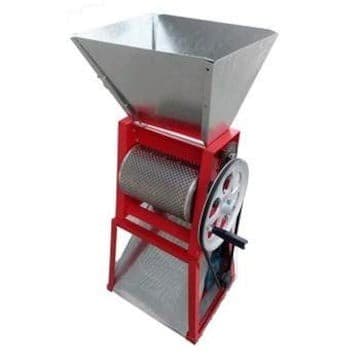
Coffee Pulper
Removes the fruit skin and outer mucilage from ripe coffee cherries to expose the parchment-covered bean — the critical first step in washed and honey processing that determines cup quality from the very beginning.
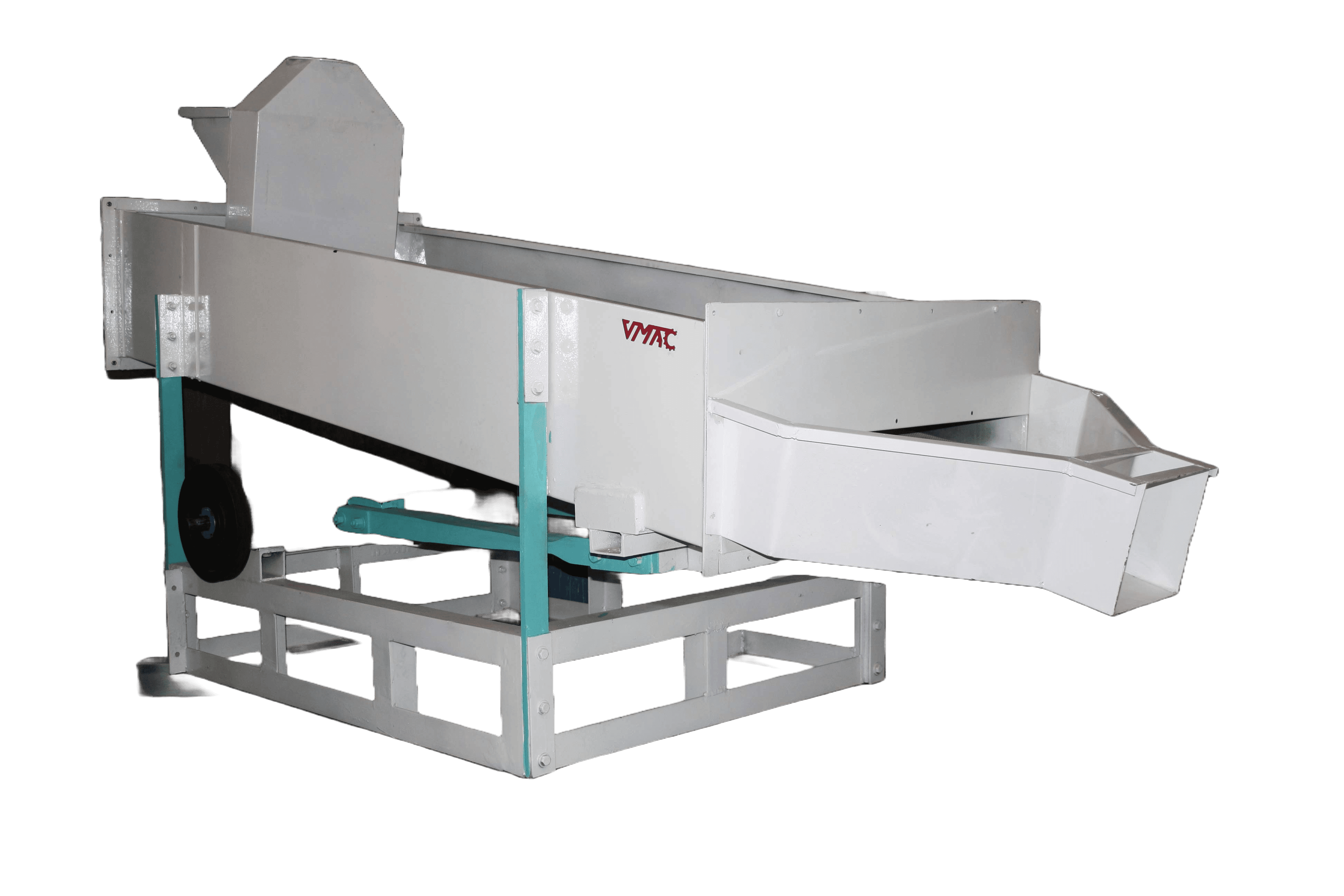
Coffee Pre-Cleaner
Vibratory scalping screen with air aspiration — removes sticks, leaves, large stones, soil clods, and light chaff from coffee cherry or parchment at intake, protecting every downstream machine in the processing line.
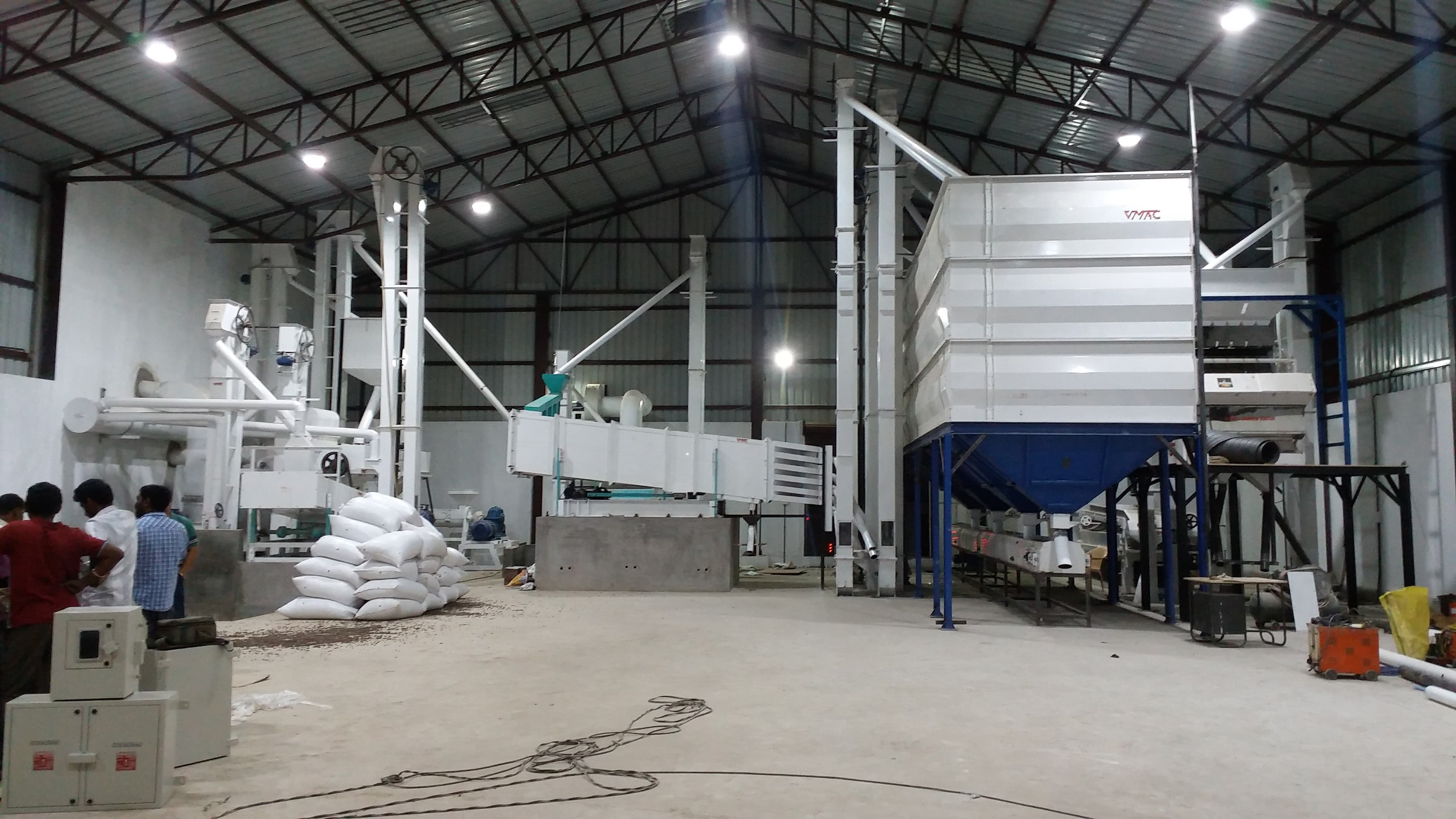
Coffee Curing Machine & Complete Processing Line
Turnkey coffee curing machines and complete wet/dry mill lines engineered by VMAC Industries — from cherry reception through export bagging, all machines matched to your capacity and supplied from a single manufacturer.