

Coffee Winnower / Aspirator
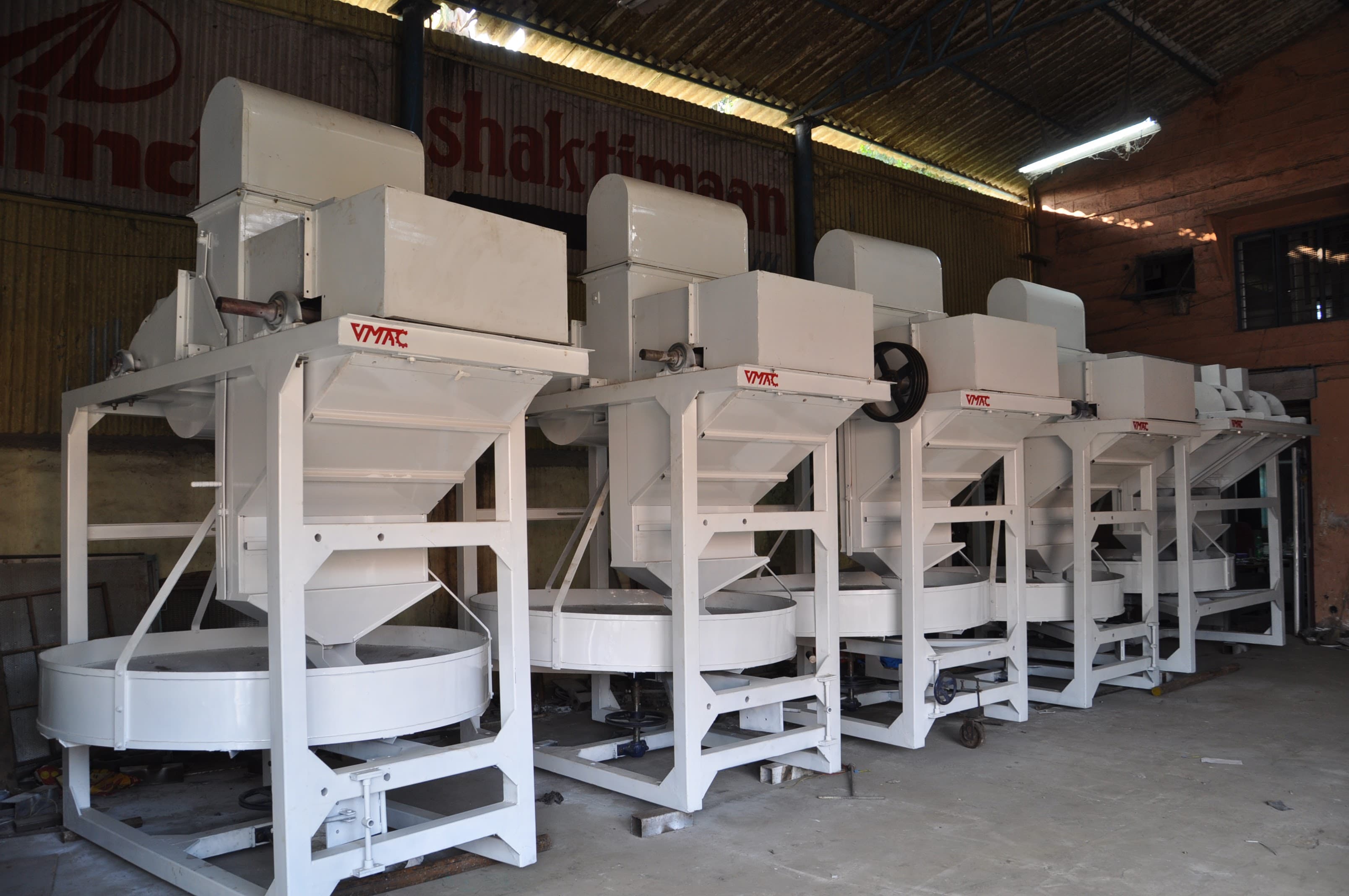
Vertical air-column winnower and aspirator that separates chaff, silver skin, parchment fragments, and dust from hulled green coffee using terminal velocity principles. Built for Indian curing works and East African dry mills processing 200 kg/hr to 5 TPH.
| Capacity range | 200 kg/hr (small cooperative) to 5,000 kg/hr (large curing works) |
| Fan motor power | 0.75 kW (small) to 7.5 kW (large); VFD option across all 3-phase models |
| Airflow range | 800 m³/hr to 4,500 m³/hr depending on model |
| Air velocity in column | Adjustable 3–9 m/s; optimal for green coffee typically 4.5–6.5 m/s |
| Chaff removal efficiency | >95% chaff and silver skin removal in single pass at correct air velocity |
| Bean loss in chaff stream | <0.3% sound bean carry-over at correctly calibrated velocity |
| Feed inlet size | 150 mm × 200 mm to 300 mm × 400 mm depending on model |
| Noise level | 62–78 dB(A) at 1 m (fan-speed dependent) |
| Power supply | 415 V / 3-phase / 50 Hz standard; 230 V single-phase for models ≤500 kg/hr |
| Construction material | Mild steel (standard) or SS 304 contact surfaces (food-grade option) |
Key Features
Vertical upward air column exploits terminal velocity differential — dense beans fall, chaff and silver skin are carried away at 3–9 m/s air velocity depending on crop
Adjustable air-inlet throttle gate with graduated scale for repeatable calibration between crop types and moisture levels
Variable-frequency drive (VFD) option on 3-phase fan motor for continuous airflow adjustment from 1,500 to 4,500 m³/hr without stopping the line
Integrated inspection window and bean-sample port at discharge chute — operator can pull a 100 g sample mid-run to check chaff carry-over without shutting down
Heavy-gauge mild steel or stainless steel contact surfaces with smooth weld seams to prevent chaff pockets and reduce fire risk
Top-mounted centrifugal fan with outward-curved backward-inclined blades for high-efficiency, low-noise operation at 60–75 dB(A) at 1 m
Quick-release cleanout panels on both sides of the air column chamber for daily chaff purge — prevents chaff accumulation that is a documented fire hazard
Compact footprint with vertical discharge ducting compatible with VMAC chaff cyclone — chaff-laden air stream exits to cyclone, clean air returns or vents externally
Three-phase 415 V / 50 Hz motor standard; single-phase 230 V option available for small cooperative models up to 500 kg/hr
Models & Sizing
Right-Sized for Every Operation
VMAC aspirators are available in four capacity tiers covering everything from a small farmer cooperative processing 200 kg/hr to a large Karnataka or Kenyan curing works handling 5 TPH on a single machine. All models are chaff-cyclone compatible and ship with a standard throttle-gate air control; VFD upgrade is available on 3-phase models.
WA-200
200–400 kg/hr
capacity
Small farmer cooperatives, 50–100 bag/day estate mills, pilot processing units in Coorg and Wayanad
WA-1000
600 kg/hr – 1.2 TPH
capacity
Mid-size estate mills and primary processing societies in Karnataka, Kerala, and Tamil Nadu; small Kenyan wet mill conversions to dry processing
WA-2500
1.5–2.5 TPH
capacity
Established curing works in Chikmagalur, Coorg, and Hassan districts; medium-scale Tanzania and Uganda dry mills
WA-5000
3–5 TPH
capacity
Large export-grade curing works and commercial dry mills; Kenya AA/AB high-volume export operations; Ethiopian ECX-grade preparation facilities
Custom
Your specification
capacity
For operations requiring throughput beyond the standard range. VMAC engineers the machine to your exact capacity and processing conditions.
Request a Custom QuoteConfigurations
Winnower / Aspirator Model Specifications
All models compatible with VMAC chaff cyclone. VFD = Variable Frequency Drive for continuous airflow adjustment.
| Model | Capacity (kg/hr) | Fan Motor | Airflow (m³/hr) | Air Velocity Range | Drive Type | Best For |
|---|---|---|---|---|---|---|
| WA-200 | 200–400 | 0.75 kW / 1-ph | 800–1,200 | 3–7 m/s | Throttle gate | Small estate, cooperative |
| WA-1000 | 600–1,200 | 2.2 kW / 3-ph | 1,500–2,500 | 3.5–8 m/s | Throttle gate + optional VFD | Mid-size estate mill |
| WA-2500 | 1,500–2,500 | 4.0 kW / 3-ph | 2,500–3,500 | 4–8.5 m/s | Throttle gate + VFD option | Curing works, dry mill |
| WA-5000 | 3,000–5,000 | 7.5 kW / 3-ph | 3,500–4,500 | 4–9 m/s | VFD standard | Large curing works, export mill |
| Custom | Built to your capacity and specification — contact us for a quote | |||||
Overview
About the Coffee Winnower / Aspirator
The coffee winnower — also widely called an aspirator, chaff aspirator, or chaff separator in Indian estates and East African mills — is the critical final cleaning stage after hulling. It exploits the difference in terminal velocity between dense green coffee beans and lightweight chaff, silver skin, parchment fragments, and dust: a controlled upward air column lifts and carries away the light fraction while beans fall through to a clean discharge chute. In Karnataka's Chikmagalur and Coorg estates and in Kerala's Wayanad curing works, the machine is universally referred to as the aspirator. The same machine is called a winnower or husk separator in Tamil Nadu mills and a catador across Ethiopian cooperatives and Latin American processing stations. VMAC's range covers both the simpler vertical-column catador-type design — where gravity and a single rising air column do the work — and more capable cyclonic aspirator models where the chaff-laden air is tangentially discharged into an integrated or external chaff cyclone for clean air return and collected chaff disposal. Charcoal-dry parchment coffee from a rubber-roll huller or disc huller still carries 4–12% chaff by weight. This chaff is a documented fire hazard: accumulated dry chaff around motors, conveyors, and lighting fixtures ignites readily. The winnower is therefore not optional from a fire-safety standpoint, and the Coffee Board of India's green-coffee grading standards require chaff-free, clean-hulled beans before submission for grading inspection. VMAC aspirators feature variable-speed fan drives that allow the mill operator to dial in exactly the air velocity needed for the crop at hand — heavier monsoon-processed beans require less airflow than light naturals; newly harvested Ethiopian-style light naturals need gentle calibration to avoid blowing sound beans into the chaff stream. An adjustable split-gate or throttle valve on the air inlet provides coarse control, with VFD-driven fan motors on larger models enabling fine continuous adjustment without stopping the machine. The winnower works as a system with a chaff cyclone: the aspirator generates a chaff-laden air stream that must be collected, and a centrifugal chaff cyclone mounted downstream drops the chaff out of the air stream and returns clean air. They are complementary, not competing, machines.
How It Works
How It Works
The winnower separates chaff from green coffee using the physical principle of terminal velocity — every particle has a characteristic velocity at which aerodynamic drag equals gravitational force. Green coffee beans (0.6–0.7 g/cm³ bulk density) and chaff (0.02–0.08 g/cm³) have dramatically different terminal velocities, allowing a single controlled air column to cleanly separate them.
Feed inlet and bean distribution
Hulled green coffee from the rubber-roll huller or disc huller enters the aspirator through a top or side gravity-fed inlet. A spread plate or distributor baffle ensures the material falls as a uniform curtain across the full width of the rising air column rather than as a dense rope, which would allow chaff buried inside the rope to pass through undetected.
Rising air column and terminal velocity separation
A centrifugal fan draws air upward through the vertical separation chamber at a set velocity — typically 4.5–6.5 m/s for arabica green coffee. Dense beans (terminal velocity 8–12 m/s) fall straight down against the airstream and exit through the bean discharge chute. Chaff, silver skin, parchment fragments, and dust (terminal velocity 1–4 m/s) are lifted by the airstream and carried upward into the chaff discharge duct. Very light or hollow beans, sometimes called floaters, are also carried away at this stage.
Air velocity calibration
The operator adjusts the throttle gate or VFD to match the specific crop. Freshly hulled naturals with loose chaff need less airflow; wet-processed parchment residues may need slightly more. The calibration check is simple: pull a 100 g sample from the bean discharge port and inspect under light — if chaff threads remain, increase air velocity slightly; if sound beans appear in the chaff stream exiting the duct, reduce velocity. This iterative adjustment is done once per crop lot and typically takes under five minutes.
Chaff-laden air stream to cyclone
The upward air stream carrying chaff exits through a duct at the top of the aspirator and is piped to a chaff cyclone. Inside the cyclone, centrifugal force throws chaff particles to the outer wall while clean air spirals inward and exits through the central vortex tube. Collected chaff drops into a hopper or bag at the cyclone base. The cyclone and aspirator work as a matched system — they are not alternatives to each other. Without a cyclone, chaff escapes to atmosphere or clogs the fan.
Clean bean discharge and downstream routing
Clean, chaff-free green coffee exits the bean discharge chute by gravity and feeds directly into the screen grader (flat-screen or rotary-drum grader) for size classification. Having removed all chaff before screen grading, the grader screens remain clean and the downstream gravity separator and color sorter receive uniformly clean material, reducing screen blinding and improving sorting accuracy.
Defect Separation
What the Winnower Removes — and What It Cannot
The aspirator is a density-and-weight separator working on aerodynamic lift. It is highly effective at removing any particle significantly lighter than a sound green coffee bean, but it cannot distinguish between two particles of similar weight and density.
Effectively removed
Chaff and silver skin
The primary target. Dry parchment husks, silver skin (the thin seed coat adhering to the bean after hulling), and loose chaff threads are all lighter than 0.1 g/cm³ and are reliably lifted and removed in a single pass at 4–7 m/s air velocity.
Parchment fragments
Broken parchment pieces from incomplete hulling or over-dry parchment shattering in the huller. These fragments, while denser than chaff, are light enough to be carried at 5–7 m/s and are effectively removed before screen grading.
Fine dust and organic fines
Mill dust, dried mucilage particles, and pulp fines accumulate in dry-processed coffees. The aspirator removes these along with the chaff stream, reducing dust hazard to downstream equipment operators.
Floaters (hollow and very light beans)
Severely under-developed or hollow beans — often indicative of insect damage or extreme drought stress — have significantly lower density than sound beans and are carried into the chaff stream at correctly calibrated air velocity. This is a useful secondary quality benefit.
Loose stem and plant debris
Dried stem pieces, leaf fragments, and light crop debris that may have passed through the pre-cleaner are removed at this stage, giving downstream equipment a cleaner feed.
Cannot remove
Stones and sand
Stones are far denser than green coffee beans. They fall through the air column faster than beans and accumulate in the discharge chute. Destoning must be done before the aspirator, never after.
Density defects of similar weight
Insect-damaged, fully black, or withered beans that happen to weigh close to a sound bean will not be separated by airflow. A gravity separator is required downstream for density-based defect removal.
Color and surface defects
Fully black beans, stinker beans, faded or bleached beans, and amber beans that are of normal weight pass through the winnower untouched. Color sorting at a later stage addresses these.
Size variation
The air column does not sort by size — a small PB (peaberry) and a large AA flat bean may both be retained even though they are different screen sizes. Screen grading after the winnower provides size classification.
Fermented beans
Sour or fermented beans that retain normal weight and density are indistinguishable from sound beans in an air column. Cup testing and color sorting are the only reliable removal methods.
For complete defect removal, the winnower is used in sequence with a destoner (upstream), a gravity separator, and a color sorter (downstream). Each machine addresses a different physical property — no single machine removes all defect types.
Know the Difference
Coffee Winnower / Aspirator vs. Chaff Cyclone
Buyers sometimes ask whether they need a winnower or a chaff cyclone. The answer is both — they serve entirely different functions and work together as a matched system. The winnower separates chaff from beans; the chaff cyclone then separates chaff from the air stream that the winnower generates. Removing one breaks the system.
| Feature | Coffee Winnower / Aspirator | Chaff Cyclone |
|---|---|---|
| Primary function | Separates chaff and light particles from green coffee beans using an upward air column | Separates chaff particles from the chaff-laden air stream produced by the winnower |
| What enters the machine | Mixed stream of green beans + chaff + parchment fragments from huller discharge | Chaff-laden air stream discharged from the top of the winnower |
| What exits the machine | Clean green beans (to screen grader) + chaff-laden air stream (to cyclone) | Collected dry chaff (to hopper/bag) + clean return air (to atmosphere or recirculation) |
| Separation principle | Terminal velocity — upward air column lifts light particles, beans fall through | Centrifugal force — rotating air throws chaff to cyclone wall, clean air exits center |
| Position in processing line | Immediately after huller, before screen grader | Mounted adjacent to or above the winnower, connected by chaff duct |
| Can it operate alone? | Not safely — without a cyclone to capture the chaff discharge, chaff escapes to air or clogs fan | No — it has no function without a winnower or aspirator generating the chaff-laden air feed |
| Fire safety role | Removes loose chaff from the bean stream, preventing chaff accumulation on downstream equipment | Collects airborne chaff in a contained hopper for safe, controlled disposal |
| Motor / drive | Fan motor 0.75–7.5 kW with adjustable speed for air velocity calibration | No moving parts — passive centrifugal separation, no motor required |
VMAC supplies both machines as a matched pair sized for the same throughput. Ordering the winnower and cyclone together ensures the duct diameter, air velocity, and chaff volume are correctly matched. They are sold separately only when replacing a failed unit in an existing installation.
Processing Line
Where It Fits in Your Processing Line
In a standard Indian or East African dry coffee mill, the winnower sits immediately after the huller and before size grading. Its clean output feeds every downstream quality-sorting step.
Pre-cleaner / Scalper
Removes large trash, stones, sticks from parchment before hulling
Destoner
Removes remaining stones and dense foreign matter by fluidized bed or inclined screen
Huller
Rubber-roll, disc, or impeller huller removes parchment or husk to expose green bean
Winnower / Aspirator
This machineAir column removes chaff, silver skin, parchment fragments, dust, and floaters from hulled green coffee
Screen Grader
Flat-screen or rotary-drum grader classifies beans by screen size (AA, AB, C, PB etc.)
Gravity Separator
Stratified air table removes remaining density defects that escaped the winnower
Color Sorter
CCD or laser/NIR optical sorter ejects black, brown, and discolored beans
Bagging / Export Preparation
Graded green coffee weighed into 60 kg jute bags or GrainPro-lined bags for export
FAQ
Frequently Asked Questions
What is the difference between a winnower and an aspirator — are they the same machine?
Yes, in the coffee milling context, the terms are used interchangeably. In Karnataka, Kerala, and Tamil Nadu the machine is almost universally called an aspirator or chaff aspirator. In Coorg estates it is often called a winnower. In Ethiopia and some East African cooperatives the gravity-only version is called a catador. The operating principle — using an air column to separate chaff from beans — is identical across all these names. VMAC's WA series covers both the simpler catador-type vertical column design and the more powerful cyclonic aspirator configuration.
Do I need both a winnower and a chaff cyclone, or will one of them do the job?
You need both. The winnower separates chaff from beans — its output is a clean bean stream plus a chaff-laden air stream. The chaff cyclone then takes that air stream and drops the chaff out of it into a collection hopper. Without a cyclone, chaff escapes to atmosphere (a dust and fire hazard) or backs up and chokes the fan. Without the winnower, the cyclone has nothing to process. VMAC supplies matched pairs sized to the same throughput.
How do I set the correct air velocity without blowing good beans into the chaff stream?
Start at minimum air velocity and increase gradually while the machine is running. After each adjustment, pull a 100 g sample from the bean discharge chute and inspect under good light for visible chaff. If chaff remains on beans, increase velocity slightly. Simultaneously, check the chaff collection hopper for sound beans — if you find more than a few per kilogram, reduce velocity. The target is typically 4.5–6 m/s for most arabica green coffees. Natural-processed coffees with loose chaff often calibrate well at 4–5 m/s; washed parchments with tightly adhering silver skin may need 5.5–6.5 m/s. Write down the setting for each lot — you will use the same setting next season for the same crop.
Is chaff really a fire hazard? How serious is this in Indian coffee mills?
Very serious. Dry coffee chaff has a moisture content below 10% during milling season and ignites at relatively low temperatures. Accumulated chaff around electric motors, bearing housings, fluorescent light fittings, and conveyor belts is a well-documented fire cause in Indian and East African dry mills. The winnower removes chaff from the bean stream and the cyclone collects it in a controlled hopper, eliminating the dispersal of dry chaff throughout the mill building. VMAC's quick-release cleanout panels are designed to make daily chaff purging of the machine interior a five-minute task.
Can the winnower remove stones? Should I run it before or after the destoner?
No — the aspirator cannot remove stones. Stones are denser than green coffee beans and fall faster through the air column; they exit with the clean bean stream and would damage downstream graders and gravity separators. The destoner must always come before the winnower, not after. The correct sequence is: pre-cleaner → destoner → huller → winnower.
My Coffee Board inspection is next month. Will the winnower help me meet the chaff-free green coffee grading requirements?
Yes, directly. The Coffee Board of India's clean coffee grading standards require that green coffee submitted for grading inspection is free of chaff, silver skin, and parchment fragments. A correctly calibrated aspirator removes over 95% of chaff in a single pass, ensuring your submission meets the visual cleanliness standard. Some large curing works run coffee through the aspirator twice — once immediately after hulling and once before bagging — for absolute certainty before export grading.
What should I do with the collected chaff? Can it be used or sold?
Coffee chaff has several practical uses. It is widely used as a carbon-rich compost amendment on Indian coffee estates — the C:N ratio of approximately 80:1 makes it a useful bulking agent when mixed with wet pulp from the pulper. Some estates use it as mulch under coffee trees. Larger mills in Karnataka sell collected chaff to mushroom substrate producers who mix it with sawdust. It also has modest calorific value and is sometimes co-fired in biomass boilers. Whatever the end use, storing collected chaff in a covered, ventilated shed away from the mill building is the safest practice.
How does the winnower handle wet or high-moisture parchment? Can it process partially dried coffee?
The aspirator is a dry-process machine designed for fully dry parchment coffee at 11–12% moisture content. Wet or partially dried parchment has chaff that is still adhesive and will not separate cleanly in an air column — the air column moves moist material erratically and may cause clumping at the bean spread plate. Coffee must be dried to 11–12% moisture before hulling and aspiration. Running wet material also accelerates corrosion inside the machine and causes chaff to mat against interior surfaces, creating cleaning and fire-risk problems.
What maintenance does the aspirator require between seasons?
Daily: open the cleanout panels and brush out accumulated chaff from the air column chamber and fan housing — this takes five minutes and is critical for fire safety. Weekly: inspect the fan blade edges for chaff adhesion and wipe clean; check the throttle gate slides smoothly through its full range. End of season: disassemble the fan housing, clean and inspect blade balance, grease bearings per manufacturer schedule, check all gaskets and seals on cleanout panels, and test the VFD (if fitted) under no-load. The chaff cyclone attached to the aspirator needs its own weekly cleanout — a partially blocked cyclone reduces aspiration efficiency significantly.
We process both washed and natural coffees in the same mill. Do we need separate settings or machines?
Separate settings, not separate machines. Washed parchment coffee — which has been fermented and washed — tends to produce tightly adhering silver skin that requires slightly higher air velocity (5.5–7 m/s typical). Natural sun-dried coffees carry more loose, flaky chaff that separates at lower velocity (4–5.5 m/s). Honey-process coffees fall between the two. Because the aspirator is calibrated per run using the throttle gate or VFD, switching between process types requires only a five-minute re-calibration check using the sample port — not a different machine. Keep a log of calibration settings per process type and origin block for consistency across seasons.
Related guides
Learn more about this equipment
Send a Enquiry Request
Retail store
Mon-Sat 9am to 5pm.
B.M road, Hassan, Karnataka 573201
Related Products
Coffee Huller
Abrasive disc huller for removing dried parchment and husk from washed parchment coffee — high throughput, adjustable hulling intensity, and low bean breakage for dry mill operations.
Rubber Roll Coffee Huller
Counter-rotating rubber roll huller that gently removes parchment from dried washed Arabica with less than 1–2% bean breakage. The industry-standard hulling machine for parchment coffee in Karnataka, Kerala, and Tamil Nadu estates.
Disc Coffee Huller
Abrasive rotating-disc huller for natural and dry-processed coffee — removes dried husk from cherry-processed Robusta and Arabica naturals that rubber roll machines cannot handle. Capacity 300 kg/hr to 5 TPH.