
VMAC Industries
·2026-04-16
Coffee Machinery Maintenance Checklist
Most equipment failures in coffee processing are not sudden. They accumulate: a bearing that ran dry for three weeks, a screen panel nobody checked after wet-processed cherry, a chaff buildup in the winnower that became a fire hazard. The machines themselves are robust — mechanical, designed for harsh mill environments — but they rely on consistent, structured attention from operators and maintenance staff.
This guide is organized machine by machine, with each section broken into daily, weekly, seasonal, and annual tasks. It is based on the maintenance intervals we recommend for VMAC equipment, but the principles apply broadly to any well-built coffee processing line.
Print this out. Laminate it. Tape it to the wall next to each machine. That is how maintenance checklists work.
Coffee Huller
The huller is where post-harvest value is either preserved or destroyed. A worn disc or incorrect gap setting strips parchment unevenly, damages green bean surfaces, and increases broken bean percentages. All of this is preventable.
Daily
- Clean the hulling chamber discharge and all chaff outlets. Residual parchment and dust restrict airflow and can cause overheating in enclosed areas.
Weekly
- Inspect disc surface condition and gap calibration. Look for uneven wear patterns — they indicate misalignment.
- Check belt tension. A slipping belt reduces disc speed and causes inconsistent hulling pressure.
- Lubricate bearings per manufacturer specification.
Per Lot
- Re-check the gap setting. Optimal clearance varies by moisture content and bean variety. A setting that works for SLN 795 at 10.5% moisture will not work for S274 at 11.5%. Treat gap adjustment as a per-lot calibration, not a seasonal one.
Seasonal
- Inspect the abrasive disc for wear channels. A disc typically lasts 1-3 seasons depending on throughput and cherry type. When hull completeness drops despite tightening the gap, the disc needs replacement.
- Re-tighten all fasteners. Vibration loosens bolts over a season.
Failure indicator: Hull completeness falling despite correct gap settings, visible wear channels on the disc surface. Replace the disc — it is field-replaceable without specialist tools.
Coffee Dryer
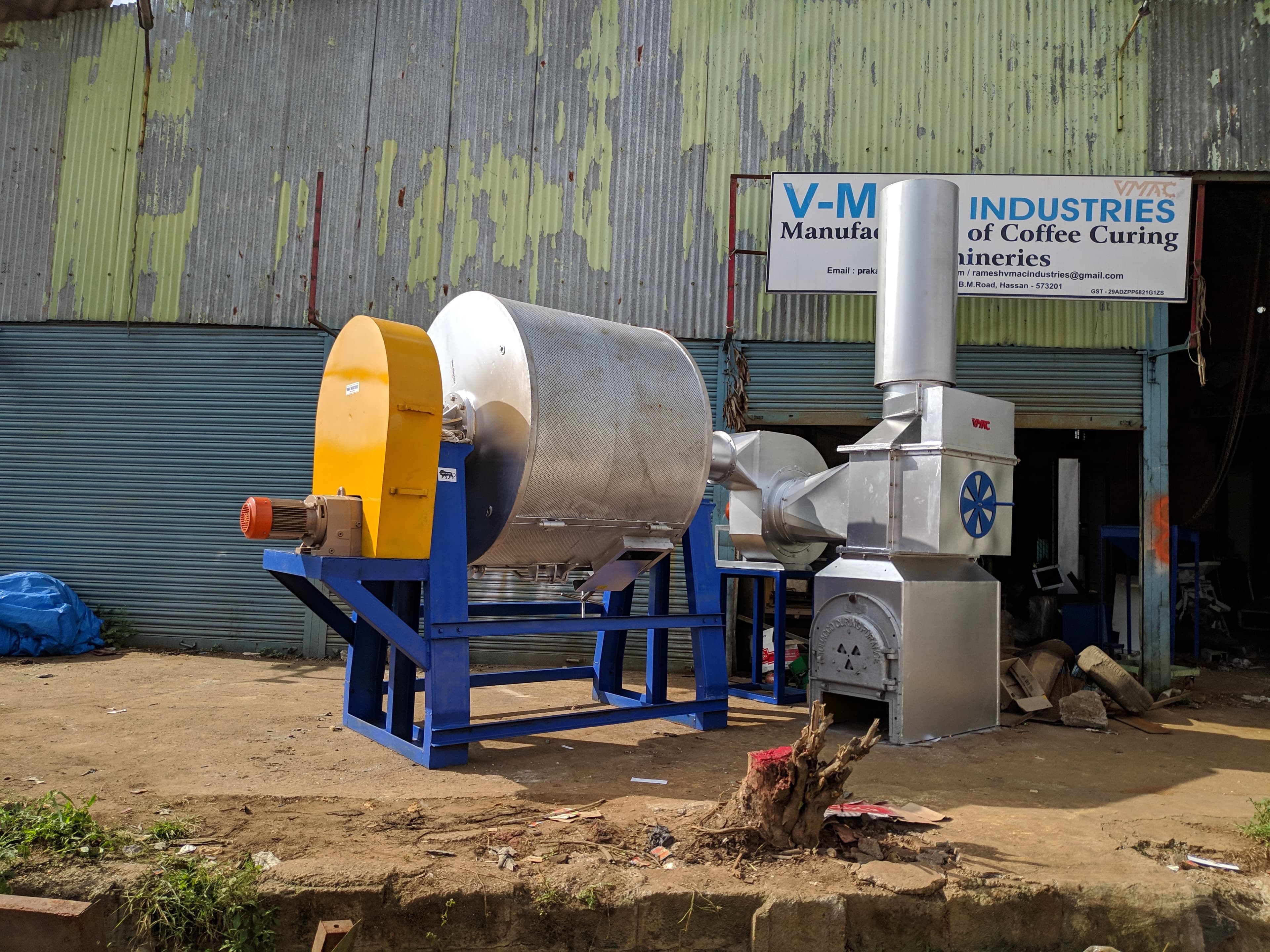
Dryers run continuously during peak season, often for weeks. They also operate at elevated temperatures around combustion sources. This combination demands disciplined daily checks.
Daily (During Season)
- Check trunnion roller bearings for overheating. A basic touch test is sufficient — if you cannot hold your hand on the bearing housing for three seconds, investigate immediately.
- Inspect perforated drum panels for blocked holes. Even partial blockage disrupts airflow uniformity across the drum cross-section, causing uneven drying.
- Check drive belt tension.
- Confirm hot-air duct seals are intact. Air leaks reduce thermal efficiency and create unpredictable temperature zones.
Every 50-100 Operating Hours
- Grease drum trunnion bearings and drive shaft bearings. Use the specified grease type and quantity — over-greasing is nearly as damaging as under-greasing, since excess grease traps heat.
Continuous (During Operation)
- Monitor the thermometer at the hot-air inlet. Target ranges: 40-50 degrees C for parchment coffee, up to 55 degrees C for cherry. Never exceed 50 degrees C for parchment. Exceeding this threshold causes case hardening — the outer shell of the bean dries and seals while the interior remains moist, producing irreversible quality defects that no amount of resting will fix.
- Sample moisture every 2-4 hours using a portable grain moisture meter. Do not rely on touch or bite tests alone. Target endpoint varies by buyer specification, but 10-12% is standard for parchment destined for hulling.
Season End
- Clean the drum interior thoroughly.
- Inspect perforated panels for corrosion. Panels exposed to wet cherry acids and humid air for months are vulnerable to pitting, which weakens the panel and enlarges perforations.
- Check firebox refractory lining for cracks or spalling.
- Re-grease all bearings before storage.
Post-drying protocol: Allow 12-24 hours of conditioning rest before hulling. This lets internal moisture equalize throughout the bean, reducing breakage during hulling.
Coffee Pulper
The pulper handles the highest-moisture, most abrasive material in the entire processing chain — fresh cherry at 60-65% moisture. It also sets the quality ceiling for all downstream processing. A poorly calibrated pulper nicks parchment, which becomes a visible defect after drying and hulling.
Pre-Season
- Gap calibration across the full operating range (0.5-8mm). Start with a loose setting and tighten incrementally while running test cherry. The target: zero whole cherries passing through, with less than 2% parchment breakage.
During Operation (Every 10-15 Minutes)
- Check output quality continuously. Pull a handful of pulped parchment and inspect. Zero whole cherries should be visible. Parchment breakage must stay below 2%. If either threshold is exceeded, stop and recalibrate.
Wear Part Replacement
- Disc surfaces: Replace every 50,000-100,000 kg of cherry processed. Actual interval depends on cherry variety and how much soil and debris enters with the fruit.
- Breast plate: Replace every 100,000-150,000 kg of cherry processed.
Water Management
- Pulp wastewater carries a BOD of 40,000-80,000 mg/L — this is not a number to ignore. Route effluent through a pulp press to recover solids, then direct to composting. Direct discharge into waterways will create regulatory problems and ecological damage.
Winnower / Aspirator
The winnower is probably the most neglected machine in the typical dry mill, and it is also the most significant fire risk. Coffee chaff is extremely flammable. Chaff accumulation inside fan housings, air columns, and ductwork has been a documented cause of mill fires in India and East Africa.
Daily
- Open cleanout panels and brush out chaff from the air column chamber and fan housing. This is a 5-minute task. It is also mandatory from a fire safety standpoint. No exceptions. No "we'll do it tomorrow."
Weekly
- Inspect fan blade edges for chaff adhesion. Accumulated chaff on blades creates imbalance and reduces airflow efficiency.
- Check throttle gate range of motion — it should move freely across its full travel.
- Verify VFD (variable frequency drive) operation if equipped.
Season End
- Disassemble the fan housing completely.
- Clean and inspect blade balance. Imbalanced blades cause vibration that accelerates bearing failure.
- Grease bearings.
- Check all gaskets and seals — worn seals allow air leakage that disrupts the velocity profile.
- Test VFD under no-load conditions.
Per Crop Calibration
- Calibrate air velocity to the process type:
- Arabica washed: 4.5-6.5 m/s
- Arabica naturals: 4.0-5.5 m/s
- Washed robusta: 5.5-7.0 m/s
Calibration check: Pull a 100g sample from the bean discharge. If chaff is visible in the sample, increase air velocity. If good beans appear in the chaff hopper, reduce air velocity. This is a manual, iterative adjustment — expect 3-5 rounds to dial in a new lot.
Gravity Separator
Gravity separators rely on precise airflow through a perforated deck to stratify beans by density. When they stop separating well, the cause is almost always the same thing: clogged air filters.
Regular (Check Frequently)
- Clean air filters. This is the single most common failure mode for gravity separators. Clogged filters reduce airflow volume, which collapses the stratification layer on the deck. The machine appears to run normally but separation quality deteriorates. Make filter checks a standing task — not something done only when problems appear.
Weekly
- Inspect vibration mount isolators for cracking or deformation.
- Verify deck inclination lock bolts hold position under vibration. Deck angle drift changes separation behavior without any visible warning.
Periodic
- Clean deck surface perforations. Dust and fine particles embed in the holes over time.
- Check fan belt tension.
- Lubricate eccentric bearings.
Operating rule: Run the gravity separator at 70-80% of rated capacity for best separation results. Overloading the deck prevents proper stratification. Underloading wastes energy and time but does not harm quality.
Pre-Cleaner
The pre-cleaner handles the dirtiest, most variable input in the mill — raw cherry or dried parchment straight from the field, complete with stones, sticks, soil clumps, and occasionally items that have no business being in a coffee lot. Its job is to protect every machine downstream.
Each Shift Start
- Inspect screen panels for blinding. "Blinding" means soil or fine particles have clogged the wire apertures, preventing material from passing through correctly. This is especially common when processing wet or damp material.
Daily
- Empty the cyclone dust collection chamber. A full chamber backs up airflow and reduces dust extraction efficiency.
Weekly
- Inspect rubber vibration isolation mounts for cracking, deformation, or separation from mounting plates.
- Lubricate eccentric shaft bearings.
Monthly
- Check fan belt tension.
Replacement
- Replace screen panels when wire shows visible wear, elongated apertures, or deformation. Panels are field-replaceable. Keep both coarse and fine screen sets in stock.
Wet material note: When processing recently harvested or rained-on material, check screens for blinding at least twice per shift rather than once.
Chaff Cyclone
The cyclone is a passive separation device with few moving parts, but it still needs attention — particularly because it handles the most flammable material in the mill.
Season Start
- Clear the inlet nozzle of compacted chaff. Off-season storage often results in chaff compacting and partially blocking the inlet, which reduces cyclone efficiency from the first day of operation.
Every 200 Operating Hours
- Grease rotary airlock valve bearings (if fitted).
Annually
- Inspect the cone interior for abrasive wear. The swirling chaff stream gradually erodes the cone wall, particularly at the transition from cylinder to cone. Thinning walls eventually develop holes that destroy the pressure differential the cyclone needs to function.
Ongoing
- Empty the collection bin regularly. A tonne of processed coffee generates 15-20 kg of chaff. A full bin backs up into the cyclone and can block the airlock.
Fire Safety: The Non-Negotiable Section
Dry coffee chaff at less than 10% moisture ignites at low temperatures. Accumulated chaff on motors, bearings, lights, conveyor belts, and electrical panels has been the documented cause of mill fires across India and East Africa. This is not theoretical.
Daily
- Winnower cleanout: 5 minutes, every day, no exceptions. This is the single highest-impact fire prevention task in the mill.
Weekly
- Inspect fan blades in winnower for chaff buildup.
- Check cyclone bin discharge — ensure the bin is being emptied and the airlock (if fitted) operates freely.
Seasonal
- Clear ALL mill surfaces of chaff accumulation. This means equipment housings, structural beams, rafters, electrical panels, light fixtures, cable trays, and conveyor belt frames. Anywhere chaff settles, fire can start.
The seasonal cleanout is not cosmetic. It is structural fire prevention. Schedule it. Staff it. Document it.
Spare Parts Inventory
Downtime during harvest season is expensive — not because of repair costs, but because of cherry spoilage while machines sit idle waiting for parts. Stock the following for each machine:
- Huller: Replacement abrasive discs (minimum one spare per huller)
- Dryer: Perforated drum panels, drive belts, trunnion bearing rollers
- Winnower: Drive belts, fan bearings, throttle gate seals
- Pre-cleaner: Screen panels in both coarse and fine mesh sizes, vibration isolation mounts
- Pulper: Disc surfaces, breast plates, water seals
- Gravity separator: Fan belts, bearing grease (correct specification), air filter elements
- Chaff cyclone: Duct connectors, collection bin seals, rotary valve star-wheel vanes (if fitted)
Order wear parts at the start of off-season, not when they fail mid-harvest. Lead times for specialized parts from manufacturers can stretch to weeks.
Record-Keeping
Maintenance without records is maintenance without memory. The person who services the machine today may not be the person who services it next month. Write it down.
Maintain a log for each machine covering:
- Hull gap settings per variety and moisture level. When you find the right setting for a particular lot profile, record it. Next season, you start from a known baseline instead of re-discovering it.
- Disc and wear-part replacement dates. Track cumulative throughput against part life to predict replacements before failure.
- Dryer temperature readings, moisture samples, and cycle times. These records also serve as quality documentation for buyers who want traceability.
- Winnower air velocity settings per process type (washed, natural, robusta). Calibration data saves hours of re-adjustment at the start of each crop.
- Bearing lubrication dates. A simple date-and-initials log prevents both missed lubrication and redundant greasing.
- Any abnormal observations. Unusual sounds, vibrations, temperature spikes, or output quality deviations. These notes are the early warning system that prevents small problems from becoming catastrophic failures.
A bound notebook at each machine station works. A shared spreadsheet works. The format does not matter. Consistency does.
VMAC Processing Equipment
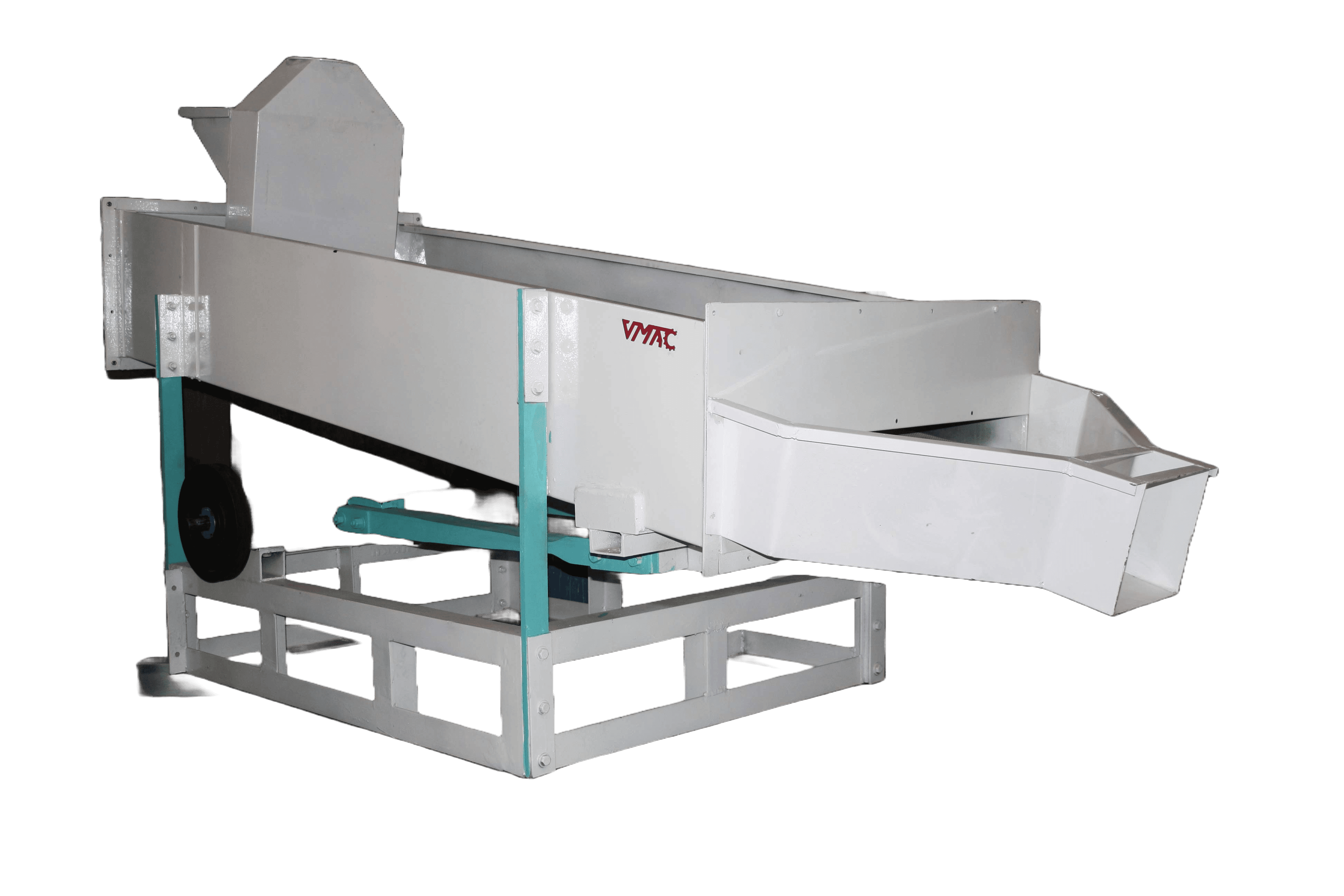
Need maintenance support for your VMAC line?
Our service team supports installations across Karnataka, Kerala, Tamil Nadu, Ethiopia, Uganda, and PNG. Whether it's scheduled servicing, spare parts, or a diagnostic question — we're one message away.