
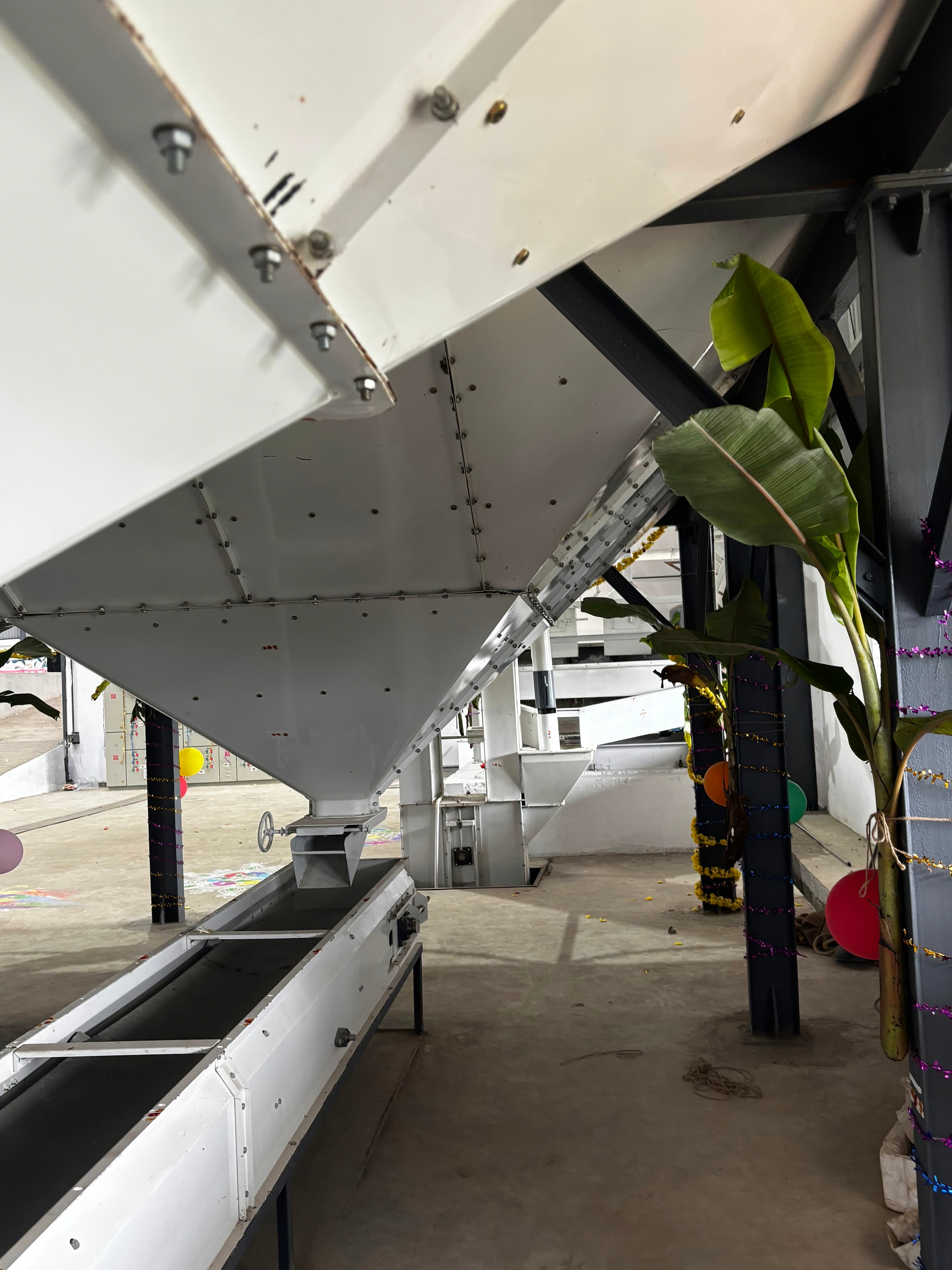
Coffee Belt Conveyor
Flat rubber or PVC transport belt for gentle, continuous movement of coffee cherry, parchment, and green beans between every machine in the dry mill — horizontal runs and inclines up to 45° with cleated belt.
| Belt width | 300 mm · 400 mm · 500 mm · 600 mm (standard); 200–1,200 mm custom |
| Capacity range | 500 kg/hr (300 mm flat belt) to 20 t/hr (600 mm troughed belt); up to 100 t/hr at 1,200 mm |
| Belt speed | 0.1–0.3 m/s (hand-sorting table) · 0.5–1.5 m/s (standard coffee conveyance) · up to 2.5 m/s (troughed high-capacity) |
| Maximum incline — flat belt | 0–20° without cleats (15–18° recommended limit for loose beans) |
| Maximum incline — cleated belt | Up to 45° with rubber or PVC cleats at 150–300 mm pitch |
| Drive motor power | 0.37 kW (300 mm, short run) · 0.75–1.5 kW (400–500 mm) · 1.5–3.0 kW (600 mm) · up to 22 kW (long heavy-duty runs) |
| Standard conveyor lengths | 2 m · 3 m · 4 m · 6 m · 8 m (custom lengths to 50 m+) |
| Belt material | Rubber (standard) · PVC food-grade · oil-resistant rubber · open-weave fabric for wet cherry drainage |
| Frame material | Mild steel (standard) · hot-dip galvanised for outdoor / wet-process environments |
| Drive arrangement | Head-pulley drive with gearmotor; VFD speed control available; lagged drive pulley for positive grip |
Key Features
Zero-contact transport: flat belt surface carries beans without shearing, grinding, or compressive stress — the gentlest method of horizontal coffee conveyance in any mill
Three belt configurations available: flat belt (0–20° incline), troughed belt with 3-roll idlers for bulk loose material and longer horizontal runs, and cleated/chevron belt for steep inclines up to 45°
Choice of belt materials: general-purpose rubber belt for parchment and green beans; food-grade PVC belt for hygiene-sensitive applications; open-weave fabric belt that drains naturally when handling wet cherry
Variable-frequency drive (VFD) as standard on most models — belt speed adjustable from 0.1 m/s (hand-sorting table use) to 2.0 m/s (high-throughput transfer) without changing pulleys
Standard belt widths of 300 mm, 400 mm, 500 mm, and 600 mm covering small curing works (0.5–2 t/hr) through mid-scale mills (up to 20 t/hr); custom widths up to 1,200 mm on request
Mild steel frame as standard; hot-dip galvanised frame available for outdoor installations, wet processing areas, or coastal environments with high humidity
Optional intermediate divert plows — manually or pneumatically actuated — allow a single inclined belt conveyor or horizontal run to feed two or more downstream hoppers from one machine
Self-tensioning tail pulley with screw-adjust take-up bearing maintains correct belt tension as the belt stretches over service life, reducing slip and extending belt life
Drive pulley lagged with rubber for positive grip; interchangeable idler rollers with sealed bearings allow field replacement without dismantling the frame
Models & Sizing
Right-Sized for Every Operation
VMAC belt conveyors are grouped by belt width, which determines both capacity and the physical size of the machine. All tiers share the same drive-pulley-and-idler working principle; the differences are width, motor size, and recommended maximum length for a single drive.
BC-300
500 kg/hr – 1.5 t/hr
capacity
Small estate mills and curing works handling up to 500 bags/day; also used as hand-sorting inspection tables at slow speed in larger mills
BC-400
1 t/hr – 4 t/hr
capacity
Mid-scale curing works processing 500–2,000 bags/day; most common inter-machine transfer belt in Indian and East African dry mills
BC-500
3 t/hr – 10 t/hr
capacity
Large curing works and export-grade dry mills; handles high-volume transfers between grader, gravity separator, and color sorter in continuous-run lines
BC-600
8 t/hr – 20 t/hr
capacity
High-throughput centralized processing stations, multi-origin blending facilities, and port-side green coffee handling where belt width and surge capacity are critical
Custom
Your specification
capacity
For operations requiring throughput beyond the standard range. VMAC engineers the machine to your exact capacity and processing conditions.
Request a Custom QuoteConfigurations
Belt Conveyor — Model Specifications
Standard configurations; custom lengths, inclinations, and frame finishes available on request
| Model | Belt Width | Capacity | Belt Speed | Motor Power | Max Incline (flat belt) |
|---|---|---|---|---|---|
| BC-300 | 300 mm | 0.5–1.5 t/hr | 0.3–1.5 m/s | 0.37–0.75 kW | 18° |
| BC-400 | 400 mm | 1–4 t/hr | 0.5–1.5 m/s | 0.75–1.5 kW | 18° |
| BC-500 | 500 mm | 3–10 t/hr | 0.5–2.0 m/s | 1.5–3.0 kW | 15° |
| BC-600 | 600 mm | 8–20 t/hr | 0.5–2.0 m/s | 2.2–5.5 kW | 15° |
| Custom | Built to your capacity and specification — contact us for a quote | ||||
Overview
About the Coffee Belt Conveyor
The belt conveyor is the backbone of horizontal material flow in any coffee processing facility. Known in Indian curing works simply as a belt conveyor, called esteira transportadora in Brazil and banda transportadora across Central America, the machine consists of a continuous rubber or PVC belt looped around a motorised head pulley and a free-spinning tail pulley, supported along its length by a series of idler rollers. The head pulley — driven by a gearmotor mounted on the discharge end — pulls the belt forward, carrying coffee at whatever speed is set on the variable-frequency drive. Unlike screw conveyors, the flat belt transport imposes no shearing, grinding, or compressive stress on the product. Beans ride on the open belt surface and discharge cleanly at the head end or through intermediate divert plows. For horizontal and gently inclined runs up to 20°, a flat belt or troughed belt conveyor is the standard choice; for steeper inclines up to 45° a cleated or chevron belt variant is used instead. Belt widths from 300 mm to 600 mm cover the full range of small-to-mid-scale coffee mills processing 500 kg/hr up to 20 t/hr. In India and East Africa the belt conveyor appears at nearly every transfer point in a dry mill: feeding cherry or parchment from an intake hopper to the pre-cleaner, linking the pre-cleaner output to the rubber-roll huller, conveying hulled beans across the grading floor, and finally moving sorted green coffee to the bagging station. The rubber belt transport is also widely used as a slow-speed hand-sorting table — at 0.1–0.3 m/s workers can inspect every bean before final packing. PVC belt variants comply with food-contact standards and are preferred wherever hygiene audits require it. VMAC Industries manufactures belt conveyor systems in mild steel and hot-dip galvanised frames from its Hassan, Karnataka facility and configures each unit to the exact length, width, incline, and discharge arrangement required by the curing works layout.
How It Works
How It Works
A belt conveyor moves coffee by looping a continuous belt around two end pulleys and driving the head pulley with a gearmotor. The belt surface carries product from the tail (feed) end to the head (discharge) end with no mechanical contact between the product and any moving parts other than the belt itself.
Drive pulley and gearmotor
The gearmotor — mounted on the discharge (head) end of the frame — turns the head pulley. Rubber lagging on the pulley surface grips the underside of the belt and pulls it forward. A VFD between the motor and the drive controls belt speed in real time, allowing the same inclined belt conveyor to serve as a slow sorting table or a fast transfer line simply by turning a dial.
Idler rollers and belt support
Along the upper (carrying) run, the belt rests on a series of flat or troughing idler rollers spaced at 0.5–1.0 m intervals. Flat idlers support a flat belt conveyor for parchment and green beans. Three-roll troughing idlers angle the belt edges upward, forming a trough that prevents loose material from rolling off the sides during inclined or high-speed transport — the basis of the troughed belt conveyor variant. Return-run rollers support the empty belt on its way back to the tail end.
Belt tensioning at the tail pulley
Correct belt tension prevents slipping on the drive pulley and stops the belt from sagging between idlers. A screw-adjust take-up bearing at the tail end moves the tail pulley away from the head end to apply tension. As the rubber belt transport stretches with use, the tail pulley is advanced a few turns of the adjusting screw to restore tension — a routine maintenance task that requires no specialist tools.
Discharge and optional divert plows
Product rides the belt to the head pulley and discharges over the end into the downstream hopper or machine. When intermediate discharge is needed — for example, routing beans to any of several grade hoppers — adjustable divert plows are fitted across the belt width at each drop point. Pushing a plow down onto the moving belt deflects the product stream sideways into a chute. Multiple plows on a single horizontal belt conveyor eliminate the need for separate short conveyor runs to each machine.
Know the Difference
Coffee Belt Conveyor vs. Screw Conveyor
For horizontal or gently inclined transfer of coffee beans the belt conveyor and the screw conveyor are the two most common choices. They differ fundamentally in how they contact and move the product.
| Feature | Coffee Belt Conveyor | Screw Conveyor |
|---|---|---|
| Product contact | Belt surface only — beans rest on top of moving belt, no part of the machine presses or rubs the bean | Helical screw flights rotate against the trough wall — unavoidable minor rubbing and shearing of beans |
| Bean breakage risk | Minimal — belt speed below 1.5 m/s with soft discharge chute causes negligible mechanical damage | Low to moderate — slightly elevated breakage and surface abrasion, especially at higher throughput rates |
| Maximum inclination | 15–18° flat belt without cleats; up to 45° with cleated belt variant | Up to 45° standard; vertical conveying possible with specialised pitch |
| Enclosure / dust control | Open by default; covers, side-skirts, and tube-belt variants available for dusty environments | Fully enclosed trough — inherently dust-tight; preferred where dust is a hygiene or fire concern |
| Throughput range | 0.5–100 t/hr depending on belt width; easily scaled by widening the belt | 0.5–30 t/hr typical for coffee-scale screws; wider diameters become expensive and mechanically complex |
| Cleaning | Belt can be hosed down; PVC belt resists staining; belt can be reversed slowly for self-cleaning scrapers | Full clean-out requires removal of end cover and sometimes the entire screw flight — more labour-intensive |
| Maintenance | Idler roller replacement, belt re-tensioning, drive pulley lagging — all done in situ without dismantling frame | Bearing replacement at both ends; screw flight tip wear; inspection requires cover removal |
| Capital cost | Moderate — proportional to length; very long runs are cost-effective | Lower for short runs; cost increases sharply with length due to shaft and bearing requirements |
For horizontal dry-mill inter-machine transfers where bean quality and cleanability matter, the flat belt transport is the preferred choice. The screw conveyor is the better option when the conveying path is short, enclosed dust control is mandatory, or the installation space is too narrow for a belt frame.
Processing Line
Where It Fits in Your Processing Line
Belt conveyors appear at multiple horizontal and inclined transfer points throughout a dry mill. The positions below follow typical Indian curing works layout; belt conveyors at each marked position handle transport — not processing — so the flow pauses at each machine and resumes on the next belt.
Cherry / Parchment Intake Hopper
Intake Belt Conveyor — feeds pre-cleaner or flotation tank
This machinePre-Cleaner / Scalper
Transfer Belt Conveyor — pre-cleaner to huller infeed hopper
This machineRubber-Roll Huller or Disc Huller
Hulled Bean Transfer Belt — huller discharge to grading building
This machineFlat-Screen Grader
Inter-Machine Transfer Belt — grader to gravity separator
This machineGravity Separator / Density Separator
Transfer Belt — gravity separator to color sorter or hand-sorting table
This machineCCD / Laser Color Sorter
Finished-Green Transfer Belt — color sorter to bagging station
This machineBag Loader / Weighing and Bagging
FAQ
Frequently Asked Questions
What is the maximum incline angle for a flat belt conveyor carrying green coffee?
For a standard flat belt conveyor with no cleats, 15–18° is the practical upper limit before beans begin sliding back on the return stroke. At inclines above 18° cleated belt variants are required. Cleated or chevron belts with 20–40 mm high rubber cleats spaced at 150–300 mm allow safe conveying up to 45°. The troughed belt conveyor extends the spillage-free range on inclines but does not significantly improve the anti-rollback limit — cleats are still needed above 20°.
Rubber belt vs PVC belt — which is better for coffee?
Rubber is the standard choice: it is durable, grips the drive pulley well, handles moderate moisture, and is easily repaired by vulcanising or cold splicing in the field. PVC is preferred when hygiene certification is required — it is non-porous, easy to wipe clean, and resists staining from coffee oils and mucilage. PVC is also the correct choice for food-contact lines where export buyers or auditors require documented food-grade materials. The cost difference is small; VMAC supplies both and recommends PVC for any line that handles wet or semi-washed coffee directly.
Does the belt conveyor damage coffee beans?
Bean damage on a properly configured rubber belt transport is negligible. There is no grinding, shearing, or compression between moving parts — the bean simply rests on the belt surface. At the discharge end, the drop height into the receiving hopper should be kept below 300 mm where possible to avoid impact breakage. Belt speed should be kept at or below 1.5 m/s for parchment coffee and green beans; higher speeds are acceptable for cherry which has its own protective skin. Damage from the belt itself is not a normal failure mode — damage is almost always caused by excessive drop height or improper discharge chute design.
Can the belt conveyor handle wet cherry straight off the flotation tank?
Yes, with the correct belt specification. Wet cherry should be carried on an open-weave fabric belt that allows free water drainage through the belt surface. Rubber or PVC belts can also carry wet cherry but water pools on the belt and can cause slipping at the drive pulley unless the drive is lagged with diamond-pattern rubber. Frame drainage channels and sealed bearings should be specified for wet-process positions. For cherry at full saturation VMAC recommends the open-weave belt with stainless-steel idler rollers to prevent rust contamination.
What routine maintenance does a belt conveyor require?
Three tasks cover the majority of routine maintenance: (1) belt tension check every two to four weeks — adjust the tail-end screw take-up until the belt has about 10–15 mm of sag between idlers at the mid-point of the carrying run; (2) idler roller inspection every quarter — a worn or seized roller makes a clicking sound and should be replaced before it causes belt edge damage; (3) drive pulley lagging inspection annually — worn lagging leads to belt slip under load and excessive heat at the drive pulley. Bearing lubrication intervals depend on the sealed-bearing type fitted; VMAC standard bearings are sealed-for-life on machines below 5 t/hr.
How long can a single belt conveyor run be?
A single-drive belt conveyor can be built to virtually any length, but practical limits are set by the tension the belt splice can safely carry. For the belt widths and materials VMAC supplies, single-drive runs up to 50 m are standard. Longer runs require either a higher-tensile belt specification or an intermediate drive booster pulley. Most dry-mill inter-machine transfers are 3–15 m, well within a single-drive frame. VMAC can configure the BC-500 and BC-600 for runs up to 50 m with a single 5.5 kW drive.
Can I install a belt conveyor at an incline to replace a bucket elevator?
A cleated belt conveyor can replace a bucket elevator on inclines up to 45°, and is often preferred for green coffee because it is gentler, easier to inspect, and simpler to clear in the event of a jam. Bucket elevators have the advantage of a smaller footprint for a given vertical lift and are better suited to very tall vertical runs (10 m+). For a 3–6 m vertical lift on a 30–45° structural incline the cleated transport belt is a practical, cost-effective alternative. For vertical lifts over 8 m in a constrained floor plan, the bucket elevator remains the preferred option.
Is the belt conveyor the same as a belt dryer?
No. A belt conveyor (or transport belt) is a material-handling machine: it moves coffee from one point to another with no processing. A belt dryer — also called a continuous belt dryer — passes coffee over a perforated belt through which hot air is forced upward; the belt moves slowly to provide residence time under the airflow and the coffee exits at a lower moisture content. The two machines share the word 'belt' and the same basic belt-and-roller mechanical principle, but they serve entirely different functions. VMAC lists them separately in its catalogue: belt conveyors under Material Handling and belt dryers under Drying Equipment.
What customisation options are available?
VMAC configures each belt conveyor to the customer's specific layout. Standard customisation options include: belt width (200–1,200 mm), conveyor length (2–50 m per drive), inclination angle (0–45° with appropriate belt variant), belt material (rubber, PVC, open-weave), frame finish (mild steel painted or hot-dip galvanised), number and position of intermediate divert plows, VFD speed control vs fixed-speed drive, and feed hopper / discharge chute geometry. Stainless-steel contact parts are available for export-grade facilities. Lead time for custom units is typically 4–6 weeks from drawing approval.
Send a Enquiry Request
Retail store
Mon-Sat 9am to 5pm.
B.M road, Hassan, Karnataka 573201
Related Products
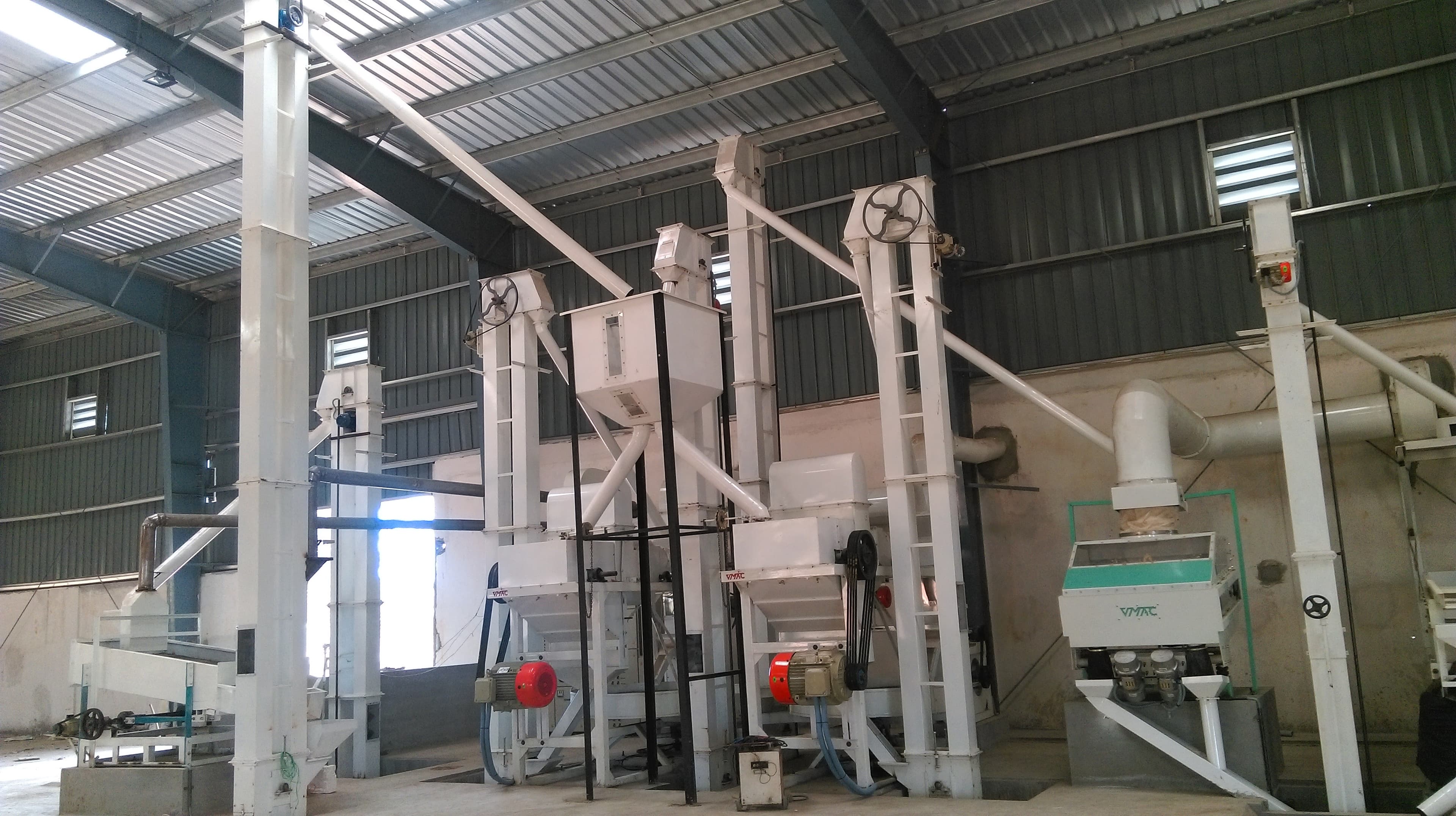
Coffee Bucket Elevator
Vertical bucket conveyor for dry-mill material handling — elevates green coffee, parchment, and cherry between every machine in the processing line with minimal bean breakage.
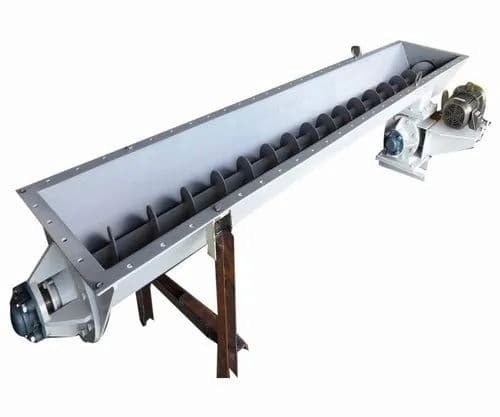
Coffee Screw Conveyor
Enclosed helical screw conveyor for horizontal and mildly inclined transfer of green coffee throughout the dry mill — dust-contained, low-maintenance, and gentle at slow RPM.
Pneumatic Coffee Conveyor
Fully enclosed air-conveying system for transferring green coffee, parchment, and chaff through pipelines — eliminates open belt runs, reduces dust, and enables flexible routing through walls, around corners, and across vertical changes in a coffee mill.