
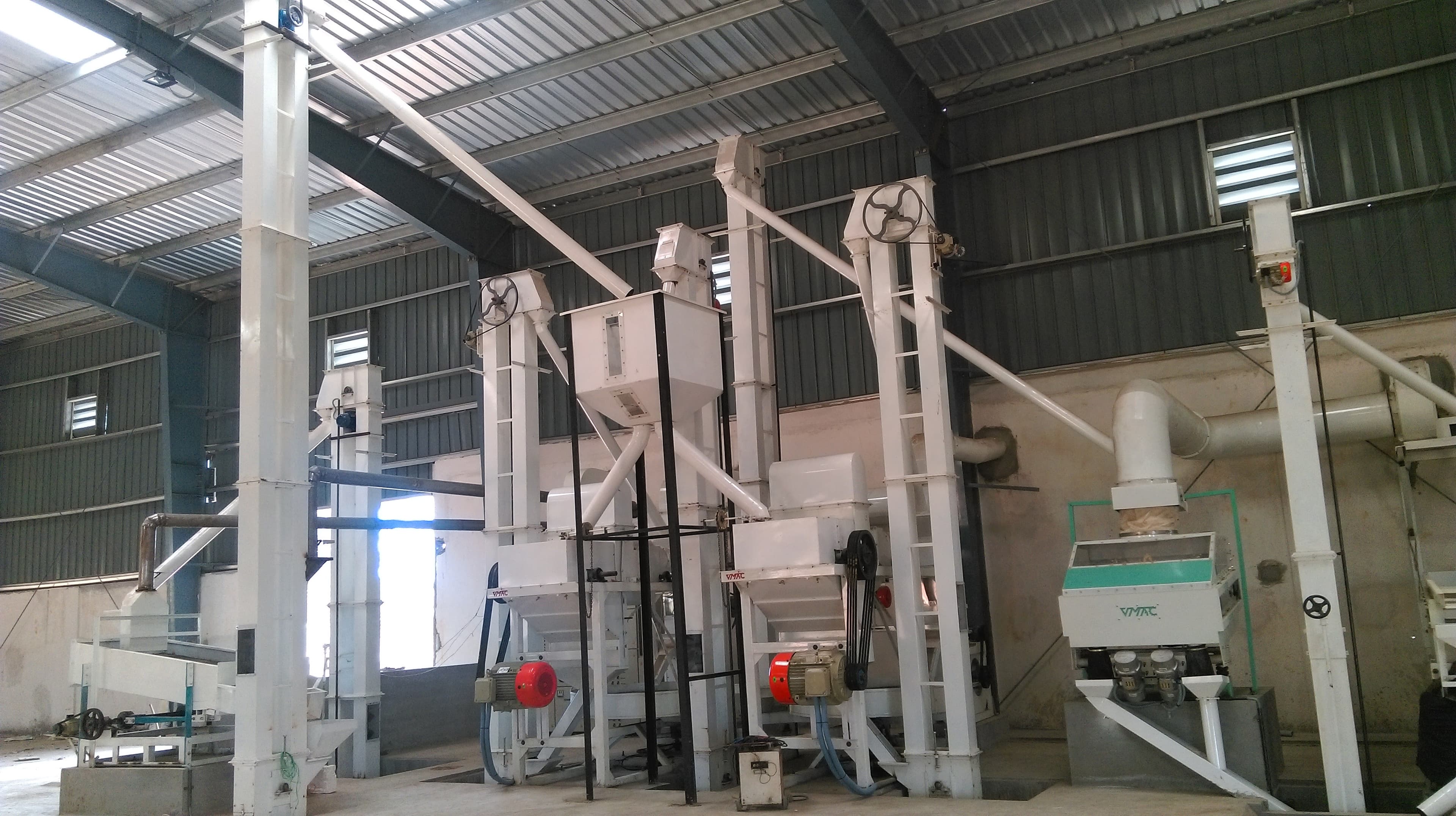
Coffee Bucket Elevator
Vertical bucket conveyor for dry-mill material handling — elevates green coffee, parchment, and cherry between every machine in the processing line with minimal bean breakage.
| Capacity | 1 TPH – 20 TPH |
| Head height (standard) | 3 m – 15 m |
| Head height (custom) | Up to 20 m |
| Bucket type | CC-type / AC-type HDPE or nylon polymer; steel for heavy-duty |
| Belt / chain speed | 30 – 90 m/min (adjustable by pulley ratio) |
| Discharge type | Centrifugal (standard); positive / gravity discharge (available) |
| Drive motor | 0.75 HP – 7.5 HP, 3-phase 415V / 440V |
| Boot inlet clearance | Minimum 2× bucket projection depth |
| Construction type | Belt-type (green coffee) or chain-type (cherry / parchment / heavy-duty) |
| Casing material | Mild steel with inspection doors; SS option available for wet-process lines |
Key Features
Vertical elevation at any dry-mill transfer point — eliminates manual lifting and floor spillage between machines
HDPE and nylon polymer CC-type and AC-type buckets designed for gentle scooping and centrifugal release — significantly lower breakage than steel buckets on hulled green coffee
Belt-type construction for light-duty green coffee and parchment handling; chain-type available for heavy-duty cherry, pulp press cake, and coarse material
Centrifugal discharge at head pulley optimised for free-flowing coffee; positive gravity discharge available for sticky or fragile product streams
Standard head heights 3 m to 15 m; custom fabrication to 20 m for multi-storey mill buildings
Boot access doors with replaceable wear liners — the highest-wear zone in the casing is maintainable without machine downtime
Adjustable belt tension system with take-up frame at boot end — belt stretch is the leading cause of bucket misalignment and is corrected without tools
Fully enclosed casing with dust-tight inspection covers — critical for maintaining clean-room conditions in parchment coffee and export-grade operations
Models from 1 TPH for small cooperative or estate dry mills to 20 TPH for large export curing works
Models & Sizing
Right-Sized for Every Operation
VMAC manufactures bucket elevators across four capacity tiers covering small estate cooperatives through large export curing works. All models are available in belt-type (recommended for hulled green coffee) and chain-type (for cherry, parchment, and heavy-duty applications). Head height is specified at order time. Contact VMAC for multi-elevator plant quotations.
Light Duty — Estate
1–3 TPH
capacity
Small estates, cooperative dry mills, and on-farm processing units. Typically one or two elevators in a compact line. Suitable for head heights up to 6 m.
Medium Duty — Small Curing Works
3–7 TPH
capacity
Small to mid-size curing works processing 100–300 bags per day. Handles the main vertical transfers in a 4–6 machine dry mill. Head heights 4–10 m.
Heavy Duty — Licensed Curing Works
7–12 TPH
capacity
Licensed curing works and large estate mills processing Plantation A, AA, MNEB, and Robusta grades for export. Multiple elevators running in parallel configurations. Head heights 5–12 m.
Industrial — Export Processing Plant
12–20 TPH
capacity
Large-scale commercial export mills and grain storage facilities. High-volume continuous operation across multiple shifts. Head heights 8–15 m; custom up to 20 m for multi-storey mill buildings.
Custom
Your specification
capacity
For operations requiring throughput beyond the standard range. VMAC engineers the machine to your exact capacity and processing conditions.
Request a Custom QuoteConfigurations
Full Model Range — Coffee Bucket Elevator
All models available in belt-type (HDPE/nylon polymer buckets, recommended for hulled green coffee) and chain-type (steel or nylon buckets, for cherry, parchment, and heavy-duty material). Head height is specified at order time within the standard range. Indicative specifications — contact VMAC for exact dimensions and custom plant configurations.
| Model Tier | Capacity (TPH) | Belt / Chain Speed (m/min) | Bucket Size (mm) | Drive Motor | Standard Head Height | Best For |
|---|---|---|---|---|---|---|
| Light Duty — Estate | 1–3 | 30–50 | 160 × 100 (CC-type HDPE) | 0.75–1.5 HP | 3–6 m | Small estate / cooperative dry mill |
| Medium Duty — Small Curing Works | 3–7 | 40–65 | 200 × 130 (CC-type HDPE) | 2–3 HP | 4–10 m | Small to mid-size curing works |
| Heavy Duty — Licensed Curing Works | 7–12 | 50–75 | 250 × 160 (AC-type HDPE/Steel) | 3–5 HP | 5–12 m | Licensed export curing works |
| Industrial — Export Processing Plant | 12–20 | 60–90 | 320 × 200 (AC-type Steel/HDPE) | 5–7.5 HP | 8–15 m (custom to 20 m) | Large-scale export mill / grain facility |
| Custom | Built to your capacity and specification — contact us for a quote | |||||
Overview
About the Coffee Bucket Elevator
VMAC's Coffee Bucket Elevator — known simply as the 'elevator' in Indian curing works and East African mills — is the backbone of vertical material handling in any dry-mill or wet-mill operation. Where a screw conveyor or belt conveyor moves product horizontally, a cup elevator moves it upward: scooping coffee at the bottom boot, carrying it to the required head height, and discharging it into the next machine's infeed with no product on the floor and no manual labour. The machine appears at every vertical transfer point in a complete dry mill: after the pre-cleaner to lift cleaned cherry or parchment to the destoner; after destoning to the huller; from the huller discharge up to the grader deck; between grader and gravity separator; and again from the gravity separator to the colour sorter or bagging station. A modern curing works with eight to twelve machines typically uses four to six elevators running simultaneously. Two construction types are available: belt-type bucket elevators for gentle handling of hulled green coffee where bean breakage is a concern, and chain-type bucket elevators for heavier-duty applications with cherry, pulp, or dried parchment. For green coffee — especially hulled, polished Arabica — VMAC specifies HDPE or nylon polymer buckets (CC-type and AC-type profiles) which grip and release beans without the impact forces that steel buckets impose. Centrifugal discharge at the head pulley is standard for most coffee applications; positive (gravity) discharge is available for fragile or sticky products. Head heights from 3 m to 15 m are standard, with custom heights to 20 m available for multi-storey mill buildings. Capacity ranges from 1 TPH for small cooperative elevators to 20 TPH for high-volume export plant installations. All models are manufactured to 3-phase power, with CE-compliant guarding and boot access doors for liner inspection.
How It Works
How It Works
A bucket elevator (cup elevator / vertical bucket conveyor) works on a simple gravity-and-belt principle: a continuous belt or chain carries equally-spaced buckets in a closed vertical loop. Product is scooped at the bottom and discharged at the top — repeating with each bucket cycle.
Boot intake — scooping at the bottom
Product falls or is fed into the boot (the lower casing housing the tail/boot pulley). As the belt rounds the boot pulley, each bucket scoops up a controlled volume of coffee or parchment from the boot. Boot geometry — specifically the clearance between bucket lip and boot liner — controls fill efficiency and is critical to capacity. Over-filled boots cause slip and drag; under-filled boots reduce throughput.
Vertical travel — carrying in the up-leg
Loaded buckets travel upward inside the enclosed elevator casing in the up-leg (carrying side). The belt speed — typically 30–90 m/min — is calculated to ensure filled buckets reach the head pulley with enough velocity for clean centrifugal discharge. The down-leg (return side) runs empty buckets back to the boot. The casing prevents dust escape and protects the product from contamination.
Head discharge — centrifugal or positive
At the top head section, the belt rounds the head/drive pulley. In centrifugal discharge — standard for most coffee applications — the combination of belt speed and bucket shape causes product to fly out of the bucket in a controlled arc and into a discharge spout aimed at the receiving machine's infeed. In positive (gravity) discharge, the bucket is inverted and product falls under gravity — used for fragile or sticky products where the centrifugal arc is not clean.
Return leg — empty bucket descent
Empty buckets return to the boot on the down-leg. This is the lowest-stress part of the cycle, but belt tracking must be monitored — a misaligned belt on the return leg causes bucket contact with the casing and accelerated wear. Belt tension, maintained via the take-up frame at the boot end, is the primary adjustment. Bucket bolts on the return leg should be checked for loosening during every scheduled maintenance inspection.
Know the Difference
Coffee Bucket Elevator vs. Screw Conveyor
Both a bucket elevator (grain elevator / cup elevator) and a screw conveyor move bulk material, and both appear in the same dry-mill equipment list. They are not interchangeable — they serve completely different transfer tasks. Understanding which to specify at each transfer point is essential for plant layout.
| Feature | Coffee Bucket Elevator | Screw Conveyor |
|---|---|---|
| Direction of travel | Vertical — elevates product upward; head height from 3 m to 15 m+ | Horizontal or slight incline — moves product along the floor between machines; max practical incline ~20° |
| Bean breakage | Low — HDPE / nylon polymer buckets scoop and release gently; centrifugal discharge is a brief free-fall arc with no metal grinding contact | Moderate to high — rotating screw flights impose shear and compression forces on every bean passing through; not recommended for hulled green coffee after polishing |
| Ideal product | Hulled green coffee, parchment coffee, dried cherry, grain — free-flowing granular material that scoops cleanly | Wet pulp, semi-liquid slurries, sticky by-products (pulp, pomace), or dry material where bean quality is less critical |
| Capacity | 1 TPH – 20 TPH depending on bucket size and belt speed; scales linearly with head section size | 0.5 TPH – 30 TPH depending on screw diameter and pitch; very high capacity available in large diameters |
| Energy efficiency | High — motor lifts product mass directly against gravity with minimal friction; no bean-on-metal grinding | Moderate — motor overcomes both friction and material compression; energy per tonne-metre is higher than a bucket elevator for the same throughput |
| Maintenance | Belt tension check, boot liner inspection, bucket bolt tightening; simple and low-frequency when correctly sized | Screw flight wear (especially at product entry/exit), bearing seal replacement, trough liner wear — more contact surfaces mean more wear items |
| Plant layout requirement | Requires vertical headroom — must fit between floor level and the infeed height of the receiving machine | Requires horizontal floor space — constrains plant layout on dense floor plans; trunking must route around other equipment |
In a standard dry mill, both machines are needed. The bucket elevator handles every vertical transfer between floor level and an elevated machine infeed. Screw conveyors handle horizontal runs — notably wet pulp evacuation in wet processing lines, where a bucket elevator would be impractical. Do not substitute one for the other based on cost alone.
Processing Line
Where It Fits in Your Processing Line
A complete dry mill typically uses four to six bucket elevators (cup elevators / grain elevators) running simultaneously — one at each vertical transfer point between processing machines. The line below shows a common configuration for a parchment dry mill; elevators are marked at two key positions.
Intake / Receiving hopper
Dried parchment or cherry received from drying yard or warehouse — ground-level intake
Pre-cleaner / Scalper
Removes sticks, rope, mud, gross debris and oversized material
Bucket Elevator
This machineElevates pre-cleaned material from pre-cleaner discharge to destoner infeed — typically 4–6 m head height
Destoner
Air-aspiration destoner removes stones, glass, and dense foreign material heavier than coffee
Huller
Rubber-roll huller removes parchment from dried washed coffee; disc huller for natural/cherry
Peeler / Polisher
Removes silver skin and polishes bean surface; chaff aspirated to cyclone
Winnower / Aspirator
Air column removes remaining chaff, parchment dust, and light husk fragments
Bucket Elevator
Second elevator — elevates hulled, polished green coffee to grader deck infeed; typically 5–8 m
Screen Grader
Flat screen or rotary drum grader separates by bean size — Grade A, B, C, Peaberry fractions
Gravity Separator
Each size fraction elevated and run separately through gravity separator to remove density-based defects
Colour Sorter → Bagging
CCD or laser colour sorter removes black, sour, and discoloured beans; graded, sorted coffee bagged for export
FAQ
Frequently Asked Questions
Will a bucket elevator crack or damage hulled green coffee beans?
Bean breakage in a correctly specified bucket elevator is very low — significantly lower than in a screw conveyor. The key is bucket material: HDPE or nylon polymer CC-type and AC-type buckets scoop beans gently from the boot and release them in a smooth centrifugal arc at the head. There is no grinding contact between bean and metal. Steel buckets, by contrast, impose impact forces during scooping and discharge that can crack brittle hulled beans. VMAC specifies polymer buckets as standard for all hulled green coffee elevators. The other variable is belt speed — running the elevator at correct rated speed (not faster) ensures clean centrifugal discharge without excessive arc impact.
Can the head height be customised for my mill building?
Yes. Head height is specified at order time and can be set to any dimension required by your plant layout within the standard range of 3 m to 15 m. For multi-storey mill buildings or grain storage towers, custom fabrication to 20 m is available. When specifying head height, the key consideration is the vertical distance between the tail/boot pulley centerline and the head/drive pulley centerline — which must match the height difference between your infeed machine discharge and the receiving machine's intake. VMAC's engineering team can prepare a layout drawing based on your machine heights and building dimensions.
What is the difference between a belt-type and a chain-type bucket elevator?
Belt-type bucket elevators use a rubber conveyor belt as the carrying medium, with buckets bolted to the belt face. They are quieter, gentler on beans, and the preferred choice for hulled green coffee and parchment coffee. Chain-type bucket elevators use a roller chain as the carrying medium, with buckets hung between two parallel chains. They are heavier duty, handle abrasive or lumpy material (dried cherry, wet pulp, coarse grain) more reliably, and are better suited to very high head heights where belt stretch would be problematic. For a complete dry mill, belt-type elevators are typically used after hulling where green coffee is in play; chain-type may be used at the intake for dried cherry or parchment from the drying yard.
How many bucket elevators does a typical curing works need?
A typical dry mill processing line uses four to six bucket elevators running simultaneously — one at each vertical transfer point between machines. A compact six-machine line might need: (1) pre-cleaner to destoner, (2) destoner to huller, (3) huller/polisher discharge to grader, (4) grader to gravity separator, (5) gravity separator to colour sorter or bagging. If the gravity separator feeds multiple fractions back up to a re-run huller, an additional elevator is needed for that return leg. VMAC can supply complete multi-elevator quotations as a package with matched capacities and discharge heights.
What maintenance does a bucket elevator require?
The three most common maintenance tasks are: (1) Belt tension adjustment — belt stretch over time is normal; the take-up frame at the boot end is adjusted to remove slack and restore correct bucket-to-boot clearance. Check tension monthly or after any period of heavy use. (2) Boot liner wear — the liner plate at the bottom of the boot casing where buckets scoop product wears faster than any other part. Access through the boot inspection door; replacement liners are stocked by VMAC. (3) Bucket bolt tightening — bolts securing buckets to the belt loosen from vibration over time, especially on the return (empty) leg. Check bolts during each scheduled maintenance stop. Additionally, inspect bucket lips for cracks or chipping, check head pulley lagging, and clear any product accumulation inside the casing at the discharge chute which can cause blockages.
What is centrifugal discharge and when would I choose positive discharge instead?
Centrifugal discharge uses belt speed to throw product out of the bucket as it rounds the head pulley — the bucket lip is designed to direct the material arc into the discharge spout. This is the standard and preferred discharge type for coffee, grain, and other free-flowing dry materials. It is fast, clean, and requires no moving parts at the head. Positive (gravity) discharge positions the head pulley differently so that the bucket is fully inverted over the discharge spout, allowing product to fall under gravity. This is used for sticky, wet, or fragile products that do not fly cleanly from a centrifugal arc. For green coffee and parchment, centrifugal discharge is almost always the correct choice.
Can a bucket elevator handle wet coffee or material from the wet process line?
Yes, with appropriate specification. Wet cherry and freshly pulped coffee can be handled by a chain-type elevator with stainless steel or polymer buckets and a stainless steel casing. The boot, which is partially immersed in the material flow, must have sealed bearings and the casing must be washable. For wet processing lines handling large volumes of pulped coffee or fermentation tank transfers, a pump or screw conveyor is often more practical than an elevator. VMAC can advise on the correct handling equipment for each point in your wet-process line based on product state and throughput.
How long does installation take and what civil works are required?
A single bucket elevator is typically installed in one to two days with a two-person crew, assuming the receiving structure or floor anchor points are already in place. Civil requirements are minimal: a concrete base pad at boot level for anchor bolts, and structural support at head level — either a wall bracket, a steel frame cross-member, or a cantilever from the building structure. For new mill buildings, VMAC recommends designing the elevator positions and head heights before the building structure is finalised, so that anchor points and floor openings are built in from the start rather than retrofitted.
Is a bucket elevator suitable for elevating coffee cherry or paddy directly from a truck reception hopper?
Yes, this is a very common application — particularly in East African mills where cherry arrives at ground level in sacks and needs to be elevated to a reception tank or pre-cleaner infeed. For this duty, a heavy-duty chain-type elevator with a large boot opening and high-capacity steel buckets is specified. The boot is designed to accept a wide infeed chute to prevent bridging with wet cherry. Capacity at this point in the process is typically higher than the downstream line, so the elevator is sized to clear the truck reception volume quickly. VMAC specifies this as the 'intake elevator' and can supply it with a receiving hopper as a matched assembly.
Send a Enquiry Request
Retail store
Mon-Sat 9am to 5pm.
B.M road, Hassan, Karnataka 573201
Related Products
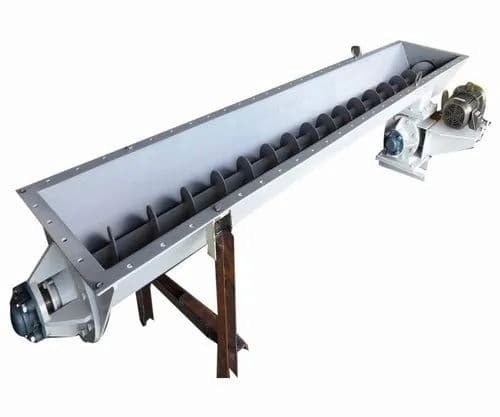
Coffee Screw Conveyor
Enclosed helical screw conveyor for horizontal and mildly inclined transfer of green coffee throughout the dry mill — dust-contained, low-maintenance, and gentle at slow RPM.
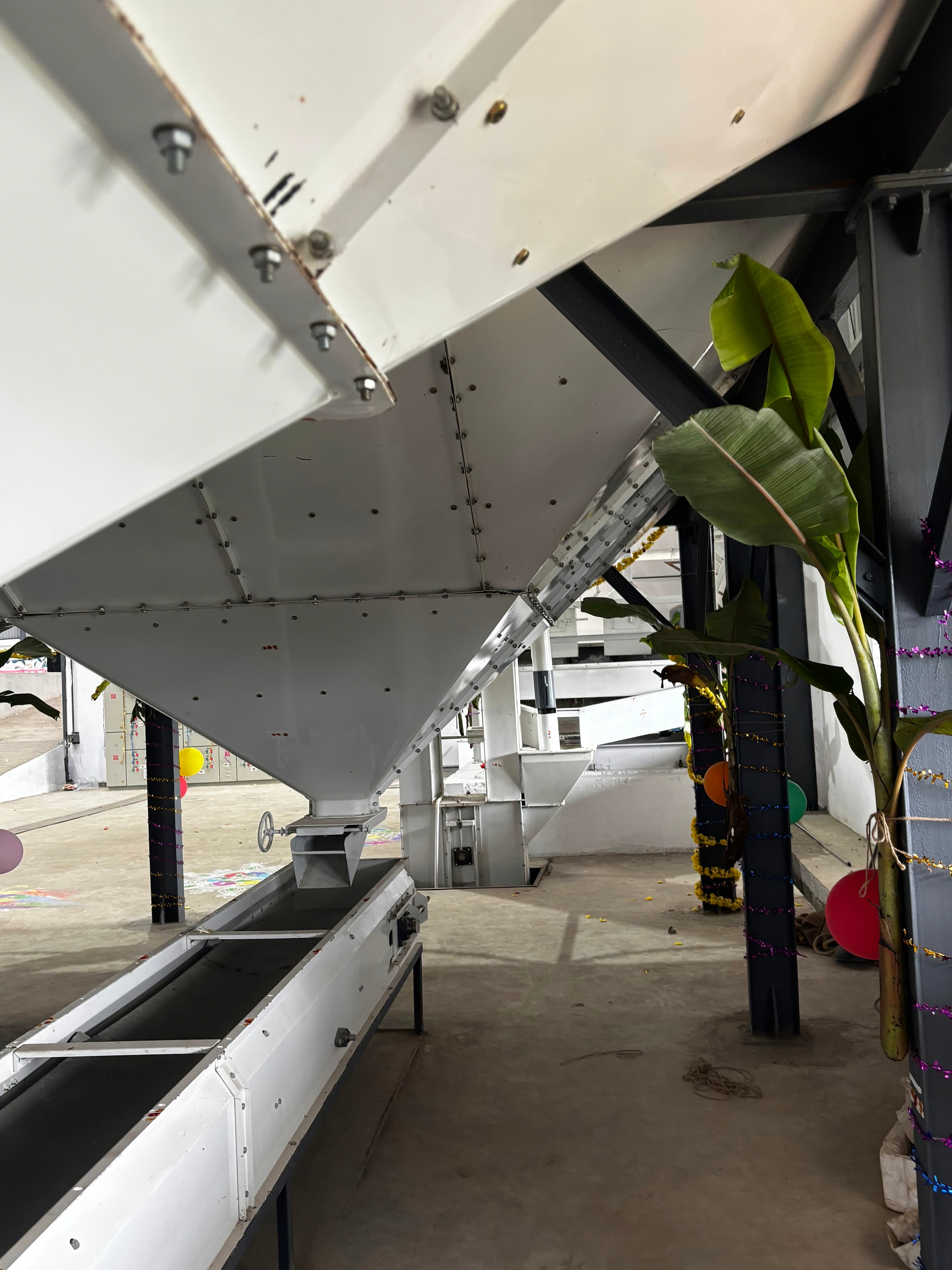
Coffee Belt Conveyor
Flat rubber or PVC transport belt for gentle, continuous movement of coffee cherry, parchment, and green beans between every machine in the dry mill — horizontal runs and inclines up to 45° with cleated belt.
Pneumatic Coffee Conveyor
Fully enclosed air-conveying system for transferring green coffee, parchment, and chaff through pipelines — eliminates open belt runs, reduces dust, and enables flexible routing through walls, around corners, and across vertical changes in a coffee mill.