
Pneumatic Coffee Conveyor
Fully enclosed air-conveying system for transferring green coffee, parchment, and chaff through pipelines — eliminates open belt runs, reduces dust, and enables flexible routing through walls, around corners, and across vertical changes in a coffee mill.
| Conveying capacity | 1 TPH – 15 TPH (green coffee and parchment; chaff systems rated separately) |
| Pipe internal diameter | 80 mm – 250 mm (matched to capacity and material; standard sizes 100 mm, 125 mm, 150 mm, 200 mm) |
| Conveying distance | Up to 100 m horizontal; up to 30 m vertical; total equivalent length varies by bend count |
| Blower / fan motor power | 2.2 kW – 22 kW (3-phase 415V / 440V, 50 Hz) depending on capacity and distance |
| Operating pressure (pressure system) | 0.3–0.8 bar gauge at blower outlet; pipeline operating pressure lower after friction losses |
| Operating vacuum (vacuum system) | –150 to –300 mm Hg (–0.02 to –0.04 bar gauge) at fan inlet; sufficient for 30–60 m equivalent length |
| Separator vessel | Cyclone separator or drop-box at destination; separated air exhausted to atmosphere or returned to blower via filter |
Key Features
Fully enclosed pipeline transport — green coffee, parchment, and chaff travel inside sealed pipes from pickup to delivery with no product exposed to the mill environment, eliminating dust, spillage, and contamination
Flexible routing through walls, floors, and ceilings — pipework bends and changes direction without mechanical constraints; connects machines at any relative height or horizontal distance without open transfer structure
Pressure and vacuum configurations available — positive displacement blower (pressure) for long-distance high-capacity transfer; centrifugal fan vacuum for clean intake from open hoppers and sack-tipping points
Adjustable conveying velocity — air velocity controlled via blower speed or damper setting to match bean fragility; lower velocity for hulled green beans reduces breakage; higher velocity for robust parchment and chaff
No moving parts inside the pipeline — the pipe carries the product; all mechanical components (blower, fan, motor) are located outside the product stream, reducing in-pipe wear and eliminating in-pipe mechanical failures
Single system handles multiple destinations — Y-valves and diverter gates in the pipeline allow one blower or fan unit to route material to multiple collection points or silos by switching gate position
Chaff and lightweight material conveying — pneumatic conveyors are particularly efficient for conveying low-density chaff, dust, and parchment fragments from cyclones and aspirators to a central chaff collection point
Suitable for vertical lifts up to 20–30 m and horizontal runs up to 100+ m in a single continuous system — far greater routing flexibility than any mechanical conveyor at equivalent distances
Models & Sizing
Pneumatic Conveyor Model Range
VMAC supplies pneumatic conveyor systems across four capacity tiers for coffee processing applications. Each system is engineered to the customer's plant layout — pipe routing, distance, vertical lift, number of delivery points, and material type are all specified at order. Capacity figures are for green coffee (bulk density approx. 650–750 kg/m³) at standard conveying velocity. Chaff and parchment systems have lower bulk density and are rated separately. Contact VMAC for a site-specific engineering proposal.
Light Duty
1–3 TPH
capacity
Small estates, cooperative mills, and on-farm processing units needing a single transfer run — typically parchment intake to pre-cleaner or green bean loading to a small silo. Pipeline runs up to 40 m equivalent length.
Medium Duty
3–7 TPH
capacity
Small to mid-size curing works — green coffee silo loading from the processing floor, chaff evacuation networks, and cross-building transfers up to 80 m equivalent length. Single blower or vacuum fan unit with 2–3 delivery points via diverter valves.
Heavy Duty
7–12 TPH
capacity
Licensed curing works and export mills with multiple large silos or extended cross-building pipeline networks. Handles green coffee silo loading at production speed to match a full dry mill processing line. Pipeline runs to 100 m equivalent length.
Industrial
12–15 TPH
capacity
Large-scale commercial export mills and grain handling facilities with high-volume continuous transfer requirements. Multi-silo routing with automated diverter valve control. Custom engineering required — contact VMAC for site survey and system design.
Custom
Your specification
capacity
For operations requiring throughput beyond the standard range. VMAC engineers the machine to your exact capacity and processing conditions.
Request a Custom QuoteConfigurations
Pneumatic Conveyor System — Model Range
All systems include blower or vacuum fan unit, rotary airlock (pressure systems), cyclone separator, pipeline and bends, and filter unit. Pipeline routing and diameter are specified at order time. Capacity figures for green coffee at standard conveying velocity; chaff and parchment systems rated separately. Contact VMAC for a site-specific proposal.
| Model Tier | Capacity (TPH) | Motor Power | Pipe Diameter | Max Equivalent Length | Best For |
|---|---|---|---|---|---|
| Light Duty | 1–3 | 2.2–5.5 kW | 100–125 mm | ~40 m | Small estate / single transfer run |
| Medium Duty | 3–7 | 5.5–11 kW | 125–150 mm | ~80 m | Small curing works / silo loading |
| Heavy Duty | 7–12 | 11–18.5 kW | 150–200 mm | ~100 m | Licensed curing works / export mill |
| Industrial | 12–15 | 18.5–22 kW | 200–250 mm | 100 m+ (custom) | Large commercial export mill |
| Custom | Built to your capacity and specification — contact us for a quote | ||||
Overview
About the Pneumatic Coffee Conveyor
VMAC's Pneumatic Coffee Conveyor — also referred to as an air conveyor, pneumatic transport system, or pneumatic pipeline conveyor — moves granular coffee material through enclosed pipes using airflow generated by a positive-displacement blower (pressure system) or a centrifugal fan (vacuum/suction system). Unlike belt conveyors and bucket elevators, which require a clear mechanical path and open transfer points, a pneumatic conveyor routes material through rigid pipework that can pass through walls, change direction with bends, run vertically, and connect machines at any relative position in the mill building. The pipeline is fully enclosed from pickup to delivery — dust, chaff, and coffee beans never contact the mill environment during transit. In a coffee dry mill or curing works, pneumatic conveyors are used at points where the flexibility of pipeline routing outweighs the higher energy cost relative to belt or screw conveyors. Common applications include: conveying green coffee from the hulling and grading floor to overhead storage silos; transferring parchment coffee from the drying yard intake to the pre-cleaner; loading green bean sacks or bulk containers from a downstream collection point; conveying chaff and dust from the winnower and polisher cyclones to a chaff collection silo or press; and long-distance transfers across multi-building mill complexes where a belt conveyor would require covered gantry structure. Capacity is rated in tonnes per hour and depends on pipe internal diameter and air velocity — larger diameter pipes at controlled velocity handle higher throughput with lower bean breakage risk. Two operating principles are available. Pressure (positive displacement) systems use a blower to push air — and entrained coffee — from the pickup point through the pipeline to the destination. They are suited to longer distances and higher capacities. Vacuum (suction) systems use a fan to create negative pressure that pulls material into the pickup point and through the pipeline to a separator vessel at the destination. Vacuum systems are cleaner at the pickup end — there is no pressurised air escaping at the intake — and are well suited to loading from open hoppers or sack-tipping stations. VMAC supplies both configurations and can design hybrid pressure-vacuum systems for complex multi-point transfer requirements.
How It Works
How It Works
A pneumatic conveyor uses the kinetic energy of moving air to entrain and carry coffee material through a closed pipeline. Material is picked up at the intake, accelerated into the airstream, transported through the pipeline, and separated from the air at the destination vessel. The blower or fan is the only rotating component — the pipeline itself has no moving parts.
Material intake and entrainment
In a pressure system, a rotary airlock valve (also called a rotary feeder or star valve) meters material from the feed hopper into the pressurised pipeline. The rotary airlock maintains a pressure seal — it allows material to enter the pipeline while preventing pressurised air from escaping back into the hopper. In a vacuum system, material is drawn into the pickup nozzle or intake hopper by the negative pressure in the pipeline — no airlock is required at the intake since ambient air flows inward. In both configurations, the material is immediately entrained in the moving airstream and carried forward.
Pipeline transport
Material travels through the enclosed pipeline as a dilute-phase suspension in the airstream — individual beans and fragments carried at the air velocity, which is maintained high enough to keep material airborne and moving (typically 18–30 m/s for coffee). The pipeline consists of straight runs connected by long-radius bends (typically 5× pipe diameter radius) to reduce velocity loss and bean impact at direction changes. Shorter bend radii increase bean breakage and pipe wear at the bend and should be avoided on green coffee lines. Material passes through bends, rises, and falls in the pipeline without mechanical intervention.
Separation at the destination
At the end of the pipeline, the material-air mixture enters a separator vessel — typically a cyclone separator or a drop-box. In a cyclone separator, the tangential inlet causes the mixture to spin; the heavier coffee material is flung to the cyclone wall, loses velocity, and drops to the product outlet at the bottom. The cleaned air exits upward through the cyclone vortex finder and is either exhausted to atmosphere (pressure system) or returned to the vacuum fan through a filter (vacuum system). A drop-box uses reduced velocity and gravity to drop material while allowing air to continue to the exhaust — simpler than a cyclone and suitable for lower-throughput or less critical applications.
Air handling and return
In a pressure system, the blower draws clean ambient air from the machine room, pressurises it, and delivers it continuously to the rotary airlock and pipeline. Exhaust air at the cyclone outlet is vented through a dust filter bag or cartridge filter to capture any fine dust entrained from the product before release to the building environment. In a vacuum system, the centrifugal fan is located at the destination end — it draws air through the entire pipeline from the intake nozzle, through the separator, and exhausts clean air to atmosphere. Vacuum system filters are located between the separator and the fan to protect the fan from fine dust. Both systems operate continuously at steady state for the duration of the conveying run.
Know the Difference
Pneumatic Coffee Conveyor vs. Bucket Elevator
Both a pneumatic conveyor and a bucket elevator are used for long-distance and vertical material transfer in coffee mills, and both appear in the same equipment selection lists. They are not interchangeable — each has a distinct cost and performance profile that makes one more suitable than the other depending on the application.
| Feature | Pneumatic Coffee Conveyor | Bucket Elevator |
|---|---|---|
| Routing flexibility | Very high — pipeline can bend, change direction, pass through walls and floors; no clear mechanical path required | Low — elevator must run in a straight vertical line; head and boot positions fixed; requires vertical headroom and structural support at a fixed location |
| Bean breakage | Moderate — high-velocity air impact at bends and at the separator can crack brittle hulled beans; velocity must be controlled; not recommended for fragile or high-value polished green coffee at high velocity | Low — HDPE polymer buckets scoop and release gently; no high-velocity impact; the preferred choice for breakage-sensitive green coffee |
| Dust containment | Excellent — fully enclosed pipeline; no dust escape during transit; only exhaust air at separator outlet needs filtration | Good — enclosed casing reduces dust, but boot intake and head discharge are open transfer points; some dust escape at connections |
| Energy consumption | Higher — blower or fan must move large volumes of air continuously; energy per tonne-metre transferred is significantly higher than a bucket elevator | Lower — motor energy is used almost entirely to lift product mass against gravity; mechanical efficiency is high; preferred where energy cost is a concern |
| Maintenance | Blower / fan bearing and seal maintenance; rotary airlock wear (vanes wear in abrasive material); pipeline bend wear at high velocity; filter cleaning or replacement. No in-pipe moving parts to fail. | Belt tension adjustment; boot liner wear; bucket bolt tightening; head pulley lagging. Simple and low-frequency when correctly specified. |
| Multi-point delivery | Possible with diverter valves — one blower system can deliver to multiple silos or machine infeeds by switching Y-valves in the pipeline | Single-point discharge only — one elevator head, one discharge chute; multiple elevators needed for multiple delivery points |
| Vertical lift height | 20–30 m practical vertical in a single system; not limited to building headroom if pipework can be routed through structure | 3–15 m standard; up to 20 m custom; strictly constrained by building headroom at the elevator location |
| Best use case | Long-distance transfers; cross-building conveying; loading overhead silos from ground-level infeed; chaff and dust evacuation from multiple machines to a central point | Short to medium vertical transfers (4–12 m) within a single building; breakage-sensitive green coffee; multiple elevators in parallel for high-volume lines |
Many large curing works and export mills use both: bucket elevators for the machine-to-machine vertical transfers within the production floor where breakage control is critical, and pneumatic conveyors for the long-distance runs between buildings or up to tall silos where flexible routing justifies the energy premium.
Processing Line
Where Pneumatic Conveyors Fit in the Coffee Processing Line
Unlike a machine-specific piece of equipment, a pneumatic conveyor is a material handling solution used at multiple points in the processing line wherever flexible, enclosed transfer between distant or awkwardly-positioned points is needed. The workflow below shows a dry mill and storage configuration with typical pneumatic conveyor positions marked.
Drying yard / mechanical dryer
Dried parchment coffee at 10–12% moisture awaiting transfer to the dry mill intake
Pneumatic conveyor — intake transfer
This machineVacuum system draws dried parchment coffee from the intake hopper at the dryer or drying yard store and conveys it to the pre-cleaner infeed on the processing floor — replaces a long belt conveyor or manual bag handling
Pre-cleaner → Destoner → Huller → Polisher → Grader → Gravity Separator
Production processing machines on the main dry mill floor — typically connected by bucket elevators for vertical transfers between adjacent machines
Chaff cyclone system
Chaff and dust from the winnower, polisher aspirator, and huller discharge are collected by a network of pneumatic ducts (low-pressure vacuum) and routed to a central chaff cyclone and collection bin — pneumatic evacuation replaces individual chaff collection bags at each machine
Pneumatic conveyor — silo loading
This machineAfter grading and gravity separation, finished green coffee is conveyed pneumatically from the processing floor to overhead storage silos — a pressure system with a rotary airlock lifts the product 10–25 m vertically and routes it to the correct silo via diverter valves
Green coffee storage silos
Finished green coffee stored in silos pending lot completion, quality sign-off, and export dispatch
Pneumatic conveyor — silo to bagging
This machineGreen coffee drawn from silos to the bagging line via pneumatic or gravity routing — may use a vacuum system to draw from silo base to a weighing and bagging station
Weighing, bagging, and export
Graded, sorted green coffee weighed into 60 kg export bags, labelled, and dispatched
FAQ
Frequently Asked Questions
What is a pneumatic conveyor and how is it different from a belt or bucket conveyor?
A pneumatic conveyor moves material through enclosed pipework using the kinetic energy of moving air — either pushed by a blower (pressure system) or pulled by a vacuum fan (vacuum system). Belt and bucket conveyors move material mechanically on a continuous surface or in buckets. The key difference is routing flexibility: a pneumatic pipeline can go around corners, through walls, change floor levels, and connect points at any relative position. Belt conveyors require a clear, straight mechanical path; bucket elevators require vertical headroom and a fixed head-and-boot position. Pneumatic conveyors are the right choice for long transfers, cross-building routing, and silo-loading applications where mechanical conveyors would require expensive structure. The trade-off is higher energy consumption and some risk of bean breakage at high air velocity.
Will a pneumatic conveyor damage or crack green coffee beans?
Bean breakage in a pneumatic conveyor is manageable with correct design and velocity control. The risk points are pipeline bends — where beans impact the outer wall of the bend — and the separator cyclone, where beans decelerate from conveying velocity. Using long-radius bends (5× pipe diameter radius), maintaining conveying velocity at the minimum required to keep material airborne (rather than maximum), and sizing the pipe diameter correctly for the throughput are the primary mitigations. Correctly designed pneumatic systems running hulled green coffee produce breakage rates comparable to a well-maintained belt conveyor. Pneumatic conveyors are not recommended for very fragile, high-value roasted coffee at high velocity — for those applications, gentle mechanical handling is preferred.
What is the difference between a pressure (positive displacement) system and a vacuum system?
In a pressure system, a positive displacement blower pushes air through the pipeline from behind the material. A rotary airlock valve at the intake meters material into the pressurised pipeline. Pressure systems handle longer distances and higher capacities, and are better suited to upward vertical runs where the blower pressure provides additional lifting force. In a vacuum system, a centrifugal fan at the destination end creates negative pressure that pulls material through the pipeline. Vacuum systems are cleaner at the intake — there is no air escaping under pressure at the pickup point — and work well for pickup from open hoppers, sack-tipping stations, or multiple intake points. For coffee mills, vacuum systems are common for chaff evacuation and sack-tip intake; pressure systems are used for long silo-loading runs and high-capacity transfers.
How far can a pneumatic conveyor transfer material in a single system?
Practical conveying distance depends on pipe diameter, blower pressure or vacuum level, and the number and radius of bends — each bend adds 'equivalent length' to the system's pressure drop calculation. As a guide, a medium-duty pressure system with a 150 mm pipe and an 11 kW blower can handle 70–100 m of equivalent pipeline length — roughly 50–70 m of straight horizontal run with up to four 90-degree bends. Vertical runs consume equivalent length faster than horizontal runs (typically 3–5× the ratio). Systems beyond 100 m equivalent length or with multiple floor levels require a detailed pressure drop calculation and custom engineering — VMAC can provide this as part of the system design proposal.
Can a single pneumatic conveyor deliver to multiple silos or collection points?
Yes — diverter valves (Y-valves or flap-gate valves) installed in the pipeline allow a single blower system to route material to multiple destinations by switching valve positions. This is one of the key advantages of pneumatic conveying over bucket elevators for silo loading: one system, one blower, multiple silos, switched by valve. Automatic valve actuation with a PLC or simple manual lever operation are both available. The constraint is that only one destination can receive material at a time — material cannot be split to two silos simultaneously in a dilute-phase system. Capacity to each silo is the full rated system capacity.
What maintenance does a pneumatic conveyor require?
The main maintenance items are: (1) Rotary airlock vane wear — the rotating star vanes that seal the pressure airlock wear over time in abrasive coffee applications; vane clearance should be checked annually and vanes replaced when leakage becomes significant. (2) Filter cleaning — the dust filter at the air exhaust (pressure system) or between separator and fan (vacuum system) accumulates fine coffee dust and chaff; filter elements should be cleaned or replaced per the maintenance schedule, typically monthly in continuous operation. (3) Blower/fan bearing lubrication — blower and fan bearings require periodic lubrication per the manufacturer's schedule. (4) Pipeline bend inspection — bends are the highest-wear point in the pipeline; external wall of each bend should be checked annually for thinning by abrasion, especially on chaff and parchment lines where particle velocity is high. (5) Separator cyclone inspection — check for material buildup at the cyclone hopper outlet and ensure the rotary lock or butterfly valve below the cyclone discharges cleanly.
Is a pneumatic conveyor suitable for conveying chaff and parchment dust?
Yes — pneumatic conveyors are highly efficient for conveying low-density chaff, parchment dust, and silver skin from multiple aspiration and winnowing points in the dry mill to a central chaff collection bin or press. Because chaff is very light, low air velocity is sufficient to maintain it airborne — a small fan and narrow ductwork can collect from many machines simultaneously. This chaff evacuation network is often the first pneumatic conveying application added to a dry mill, before a full green coffee pipeline is justified. Chaff collected centrally can be pressed into briquettes for fuel or bagged for sale as mulching material — both more practical when chaff is already collected at one point by the pneumatic system.
How is the system installed and what civil works are required?
A pneumatic conveyor system consists of the blower or fan unit (floor-mounted, standard base plate), pipeline (supported by wall brackets, ceiling hangers, or floor stands at 2–3 m intervals), rotary airlock (bolted to infeed hopper), cyclone separator (floor-mounted or suspended at destination), and filter unit. Wall penetrations are required where pipework passes through building walls — typically cored holes with flanged pipe sleeves. Civil works are minimal compared to installing a gantry for a long belt conveyor. Installation time for a complete system is typically 3–7 days depending on complexity. VMAC provides a piping layout drawing showing support point locations, wall penetration positions, and equipment anchor bolt patterns as part of the supply package.
Send a Enquiry Request
Retail store
Mon-Sat 9am to 5pm.
B.M road, Hassan, Karnataka 573201
Related Products
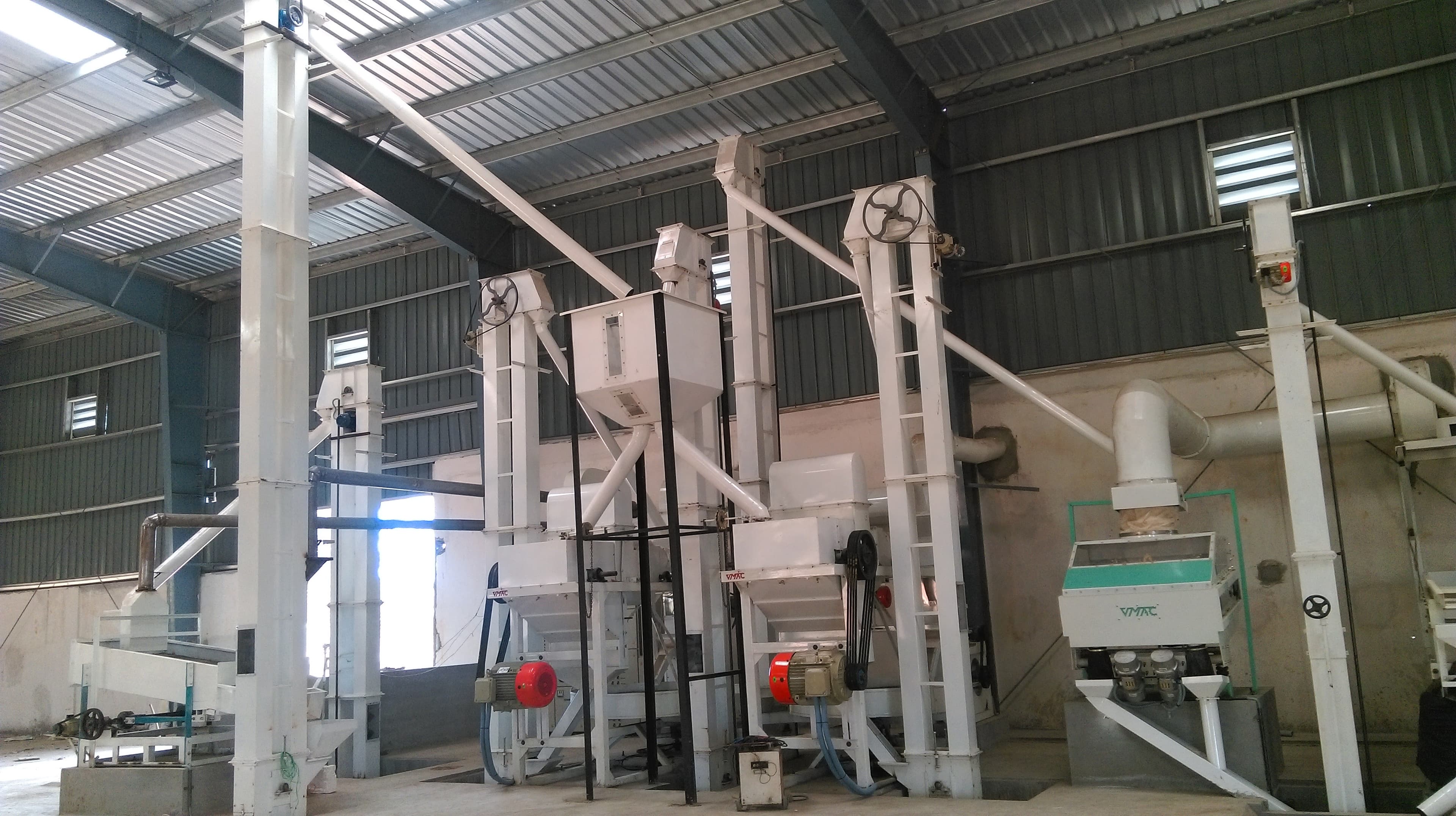
Coffee Bucket Elevator
Vertical bucket conveyor for dry-mill material handling — elevates green coffee, parchment, and cherry between every machine in the processing line with minimal bean breakage.
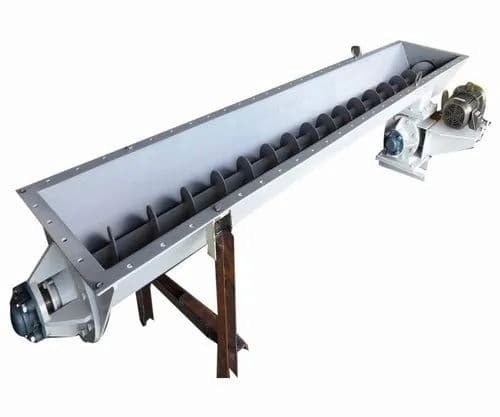
Coffee Screw Conveyor
Enclosed helical screw conveyor for horizontal and mildly inclined transfer of green coffee throughout the dry mill — dust-contained, low-maintenance, and gentle at slow RPM.
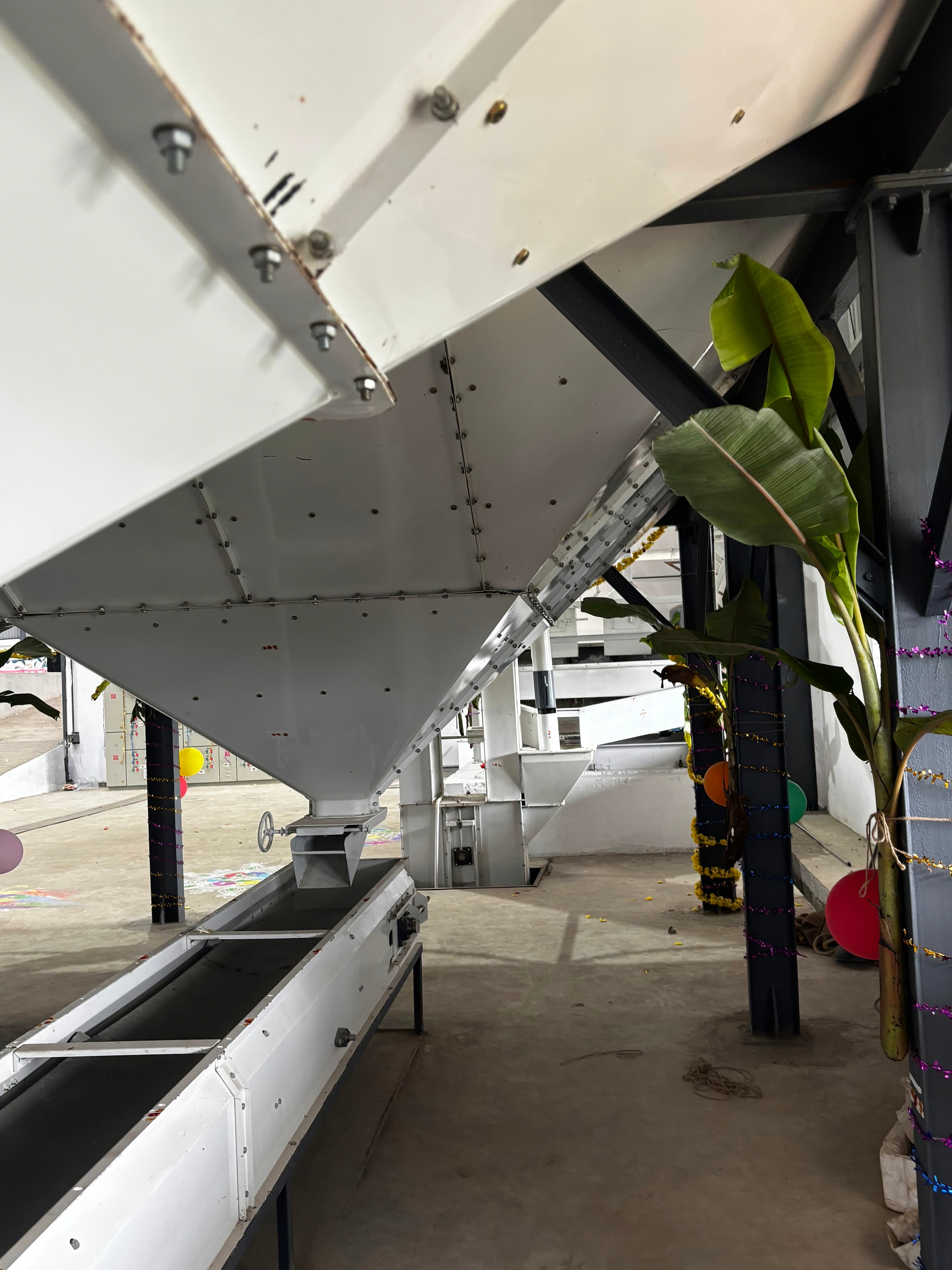
Coffee Belt Conveyor
Flat rubber or PVC transport belt for gentle, continuous movement of coffee cherry, parchment, and green beans between every machine in the dry mill — horizontal runs and inclines up to 45° with cleated belt.