
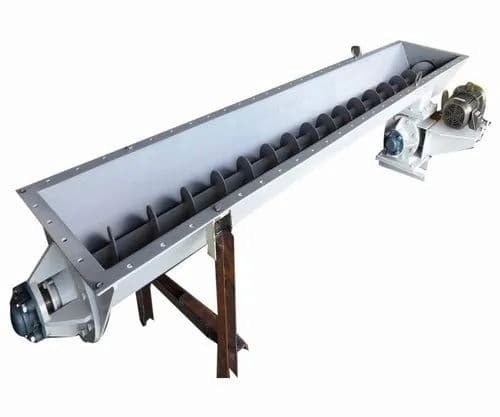
Coffee Screw Conveyor
Enclosed helical screw conveyor for horizontal and mildly inclined transfer of green coffee throughout the dry mill — dust-contained, low-maintenance, and gentle at slow RPM.
| Screw diameters available | 100 mm, 150 mm, 200 mm, 250 mm, 300 mm, 400 mm |
| Capacity range | 500 kg/hr (100 mm) — 10,000 kg/hr / 10 TPH (400 mm) |
| Operating speed | 30–60 RPM (green coffee); lower RPM reduces breakage |
| Maximum incline | 15–20° with short-pitch flighting; capacity reduced ~30–50% on steep inclines |
| Standard trough lengths | 1.5 m, 2 m, 3 m, 4 m, 6 m — custom lengths on request |
| Trough material | Mild steel (standard); SS 304 stainless steel (food-grade option) |
| Motor power | 0.75 kW (100 mm) to 7.5 kW (400 mm, depending on length and incline) |
| Power supply | 3-phase, 415V, 50 Hz |
| Trough type | U-trough with removable cover (standard); tubular enclosed (option for very dusty environments) |
| Drive arrangement | Gearbox-coupled motor at discharge end; shaft supported by end and intermediate hanger bearings |
Key Features
Fully enclosed U-trough or tubular housing — contains chaff and dust, prevents contamination of coffee and working environment
Slow helical flight rotation at 30–60 RPM minimises bean breakage — critical for green Arabica and Robusta grades
Screw diameters from 100 mm to 400 mm — covers throughputs from 500 kg/hr up to 10 TPH from a single product family
Standard pitch (1× diameter) for level transfers; short pitch available for inclined installations up to 15–20°
Flanged trough sections bolt together for custom lengths — suit any plant layout without on-site fabrication
Mild-steel construction as standard; stainless-steel trough and flighting available for specialty-grade food-contact applications
Removable trough cover for visual inspection and manual cleaning between crop seasons or product changeovers
Low energy consumption — 0.75 kW to 7.5 kW depending on diameter and length; significantly less than pneumatic conveying
Compatible with all dry-mill inlet/outlet heights — inlet chutes and discharge spouts fabricated to match your equipment connections
Models & Sizing
Right-Sized for Every Operation
VMAC manufactures screw conveyors across four diameter tiers, covering small estate operations up to large export curing works. All models are available in standard trough lengths of 1.5 m, 2 m, 3 m, 4 m, and 6 m, with custom lengths fabricated to order. Contact VMAC for a layout-specific quotation.
100 mm / 150 mm — Light Duty
500–1,500 kg/hr
capacity
Small estates and cooperative wet mills with low daily throughput. Suits sample transfer, under-hopper discharge, and bag-loader feed applications where volume is modest.
200 mm — Medium Duty
1,500–3,500 kg/hr
capacity
Medium estates and small curing works. The most common diameter for inter-machine transfers in an Indian estate dry mill: huller-to-pre-cleaner or pre-cleaner-to-destoner runs of 2–4 m.
250 mm / 300 mm — Heavy Duty
3,500–7,000 kg/hr
capacity
Licensed curing works and export mills processing multiple grades simultaneously. Handles main-line transfers from huller banks to screen grader banks where throughput exceeds 3 TPH.
400 mm — High-Volume
7,000–10,000 kg/hr
capacity
High-volume export processing plants and large curing works in Karnataka, Kerala, and East Africa. Used as the main trunk conveyor receiving discharge from multiple parallel hullers and feeding central grading lines.
Custom
Your specification
capacity
For operations requiring throughput beyond the standard range. VMAC engineers the machine to your exact capacity and processing conditions.
Request a Custom QuoteConfigurations
Full Model Range — Coffee Screw Conveyor
All models available in U-trough (standard) or tubular enclosed configuration. Standard trough lengths: 1.5 m, 2 m, 3 m, 4 m, 6 m — custom lengths fabricated on request. Stainless-steel (SS 304) trough and flighting available for all diameters. Indicative specifications — contact VMAC for exact dimensions and custom configurations.
| Screw Diameter | Capacity (kg/hr) | Operating Speed | Motor Power | Standard Lengths (m) | Trough Type | Best For |
|---|---|---|---|---|---|---|
| 100 mm | 500–800 | 40–60 RPM | 0.75 kW | 1.5, 2, 3 | U-trough | Small estate / sample transfer |
| 150 mm | 800–1,500 | 40–60 RPM | 1.1–1.5 kW | 1.5, 2, 3, 4 | U-trough | Small estate / cooperative |
| 200 mm | 1,500–3,500 | 35–55 RPM | 1.5–3 kW | 2, 3, 4, 6 | U-trough | Medium estate / small curing works |
| 250 mm | 3,500–5,000 | 30–50 RPM | 3–4 kW | 2, 3, 4, 6 | U-trough | Large estate / medium curing works |
| 300 mm | 5,000–7,000 | 30–45 RPM | 4–5.5 kW | 3, 4, 6 | U-trough / Tubular | Licensed curing works — main line |
| 400 mm | 7,000–10,000 | 30–40 RPM | 5.5–7.5 kW | 3, 4, 6 | U-trough / Tubular | High-volume export processing plant |
| Custom | Built to your capacity and specification — contact us for a quote | |||||
Overview
About the Coffee Screw Conveyor
VMAC's Coffee Screw Conveyor — also called an auger conveyor, helical screw conveyor, or flighting conveyor — is the workhorse horizontal transfer machine in a coffee dry mill. A slowly rotating helical flight inside a U-trough or tubular housing pushes green coffee from one point to the next: from the huller discharge to the pre-cleaner, from the pre-cleaner to the destoner, across the screen grader to collection bins, or directly under a bag-loader hopper. Unlike a belt conveyor, the screw is fully enclosed — chaff, dust, and fines cannot escape into the working environment, and ambient dust cannot contaminate the coffee. Designed for green coffee at 30–60 RPM to minimise bean breakage, VMAC screw conveyors are available in screw diameters from 100 mm to 400 mm, covering throughputs from 500 kg/hr (100 mm, small estate) to 10 TPH (400 mm, large export curing works). Standard mild-steel U-trough construction is supplied for most dry-mill applications; stainless-steel trough and flighting is available for specialty-grade and food-contact installations. Trough sections are flanged and bolted for clean disassembly, and the top cover lifts clear for inspection and manual cleaning between crop seasons. Widely installed in Coffee Board of India-licensed curing works and in East African export mills, the screw conveyor is specified where dust containment matters, floor space is limited, or where a compact enclosed transfer is preferred over a belt. Custom trough lengths are quoted to suit your plant layout.
How It Works
How It Works
A screw conveyor — known in engineering literature as an Archimedes screw conveyor, auger conveyor, or worm conveyor — moves material by the rotation of a continuous helical flight (the screw) inside a fixed trough. As the screw turns, its helical blade pushes material along the trough axis in the same direction as the pitch advance of the thread. No belts, buckets, or pneumatic lines are involved — the principle is the same one Archimedes used to move water in 250 BC.
Feed and flight engagement
Green coffee enters the screw conveyor through an inlet chute located at one end of the trough (or at an intermediate point for multi-inlet layouts). As the rotating helical flight sweeps through the material, beans are caught between adjacent flight turns. The rotating screw face pushes the material forward along the trough floor toward the discharge outlet. Trough fill level is kept at 30–45% of the screw diameter cross-section — overfilling causes compaction, excessive friction, and bean breakage.
Controlled forward movement
Material moves forward at a rate determined by screw diameter, pitch, and rotational speed (RPM). For green coffee, VMAC recommends 30–60 RPM — significantly slower than the 90–120 RPM common for grain or fertiliser applications. This slow rotation reduces shear forces on the bean and keeps breakage within acceptable limits. Standard pitch (one full helix turn per screw diameter length) gives maximum throughput for horizontal transfers. Short pitch (0.5–0.67× diameter) is used for inclined runs where standard pitch would let material slide back under gravity.
Discharge at the outlet
At the discharge end, beans fall through a spout fabricated to match the receiving machine's inlet. Spout angle and height are custom-fabricated per installation. Multiple intermediate discharge openings can be added along the trough length for multi-point distribution — for example, discharging different size fractions from a screen grader into separate collection bins along a single auger conveyor run.
Incline limitations
On level runs, capacity matches rated throughput. As incline increases above 5°, effective capacity reduces: at 10° inclination approximately 20% capacity reduction; at 15–20° approximately 30–50% reduction, depending on bean density and moisture. Beyond 20° a screw conveyor becomes impractical for coffee — a bucket elevator is the correct machine for steep vertical lifts. Short-pitch flighting and a reduction in RPM both help maintain controllable flow on inclined runs.
Know the Difference
Coffee Screw Conveyor vs. Belt Conveyor
Both screw conveyors and belt conveyors are used for horizontal transfer of green coffee between dry-mill machines, but they suit different situations. Choosing between them depends primarily on dust containment requirements, the need for inclined transfer, and sensitivity to bean damage.
| Feature | Coffee Screw Conveyor | Belt Conveyor |
|---|---|---|
| Dust and chaff containment | Fully enclosed U-trough with cover — chaff and fines cannot escape; no ambient dust enters the coffee stream | Open belt surface — chaff, dust, and fines are exposed to air movement and can become airborne in the mill building |
| Bean breakage potential | Moderate — screw action is gentler than buckets but there is contact between beans and the trough floor; minimised by running at 30–60 RPM | Lower — beans rest on the belt surface with minimal inter-bean friction; a belt conveyor is the gentler option for fragile or peaberry lots |
| Horizontal transfer | Excellent — designed for horizontal and slightly inclined transfer; compact, no return strand wasted | Excellent — flat belt handles any horizontal distance efficiently; standard for long horizontal runs |
| Incline capability | Limited — effective up to ~15–20° with short-pitch flighting; capacity drops significantly above 10° | Better — a cleated belt can carry material at 20–30° inclination without capacity loss; troughed belt extends this further |
| Floor space and installation height | Very compact — trough sits low; can be positioned under machine discharge chutes with minimal headroom required | Longer footprint — requires head and tail pulleys plus a return path underneath the carrying strand; taller overall profile |
| Maintenance access | Removable cover for full trough access; intermediate hanger bearings require periodic lubrication; flight weld inspection recommended seasonally | Belt tension and tracking adjustments required regularly; lagging wear on drive drum; belt splice condition must be monitored |
| Capital cost | Generally lower for short runs (1–6 m) — simple fabrication; stainless upgrade adds cost | Competitive for longer runs; belt and pulleys add material cost on short distances; wider variety of off-the-shelf widths available |
| Suitability for abrasive material (sand, stones) | Not recommended — stones and grit between screw flight and trough floor cause rapid wear; a belt is safer after pre-cleaning | More tolerant — stones ride on the belt surface without grinding; suitable if some foreign material is present |
Recommendation: Use a screw conveyor where dust containment is the priority — under hullers, screen graders, and gravity separators where chaff is present. Use a belt conveyor where bean gentleness is paramount — for specialty peaberry or high-value micro-lots — or where a long horizontal run makes a belt more practical. In most Indian curing works, both machine types are used at different points in the same processing line.
Processing Line
Where It Fits in Your Processing Line
Screw conveyors appear at multiple horizontal transfer points throughout the dry mill. The two most common positions are shown — after the pre-cleaner (horizontal transfer to the destoner) and after the huller (horizontal transfer to the screen grader). Additional screw conveyors are often used under the screen grader to collect graded fractions into separate holding bins.
Pre-cleaner / scalper
Removes gross foreign material: sticks, leaves, stones, and large debris before hulling
Screw Conveyor
This machineHorizontal transfer from pre-cleaner discharge to destoner inlet — enclosed transfer prevents chaff from escaping the machine line
Destoner
Air-table destoner removes dense stones and foreign material heavier than coffee before hulling
Huller
Rubber-roll huller (washed parchment) or disc huller (natural / cherry) removes dried husk
Screw Conveyor
This machineHorizontal transfer from huller discharge to pre-cleaner or screen grader — enclosed trough contains chaff and parchment dust generated at the huller
Screen Grader
Flat screen or rotary drum grader separates beans by size — produces Grade A, B, C, and Peaberry fractions
Gravity Separator
Density separation of each sized fraction — removes immature beans, hollow shells, and insect-damaged beans
Color Sorter
CCD or laser optical sorter — final automated removal of black, sour, and discoloured beans before export bagging
FAQ
Frequently Asked Questions
Will a screw conveyor break green coffee beans?
At correct operating speeds for coffee — 30 to 60 RPM — breakage is low and acceptable for standard dry-mill applications. The key factors are: do not overfill the trough beyond 40% cross-sectional fill; keep RPM at the lower end for delicate Arabica or specialty peaberry lots; ensure the inlet chute is not creating a drop height that impacts beans against the flight. Compared with a bucket elevator (which has impact forces at the boot and head), a slow-running screw conveyor is generally gentler. For extremely fragile micro-lot specialty coffee, a belt conveyor is the lower-risk choice for the final transfer before bagging.
What is the maximum incline angle for a coffee screw conveyor?
For green coffee, 15–20° is the practical maximum with short-pitch flighting. At 10° incline, expect approximately 15–20% capacity reduction compared with the horizontal rating. At 15–20°, expect 30–50% capacity reduction and a tendency for beans to slide back during stops — include a discharge gate if the conveyor will be stopped under load. Beyond 20°, a bucket elevator is the correct machine: it maintains rated capacity on any steep incline and is gentler than forcing a screw at steep angles where beans are compressed against the trough floor under the weight of material above.
What is the difference between a U-trough and a tubular screw conveyor for coffee?
A U-trough has an open top covered by a removable bolted cover — the standard configuration for coffee dry mills. The cover is easy to remove for cleaning, inspection, and clearing blockages. A tubular (pipe) housing completely encloses the screw in a round cross-section tube; it is more dust-tight than a U-trough but harder to access for cleaning and inspection. For coffee, the U-trough is almost always the correct choice: coffee is not toxic and the ability to quickly inspect and clean the trough between lots matters more than the marginal improvement in dust sealing that a tubular conveyor provides.
Can I customise the trough length to fit my mill layout?
Yes. VMAC fabricates screw conveyors to custom lengths to match your plant layout. Standard modular trough sections are available in 1.5 m, 2 m, 3 m, 4 m, and 6 m lengths, flanged and bolted together. When ordering, provide the required centre-to-centre distance between inlet and discharge, the inlet and discharge heights, and whether any intermediate discharge openings are required. Custom inlet chute angles and discharge spout positions are fabricated as part of the order at no additional fabrication premium for standard custom lengths.
Should I use mild steel or stainless steel for a coffee screw conveyor?
Mild steel is the standard material and is appropriate for all conventional dry-mill applications transferring dry green coffee at normal ambient moisture. It is cost-effective, readily weldable for repairs, and surfaces in contact with coffee have no health or contamination concern for standard commercial grades. Stainless steel (SS 304) trough and flighting is recommended for specialty-grade and export-certified operations that require food-contact compliance documentation, for installations in humid coastal mills where condensation causes surface rust on mild steel, and for any application where the conveyor will also handle washed parchment or wet coffee from a honey-process station.
How do I size the screw conveyor for my throughput?
Match the screw diameter to your peak hourly throughput — not your average. A 200 mm auger conveyor rated at 3,500 kg/hr handles a mill running at 2,000 kg/hr comfortably while providing headroom for surge loads. Running a screw at 60–70% of its rated capacity produces better flow and lower breakage than running at 95% capacity. For the main transfer after the huller in a medium curing works processing 4 TPH, a 250 mm or 300 mm screw conveyor is appropriate. For small estate transfers under 1 TPH, a 150 mm or 200 mm unit is standard.
How do I clean a screw conveyor between coffee lots or at season end?
For lot-to-lot changeovers, run the conveyor empty for 30–60 seconds after the last of the previous lot has cleared — this purges residual beans from the trough. For season-end cleaning, remove the trough cover panels, brush or vacuum the trough floor and flight surfaces, and inspect the hanger bearings for accumulation of chaff and bean debris around the bearing housing. Do not use water to wash a mild-steel trough — dry cleaning only. Stainless-steel troughs can be wiped down with a damp cloth after dry brushing. Reassemble the cover panels and run the empty screw briefly to verify free rotation before the next season.
What maintenance does a coffee screw conveyor require?
Routine maintenance is minimal: lubricate the end bearings and hanger (intermediate) bearings per the schedule — typically every 200–300 operating hours for grease-packed bearings. Inspect the helical flighting for wear at the outer diameter — the flight tip is the highest-wear surface. Check the trough floor for grooves worn by the flight tip; a clearance of 3–6 mm between flight tip and trough is normal; if it exceeds 10 mm, separation efficiency drops and bean fines accumulate under the flight. Check the shaft-to-gearbox coupling alignment annually. Replace the drive belt or chain (if applicable) at the first sign of stretching or cracking.
Is a screw conveyor or a belt conveyor better for transferring coffee in my dry mill?
It depends on your priorities. Choose a screw conveyor (auger conveyor) when dust and chaff containment is critical — for example, directly under a huller or screen grader where parchment dust is heavy — or when your transfer run is short (1–6 m) and floor space is limited. Choose a belt conveyor when bean gentleness is paramount (specialty peaberry or micro-lots), when the run is long (more than 8–10 m where belt costs become competitive), when the incline exceeds 20°, or when the material may contain residual stones or grit that would rapidly abrade a screw flight. In practice, most Indian curing works and East African mills use both types in the same building — screws for enclosed dusty transfers, belts for long open-hall runs.
Send a Enquiry Request
Retail store
Mon-Sat 9am to 5pm.
B.M road, Hassan, Karnataka 573201
Related Products
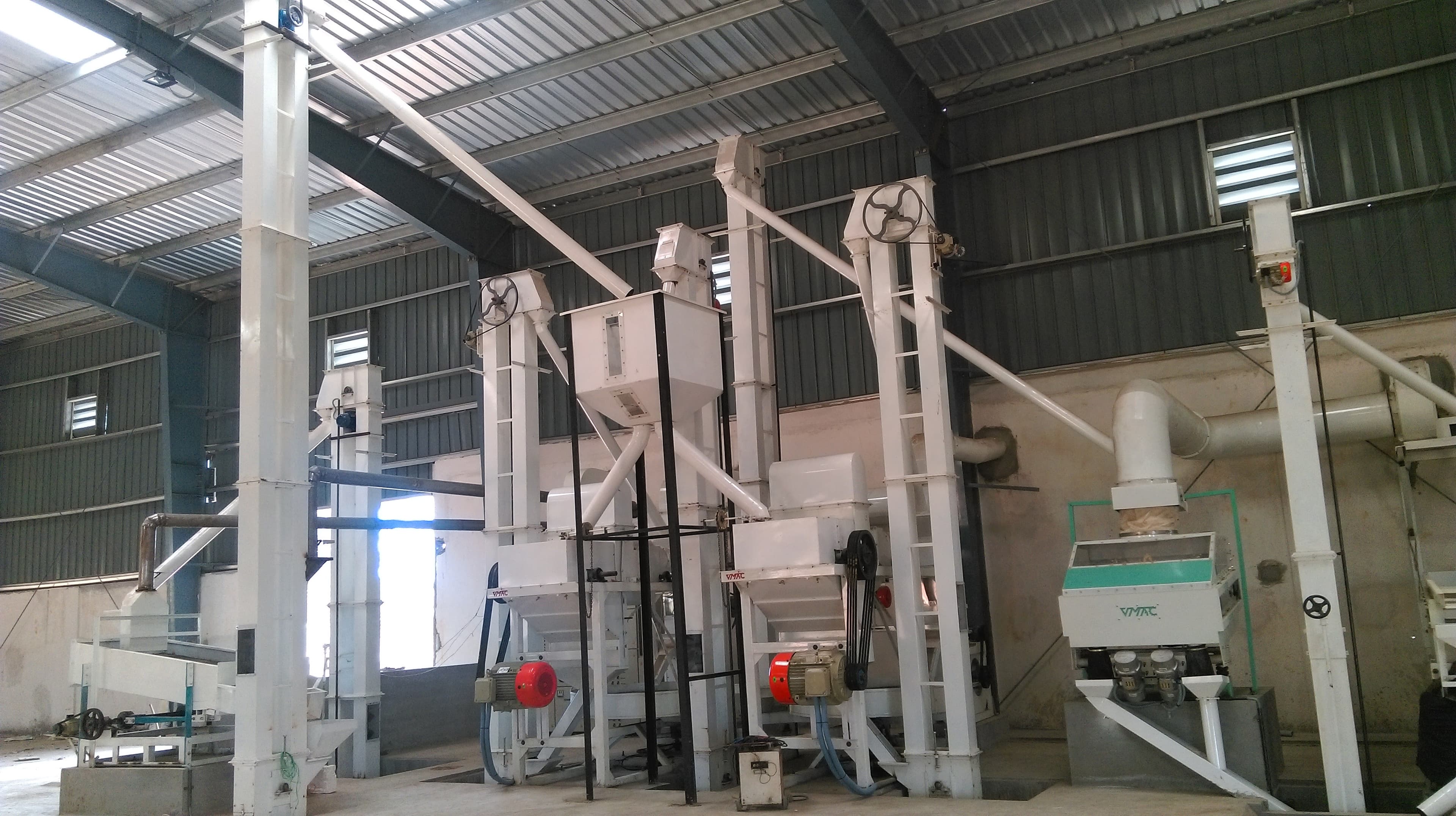
Coffee Bucket Elevator
Vertical bucket conveyor for dry-mill material handling — elevates green coffee, parchment, and cherry between every machine in the processing line with minimal bean breakage.
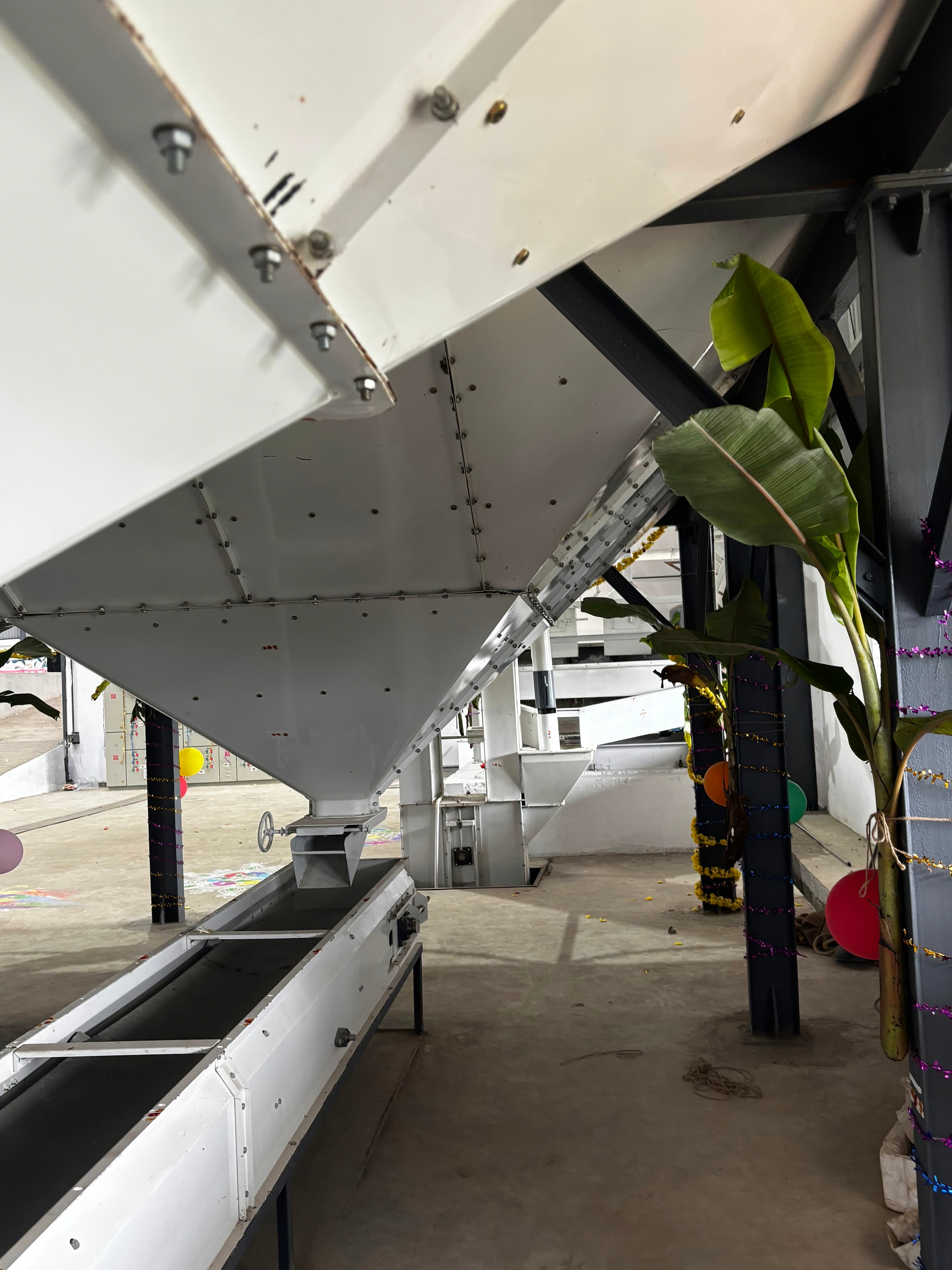
Coffee Belt Conveyor
Flat rubber or PVC transport belt for gentle, continuous movement of coffee cherry, parchment, and green beans between every machine in the dry mill — horizontal runs and inclines up to 45° with cleated belt.
Pneumatic Coffee Conveyor
Fully enclosed air-conveying system for transferring green coffee, parchment, and chaff through pipelines — eliminates open belt runs, reduces dust, and enables flexible routing through walls, around corners, and across vertical changes in a coffee mill.