
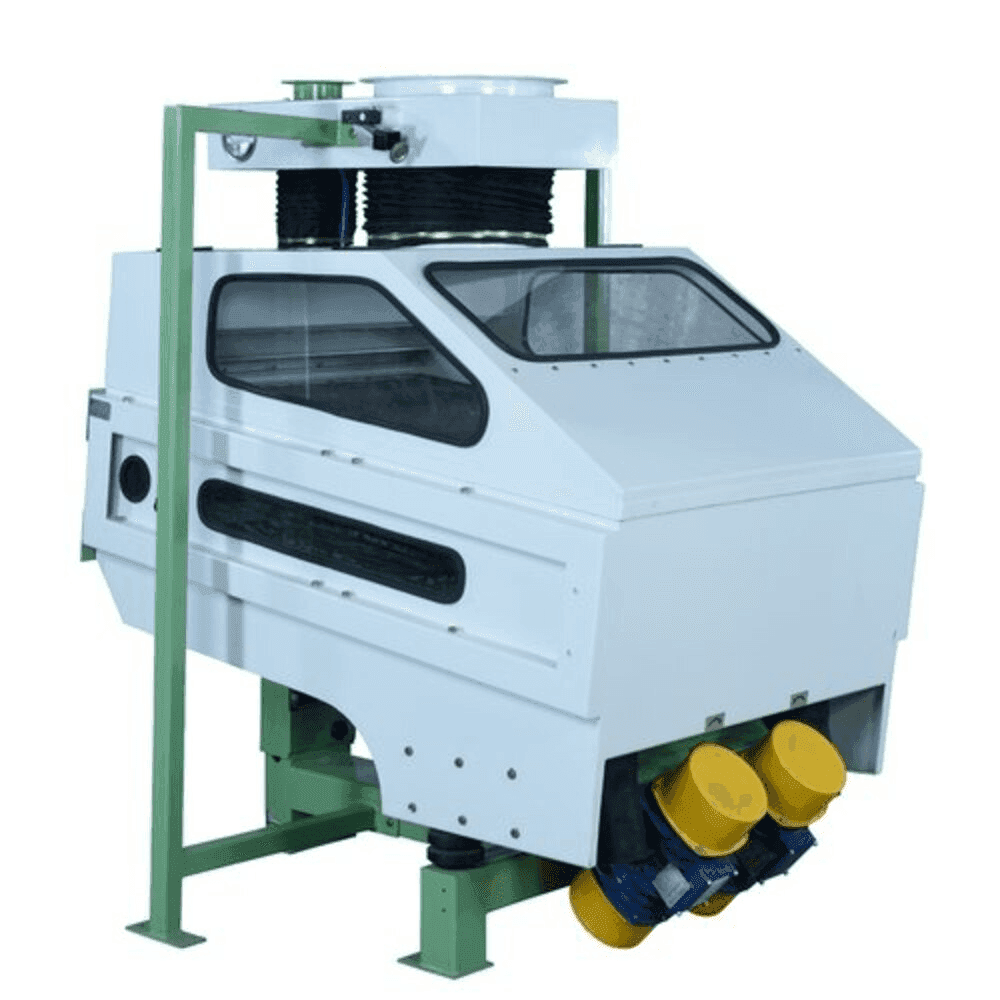
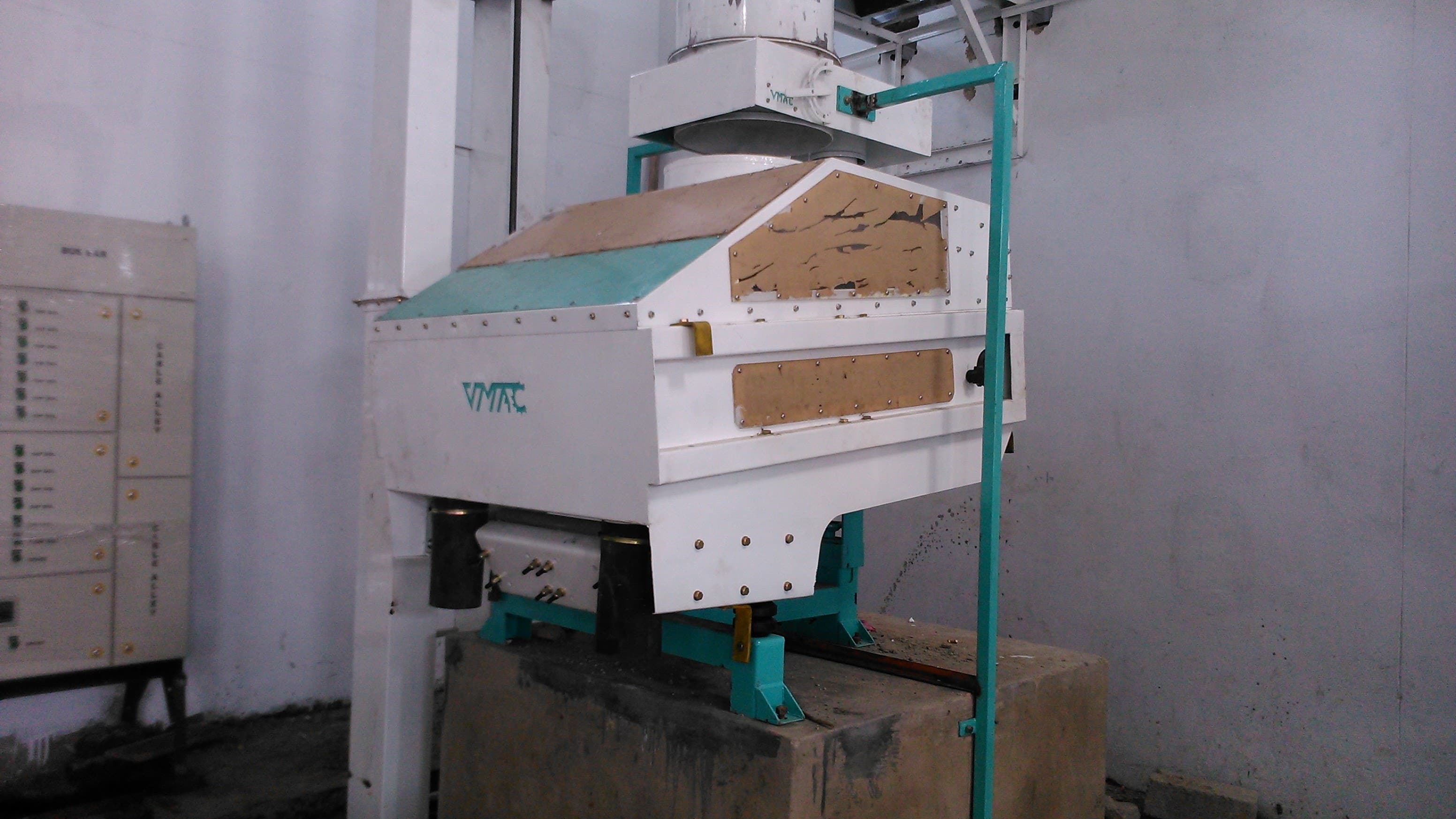
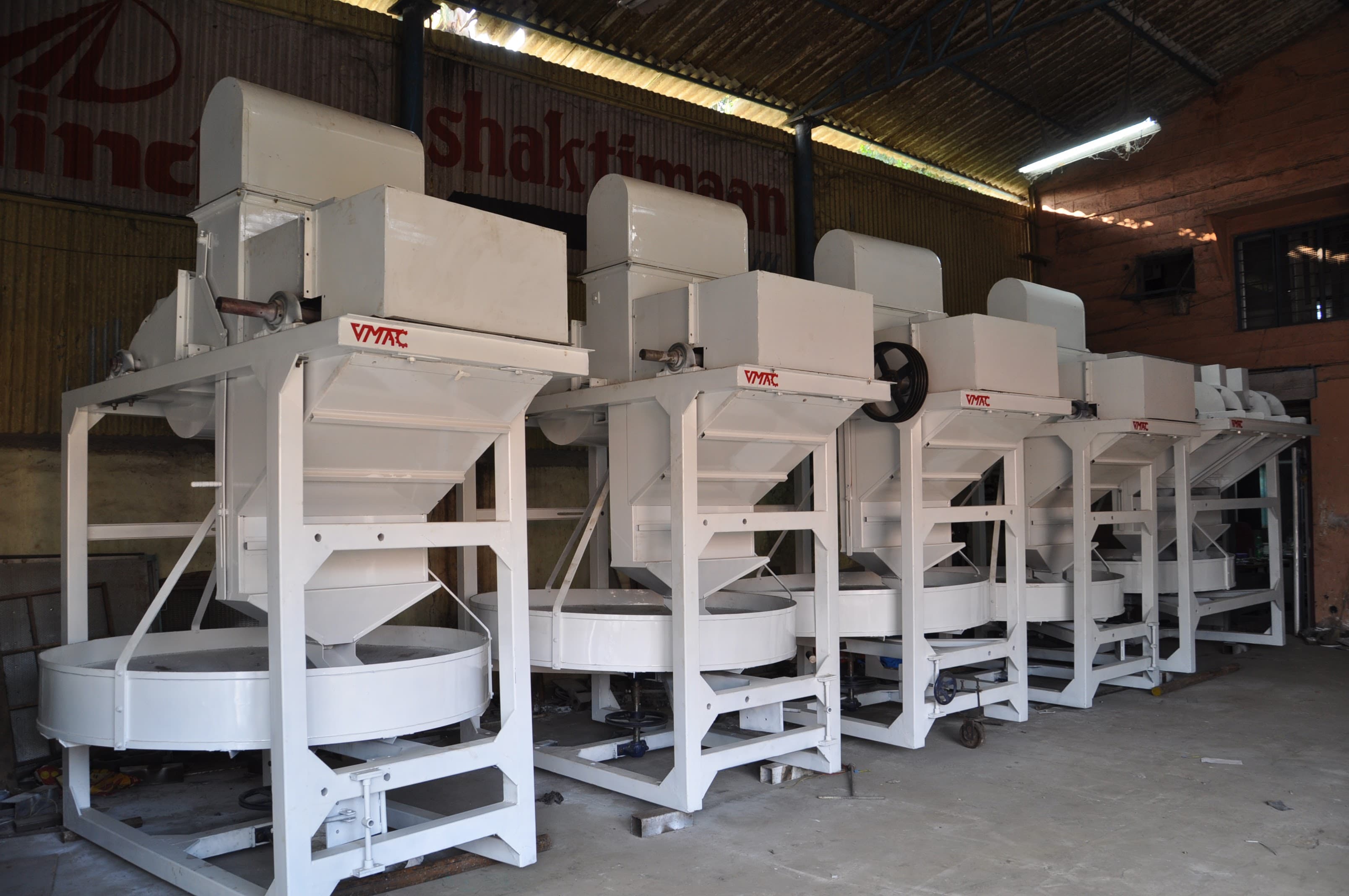
Coffee Destoner
Inclined vibrating deck with calibrated upward airflow — removes stones, glass, and heavy foreign matter from coffee before hulling, protecting downstream machinery and meeting export purity requirements.
| Capacity | 500 kg/hr – 5,000 kg/hr (model-dependent) |
| Vibration motor | 0.37 kW – 1.5 kW |
| Fan / aspiration motor | 0.75 kW – 2.2 kW |
| Total installed power | 1.1 kW – 3.7 kW |
| Deck inclination | 5° – 15° from horizontal (field-adjustable without tools) |
| Air volume control | Adjustable damper or variable-speed fan (model-dependent) |
| Stone pocket capacity | 5 – 25 kg (model-dependent); audible alarm on full-pocket models |
| Discharge outlets | 2 (clean coffee product + stone reject pocket) |
| Power supply | 3-phase, 415V, 50 Hz (single-phase on smallest model) |
| Adjustable parameters | Deck inclination, air volume/velocity, vibration frequency (amplitude fixed per model) |
Key Features
Vibrating inclined deck combined with upward air column — the vibratory destoner type is more effective than air-aspirator-only designs at separating all dense foreign matter
Exploits a 2:1 density gap: stones (~2.5 g/cm³) vs coffee (~1.35 g/cm³) — the largest and most reliable separation gap in the entire dry mill line
Stones conveyed uphill by deck vibration into sealed collection pocket; coffee flows downhill to clean product discharge — the two streams never mix
Field-adjustable deck inclination (5°–15°) without tools — re-calibrate at season start when bean density and moisture change
Protects downstream equipment: a single stone entering a rubber-roll huller can shred rolls and cause thousands of dollars in damage in minutes
Stone pocket designed for continuous operation — high-capacity models include a full-pocket alarm so the reject does not back-flow into the clean stream
Compact footprint and low power consumption (1.1–3.7 kW total) relative to the cost risk it eliminates
Standard equipment in all Coffee Board of India licensed curing works — required for achieving zero heavy foreign matter in export lots
Models from 500 kg/hr (small estate dry mill) to 5,000 kg/hr (large commercial curing works) — sized to match huller throughput
Models & Sizing
Right-Sized for Every Operation
VMAC manufactures vibratory destoners across four capacity tiers, from small estate dry mills at 500 kg/hr to large commercial curing works at 5 TPH. All models combine a vibrating inclined deck with an upward air column — the vibratory type — for superior separation vs air-aspirator-only units. Contact VMAC for exact specifications and custom configurations.
Small Estate
500–1,000 kg/hr
capacity
Small estate dry mills and cooperative processing stations. Single-shift operation during harvest. Suits farms producing up to 50 bags per season with high stone contamination risk from field-picked cherry.
Medium Estate
1,000–2,000 kg/hr
capacity
Medium estates and mid-sized cooperative curing works. Handles typical Karnataka and Kerala smallholder cherry intake volumes. Suits operations receiving cherry from multiple farms with variable contamination levels.
Large Estate / Commercial Mill
2,000–3,500 kg/hr
capacity
Large estate dry mills and medium-scale Coffee Board-licensed curing works. Multi-shift operation. Suits facilities processing Plantation A, Plantation AA, and Robusta grades requiring export-compliant stone separation.
Industrial Curing Works
3,500–5,000 kg/hr
capacity
High-volume licensed curing works and commercial export processing plants. Continuous multi-shift operation across the full harvest season. Suits large Karnataka curing works exporting 500+ containers per year.
Custom
Your specification
capacity
For operations requiring throughput beyond the standard range. VMAC engineers the machine to your exact capacity and processing conditions.
Request a Custom QuoteConfigurations
Full Model Range — Coffee Destoner
All models are vibratory destoners (vibrating deck + air column). Field-adjustable deck inclination 5°–15°, adjustable air volume, sealed stone collection pocket. 3-phase 415V supply; smallest model also available in single-phase. Indicative specifications — contact VMAC for exact dimensions and custom configurations.
| Model Tier | Capacity (kg/hr) | Vibration Motor | Fan Motor | Deck Size (mm) | Stone Pocket | Best For |
|---|---|---|---|---|---|---|
| Small Estate | 500–1,000 | 0.37 kW | 0.75 kW | 600 × 400 | 5 kg | Small estate / cooperative |
| Medium Estate | 1,000–2,000 | 0.55 kW | 1.1 kW | 900 × 600 | 10 kg | Medium estate / curing works |
| Large Estate / Commercial | 2,000–3,500 | 0.75 kW | 1.5 kW | 1,200 × 750 | 15 kg | Licensed curing works — export grades |
| Industrial Curing Works | 3,500–5,000 | 1.5 kW | 2.2 kW | 1,600 × 950 | 25 kg | High-volume commercial export mill |
| Custom | Built to your capacity and specification — contact us for a quote | |||||
Overview
About the Coffee Destoner
VMAC's Coffee Destoner — also called a stone separator, de-stoner, or gravity destoner — uses a vibrating inclined deck with a precisely calibrated upward air column to separate stones, gravel, glass fragments, dense metal pieces, and heavy soil clods from coffee before it enters the huller. The working principle exploits a fundamental density difference: stones are approximately 2.5 g/cm³ while coffee beans are approximately 1.35 g/cm³. The upward air flow is set to fluidize and carry coffee beans downhill to the clean product discharge, while dense stones receive insufficient air support, remain in contact with the vibrating deck, and are conveyed uphill into a sealed stone collection pocket. Positioning is critical: the destoner runs early in the dry mill line — after the pre-cleaner/scalper that removes large debris, and before the huller. Running stones through a rubber-roll huller causes catastrophic damage: shredded rubber rolls, broken huller components, and metal-on-metal contact that can destroy a machine mid-season. A single undetected stone entering a huller can cause damage costing many times the price of the destoner itself. Hulling also generates parchment dust and loose material that complicates stone detection; destoning with cherry or paddy still intact gives cleaner, more reliable separation. In India, rocks and gravel are a consistent contamination in cherry lots received at curing works — especially from smallholder-sourced cherry where field picking includes soil and gravel from drying beds. The Coffee Board of India requires zero heavy foreign matter in export lots, and destoning is standard equipment in every licensed curing works in Karnataka, Kerala, and Tamil Nadu. The same machine is called a "despedradora" in Central America, "catador de pedras" or "separador de pedras" in Brazil, and a "destoner" across East Africa and standard Coffee Board curing works in India. VMAC manufactures vibratory destoners — the more effective type that combines a vibrating deck with an air column, outperforming simple air-aspirator-only designs — in models from 500 kg/hr for small estate dry mills to 5 TPH for large commercial curing works.
How It Works
How It Works
A vibratory destoner separates coffee from stones using two simultaneous physical forces — upward air flow and eccentric deck vibration — acting on a fundamental density difference. Stones are approximately twice as dense as coffee beans, which makes this the largest and most reliable density gap in the dry mill. The separation is highly consistent once calibrated.
Air fluidization of the coffee layer
A fan forces air upward through perforations in the inclined deck surface. Air velocity is calibrated to be high enough to support and fluidize coffee beans (density ~1.35 g/cm³), lifting them off the deck surface into a free-floating layer. Stones and dense foreign matter (density ~2.5 g/cm³) are too heavy to be lifted and remain in firm contact with the deck. This is the primary separation mechanism — the air velocity must be re-set at season start and whenever bean moisture or density changes significantly.
Vibration-driven transport in opposite directions
The deck oscillates in an elliptical vibrating motion. Beans floating on the air cushion receive no traction from the deck and flow downhill under gravity toward the low end — the clean coffee discharge. Dense stones sitting on the deck surface are gripped by the vibrating deck through friction and are progressively conveyed uphill toward the high end — the stone collection pocket. The two streams travel in opposite directions on the same deck surface.
Density stratification and continuous separation
Material of intermediate density — dense soil clods, glass fragments, heavy ceramic pieces — behaves like stones and is also conveyed uphill into the reject pocket. Very light material such as chaff has already been removed by the upstream pre-cleaner; the destoner targets only the high-density tail of the contamination distribution. Under steady-state operation, separation is continuous: coffee discharges at the low end and the stone pocket fills at the high end.
Stone pocket collection
Dense rejected material accumulates in a sealed collection pocket at the upper end of the deck. The pocket must be emptied periodically — on high-throughput models, a full-pocket indicator or alarm signals the operator. If the pocket overfills and is not emptied, stones can begin to migrate backward into the clean coffee stream, compromising separation quality. Pocket capacity ranges from 5 kg on small models to 25 kg on large commercial models.
Clean coffee discharge
Air-supported coffee beans exit continuously at the low end of the deck as clean product, ready to enter the huller. The clean discharge stream should be visually monitored during operation for the first few minutes after any parameter adjustment — if any stones are visible in the clean outlet, air velocity is too high or deck inclination needs adjustment. Proper calibration produces a clean stream with zero visible stones and a reject pocket containing only dense foreign matter with negligible good coffee.
Defect Separation
What the Destoner Removes — and What It Cannot
The destoner targets one specific class of contamination: material that is significantly denser than coffee. It is positioned early in the line precisely because the density gap between stones and coffee is enormous — far easier to exploit before hulling than any separation downstream. It does not perform fine density sorting within the coffee lot; that is the gravity separator's role much later in the line.
Effectively removed
Stones and gravel
The primary target. Field stones, road gravel, and drying-bed grit picked up during cherry harvest or cherry reception. Common in smallholder cherry lots received at curing works — especially in India's Karnataka and Kerala growing regions. Stones entering a huller cause catastrophic rubber roll damage.
Glass fragments
Broken glass from bottles or containers near cherry reception or drying beds. Density similar to stone (~2.5 g/cm³). Extremely hazardous in export lots — a single glass fragment reaching a roastery grinder or consumer causes severe equipment damage and liability. Reliably removed by the destoner.
Dense metal fragments
Nails, wire fragments, bolts, and other metal debris from farm equipment, drying beds, or processing yards. Higher density than stone — even easier to separate. Also removed by magnetic pre-separators on some lines, but the destoner provides a complementary physical separation independent of magnetic properties.
Dense soil clods and hardened mud
Compacted dried soil clods that arrive with cherry, particularly from muddy harvest conditions or road-dried cherry. Dense enough to behave like stone on the vibrating deck. Their removal prevents huller blockages and contamination of the clean bean lot.
Heavy ceramic and masonry fragments
Broken tile, brick, or concrete fragments occasionally found in cherry from farm collection areas with paved or tiled drying surfaces. Similar density to stone — separated reliably.
Cannot remove
Beans at the same density as stones
In practice this is rare, but extremely water-stressed cherry with abnormally high mineral content, or heavily soil-coated beans, can approach higher density values. The density gap is large enough that this is not a practical limitation in normal operation.
Low-density defects within the coffee lot
Immature beans, hollow shells, withered beans, insect-damaged beans, and floaters are lighter than sound coffee — the opposite of what the destoner targets. These require a gravity separator positioned late in the line, after screen grading. The destoner's air velocity is calibrated to float all coffee, including defective low-density beans.
Color-based defects
Black beans, sour beans, partial blacks, and discoloured beans are not distinguishable by density from sound beans. These require a CCD or laser color sorter operating on optical contrast. The destoner has no optical capability.
Same-size light foreign matter
Very light material — husk fragments, chaff, parchment dust, dry leaf fragments — that is lighter than or similar to coffee in density is not removed by the destoner. Aspiration and winnowing handles this material. The destoner targets only the dense tail of the foreign matter distribution.
A complete dry mill requires both a destoner (removes denser-than-coffee foreign matter early, before hulling) and a gravity separator (sorts within the coffee lot by density, after screen grading). They target opposite ends of the density spectrum and are not interchangeable.
Know the Difference
Coffee Destoner vs. Gravity Separator
The destoner and the gravity separator are the two machines in a dry mill that both use inclined vibrating decks and air flow — and they are the most frequently confused pair in the line. They target completely opposite density directions, run at completely different points in the process, and perform entirely different functions. Both are required in a complete dry mill.
| Feature | Coffee Destoner | Gravity Separator |
|---|---|---|
| Primary purpose | Remove foreign matter much denser than coffee — stones, glass, metal — that arrives mixed with cherry at intake | Sort within the coffee lot itself, separating sound dense beans from low-density defective beans (immature, hollow, insect-damaged) |
| Density direction targeted | Removes material heavier than coffee: stones ~2.5 g/cm³ vs coffee ~1.35 g/cm³ — a 2:1 density ratio, a very large gap | Removes material slightly lighter than coffee: separates within the 0.60–0.75 g/mL range — a fine gap requiring precise calibration |
| What the stone/reject path is | Stones travel uphill on the vibrating deck (air cannot float them); coffee is the downhill product | Dense good beans travel uphill (heavy fraction / premium grade); light defective beans slide downhill (lights / tailings reject) |
| Input material | Whole cherry or paddy — ungraded, unsized. Positioned early so hulling is protected | Screen-graded green coffee — must run after hulling, polishing, aspiration, and screen grading. Mixed sizes defeat air stratification |
| Output fractions | Two: clean coffee product (downhill discharge) + stone/dense reject (uphill collection pocket) | Three: heavy fraction (premium), middlings blend, and lights fraction (defects tailings) |
| Position in dry mill | Early — second or third machine after cherry intake, after pre-cleaner/scalper, before huller | Late — after hulling, peeling, aspiration, and screen grading; one of the last mechanical separation steps |
| Why placement matters | Stones that enter the huller cause catastrophic rubber-roll damage. Must be removed before hulling. Hulling debris also makes downstream stone detection harder | Gravity separation requires uniform bean size — must follow screen grading. Running it early on ungraded cherry produces no useful separation |
| Can it replace the other? | No — cannot sort within the coffee density range; too coarse a separation. Leaves all low-density bean defects in the product | No — cannot remove dense stones; stones damage the gravity separator deck and pass into the heavy fraction as false premium |
Correct line sequence: Pre-cleaner/scalper → Destoner → Huller → Peeler/Polisher → Winnower → Screen Grader → Gravity Separator → Color Sorter → Bagging. The destoner and gravity separator are not alternatives — they are complements addressing opposite ends of the density spectrum.
Processing Line
Where It Fits in Your Processing Line
The destoner runs near the start of the dry mill — positioned after the pre-cleaner removes large gross debris, and before the huller where stone entry would be catastrophic. Its early position protects every downstream machine in the line.
Cherry intake and weighing
Cherry received, weighed, and logged by lot. Visual assessment for quality and contamination level at intake.
Pre-cleaner / scalper
Removes large gross foreign material: sticks, rope, leaves, mud balls, large clods. Vibratory screen and air aspiration. Reduces the load on the destoner and prevents deck bridging.
Destoner
This machineVibrating inclined deck with calibrated upward air column removes stones, glass, metal, and dense soil from the cherry lot. Critical protection for the huller. Must run before hulling — stone detection is harder and machine risk is higher after husk removal.
Huller
Rubber-roll huller (washed parchment coffee) or disc/drum huller (natural/honey cherry) removes dried husk. Protected from stone damage by the upstream destoner.
Peeler / polisher
Removes adhering silver skin; smooths bean surface for improved visual appearance and color sorter accuracy.
Winnower / aspirator
Air column removes chaff, parchment fragments, and dust generated by hulling and polishing.
Screen grader
Flat screen or rotary drum grader separates beans by screen size — produces Grade A, B, C, and Peaberry fractions. Must run before gravity separation.
Gravity separator
Sorts within each size fraction by density — removes immature beans, hollow shells, withered beans, insect-damaged beans, and floaters. Runs each screen grade separately.
Color sorter (CCD / laser)
Removes colour-based defects that density separation cannot handle: full blacks, partial blacks, sour beans, and discoloured beans.
Weighing, bagging, and export
Bags labelled with lot number, grade, crop year, and ICO mark. Ready for export certification by Coffee Board of India.
FAQ
Frequently Asked Questions
Why must the destoner run before the huller and not after it?
This is the most important positioning rule in dry mill design. Stones entering a rubber-roll huller cause catastrophic damage: the rubber rolls are shredded, the machine may sustain metal-on-metal contact, and the repair cost can be many times the price of a destoner. Hulling also generates parchment dust, chaff, and loose material that makes stone detection harder. With cherry or paddy still intact, the density contrast between stones and the uniform coffee mass is cleaner and easier to exploit. Positioning the destoner after hulling is technically possible but practically a serious mistake: you have already risked your huller, and the dust-laden environment reduces destoner accuracy.
Why does the destoner need to run after the pre-cleaner and not before it?
The pre-cleaner removes large gross debris — sticks, rope, large mud balls, leaves, and oversized clods. If this material reaches the destoner deck, it bridges across the perforations, disrupts the air flow pattern, and creates dead zones where stones can pass through unseparated. Running the pre-cleaner first ensures the destoner receives a clean, relatively uniform feed where the air column can work correctly on every part of the deck surface.
What happens if a stone enters the huller without destoning?
At best, the stone passes through and contaminates the green coffee lot, causing a commercial rejection if detected by the buyer's quality team or a roastery grinder failure if it reaches the end consumer. At worst — and this is common — the stone is caught between the rubber rolls, shreds them within seconds, and may cause metal contact that damages the huller frame or bearings. A rubber-roll replacement plus downtime during peak harvest season typically costs far more than the destoner. In India, Coffee Board curing works that process large volumes of smallholder cherry from diverse farms encounter stones in nearly every intake batch.
How do I know the destoner is calibrated correctly?
Visually inspect both discharge streams for the first few minutes after any parameter adjustment. The stone reject pocket should contain only dense foreign matter — stones, glass, soil clods — with minimal or no good coffee beans in it. The clean coffee discharge should have zero visible stones. If stones appear in the clean outlet, air velocity is too high or deck inclination too steep — reduce air flow or flatten the deck slightly. If good coffee beans are accumulating in the stone pocket, air velocity is too low — increase it gradually. Calibration is most critical at season start when new-crop bean density and moisture content differ from the previous season.
How often does the stone collection pocket need to be emptied?
This depends entirely on the contamination level of the incoming cherry lot. Smallholder-sourced cherry from field-picked Karnataka or Kerala lots can fill the stone pocket in 15–30 minutes on a busy intake day. Estate cherry from well-managed drying beds may only produce a small stone pocket fill in a full processing shift. The practical rule: check and empty the stone pocket at every break during initial processing of a new lot, and establish a rhythm based on the contamination rate you observe. High-capacity industrial models with 25 kg stone pockets and full-pocket alarms reduce the risk of overflow into the clean stream.
Can a color sorter or gravity separator substitute for a destoner?
No — neither machine can substitute for a destoner. A color sorter operates on optical contrast and cannot distinguish a dark stone that matches bean colour. A gravity separator sorts within the coffee density range (around 0.6–0.75 g/mL) and is designed to separate good beans from marginally defective beans — it is not designed to handle stones at 2.5 g/cm³, and stones entering the gravity separator deck cause surface damage. The destoner must be present in the line as the only machine designed specifically to handle denser-than-coffee foreign matter.
What is the difference between an air destoner and a vibratory destoner?
An air destoner (aspirator type) uses only an air column — the coffee is thrown upward into an air stream, and dense stones fall while lighter coffee is carried upward. A vibratory destoner combines a vibrating inclined deck with an upward air column — the air fluidizes coffee while the vibration transports stones uphill. The vibratory type is significantly more effective: it handles a wider range of stone sizes, is less sensitive to feed rate variations, and provides a more reliable separation of dense soil clods and glass fragments that an air-only design sometimes misses. VMAC manufactures the vibratory type exclusively.
Is destoning required by the Coffee Board of India?
The Coffee Board of India's export grade specifications require zero heavy foreign matter in all licensed curing works output. While specific equipment is not mandated by name in the regulations, practical compliance with the zero heavy foreign matter standard is not achievable without a destoner at commercial throughput volumes. All Coffee Board-licensed curing works in India use destoners as standard equipment — the machine is considered a basic requirement of a functioning dry mill, not an optional upgrade.
What regular maintenance does the destoner require?
The destoner is one of the lowest-maintenance machines in the dry mill due to its simple operating principle. Key routine tasks: clean the perforated deck surface weekly or as needed — coffee oil, chaff, and fines can block perforations and reduce air flow uniformity, creating dead zones. Inspect the perforations monthly for wear or enlargement that could let stones pass. Check vibration motor bearing lubrication per the maintenance schedule. Inspect rubber vibration mounts for deterioration — worn mounts reduce vibration amplitude and stone transport efficiency. Verify fan belt tension if the fan is belt-driven. Re-calibrate deck inclination and air volume at the start of each new cherry intake lot.
What capacity destoner do I need?
Size the destoner to match your huller's throughput — the destoner feeds the huller, so the destoner capacity must equal or exceed the huller throughput. As a rule: a single 500–1,000 kg/hr huller needs the Small Estate destoner model; a medium curing works with 1,000–2,000 kg/hr total hulling throughput needs the Medium Estate model; a licensed curing works running multiple hullers at 3,000–5,000 kg/hr combined needs the Industrial Curing Works model. Run the destoner at 75–85% of rated capacity rather than maximum throughput for best separation quality — an overloaded deck produces a thicker bean layer that reduces the air column's ability to fully fluidize the bottom beans.
Related guides
Learn more about this equipment
Send a Enquiry Request
Retail store
Mon-Sat 9am to 5pm.
B.M road, Hassan, Karnataka 573201
Related Products
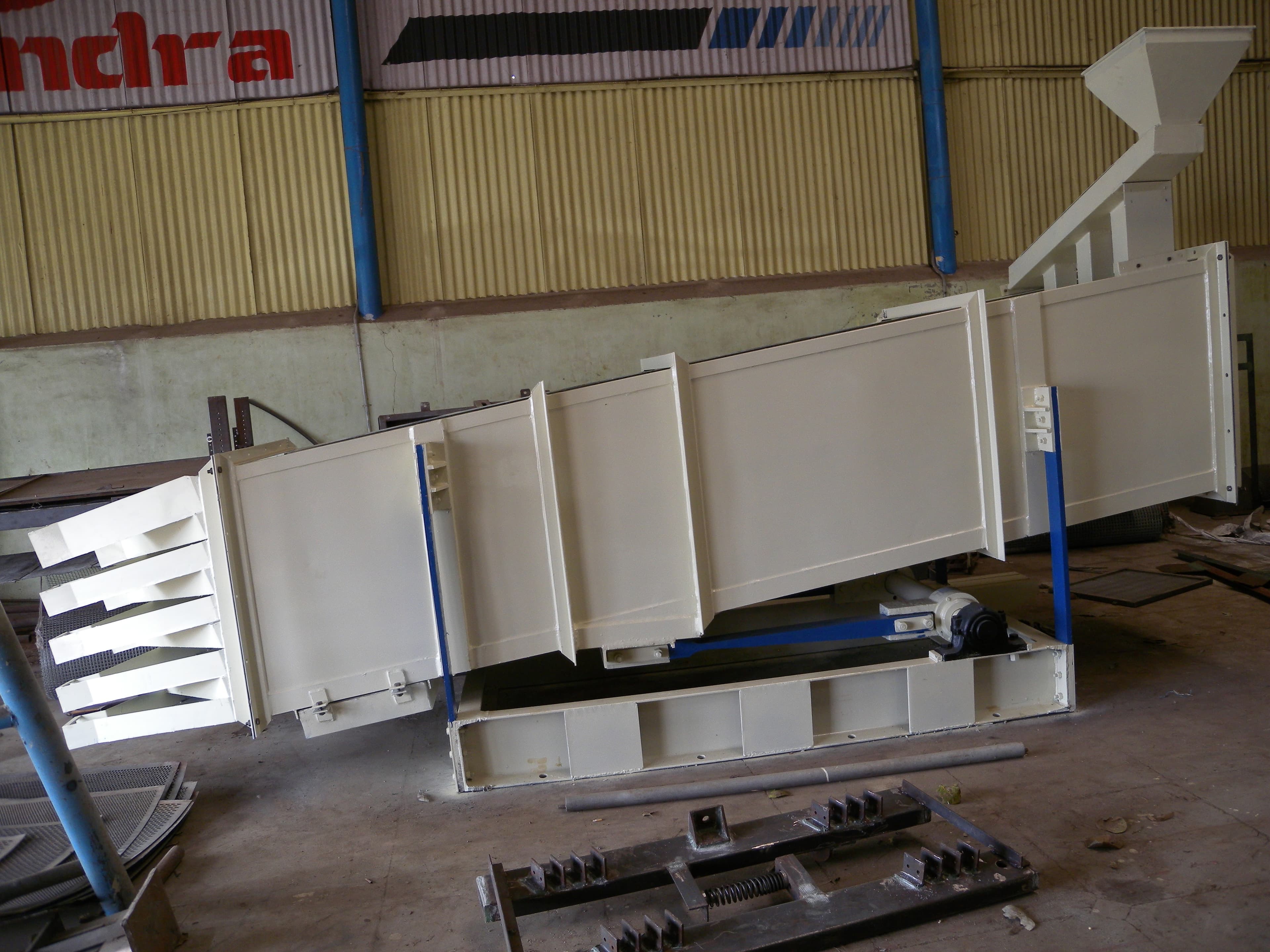
Coffee Grader / Screen Grader
Reciprocating flat-screen grader with round and oblong perforations. Sorts green coffee by physical size into export-specification screen grades — AA, A, B, C, and Peaberry — as required by India Coffee Board and all major export standards.
Coffee Gravity Separator
Separates green coffee by density — concentrating premium dense beans and removing low-density defects like immature beans, hollow shells, and insect-damaged beans.
Coffee Color Sorter
CCD optical sorting machine that removes black, sour, white, and discoloured beans from green coffee — the final automated quality gate before export bagging.