
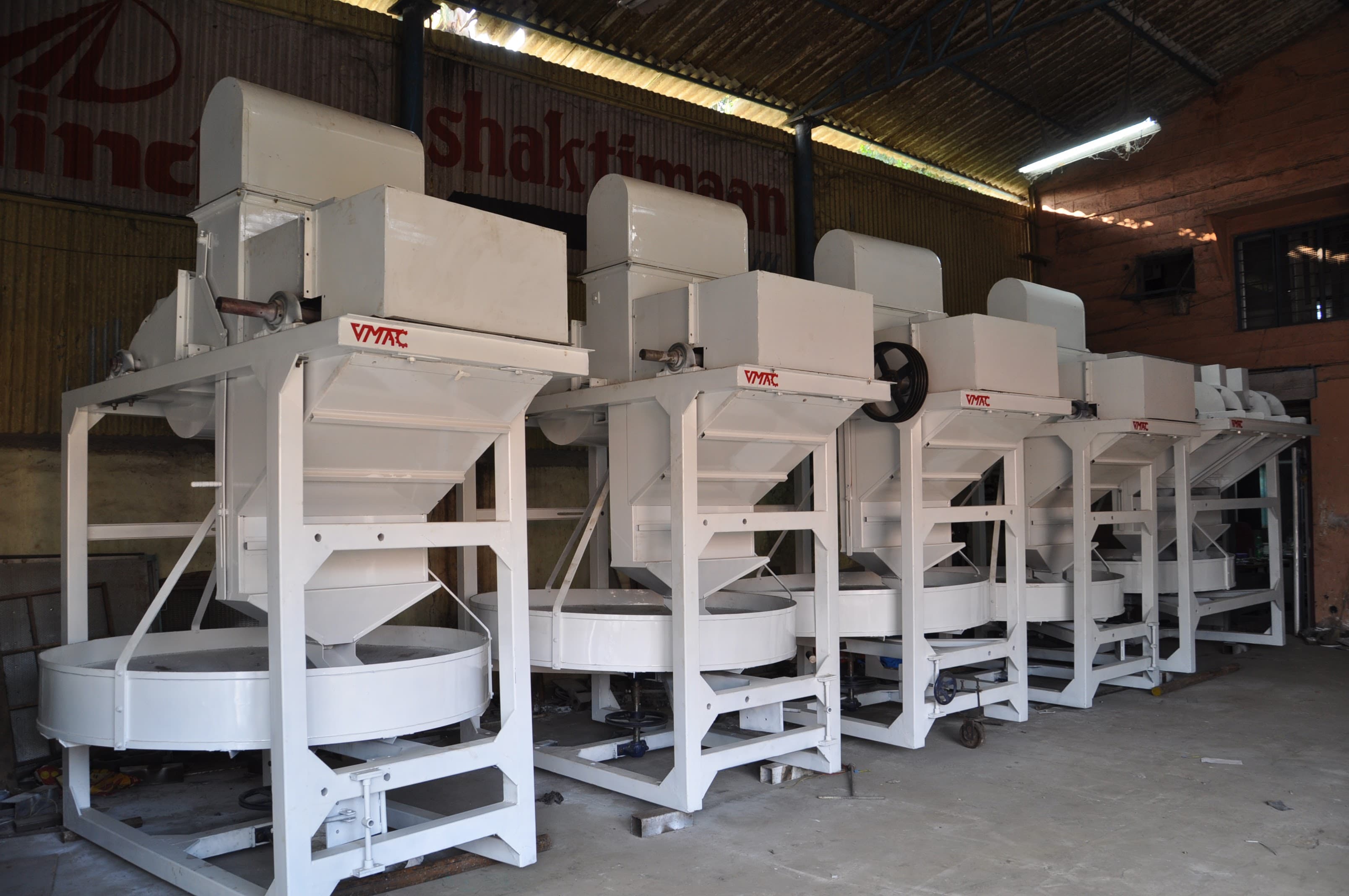
Coffee Color Sorter
CCD optical sorting machine that removes black, sour, white, and discoloured beans from green coffee — the final automated quality gate before export bagging.
| Throughput range | 500 kg/hr – 8 TPH (model-dependent) |
| Camera resolution | 4,096 pixels per row per camera |
| Imaging sides | Dual-side (front + back simultaneous) |
| Ejection valve response | 1–3 milliseconds |
| Compressed air required | 0.6–0.8 MPa (6–8 bar), dry air |
| Ejection accuracy | >99% (dual-side CCD) |
| False ejection rate | <1% (well-calibrated dual-side) |
| Power supply | 3-phase 415V, 50 Hz |
| Power consumption | 3–15 kW (model-dependent) |
| Chute configurations | 8, 16, 32, 48, 64 chutes |
Key Features
Dual-side CCD cameras — scans both faces of every bean simultaneously, >99% ejection accuracy
4,096-pixel resolution per camera row — detects defects as small as 1 mm
Air-jet response in 1–3 ms — no mechanical contact, beans are never bruised
Second-sort outlet — reject stream re-run recovers 30–70% of falsely ejected good beans
Separate calibration profiles for Arabica and Robusta — switch between crops in minutes
Sealed electronics and dust-filtered air supply — designed for tropical dry-mill environments
8 to 64 chute configurations — throughput from 500 kg/hr to 8 TPH from the same platform
3-phase 415V, 50 Hz — direct fit for Indian and East African grid supply
Models & Sizing
Right-Sized for Every Operation
Configured by chute count — more chutes means more parallel lanes and higher throughput from the same footprint. All models use the same 4,096-pixel dual-side CCD platform.
8-chute
500–800 kg/hr
capacity
Small cooperative or estate dry mill, 5–15 bags/shift
16-chute
800–1,500 kg/hr
capacity
Mid-scale estate or small curing works, 15–30 bags/shift
32-chute
1,500–3,000 kg/hr
capacity
Coffee Board-licensed curing works handling 1–3 tonnes/hr
48-chute
3,000–5,000 kg/hr
capacity
Large curing works and export-volume dry mills
64-chute
5,000–8,000 kg/hr
capacity
High-volume export plant processing 80–150 bags/hour
Custom
Your specification
capacity
For operations requiring throughput beyond the standard range. VMAC engineers the machine to your exact capacity and processing conditions.
Request a Custom QuoteConfigurations
Model Selection Guide
All models — dual-side CCD, 4,096 px/row, 3-phase 415V supply
| Model | Chutes | Throughput | Power | Air Required | Best For |
|---|---|---|---|---|---|
| CS-08 | 8 | 500–800 kg/hr | 3–5 kW | 0.6 MPa / 200 L/min | Estate dry mill, cooperative |
| CS-16 | 16 | 800–1,500 kg/hr | 4–7 kW | 0.6 MPa / 350 L/min | Small curing works |
| CS-32 | 32 | 1,500–3,000 kg/hr | 6–10 kW | 0.6 MPa / 600 L/min | Licensed curing works |
| CS-48 | 48 | 3,000–5,000 kg/hr | 8–12 kW | 0.7 MPa / 900 L/min | Large export dry mill |
| CS-64 | 64 | 5,000–8,000 kg/hr | 10–15 kW | 0.7 MPa / 1,200 L/min | High-volume export plant |
| Custom | Built to your capacity and specification — contact us for a quote | ||||
Overview
About the Coffee Color Sorter
VMAC's Coffee Color Sorter uses high-resolution CCD camera arrays to inspect every bean in free fall and eject defective beans with a millisecond-fast air jet. The machine slots in after the gravity separator in the dry mill line — after mechanical cleaning, sizing, and density separation — to catch colour-visible defects that density and screen grading cannot remove. Available in single-side and dual-side camera configurations, with channel counts from 8 to 64 chutes to match your throughput from a small cooperative at 500 kg/hr through to a large curing works at 8 TPH. Each machine includes a second-sort outlet so the reject stream can be re-run to recover good beans falsely ejected alongside defectives. Built for the Indian and East African export market — calibration profiles for both Arabica and Robusta, dust-sealed electronics for tropical dry-mill environments, and compatibility with 3-phase 415V supply.
How It Works
How It Works
A color sorter works on one principle: compare the reflected colour of every bean against a calibrated acceptance window, and eject anything outside it. The machine does this for thousands of beans per second, per chute, with no mechanical contact.
Feed and alignment
Green coffee is loaded into the top hopper. A vibrating feeder trough meters beans into individual lanes — one bean wide per lane — and releases them into free fall. This alignment ensures each bean passes the camera in a consistent position and orientation.
CCD scanning
As each bean falls through the scan zone, a linear CCD camera array captures its reflected colour. A back-lit reference panel provides a consistent background. The system reads red, green, and blue channels at 4,096 pixels per row — the equivalent of scanning the bean at the resolution of a document scanner. In dual-side configurations, cameras positioned front and back capture both faces of the bean simultaneously in the same pass.
Comparison and decision
The controller compares each pixel reading against the calibrated acceptance window for that crop and grade. Pixel values outside the window — too dark (black bean), too yellow (sour bean), too pale (white/chalky bean), or too bright (silver skin fragment) — trigger a reject signal. The decision is made within microseconds of the pixel being read.
Air-jet ejection
A solenoid-controlled air-jet nozzle, positioned a few centimetres below the scan zone, fires in 1–3 milliseconds when a reject signal arrives. The jet blows the defective bean sideways into the reject chute. Acceptable beans continue in free fall to the accept output. The reject stream exits to a second-sort outlet where it can be re-run to recover good beans that were caught in the proximity of ejected defects.
Second sort (yield recovery)
When a defect bean is ejected, any good beans falling immediately adjacent to it may also be caught by the air jet — this is called false ejection. Rather than discarding the reject stream, it is passed through the machine a second time. This second sort recovers 30–70% of falsely ejected good beans, improving net yield by 0.5–2% of total lot weight depending on defect density.
Defect Separation
What the color sorter removes — and what it cannot
A CCD color sorter detects defects by colour contrast against a calibrated reference. It is the right tool for all colour-visible defects, but is not a substitute for density separation or stone removal — each machine handles what it is designed for.
Effectively removed
Full black beans
Over-fermented, mold-damaged, or severely insect-damaged beans with dark exterior surfaces. The strongest colour signal a sorter detects — very high ejection accuracy.
Full sour / yellowed beans
Beans that fermented incorrectly or aged in high-humidity storage — yellow, tan, or olive-coloured surface. Well-detected by the red and green channels of the CCD sensor.
White / chalky beans
Underdeveloped endosperm resulting in a chalky-white interior visible at the bean surface. Detected as outliers in the brightness channel.
Withered and shell beans
Collapsed or hollow beans with a wrinkled, pale-tan appearance. Some withered beans will have already been removed by the gravity separator; color sorter catches remaining surface-visible cases.
Quakers (partial)
Underdeveloped pale-tan beans. CCD sorters detect strongly pale quakers reliably. Very lightly tanned quakers are a known limit — see below.
Parchment and silver skin fragments
Light-coloured fragments of parchment or silver skin remaining after hulling and polishing. These appear white-bright to the CCD sensor and are reliably ejected.
Foreign matter with colour contrast
Small light-coloured stones, plastic fragments, and other non-bean material that differs in colour from the bean acceptance window.
Cannot remove
Coffee Berry Borer (CBB) internal damage
CBB enters the bean tip, bores inside, and leaves the exterior visually intact. The bean appears normal colour to any camera — CCD, NIR, or otherwise cannot detect internal voids from borer damage without X-ray or destructive testing. NIR/laser sorters are needed for CBB risk in high-altitude East Africa or South India lots.
Early-stage internal mold
Before mold growth reaches the bean surface and causes visible discoloration, there is no colour signal for the CCD to detect. A water activity meter (aw > 0.65) is the right tool for mold risk screening at intake; multispectral NIR sorters can detect late-stage mold.
Subtle quakers
Very lightly tanned quakers — underdeveloped beans whose colour is within normal tolerance for that crop and origin — have insufficient colour contrast for reliable CCD detection. Post-roast hand sorting or a tighter second-pass calibration setting is needed for SCA Grade 1 zero-quaker targets.
Stones (same colour as beans)
Dark or reddish stones that fall within the bean colour acceptance window are not ejected. The de-stoner (gravity table for stones) must run before the color sorter — stone removal is a density task, not a colour task.
Density defects with normal colour
Low-density floaters or shell beans that happen to be normal in colour will not be ejected. This is why gravity separation runs before color sorting in the dry mill line.
For lots targeting EU specialty buyers with CBB risk or OTA documentation requirements, consider pairing the CCD sorter with an NIR or laser sorter on a second pass. VMAC can advise on line configurations for specific market requirements.
Know the Difference
Coffee Color Sorter vs. Hand Sorting
Hand sorting remains common in specialty mills and as a final audit step. Color sorters do not fully replace hand sorting for zero-defect specialty targets — but they change the economics fundamentally.
| Feature | Coffee Color Sorter | Hand Sorting |
|---|---|---|
| Throughput | 500–8,000 kg/hr (machine) | 5–8 kg/person/day |
| Consistency | Consistent — calibrated acceptance window, same standard every bean | Variable — sorter fatigue, lighting, training level all affect accuracy |
| Accuracy (colour defects) | >99% ejection of colour-visible defects (dual-side CCD) | 90–98% depending on sorter skill and defect severity |
| CBB detection | Cannot detect internal CBB damage | Cannot detect internal CBB damage — same limitation |
| Quaker removal | Good for strong quakers; subtle quakers are a known limit | Experienced hand sorters detect subtle quakers better than CCD |
| Documentation | Machine logs rejection rates, calibration settings per lot | No automated documentation; relies on supervisor records |
| Operating cost per tonne | Low — electricity + maintenance; scales with volume | High — labour per kg is fixed regardless of volume |
| For specialty Grade 1 | 2–3 machine passes achieves Grade 1 with minimal hand sort audit | Required as final audit after machine sorting for strict zero-defect targets |
Best practice for specialty lots: 2 machine passes on the color sorter, then a hand-sort audit on a 10% sample to verify calibration quality. This delivers Grade 1 defect levels with the economic efficiency of machine sorting.
Processing Line
Where It Fits in Your Processing Line
The color sorter is the last automated quality gate in the dry mill line — it runs after all mechanical separation is complete, so it receives the cleanest possible input and its sensitivity can be set precisely.
Cherry intake & flotation
Pulping / hulling
Drying (patio, raised bed, or mechanical)
Pre-cleaner / scalper
Removes sticks, dust, large FM
De-stoner
Removes stones and heavy metal by density
Huller
Removes parchment from Arabica; husk from natural Robusta
Peeler / polisher
Removes silver skin for cleaner export appearance
Screen grader
Sizes to AA, AB, C, PB grade screens
Gravity separator
Removes low-density defects (floaters, shells, withered)
Color sorter
This machineRemoves colour-visible defects (black, sour, white, FM)
Hand sort (optional)
Final audit pass for specialty lots
Bagging / GrainPro filling
FAQ
Frequently Asked Questions
How many passes does a coffee color sorter need for export grade?
For standard commercial export — Indian Plantation A/B or Uganda FAQ — one pass through a dual-side CCD sorter is sufficient, plus a second sort run on the reject stream to recover yield. For specialty Arabica targeting SCA Grade 1 (zero primary defects, ≤5 secondary defects per 300g), plan for 2–3 machine passes. Each pass raises defect removal incrementally: pass 1 catches ~97% of colour-visible defects; pass 2 brings this above 99.5%.
What is the difference between 8-chute and 32-chute models?
Chute count determines throughput — each chute is one parallel lane running simultaneously. An 8-chute machine processes 500–800 kg/hr. A 32-chute machine processes 1,500–3,000 kg/hr. The camera quality, ejection accuracy, and calibration platform are the same across the range. Choose your chute count based on your peak throughput requirement and how many hours per day the machine runs.
Does a color sorter also remove stones?
No. A color sorter works only on colour contrast — it ejects beans that differ in colour from the calibrated acceptance window. A stone that is darker than the acceptance window will be ejected; a stone that happens to be the same colour as a coffee bean will not. Stone removal is a density task, done by the de-stoner before the color sorter in the mill line.
Can the same machine sort Arabica and Robusta?
Yes. Arabica and Robusta have different colour profiles — Arabica green beans tend to be more blue-green; Robusta tends toward a more yellow-green. The machine stores separate calibration profiles for each. Switching between crops takes a few minutes at the control panel. The same machine can also store profiles for different origins or processing methods (washed vs. natural) that have different baseline colour ranges.
What compressor size do I need?
Compressed air must be dry — moisture causes bean sticking at the reject chute and degrades ejection valve reliability in humid environments. For an 8-chute machine, plan for a 7.5 kW compressor delivering ~200 L/min at 0.6 MPa. For a 32-chute machine, you need a 15–22 kW compressor delivering ~600 L/min. An air dryer (refrigerant or desiccant type) between the compressor and the sorter is strongly recommended for mills in Kerala, coastal Karnataka, Uganda coast, or any humid location.
Can it detect Coffee Berry Borer (CBB) damage?
No. CBB bores into the bean through the tip, leaving the exterior surface intact and normal in colour. A CCD camera sees only the bean surface — internal voids from borer damage are invisible to it. For lots from high-altitude East Africa (Ethiopia, Kenya, Uganda) or South India with known CBB pressure, an NIR or laser sorter on a second pass is the correct tool. VMAC can advise on NIR sorter options for CBB-risk lots.
What is a second sort and how much yield does it recover?
When the air jet ejects a defect bean, it inevitably catches some adjacent good beans in the same burst — this is called false ejection. The false ejection rate on a well-calibrated dual-side CCD is <1%, but at 2,000 kg/hr that still represents up to 20 kg/hr of good beans in the reject stream. Running the reject stream through the machine a second time recovers 30–70% of those falsely ejected beans. At 1,500 kg/hr throughput over a 10-hour day, that can recover 100–300 kg of additional good export-grade coffee per day.
How often does the machine need calibration?
Recalibrate at the start of each new lot — especially when switching between origins, crop years, or processing methods. Old-crop and new-crop beans of the same variety can differ in colour reference. Calibration takes 5–10 minutes: run a known-clean reference sample, observe the reject rate, adjust the acceptance window until the reject rate is at your target. Clean the camera lens at the start of every shift — dust accumulation in dry-mill environments is the most common cause of degraded accuracy.
Related guides
Learn more about this equipment
VMAC Industries
How to Plan a Coffee Export Facility
A step-by-step equipment and compliance guide for setting up a coffee export facility in India — from Coffee Board registration to export-grade sorting, grading, and packaging.
Read the guide →
VMAC Industries
Export-Ready Coffee: Meeting International Standards and Compliance
Learn how to navigate the rigorous requirements of global coffee markets, ensuring your beans meet quality, safety, and certification standards for smooth international trade.
Read the guide →
Send a Enquiry Request
Retail store
Mon-Sat 9am to 5pm.
B.M road, Hassan, Karnataka 573201
Related Products
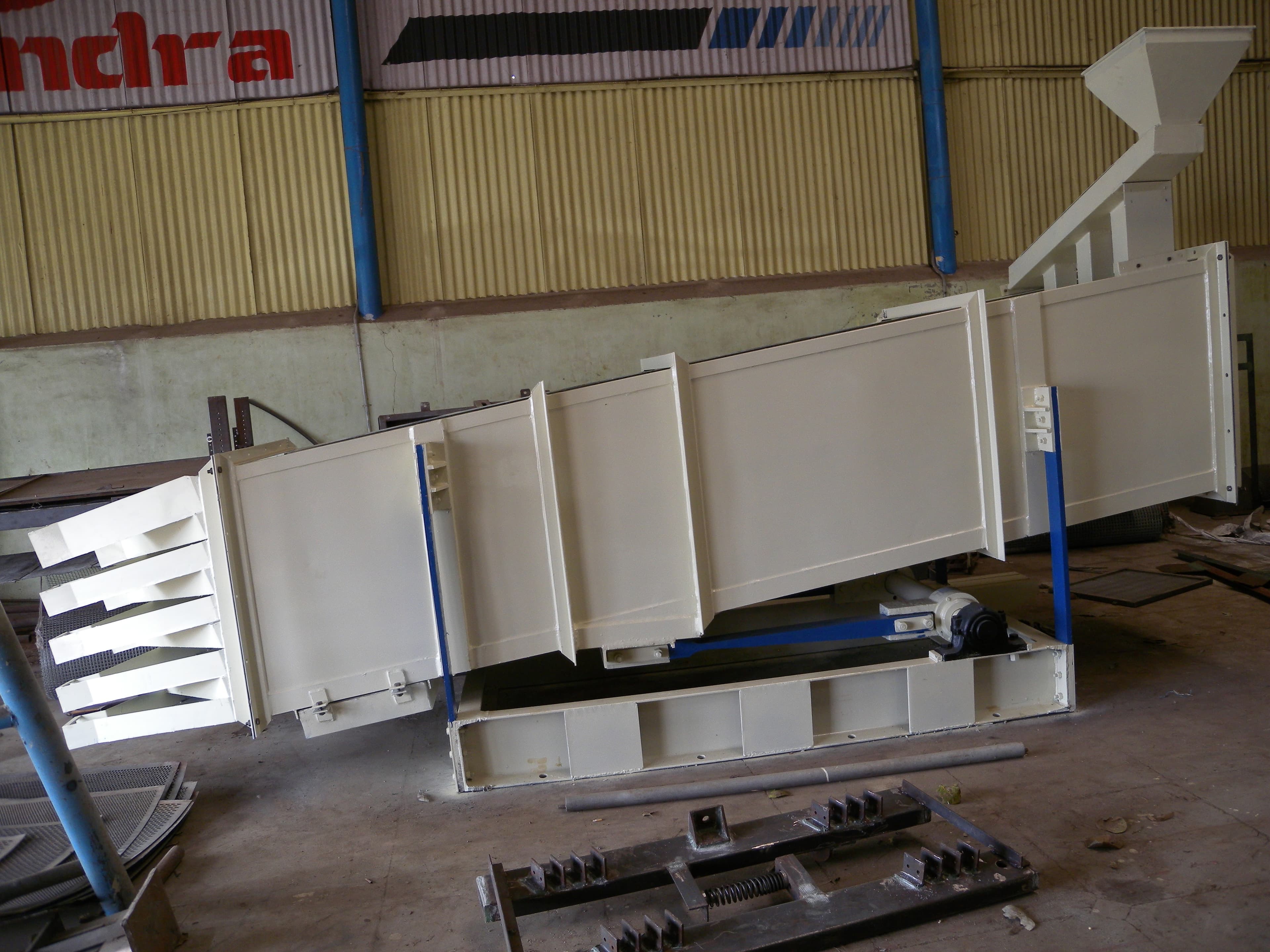
Coffee Grader / Screen Grader
Reciprocating flat-screen grader with round and oblong perforations. Sorts green coffee by physical size into export-specification screen grades — AA, A, B, C, and Peaberry — as required by India Coffee Board and all major export standards.
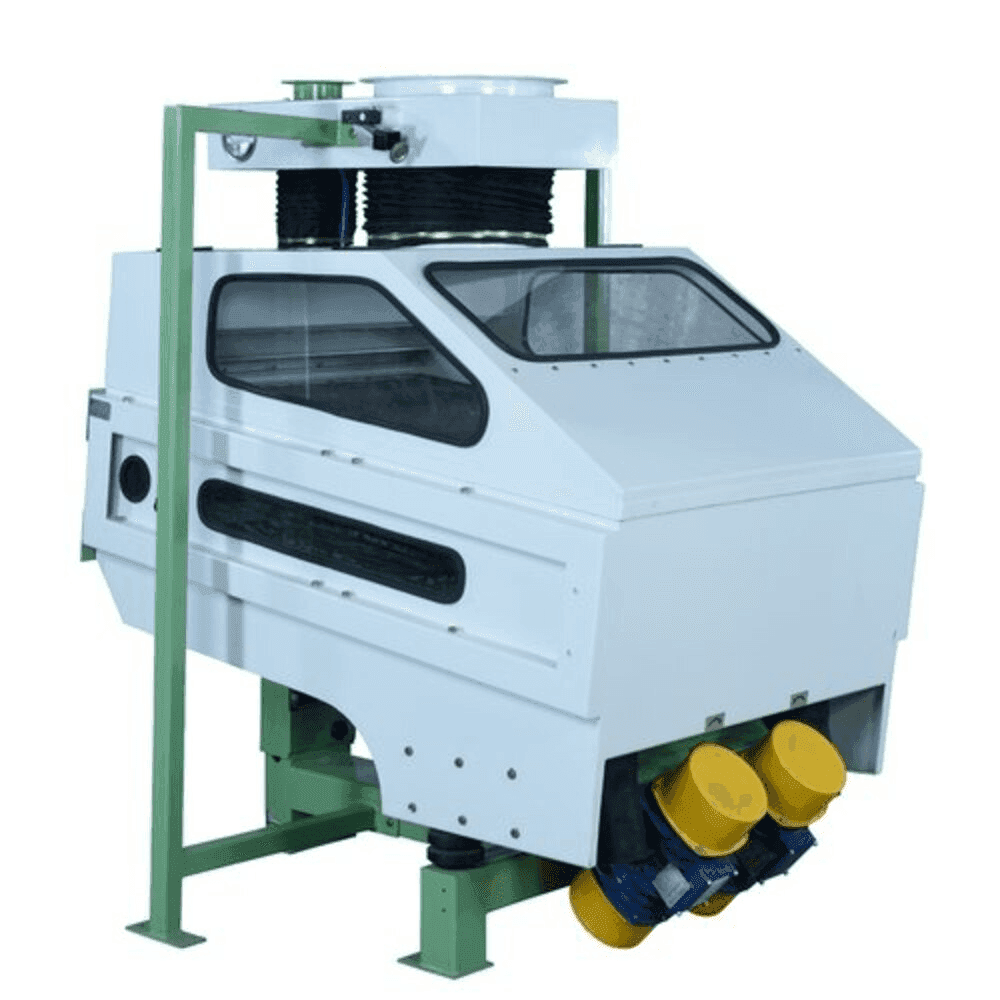
Coffee Destoner
Inclined vibrating deck with calibrated upward airflow — removes stones, glass, and heavy foreign matter from coffee before hulling, protecting downstream machinery and meeting export purity requirements.
Coffee Gravity Separator
Separates green coffee by density — concentrating premium dense beans and removing low-density defects like immature beans, hollow shells, and insect-damaged beans.