
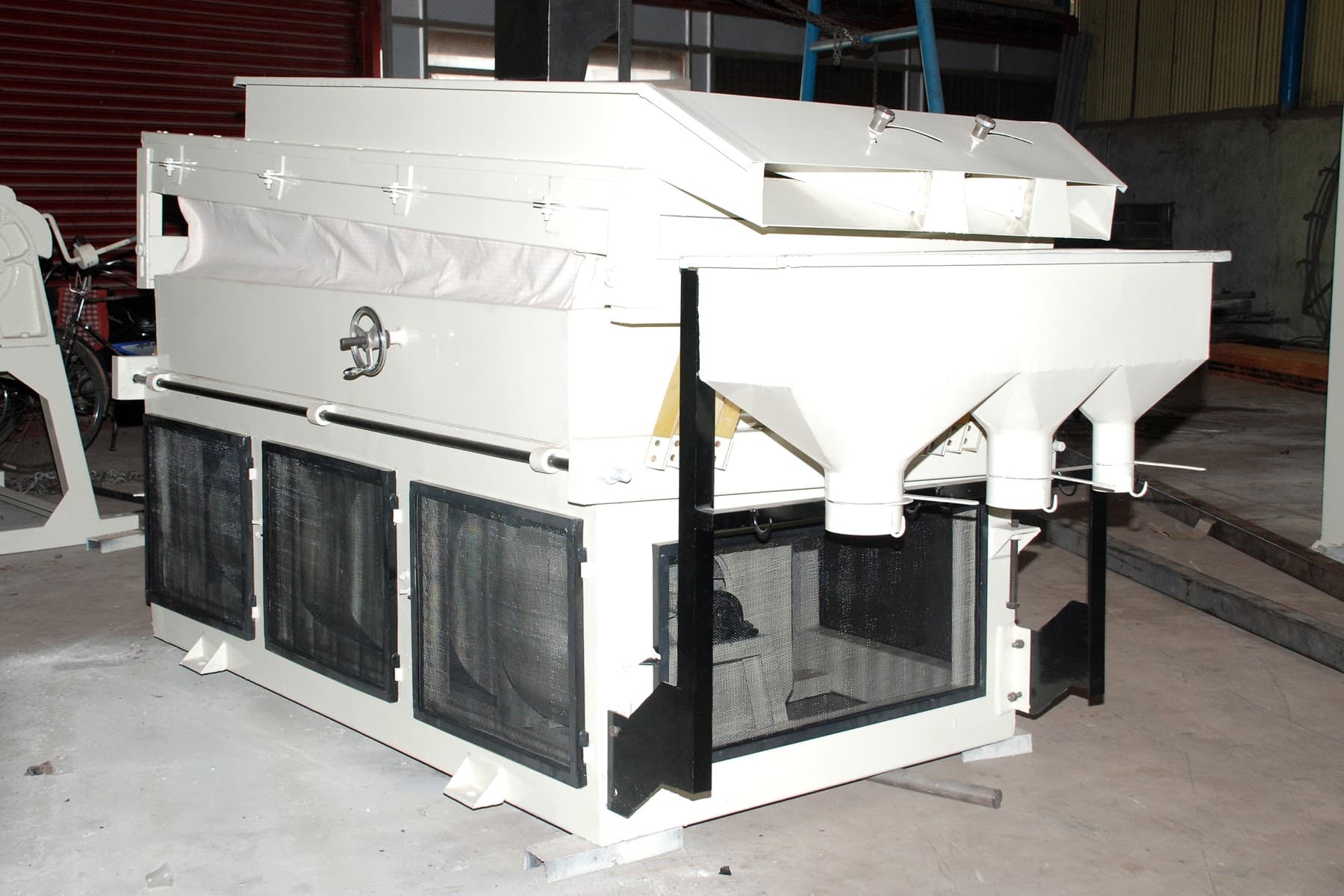
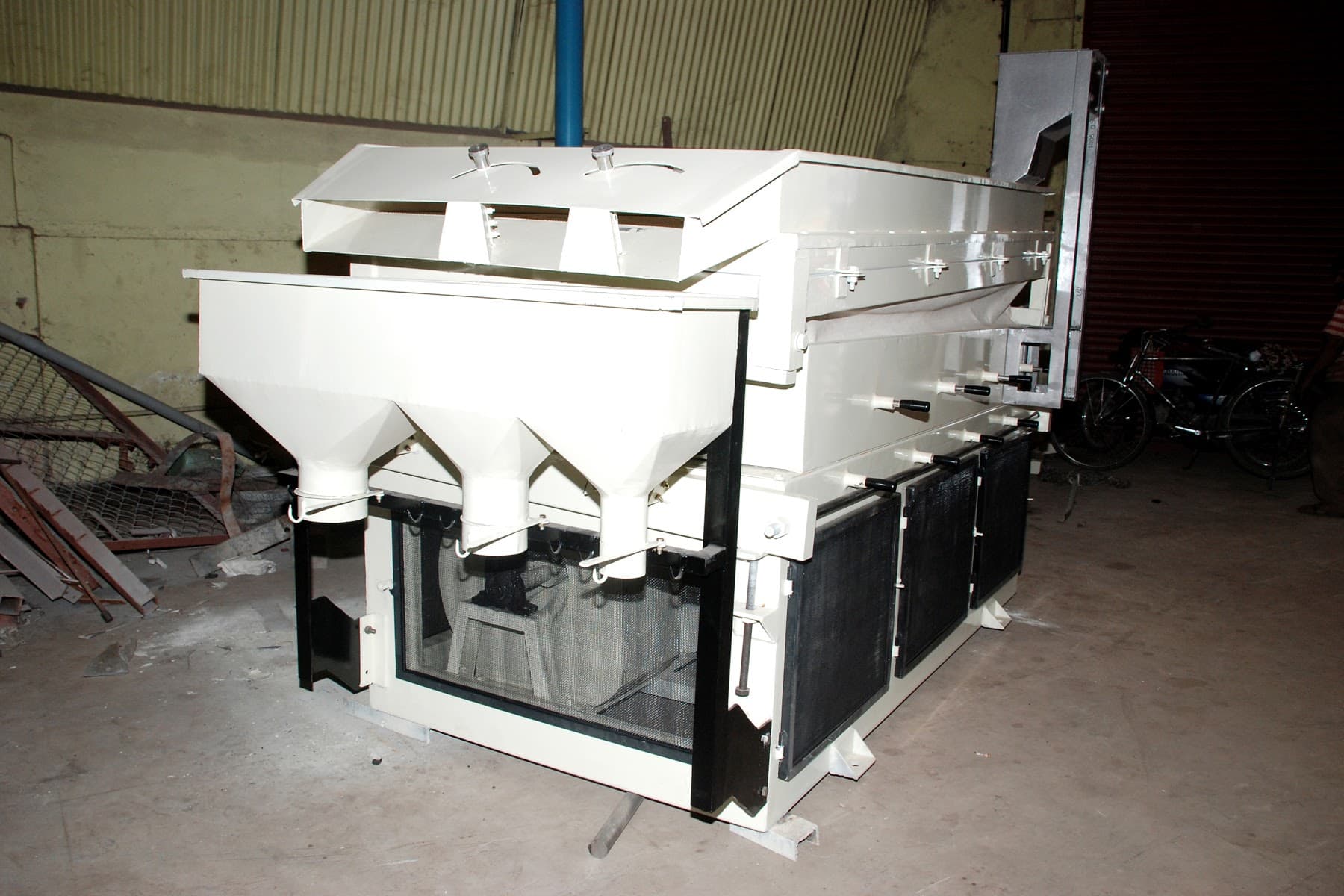
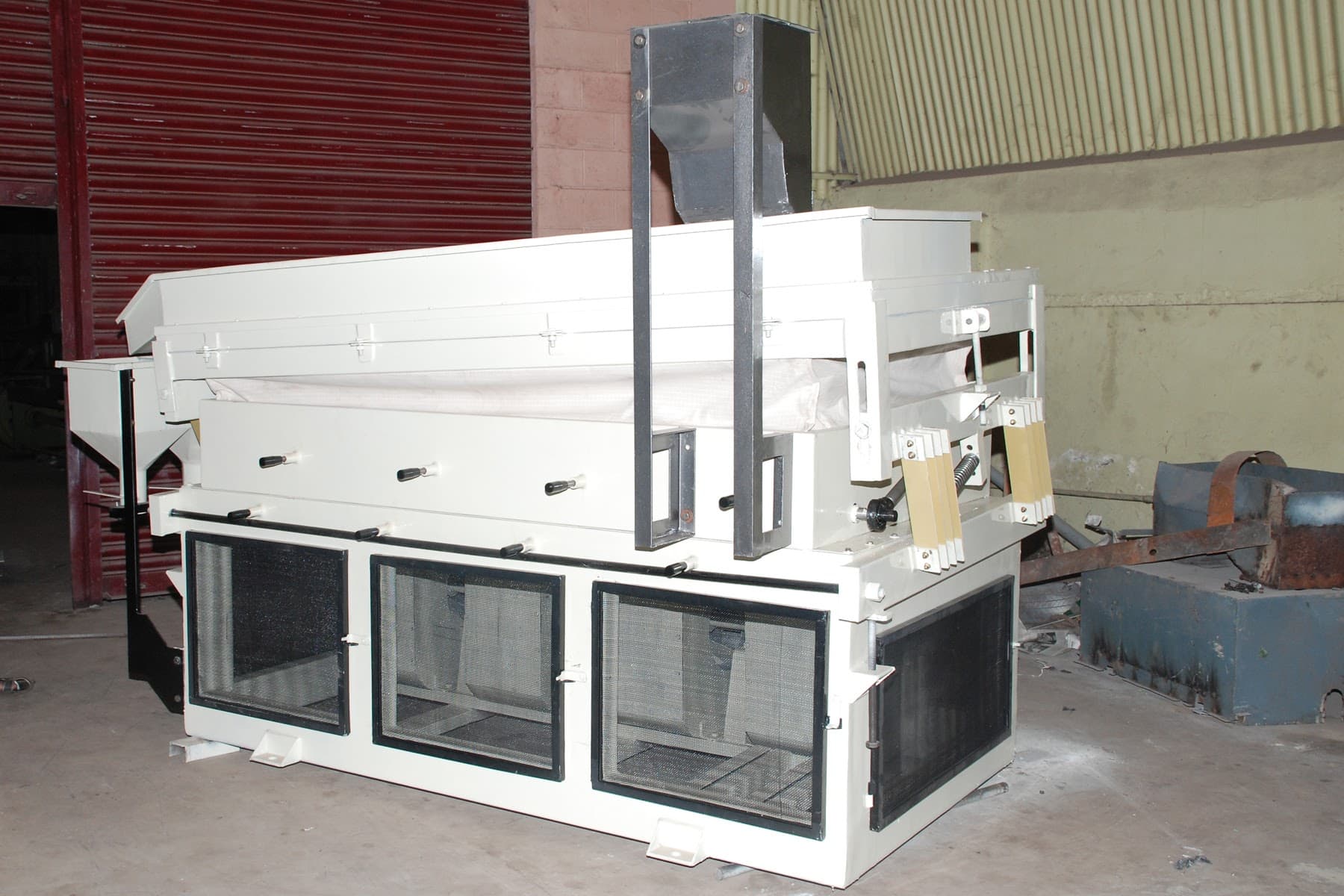
Coffee Gravity Separator
Separates green coffee by density — concentrating premium dense beans and removing low-density defects like immature beans, hollow shells, and insect-damaged beans.
| Capacity | 500 kg/hr – 10 TPH |
| Fan motor | 3 HP – 17 HP |
| Discharge outlets | 3 (Heavy / Middlings / Lights) |
| Power supply | 3-phase, 440V |
| Vibration speed | 200–600 RPM (adjustable) |
Key Features
Air-fluidized vibrating deck stratifies green coffee into precise density bands — separates where screens cannot
Three-fraction output: heavy (premium grade) / middlings / lights tailings (defects)
Removes immature beans, hollow shells, withered beans, insect-damaged beans, and floaters
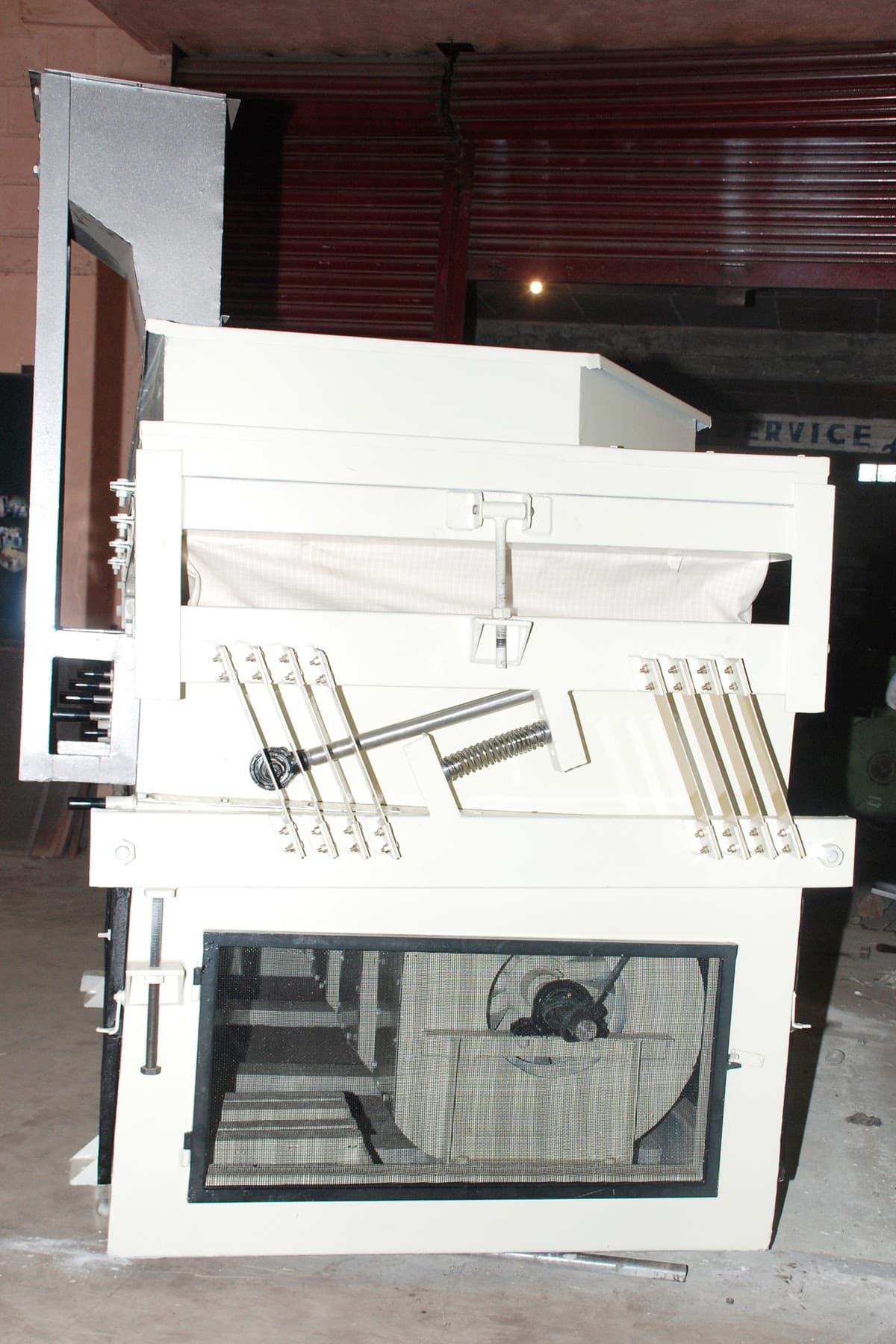
Four independently adjustable parameters: feed rate, air volume, side tilt, end raise
Gentle on beans — no impact forces; breakage rate far lower than hullers or screen graders
Models from 500 kg/hr (small estate) to 10 TPH (large curing works / export mill)
Concentrates dense, premium beans for higher Coffee Board grade certification
Used in all serious Indian curing works processing Plantation AA, MNEB, and specialty grades
Models & Sizing
Right-Sized for Every Operation
VMAC manufactures gravity separators across six capacity tiers, from small estates running 500 kg/hr to large export curing works processing 10 TPH. All models feature adjustable deck tilt, multi-zone air control, and three-fraction discharge. Contact us for exact specifications and custom configurations.
Small Estate
500–1,200 kg/hr
capacity
Estates processing 50–100 acres. Single variety, single-pass operation. Suits smallholder cooperatives and micro-mills.
Medium Estate
1,200–2,500 kg/hr
capacity
Medium estates and cooperative wet mills. Handles two size fractions per shift. Suits farms producing 50–200 bags per season.
Large Estate / Small Curing Works
2,500–4,000 kg/hr
capacity
Large estates and small curing works serving multiple farms. Multi-grade processing. Suits operations requiring Coffee Board grade certification.
Medium Curing Works
4,000–6,000 kg/hr
capacity
Licensed curing works processing Plantation A, AA, MNEB, and Robusta grades for export. Handles full daily throughput across all size fractions.
Large Curing Works
6,000–8,000 kg/hr
capacity
High-volume curing works and export processing plants. Continuous operation across multiple shifts. Suits operations exporting 1,000+ containers per season.
Export Processing Plant
8,000–10,000 kg/hr
capacity
Large-scale commercial export mills. Often installed in parallel pairs for redundancy. Suits bulk robusta and Arabica export plants in Karnataka, Kerala, and Tamil Nadu.
Custom
Your specification
capacity
For operations requiring throughput beyond the standard range. VMAC engineers the machine to your exact capacity and processing conditions.
Request a Custom QuoteConfigurations
Full Model Range — Gravity Separator
All models feature adjustable air volume (multi-zone), independently adjustable deck side tilt and end raise, three-fraction discharge, and 3-phase 440V power supply. Indicative specifications — contact VMAC for exact dimensions and custom configurations.
| Model Tier | Capacity (kg/hr) | Fan Motor | Vibration Motor | Deck Size (mm) | Discharge Outlets | Best For |
|---|---|---|---|---|---|---|
| Small Estate | 500–1,200 | 3 HP | 0.5 HP | 900 × 600 | 3 | Small estate / cooperative |
| Medium Estate | 1,200–2,500 | 5 HP | 0.75 HP | 1,300 × 800 | 3 | Medium estate / coop wet mill |
| Large Estate / Small Curing Works | 2,500–4,000 | 7.5 HP | 1 HP | 1,600 × 950 | 3 | Large estate / small curing works |
| Medium Curing Works | 4,000–6,000 | 10 HP | 1 HP | 2,000 × 1,050 | 3 | Licensed curing works — export grades |
| Large Curing Works | 6,000–8,000 | 12 HP | 1.5 HP | 2,500 × 1,150 | 3 | High-volume export mill |
| Export Processing Plant | 8,000–10,000 | 17 HP | 1.5 HP | 3,100 × 1,300 | 3 | Large-scale commercial export plant |
| Custom | Built to your capacity and specification — contact us for a quote | |||||
Overview
About the Coffee Gravity Separator
VMAC's Coffee Gravity Separator uses an air-fluidized vibrating deck to sort green coffee beans by specific density — the single most reliable way to separate premium, fully-developed beans from low-density defects that screening and hulling cannot remove. The machine produces three distinct outputs: a heavy fraction of concentrated, dense premium-grade beans; a middlings blend; and a lights tailings fraction containing immature beans, hollow shells, withered beans, insect-damaged beans, and floaters. Available in models from 500 kg/hr for small estates to 10 TPH for large export curing works, it is standard equipment in Coffee Board of India-licensed curing works and a prerequisite for achieving Plantation AA, MNEB, and specialty export grades.
How It Works
How It Works
A gravity separator uses two simultaneous physical forces — upward air flow and eccentric vibration on an inclined deck — to stratify green coffee beans by their specific weight. Beans with different densities travel in different directions, separating automatically into three distinct fractions.
Air fluidization
A fan forces air upward through a perforated deck surface, creating a thin fluidized layer above the deck. Lighter, less-dense beans float above the deck surface on this air cushion. Denser, fully-developed beans remain in firm contact with the deck.
Vibration and inclination
The deck oscillates in an elliptical motion while tilted at a controlled angle. Denser beans in contact with the deck are conveyed uphill by friction and vibration — toward the heavy discharge corner. Lighter beans floating in the air layer slide downhill under gravity — toward the lights (tailings) discharge corner.
Three-fraction stratification
The result is a repeatable density gradient across the deck. Heavy beans concentrate at the upper-far corner (heavy discharge). Low-density defect beans collect at the lower-near corner (lights discharge). A middlings band spans between the two extremes, collected at a third outlet.
Operator fine-tuning
Four parameters are adjusted per crop and moisture level: feed rate (controls layer thickness), air volume in CFM (controls float height), side tilt (controls cross-deck flow direction), and end raise — the longitudinal angle (controls speed of heavy fraction travel). Running at 70–80% rated capacity consistently produces better separation than running at maximum throughput.
Defect Separation
What a Gravity Separator Removes — and What It Cannot
Density separation works on a simple physical principle: defective beans weigh less than sound beans. Any defect that reduces a bean's mass — internal voids, incomplete development, insect damage, moisture loss — makes it separable. Defects that change only colour or taste but not density require a colour sorter.
Effectively removed
Immature / unripe beans (quakers)
Insufficiently developed beans have low sugar and cellular density. When roasted, they become pale tan 'quakers' that introduce grassy, peanut, and flat flavours. The gravity table is the most effective machine for quaker removal before roasting.
Withered / shriveled beans
Caused by drought stress or post-harvest delay. Very low density due to incomplete cellular development. Highly separable — one of the easiest defects for a gravity table to isolate.
Hollow shells ("elephant ears")
A genetic half-bean defect where one half of the bean forms around a hollow cavity. Extremely low density. Well-calibrated gravity separators remove these effectively and consistently.
Insect-damaged beans (CBB)
Coffee Berry Borer (Hypothenemus hampei) tunnels through the bean, creating internal voids and reducing density. Multi-hole severe damage — classified as a primary SCA defect — is reliably removed. Single-hole light damage is less consistently separated.
Floaters and overripe beans
Cherries that floated during wet processing but were not fully removed carry into the dry mill. Their low density due to internal breakdown makes them well-suited to density separation.
Broken fragments and chip pieces
Small broken pieces from hulling have lower mass relative to whole beans. The gravity table concentrates them in the lights fraction, reducing the defect count of the output lot.
Parchment remnants and husk fragments
Any unhulled parchment or husk fragments that pass through the winnower have very low density and are captured immediately in the lights fraction.
Cannot remove
Full black beans
Fully fermented black beans have similar or sometimes higher density than sound beans. A colour sorter is required for reliable black bean removal.
Full sour beans
Sour beans caused by over-fermentation do not differ reliably in density from normal beans. Optical / colour sorting is the correct tool.
Partial black / partial sour beans
Same limitation as full blacks and sours — density is not sufficiently different. Use a CCD or laser colour sorter after density separation.
Same-density foreign material
Dense stones similar in density to green coffee beans must be removed by a destoner upstream — before the gravity separator. The destoner targets material heavier than coffee; the gravity separator targets material lighter than coffee.
A gravity separator and a colour sorter are complementary, not interchangeable. The correct sequence is: screen grading → gravity separator (removes density-based defects) → colour sorter (removes colour-based defects). Neither machine replaces the other.
Know the Difference
Coffee Gravity Separator vs. Destoner
The gravity separator and the destoner are the two most commonly confused machines in a coffee dry mill — and one of the most frequently asked questions before purchase. They work on different principles, target different materials, and are positioned at completely different points in the processing line.
| Feature | Coffee Gravity Separator | Destoner |
|---|---|---|
| Primary purpose | Sort coffee beans by density; remove low-density defective beans from within the coffee lot | Remove heavy foreign material (stones, glass, metal) that is denser than coffee |
| What it targets | Immature beans, hollow shells, withered beans, insect-damaged beans, floaters | Stones, gravel, glass fragments, dense metal pieces, soil clods |
| Separation direction | Heavy (good) beans travel uphill; light (defective) beans slide downhill | Heavy stones travel uphill and are rejected; coffee beans travel downhill as product |
| Density gap targeted | Fine gap — distinguishes between sound and marginally-defective coffee (0.60–0.75 g/mL range) | Large gap — removes material far denser than coffee (stones: ~2.5 g/cm³ vs coffee: ~1.35 g/cm³) |
| Input requirement | Requires pre-sized, screen-graded beans — mixed sizes defeat air stratification | Handles unsized, ungraded material — positioned early in the line |
| Output fractions | Three: heavy fraction (premium), middlings, lights (defects tailings) | Two: product (coffee) and reject (stones/foreign material) |
| Position in dry mill | After hulling, polishing, aspiration, and screen grading | Early — typically second or third after pre-cleaner, before hulling |
| Can it replace the other? | No — cannot remove dense stones; those damage the gravity separator deck | No — cannot distinguish between good and defective beans by density |
Correct sequencing: Pre-cleaner → Destoner → Huller → Winnower → Screen Grader → Gravity Separator → Colour Sorter. Both machines are standard in a complete dry mill — they perform entirely different functions.
Processing Line
Where It Fits in Your Processing Line
The gravity separator runs near the end of the dry mill sequence — after size grading has produced uniform size fractions. Each size fraction (Grade A, B, C, Peaberry) is run through the gravity separator separately, with settings re-tuned for each.
Pre-cleaner / scalper
Removes gross foreign material: sticks, rope, mud, large debris
Destoner (upstream)
Removes stones and dense foreign objects heavier than coffee — protects downstream equipment
Huller
Rubber-roll huller (washed parchment) or disc huller (cherry / natural) removes dried husk
Peeler / polisher
Removes silver skin; smooths bean surface
Winnower / aspirator
Air column removes chaff, dust, and parchment fragments
Screen grader
Separates beans by screen size — produces Grade A, B, C, and Peaberry fractions. Must run before the gravity separator.
Gravity Separator
This machineRuns each size fraction separately. Produces heavy (premium), middlings, and lights (defects) fractions. Four adjustable parameters per crop and moisture level.
Colour sorter (CCD / laser)
Removes colour-based defects invisible to the gravity separator: full blacks, partial blacks, sour, discoloured
Hand sorting / garbling table
Final manual inspection pass before weighing and bagging
Weighing, bagging, export
Bags labelled with lot number, grade, crop year, ICO mark
FAQ
Frequently Asked Questions
What is the difference between a gravity separator and a destoner?
They are completely different machines targeting opposite density directions. A destoner removes material that is much heavier than coffee — stones, gravel, glass — using an air velocity high enough to float coffee but not dense stones. A gravity separator, by contrast, sorts within the coffee lot itself, separating sound beans from low-density defective beans like immature beans, hollow shells, and insect-damaged beans. Both machines are needed in a complete dry mill — a destoner before hulling, a gravity separator after screen grading.
Do I need to screen-grade the coffee before running it through the gravity separator?
Yes — this is mandatory for effective separation. The gravity separator works by stratifying beans of similar size by density using air fluidization. If beans of different sizes are mixed, larger beans and smaller beans behave differently under the air flow, and the separation breaks down. A flat screen grader or rotary drum grader must run before the gravity separator to produce uniform size fractions (Grade A, B, C, Peaberry). Each fraction is then run through the gravity separator separately with settings tuned for that size.
Can a gravity separator remove black or sour beans?
No. Fully black beans (over-fermented) and sour beans have similar density to sound beans, so they cannot be reliably separated by a gravity table. These colour-based defects require a CCD or laser colour sorter. The gravity separator and colour sorter are complementary machines — the correct sequence is gravity separation first, then colour sorting. A gravity separator alone is not sufficient for export-grade quality; it must be followed by optical sorting.
What capacity gravity separator do I need for my estate or curing works?
As a rule of thumb, size the machine to run at 70–80% of its rated capacity for best separation quality. For a small estate processing up to 150 bags per day, a 500–1,200 kg/hr model is suitable. A medium curing works processing 300–600 bags per day needs 2,500–4,000 kg/hr. A large export curing works needs 6,000–10,000 kg/hr. Remember that the gravity separator runs each screen-graded size fraction separately, so total throughput time is longer than just the coffee weight — factor in setup and adjustment time between fractions.
How do I know if the gravity separator is set correctly?
Visually inspect the three discharge fractions continuously during operation. The lights fraction (tailings) should visibly contain shriveled, hollow, discoloured, and withered beans — if it looks like perfectly good coffee, the machine is not separating. The heavy fraction should look uniform, dense, and well-developed. The middlings fraction is a blend. Adjust air volume first (primary fluidization control), then side tilt, then end raise. Feed rate affects layer thickness — reduce feed rate if fractions are mixing. Experienced operators develop an eye for correct discharge quality within a few runs.
Is a gravity separator required for export-grade coffee in India?
The Coffee Board of India does not mandate specific equipment by name. However, the defect standards for Plantation AA, MNEB (Mysore Nuggets Extra Bold), Robusta Kaapi Royale, and specialty grades require zero tolerance for primary defects that are practically impossible to achieve without density separation. All licensed curing works processing these grades use gravity separators as standard equipment. Coffee Board inspectors verify defect counts at curing works — operations without density separation consistently fail to meet the defect limits for premium grades.
What maintenance does the gravity separator require?
The most common failure mode is clogged air filters — when airflow is reduced, stratification collapses and separation quality falls noticeably. Clean filters are the single most important maintenance item. Other routine tasks: clean the deck surface periodically (coffee dust and chaff accumulate in the perforations), check fan belt tension, lubricate eccentric bearings per the maintenance schedule, inspect vibration mount isolators for deterioration, and check that deck inclination locks hold their set position during operation.
Related guides
Learn more about this equipment
VMAC Industries
What to Look for When Buying a Gravity Separator
A buyer's guide to coffee gravity separators — how they work, what defects they remove, how to size one for your operation, and what to check before purchasing.
Read the guide →
VMAC Industries
Enhancing Bean Purity with Destoners and Gravity Separators
Discover how advanced destoning and gravity separation technologies can elevate your coffee quality by removing foreign materials and sorting beans for uniform excellence.
Read the guide →
Send a Enquiry Request
Retail store
Mon-Sat 9am to 5pm.
B.M road, Hassan, Karnataka 573201
Related Products
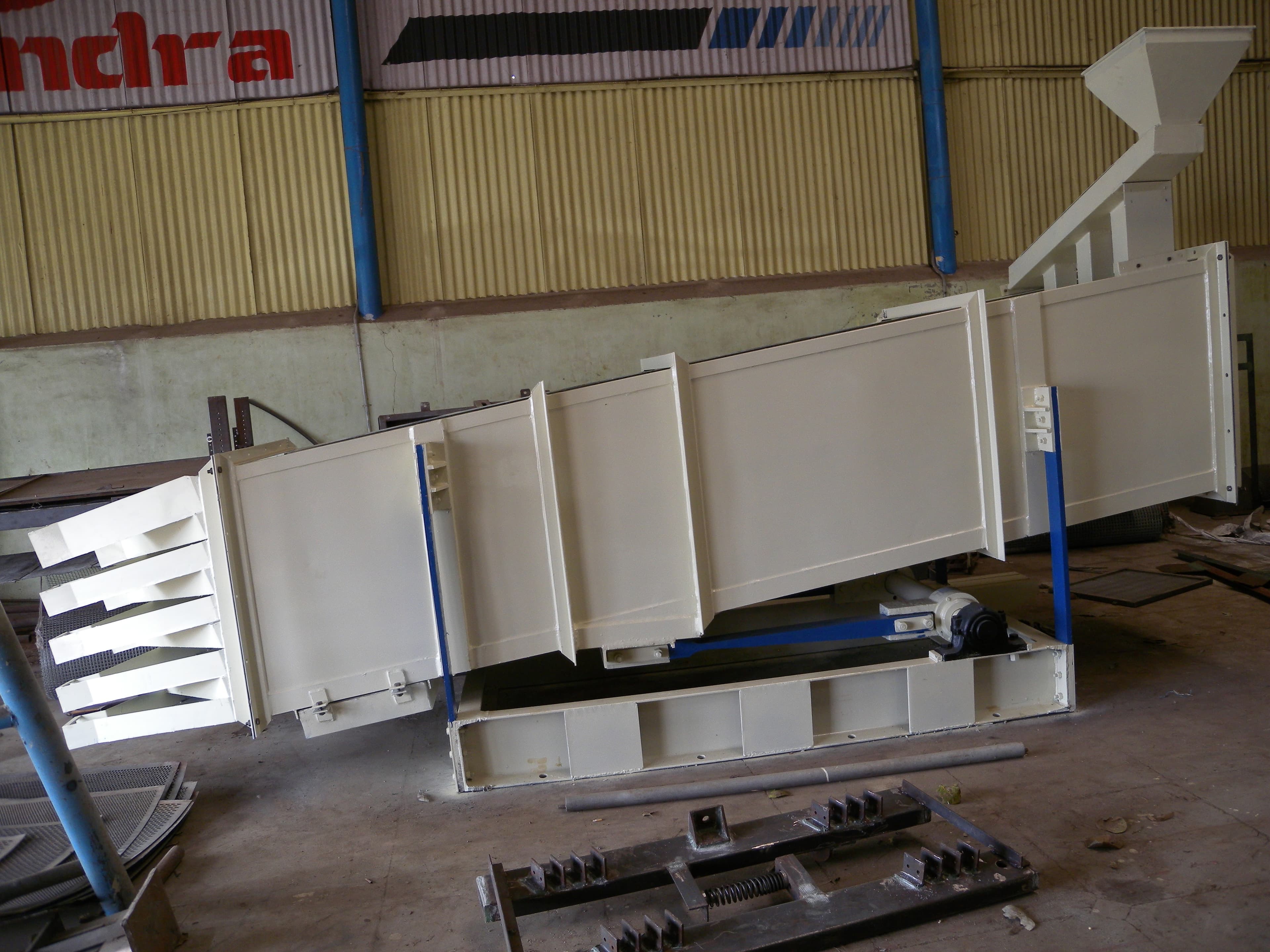
Coffee Grader / Screen Grader
Reciprocating flat-screen grader with round and oblong perforations. Sorts green coffee by physical size into export-specification screen grades — AA, A, B, C, and Peaberry — as required by India Coffee Board and all major export standards.
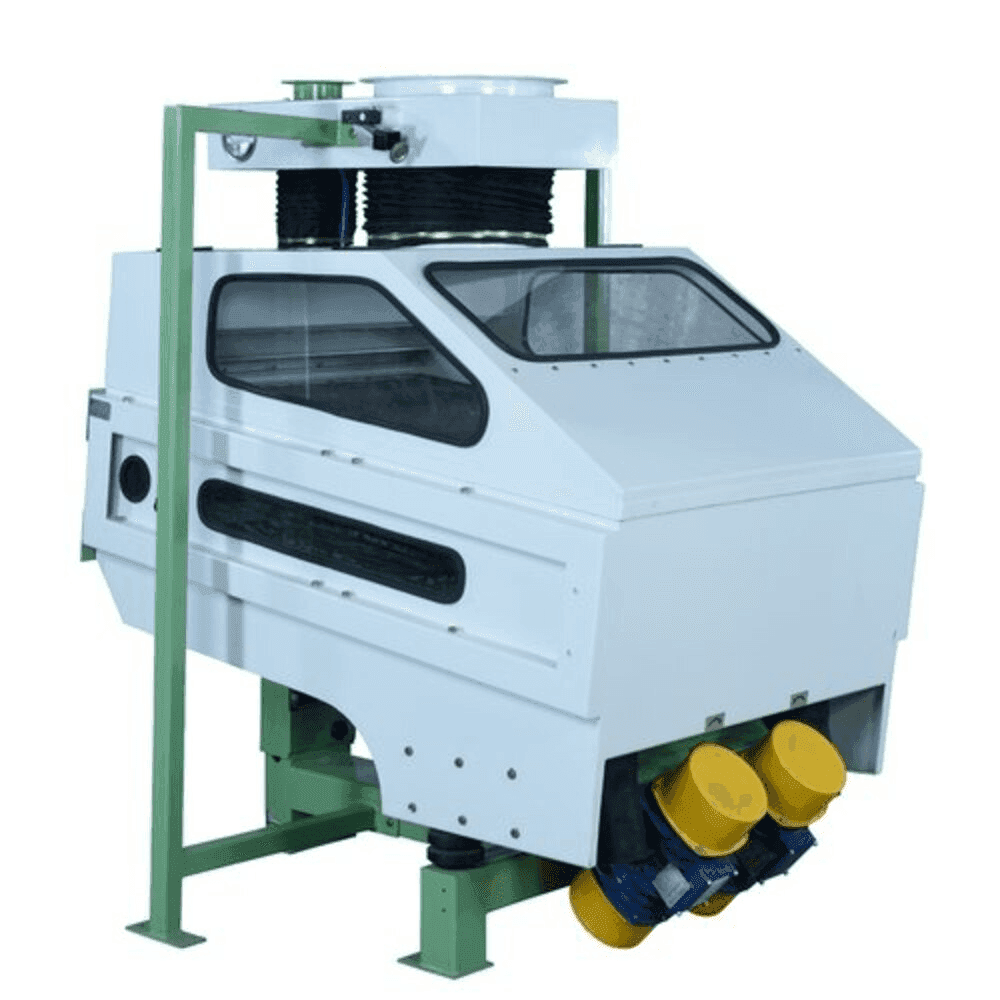
Coffee Destoner
Inclined vibrating deck with calibrated upward airflow — removes stones, glass, and heavy foreign matter from coffee before hulling, protecting downstream machinery and meeting export purity requirements.
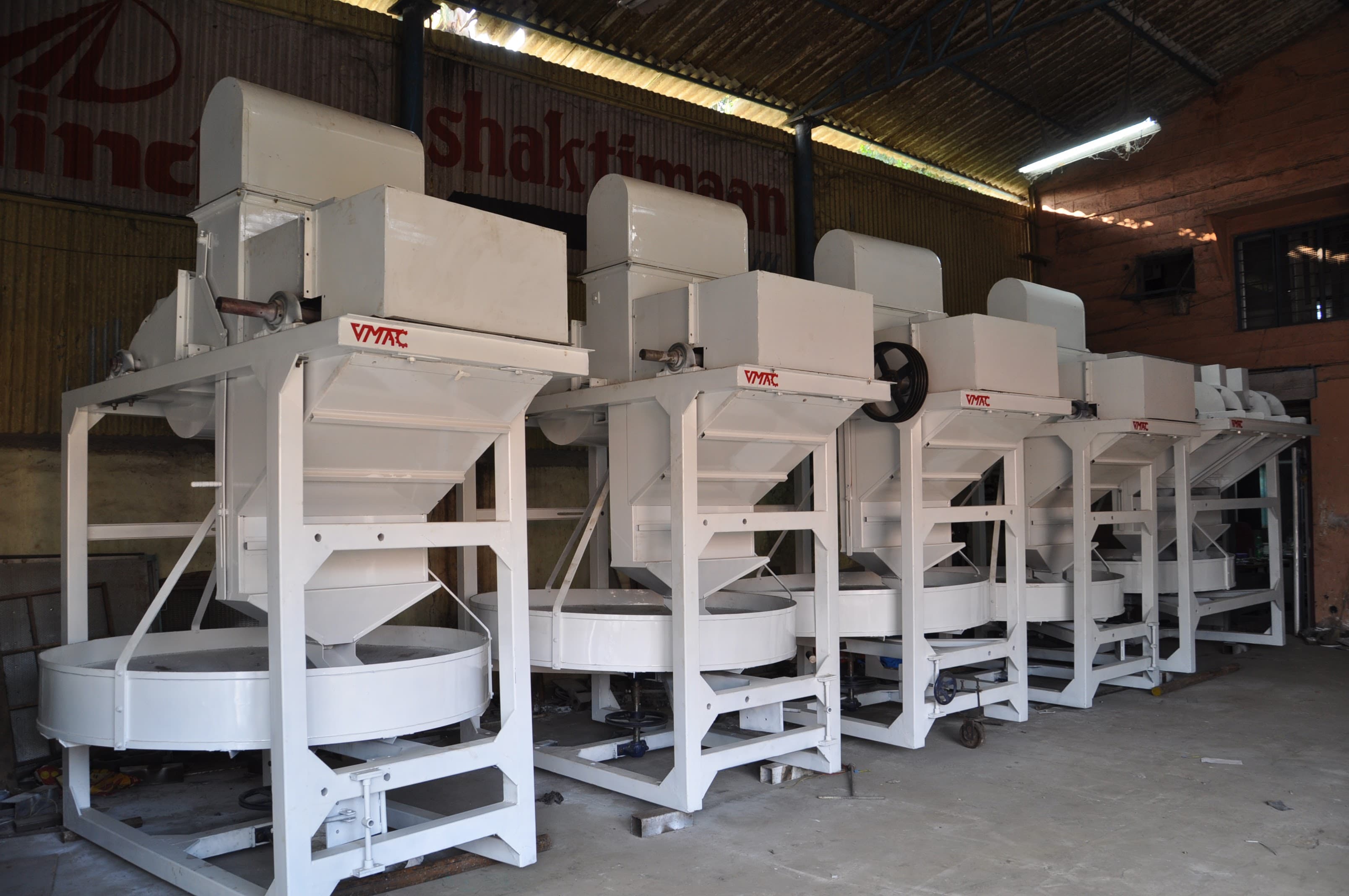
Coffee Color Sorter
CCD optical sorting machine that removes black, sour, white, and discoloured beans from green coffee — the final automated quality gate before export bagging.