
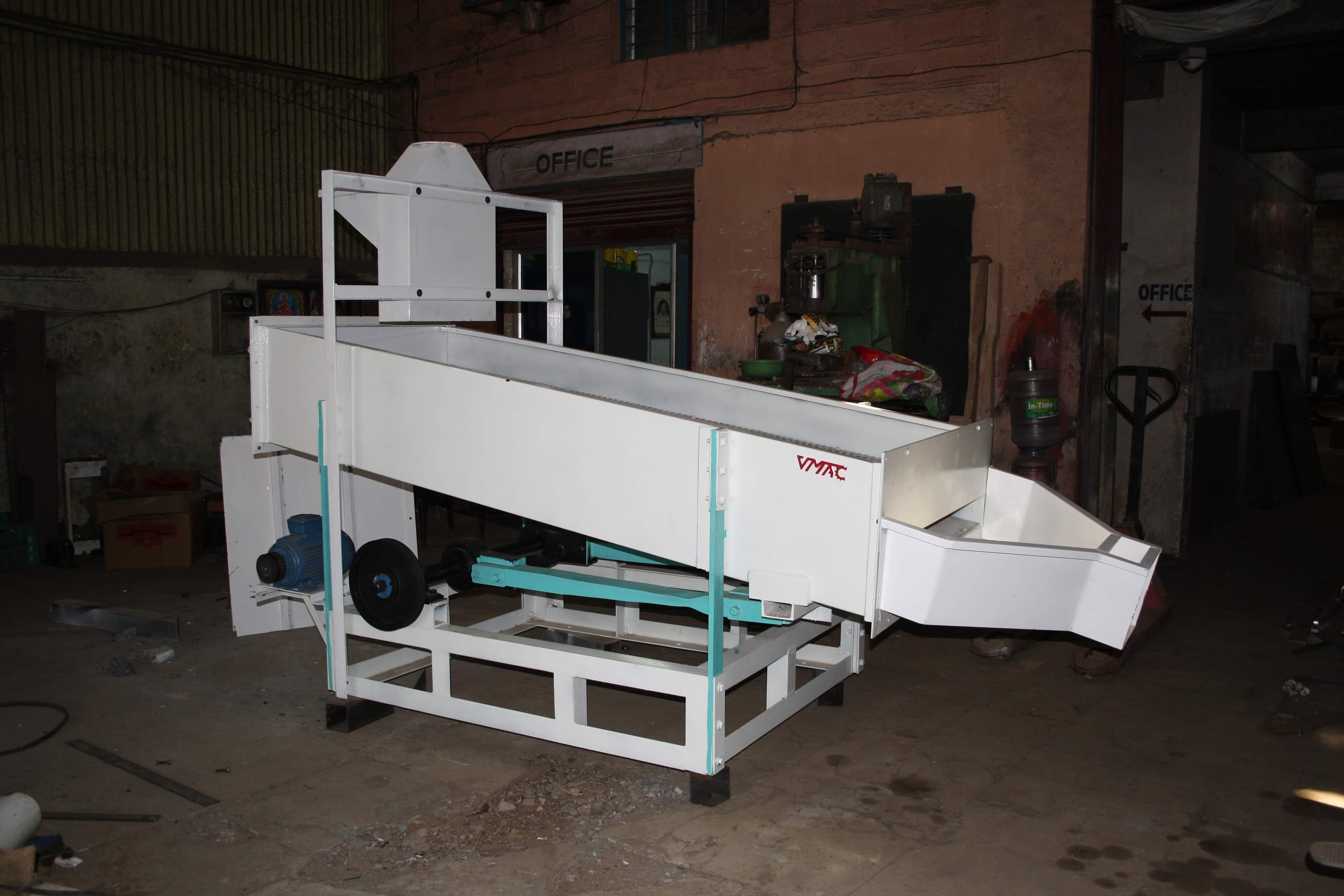
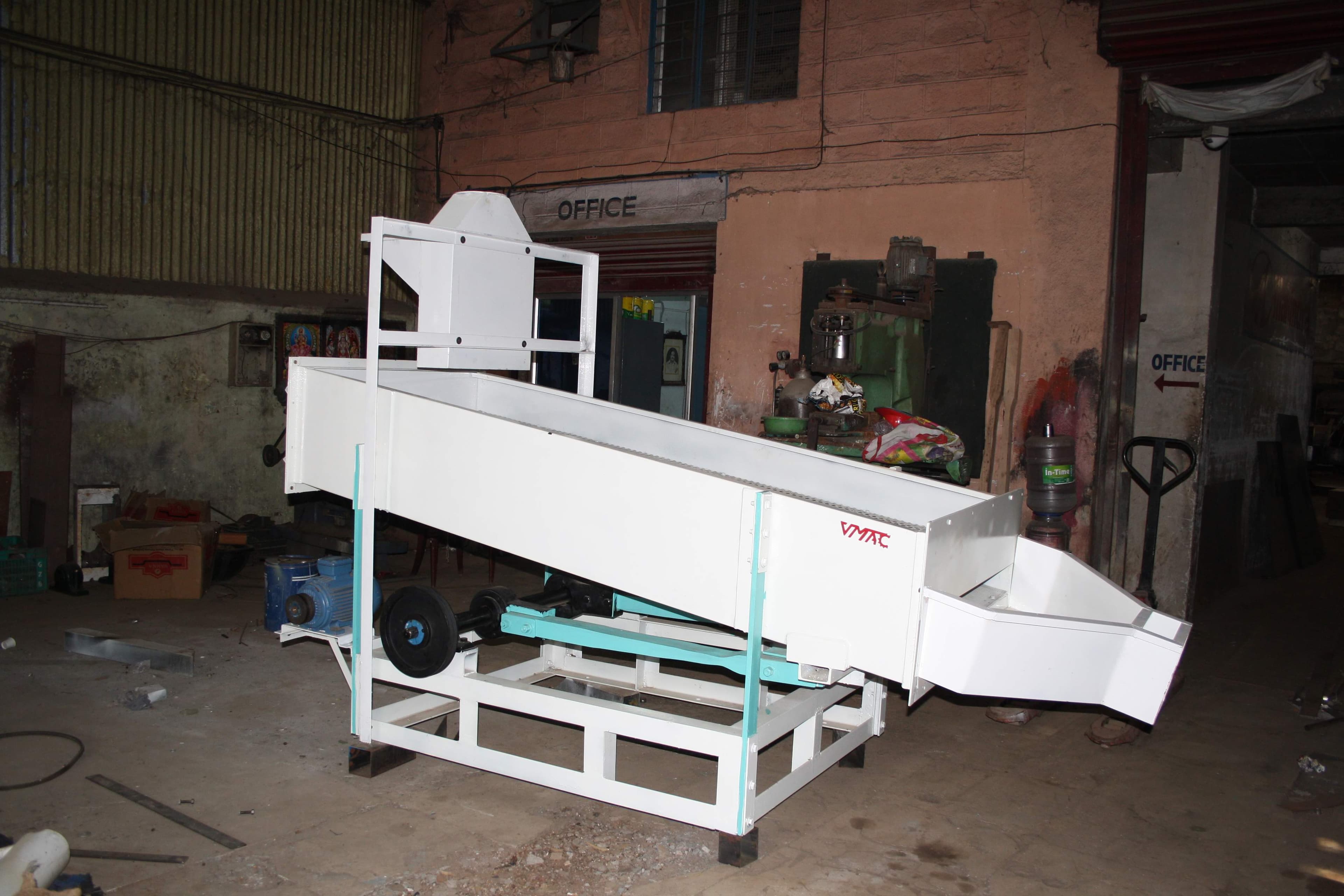
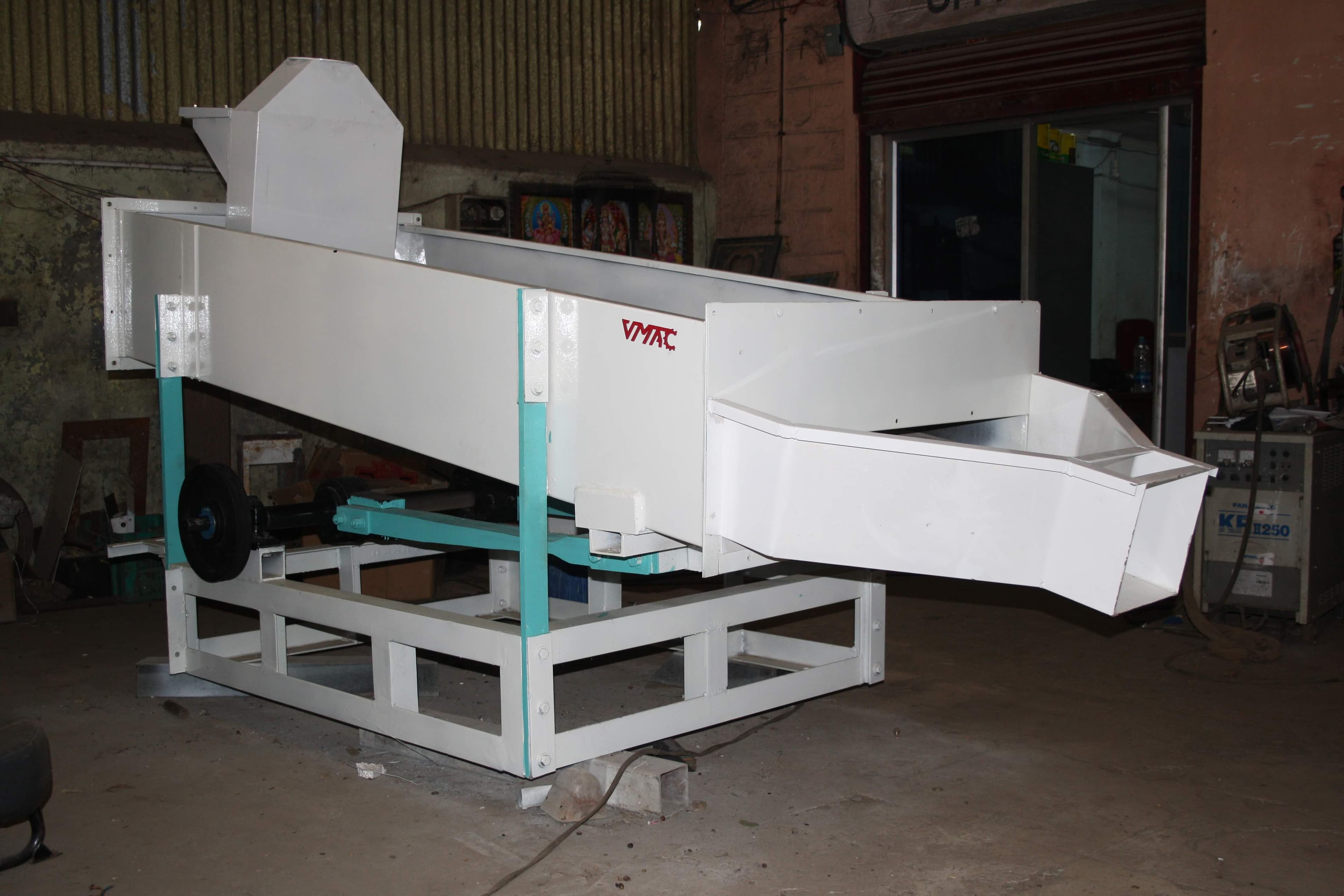
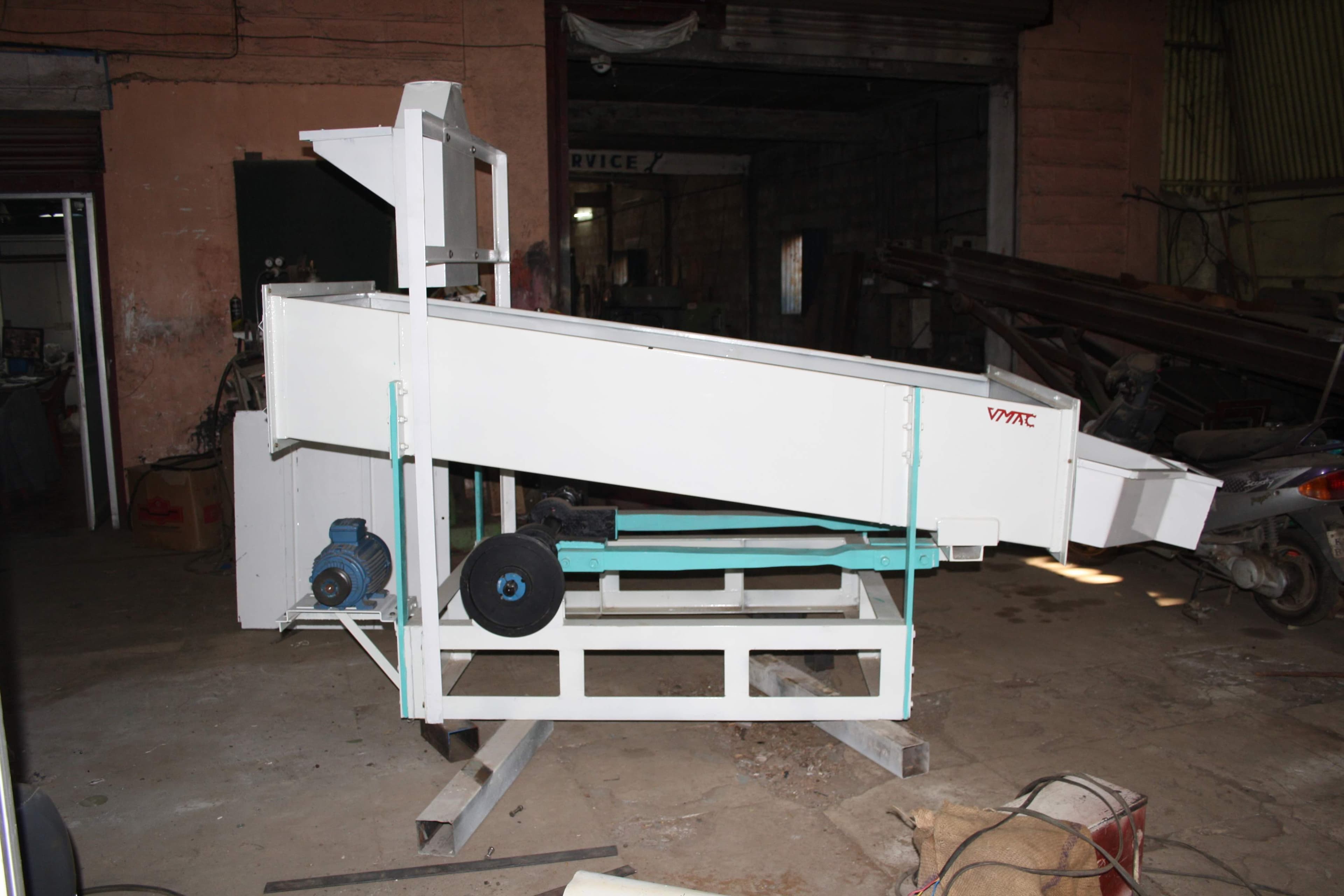
Coffee Grader / Screen Grader
Reciprocating flat-screen grader with round and oblong perforations. Sorts green coffee by physical size into export-specification screen grades — AA, A, B, C, and Peaberry — as required by India Coffee Board and all major export standards.
| Capacity range | 500 kg/hr (2-deck small estate model) to 10,000 kg/hr (4–5-deck industrial model). Pre-grading with an upstream rotary drum grader increases effective flat-screen throughput by narrowing the size spread of the feed. |
| Screen sizes (round holes) | Screen 12 (4.8 mm) · Screen 13 (5.2 mm) · Screen 14 (5.6 mm) · Screen 15 (6.0 mm) · Screen 16 (6.3 mm) · Screen 17 (6.7 mm) · Screen 18 (7.1 mm) · Screen 19 (7.5 mm) · Screen 20 (7.9 mm). Each increment = 1/64 inch. Custom screen combinations built to order. |
| Screen type (peaberry) | Oblong slot perforations, typically 10 × 5 mm. Round peaberries pass through the slot; flat beans are retained. Can be fitted as any deck in the stack; typically the lowest deck for peaberry harvest below the flat-bean fractions. |
| Deck count | 2 decks (2 fractions + undersize) · 3 decks (3 fractions + undersize) · 4 decks (4 fractions + undersize) · 5 decks (5 fractions + undersize). More decks produce more separated fractions per pass. Standard export-grade configuration: 3–4 decks. |
| Motion type | Eccentric-drive reciprocating (linear oscillation). Beans travel across the screen surface by oscillation; beans smaller than the perforation fall through; beans larger than the perforation travel to the discharge end. |
| Oscillation speed | 200–350 RPM (eccentric shaft speed). Adjustable via belt-pulley ratio or VFD. Higher speed suits lighter, smaller beans; lower speed suits larger, denser beans. |
| Stroke length | 25–40 mm (eccentric throw). Factory-set per model; determines bean travel speed per oscillation cycle. Longer stroke increases throughput at the cost of some precision at size-boundary fractions. |
| Motor power | 1.5 kW (2-deck, 500–1,000 kg/hr) · 2.2 kW (3-deck, 1,000–2,500 kg/hr) · 3.7 kW (4-deck, 2,500–5,000 kg/hr) · 5.5–7.5 kW (5-deck, up to 10,000 kg/hr). |
| Screen frame size | Small: 600 × 1,200 mm · Medium: 800 × 1,500 mm · Large: 1,000 × 2,000 mm · Extra-large: 1,200 × 2,400 mm. Larger frames provide more active screen area and higher throughput per deck. |
| Construction | Heavy mild-steel fabricated main frame · Bolted screen panel frames (field-replaceable) · Anti-vibration rubber isolation mounts · MS or SS 304 screen panels · Inlet feed hopper with flow-control gate |
Key Features
Dual screen-type capability: round-hole decks for flat bean (Arabica and Robusta) sizing combined with oblong slot decks for peaberry separation — both in a single machine pass
India Coffee Board compliant output fractions: Plantation AA (Screen 17+), A (Screen 16+), B (Screen 15+), C (Screen 14+), and Peaberry grades PB-1 and PB-2 from one machine
Eccentric-drive reciprocating mechanism delivers consistent linear oscillation at 200–350 RPM; adjustable via belt-pulley ratio change or optional VFD for fine-tuning to bean density and moisture
Modular deck configuration: 2-deck entry models to 5-deck industrial machines — additional decks produce more size fractions in a single pass without adding floor space for a second machine
Field-replaceable bolted screen panels in mild steel or optional SS 304; no special tooling required — worn or mis-sized screens swapped in under 30 minutes during seasonal changeover
Heavy mild-steel fabricated frame with anti-vibration rubber isolation mounts; reduces transmitted vibration to support structure and floor, extending bearing and fastener service life
Optional rubber-ball cleaning decks below screen panels prevent perforation blinding from fine chaff, dust, or residual moisture — critical for Robusta processing seasons with variable input moisture
Designed to accept pre-graded feed from an upstream rotary drum grader (trommel grader), maximising separation accuracy at screen-size boundary fractions and protecting screen panel longevity
Discharge spouts individually positioned per fraction — AA, A, B, C, Peaberry, and triage outlets independently routed to bags, bins, or conveyors without cross-contamination between grades
Models & Sizing
Right-Sized for Every Operation
VMAC flat screen graders are available in four configurations scaled from estate-level two-deck machines to high-capacity five-deck industrial graders with integrated peaberry screens. All models share the same eccentric-drive reciprocating mechanism and field-replaceable bolted screen panels.
SG-500 (2-Deck Estate)
500–1,000 kg/hr
capacity
Estate and cooperative-level mills processing a single origin or a single coffee type. Produces two flat-bean size fractions plus undersize triage. Suitable for Coffee Board Plantation A and B separation.
SG-2000 (3-Deck Commercial)
1,500–2,500 kg/hr
capacity
Mid-scale commercial dry mills requiring full Coffee Board Plantation grading (AA, A, B, C). Three round-hole decks produce four fractions in one pass. Most common configuration for Karnataka and Tamil Nadu estate mills.
SG-5000 (4-Deck with Peaberry Screen)
3,000–5,000 kg/hr
capacity
Large commercial mills requiring full grade separation including Peaberry recovery. Three round-hole decks (AA, A, B, C) plus one oblong slot deck for PB-1 / PB-2 peaberry separation. Standard configuration for export-focused Indian processors and East African dry mills.
SG-10000 (5-Deck Industrial)
6,000–10,000 kg/hr
capacity
High-volume industrial processing stations and central dry mills handling multiple origins. Five decks produce five size fractions plus peaberry and triage in one pass. Used with an upstream rotary drum pre-grader (trommel grader) for maximum throughput and precision. Suitable for large Robusta processors in India and Vietnam-equivalent scale operations.
Custom
Your specification
capacity
For operations requiring throughput beyond the standard range. VMAC engineers the machine to your exact capacity and processing conditions.
Request a Custom QuoteConfigurations
Flat Screen Grader Model Range
Configurations from estate 2-deck to industrial 5-deck with peaberry screen
| Model | Decks | Capacity | Motor | Screen Frame | Output Fractions | Peaberry Screen |
|---|---|---|---|---|---|---|
| SG-500 | 2-deck | 500–1,000 kg/hr | 1.5 kW | 600 × 1,200 mm | 2 flat-bean + triage | Optional add-on |
| SG-2000 | 3-deck | 1,500–2,500 kg/hr | 2.2 kW | 800 × 1,500 mm | AA + A + B/C + triage | Optional add-on |
| SG-5000 | 4-deck | 3,000–5,000 kg/hr | 3.7 kW | 1,000 × 2,000 mm | AA + A + B + C + PB + triage | Included (1 oblong deck) |
| SG-10000 | 5-deck | 6,000–10,000 kg/hr | 7.5 kW | 1,200 × 2,400 mm | AA + A + B + C + PB-1 + PB-2 + triage | Included (2 oblong decks) |
| Custom | Built to your capacity and specification — contact us for a quote | |||||
Overview
About the Coffee Grader / Screen Grader
The flat screen grader — also called an oscillating screen grader, coffee bean grader, or sizing machine — is the defining final-grading machine in every commercial dry mill. Coffee exits the winnower as a mixed-size lot; it cannot be sold to export specification until each bean has been physically sorted by its screen size. VMAC's flat screen grader uses an eccentric-drive reciprocating mechanism to oscillate a stack of two to five horizontally mounted perforated screen decks. Beans smaller than each screen's perforation diameter fall through to the deck below; beans too large to pass travel forward and discharge into their own collection chute. Round perforations sort flat Arabica and Robusta beans by diameter. Oblong slot perforations (typically 10 × 5 mm) separate round peaberries, which pass through the slot while flat beans are retained — enabling a single machine to produce both screen-size grades and a separated peaberry fraction in one pass. In India, Coffee Board grading is legally required for export. Plantation AA must be Screen 17 and above (6.7 mm); Plantation A is Screen 16 and above; Plantation B is Screen 15 and above; Plantation C is Screen 14 and above. Getting these fractions right is not optional — incorrect grading leads to downgrading at the export inspection stage. The screen grader is the machine that makes this compliance possible. In East Africa, the same machine is simply called a grader or screen grader and produces grades 18, 17, 15, and AB. In Brazil it is known as the classificador de café or peneira classificadora; in Central America, clasificadora de café. The working principle is identical worldwide. A critical operational rule: screen grading must occur before the gravity separator, not after. The gravity table works by separating beans of identical size by density — if beans of different sizes are fed together, the air-stratification pattern is disrupted and the gravity separator cannot function correctly. Every size fraction must go to its own gravity table pass. VMAC machines are built for the full range of Indian and export mills, from 500 kg/hr estate-scale two-deck machines to 10 TPH four-deck industrial configurations with an integrated peaberry screen.
How It Works
How It Works
The flat screen grader separates green coffee into precise export-grade size fractions using stacked reciprocating perforated screens. The process moves from coarse separation at the top deck to fine separation at the bottom, with each deck collecting its own size fraction.
Feed inlet and deck entry
Pre-cleaned, hulled, winnowed green coffee enters the inlet hopper at the top of the machine. A flow-control gate spreads the feed evenly across the full width of the top screen deck. The eccentric-drive shaft begins oscillating the entire screen stack in a linear reciprocating motion at 200–350 RPM. The oscillation agitates the bean mass so that smaller beans work downward through the column while larger beans ride on top — a process called stratification.
Top deck — largest fraction retained
The top screen deck carries the largest perforation (for example, Screen 17, 6.7 mm). Beans larger than 6.7 mm cannot pass through the perforations. As the deck oscillates, these oversized beans travel the length of the screen and discharge at the far end into the Screen 17-and-above collection chute — this becomes the Plantation AA fraction. All beans smaller than 6.7 mm fall through to the deck below.
Intermediate decks — successive size fractions
Each lower deck carries a progressively smaller perforation. A 3-deck machine set for Screen 17 / Screen 16 / Screen 15 will produce AA (17+), A (16–17), B (15–16), and an undersize (below 15) triage stream. A 4-deck machine adds Screen 14, producing an additional Plantation C fraction. Beans travel across each deck in sequence, with each deck retaining its target fraction and passing everything below it to the next level. This cascade structure means the entire sizing operation happens in one continuous machine pass.
Peaberry separation by oblong screen
Peaberries are round, single-seed coffee beans that form when only one ovule develops inside the cherry. Because they are round in cross-section, they can pass through an oblong slot perforation (typically 10 × 5 mm) that retains flat beans of the same weight. A peaberry deck — fitted as the lowest or a dedicated intermediate deck — allows round peaberries to fall through while retaining flat beans. This separates PB-1 (large peaberry, passing through a wider slot) and PB-2 (small peaberry) from the flat-bean fractions without a separate machine pass.
Output fractions and downstream routing
Each fraction discharges from its own individual spout: AA, A, B, C (flat-bean grades) + Peaberry (PB) + Triage (below C undersize). Each fraction must be handled separately from this point. Critically, each screen-size fraction must be processed through its own dedicated gravity separator pass — the gravity table's air-stratification mechanism only functions correctly when all beans in the feed are the same size. Mixing sizes at the gravity table stage is a common mill error that the screen grader prevents when used correctly.
Know the Difference
Coffee Grader / Screen Grader vs. Rotary Drum Grader (Trommel Grader)
Both the flat screen grader and the rotary drum grader (trommel) separate coffee by physical size, but they differ fundamentally in precision, throughput, and position in the processing line. Understanding this distinction determines whether to use one or both machines.
| Feature | Coffee Grader / Screen Grader | Rotary Drum Grader (Trommel Grader) |
|---|---|---|
| Separation principle | Reciprocating flat screens — beans oscillate over perforated panels; stratification moves smaller beans to the bottom, larger beans travel to discharge end | Rotating perforated cylinder (trommel) — beans tumble as the drum rotates; smaller beans fall through perforations along the cylinder length |
| Separation precision at size boundaries | High precision — suitable for final export-specification grading. Accurately produces Screen 17+, Screen 16–17, Screen 15–16 fractions for Coffee Board compliance | Lower precision at screen-size edges due to tumbling motion and continuous bean passage — not recommended as the sole final-grading machine for export lots |
| Throughput | 500 kg/hr to 10 TPH. Throughput is maximised when feed size range is pre-narrowed by an upstream rotary drum grader | 1 TPH to 25 TPH. Higher throughput per unit because continuous rotation avoids the reciprocating inertia of flat-screen drives |
| Screen blinding risk | Moderate — dusty or wet beans can coat round perforations. Rubber-ball cleaning decks available. Pre-cleaning required upstream | Low — drum rotation continuously self-clears perforations. Better tolerance of slightly sticky or wet material |
| Peaberry separation | Yes — oblong slot decks can be incorporated into the screen stack to separate peaberries in the same machine pass as flat-bean sizing | No — trommel perforations are round or shaped for size separation only; peaberry separation requires a separate machine |
| Recommended position in dry mill | Final grading stage: after destoner, huller, polisher, and winnower; before gravity separator and color sorter | Pre-grading stage: upstream of the flat screen grader to reduce the size spread of the feed; not suitable as the sole final grader |
| Ideal use case | Any mill producing export-grade coffee requiring Coffee Board or buyer specification compliance. Standard machine for Indian, East African, and Central American dry mills | Large-volume mills (India, Vietnam, Brazil, Indonesia Robusta) where pre-grading the widest-spread bean lots before flat-screen final grading improves throughput and screen longevity |
Best practice for large commercial mills: install the rotary drum grader (trommel) upstream to rough-sort the widest-size-spread lots first, then pass each rough fraction through the flat screen grader for precise export-specification final grading. For estate or mid-scale mills processing one origin, the flat screen grader alone is sufficient.
Processing Line
Where It Fits in Your Processing Line
The screen grader (coffee bean grader / flat screen grader) sits at the centre of the dry mill sequence — after physical cleaning and hulling, before density separation and optical sorting.
Pre-cleaner / Scalper
Removes sticks, stones, and oversized debris before hulling
Destoner
Removes stones and dense foreign matter by specific gravity
Huller (Rubber-roll, Disc, or Wet Huller)
Removes parchment or dried husk
Peeler / Polisher
Removes residual silver skin; improves bean appearance
Winnower / Aspirator
Removes chaff, silver skin, and light material by air
Screen Grader (Flat Screen / Oscillating Screen Grader)
This machineSeparates into size fractions: AA, A, B, C, Peaberry. MUST precede gravity separation.
Gravity Separator
Run separately per size fraction — each fraction gets its own gravity table pass to separate by density
Color Sorter (CCD or Laser)
Removes black beans, discoloured beans, and defects by optical detection
Bagging / Bulking
Weighing, bagging, stitching, and storage per grade
FAQ
Frequently Asked Questions
What are the India Coffee Board screen size requirements for Plantation grades?
The Coffee Board of India mandates the following minimum screen sizes for Arabica Plantation grades exported under the Coffee Act: Plantation AA requires Screen 17 and above (6.7 mm minimum hole diameter); Plantation A requires Screen 16 and above (6.3 mm); Plantation B requires Screen 15 and above (6.0 mm); Plantation C requires Screen 14 and above (5.6 mm). Coffee that does not meet the minimum screen size for its declared grade is downgraded at the Coffee Board inspection and will not receive the grade certificate required for export. Screen grading is therefore a legal compliance requirement for Indian exporters, not simply a quality preference.
Can the flat screen grader separate peaberries, or do I need a separate peaberry machine?
Yes — VMAC's flat screen grader can separate peaberries in the same machine pass as flat-bean size grading. Peaberries are round-cross-section single-seed beans; they can pass through oblong slot perforations (typically 10 × 5 mm) that retain flat beans of the same approximate weight. One or two oblong-hole decks are incorporated into the screen stack alongside the round-hole decks. The SG-5000 (4-deck) and SG-10000 (5-deck) models include oblong peaberry decks as standard. Smaller 2- and 3-deck models can have a peaberry deck added as an option. This eliminates the need for a separate standalone peaberry separator machine in most mills.
How many size fractions does the grader produce, and what are they typically called?
The number of fractions equals the number of decks plus one (the undersize triage stream that passes through all screens). A 3-deck machine produces 4 fractions; a 4-deck machine with a peaberry deck produces 5 named fractions plus triage. In Indian export terminology, the fractions are named Plantation AA (Screen 17+), Plantation A (Screen 16–17), Plantation B (Screen 15–16), Plantation C (Screen 14–15), Peaberry PB-1, and Peaberry PB-2. In East Africa, the equivalent fractions are named by screen number (AA = Screen 18, AB = mixed 15–17, etc.). Regardless of naming convention, the physical separation is the same.
Why must screen grading happen before the gravity separator?
The gravity separator (density table) works by feeding a flat stream of beans over a vibrating, inclined deck with air blown upward through the porous table surface. The air stratifies the bean column — dense beans sink to the table surface and travel in one direction; light beans float above the surface and travel in the opposite direction. This stratification only works correctly when all beans in the feed are approximately the same physical size. If beans of Screen 15 and Screen 18 are mixed, the air velocity that is correct for Screen 15 is wrong for Screen 18, and the separation collapses. Each screen fraction must go through its own dedicated gravity table pass. Feeding unsized mixed coffee directly to a gravity separator is one of the most common processing errors in small and mid-scale mills.
How often should screen panels be inspected and replaced?
Inspect screen panels at the start of every processing season and weekly during active processing. The failure mode to look for is perforation enlargement — perforations wear from their nominal hole size to a larger diameter as millions of hard beans pass over the screen surface. Enlarged holes cause beans that should be retained (and graded up) to fall through into the lower fraction, reducing the yield of higher-value grades and causing grade mixing that can fail export inspection. Mild-steel screens typically require replacement after 2–4 processing seasons depending on throughput volume. SS 304 screens last longer but cost more. VMAC supplies replacement screen panels for all models; panels are bolted and can be swapped in the field without special tools.
What causes screen blinding, and how is it prevented?
Screen blinding occurs when dust, fine chaff, moisture, or residual mucilage coats the inside surfaces of the screen perforations, effectively reducing or blocking the holes. This reduces throughput and causes oversized beans to appear in lower fractions. The primary prevention is ensuring that the pre-cleaner (scalper) and winnower upstream have removed all fine chaff and dust before beans reach the grader. If the feed is slightly wet or sticky, a short holding period for moisture equilibration before grading helps. VMAC's optional rubber-ball cleaning decks — a layer of rubber balls sitting on a coarse supporting screen beneath each graded screen panel — bounce against the screen from below as the machine oscillates, continuously dislodging material from the perforations. This is particularly recommended for Robusta processing where pulped natural or honey-processed coffees may carry more surface residue.
What is the difference between a flat screen grader and a rotary drum grader (trommel grader)?
A flat screen grader uses horizontally mounted, reciprocating perforated flat panels through which beans fall by size. A rotary drum grader (trommel grader) uses a rotating perforated cylinder that tumbles beans through. The flat screen grader produces more precise separation at screen-size boundaries and is the required machine for final export-specification grading. The rotary drum grader handles much higher throughput with less precision and is best used as a pre-grading stage upstream of the flat screen — narrowing the size spread of the feed so the flat screen can work more accurately and at higher throughput. In India, old-timers sometimes call either machine a 'screen.' For export compliance, the flat screen grader is the final arbiter of grade.
Can I run Robusta and Arabica through the same screen grader?
Yes, the same machine can process both Arabica and Robusta, but the screen size configurations are different between the two crops. Arabica beans are typically larger and flatter, grading in the Screen 15–20 range with premium grades above Screen 17. Indian Robusta grades (MNEB and Cherry grades) typically fall in the Screen 13–17 range. If you are processing both Arabica and Robusta, you will either need to change the screen panels between crops (which takes 30–60 minutes on a VMAC machine), or specify a second set of screen frames to fit your machine. VMAC supplies screen panels in all standard screen sizes and can supply complete second frame sets on request.
What maintenance is required on the eccentric drive mechanism?
The eccentric drive consists of an electric motor, belt drive, and eccentric shaft with bearings. Daily maintenance involves checking for unusual noise or vibration, which often indicates bearing wear. Grease the eccentric shaft bearings according to the schedule in the manual — typically every 100–200 operating hours during the season. Check V-belt tension monthly; a loose belt causes oscillation speed variation and inconsistent separation. Replace bearings at the first sign of play or noise; delayed bearing replacement can damage the eccentric shaft, which is a more costly repair. At the end of each season, clean the entire machine, re-grease all bearings, and inspect the screen panels and frame fasteners for tightening.
How does VMAC supply screen panels — can I order non-standard screen sizes?
VMAC manufactures screen panels in all standard Coffee Board screen sizes from Screen 12 through Screen 20 in round perforations, and standard oblong slot sizes (10 × 5 mm and 12 × 5 mm) for peaberry separation. Non-standard perforation sizes — for example, a Screen 13.5 intermediate, or a wider oblong slot for a specific origin's peaberry size — can be manufactured to order with a lead time of 2–4 weeks. When ordering, specify your machine model (to confirm frame dimensions), the screen size required, the perforation type (round or oblong), and the material (MS or SS 304). Panels are bolted to the screen frame and require no welding or machining for field installation.
Send a Enquiry Request
Retail store
Mon-Sat 9am to 5pm.
B.M road, Hassan, Karnataka 573201
Related Products
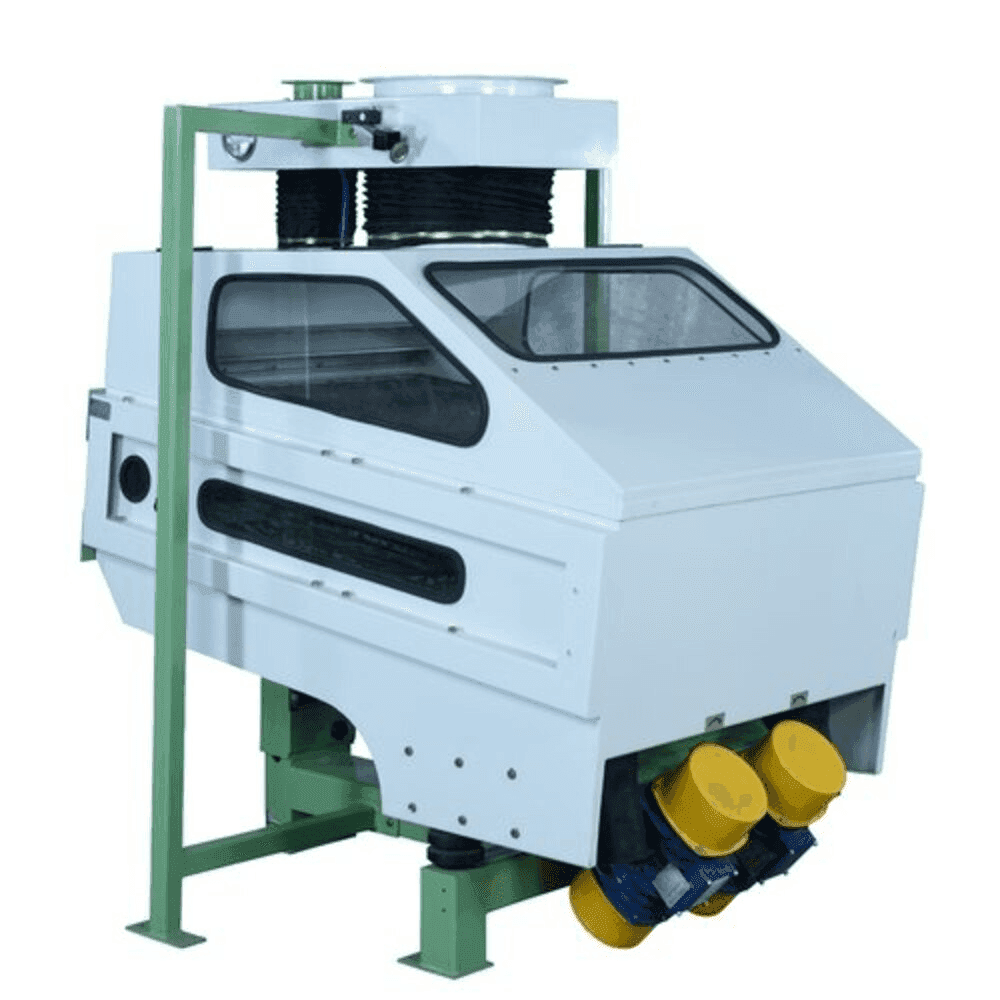
Coffee Destoner
Inclined vibrating deck with calibrated upward airflow — removes stones, glass, and heavy foreign matter from coffee before hulling, protecting downstream machinery and meeting export purity requirements.
Coffee Gravity Separator
Separates green coffee by density — concentrating premium dense beans and removing low-density defects like immature beans, hollow shells, and insect-damaged beans.
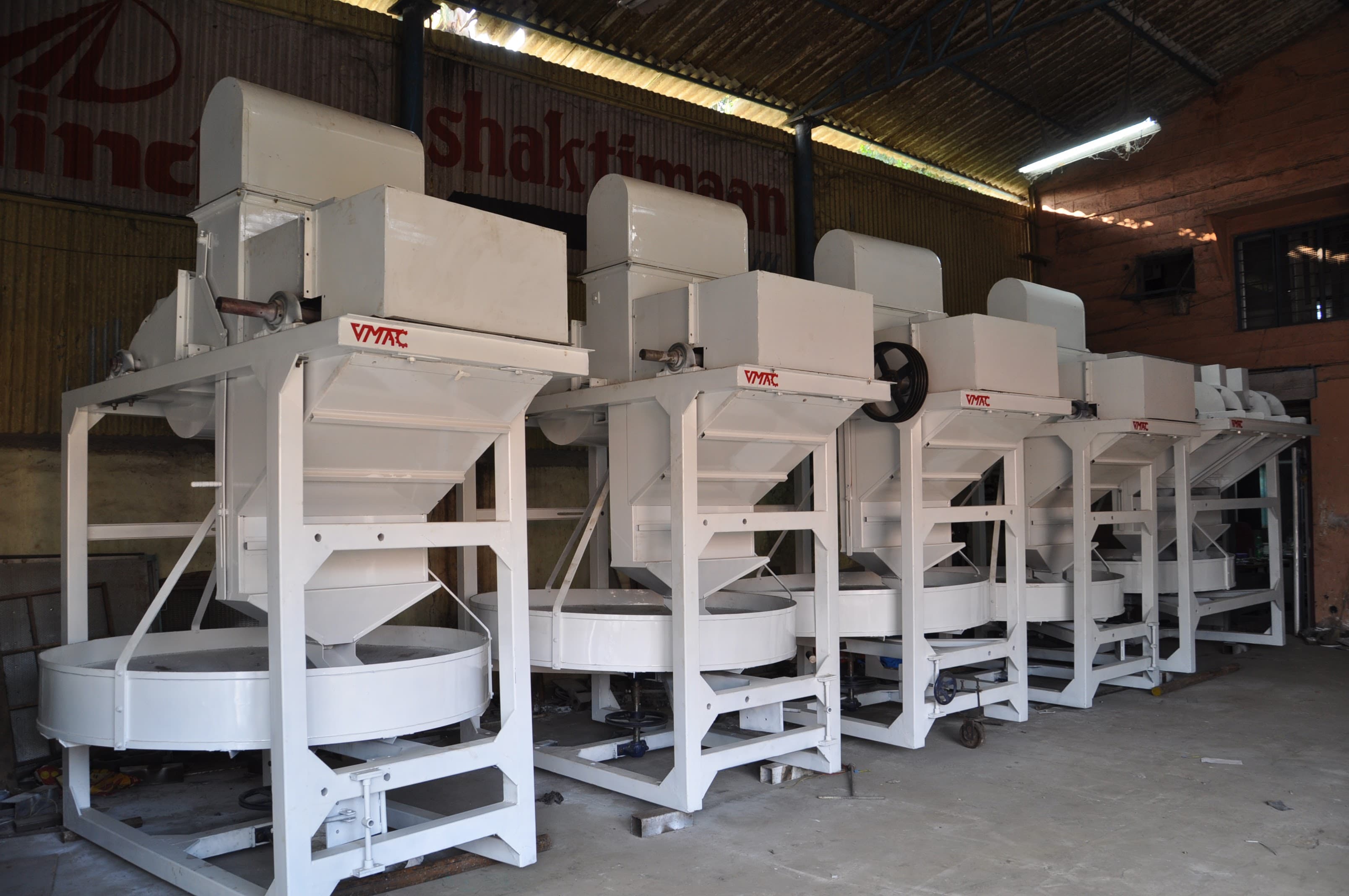
Coffee Color Sorter
CCD optical sorting machine that removes black, sour, white, and discoloured beans from green coffee — the final automated quality gate before export bagging.